fj LI
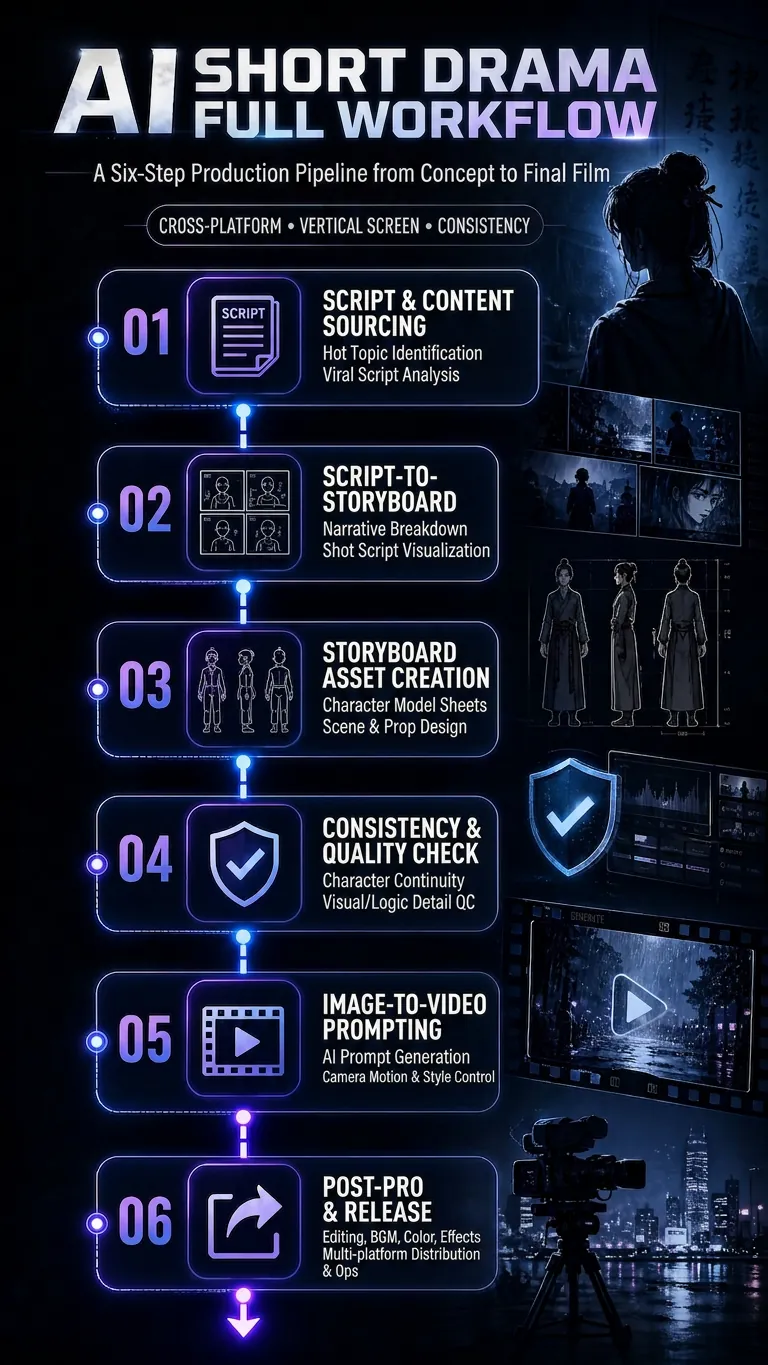
AI Short-Drama Workflow v5
Turn a concept, novel, or script into an executable AI video production plan, covering three formats: AI short drama, AI comic drama, and AI live-action drama. The Skill includes a complete six-step production pipeline: find scripts and hit copy → adapt the script into a shot list (including shot language and dialogue-duration adjustments) → design shot assets (character turnarounds, scene concept art with physical lighting, and material details) → consistency checks and pre-generation quality control (asset binding, cross-shot consistency, and P0/P1 blocking gates) → image-to-video prompts (Vidu/Jimeng/Doubao standard templates + Jimeng Seedance first/last-frame template) → final-cut production and publishing quality control. By default, the workflow uses no subtitles or background music, retaining only dialogue and necessary sound effects. Supports locked visual styles including realistic cinematic, 2D Chinese animation, and 3DCG Chinese animation. Designed for scaled production on vertical platforms such as Douyin, Kuaishou, WeChat Channels, and Xiaohongshu.

Viral Science Video Factory v9
Turn any science knowledge point into a ready-to-produce science short video: Footage → Mandatory fact-checking → Topic selection → Storyboarding → AI prompts → Tool mapping → Voiceover → Editing → Cross-platform publishing → Data review. Each Phase outputs a visual "Project Dashboard" and archives the final version. Aspect ratio (9:16/16:9/1:1/3:4/21:9), duration (30s/60s/2min/3min), and platform are all user-selectable. Medical and health topics undergo stricter fact-checking.
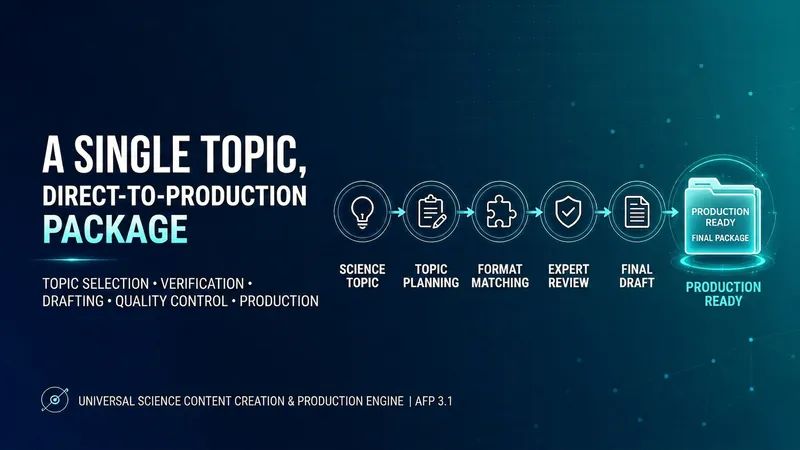
Science Content Engine v7.0
An integrated science communication pipeline from science topic selection to production-ready gate. System baseline: AFP 3.1 · three-layer nesting · silent execution · persistent HUD dashboard · dual-core confrontation · ratchet gate. Trigger words: make science / science creation / science competition / science short video / science graphic / science topic / help me make a science episode.
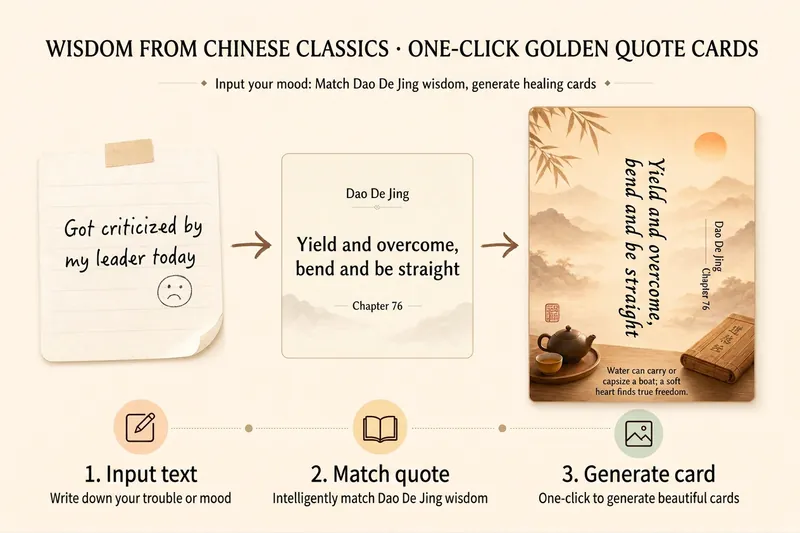
Lao Zi Wisdom Cards·All-in-One
Transform any text into Lao Zi Wisdom Cards. Bilingual: Chinese channel & English channel. - Matches the perfect quote from the built-in 81-chapter Tao Te Ching - AI commentary referencing Nan Huaijin's insights - Eight visual styles including ink wash, moonlit scenery, mountain mist, and more - Choose Chinese or English at startup—entire experience in your language After opening, select your language channel, enter any text, and say 'Continue' to start.

Short Video Topic Engine v6
A 5-stage short video viral topic system, delivering the full pipeline from account diagnosis to a 7-day publishing plan. 🎯 Account Diagnosis & Variable Profiling — 9 variable slots to precisely lock down your niche, audience, goal, and stage 🔬 Build 5 Topic Models — Pain-point, Counter-intuitive, Outcome, Pitfall-avoidance, and Story types, each with attached hooks and forbidden phrases 📋 30 Candidate Topic Library — Each entry includes a 3-second hook, viral potential score, filming difficulty, and risk notes 💎 Top 10 Deep Polish — Polishes selection rationale, video structure, ending prompts, and series expansion 📅 7-Day Publishing Plan + Review Metrics — Executable schedule, data review, and next-round optimization direction Once opened, enter your account niche, target audience, and account goal, then reply "Start Diagnosis" to begin the 5-stage process. At the end of each stage, a checkpoint is provided; confirm to move on to the next stage.
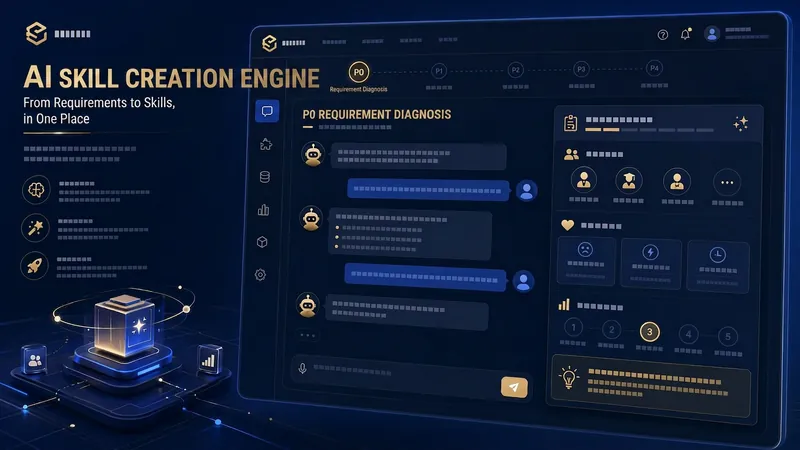
AFP .skill Forging Engine v4
> Turn a one-sentence idea into an AFP skill people actually want to install—full-process forging. 🌍 Niche reconnaissance — scan similar skills before starting (GitHub, ClawHub, skill market), benchmark horizontally and vertically to find real differentiation. No niche statement, no start. 🧬 Three-layer nested architecture — governance, cognitive, and execution layers separate skeleton from flesh; four-quadrant admission judgment, actively discourage forbidden zones, don't overspec simple tasks. 🔬 Dual-core adversarial audit — A-core builds + B-core dismantles, 9-dimension scoring matrix (including release readiness), ratchet lock ensures scores only increase, single-variable control prevents disorder from over-editing. 📦 Full asset packaging for listing — naming formula + subtitle + icon + golden description structure + 3 intro images + 4-channel promotion copy + 15-item listing checklist + direct callApi creation. After opening, just tell it what you want to do (e.g., 'Turn my writing method into a skill,' 'Optimize my existing XX skill,' 'Upgrade the old AFP to 3.1'). The engine will guide you from niche reconnaissance all the way to packaging for listing. Each phase has deliverables, quality gates, and stop points. > v3.1 meta-architecture refactoring: replaced the old five-stage process with a three-layer nested skeleton, added niche reconnaissance and horizontal/vertical competitor benchmarking, 9-dimension audit matrix and ratchet mechanism, cross-conversation state persistence, and fully retained full-asset packaging capability.

Four Ledgers Financial Planner
Financial planning advisor based on Dr. Go Gyeong-ho's 'Four Ledgers System' methodology. Provides a complete six-stage plan from living paycheck to paycheck to financial freedom: data collection → financial diagnosis → account architecture → fund automation → investment allocation → continuous optimization, with five red lines for automatic interception, an adaptive step protocol, and phase role switching. Trigger words: help me with finances / financial planning / I want to save money / Four Ledgers / how to save up to XX / financial freedom plan. This does not constitute investment advice.
Account Launch Assistant v2.3
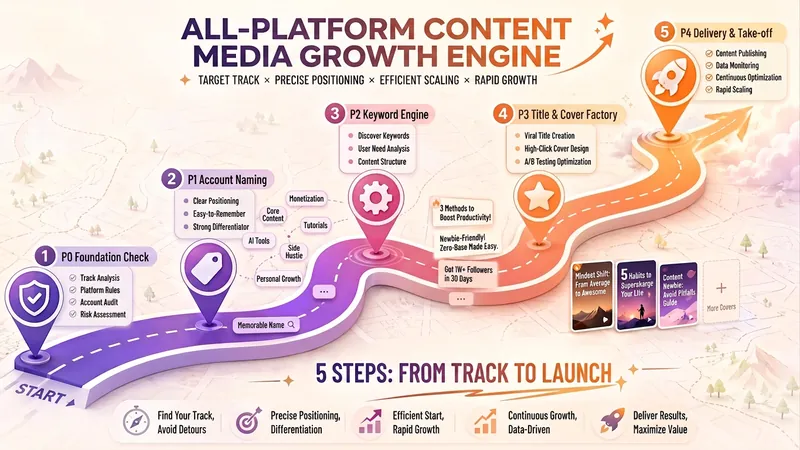
📝 Skill Overview In one sentence: input your niche and platform, get a complete account launch plan in 5 steps—account name, keywords, viral titles, covers, and posting calendar—no thinking required. 🎯 Core Capabilities · Niche Panorama Matching — covers 70+ niches across 7 major categories (money-making, wellness, fashion, workplace, etc.), with custom options · Keyword × Trend Engine — combines underlying desire words, current trends, and collective memory keywords to generate high-click title prototypes · Title Combination Factory — 6-element formula (identity/audience/time/method/endorsement/result) + platform word-count adaptation + good/bad comparison samples, producing 10+ titles at once · Cover Strategy + AI Mockups — 6 cover types with image prompt templates, plus an A/B testing schedule (stable values on weekdays, test new types on weekends) · Platform Knowledge Base — automatically adapts title length and cover specs for Douyin, Xiaohongshu, Bilibili, WeChat Official Account, WeChat Channels, and Kuaishou · Full Plan Delivery — cross-phase consistency check + 7-day posting calendar + launch checklist + review template 🛡️ Structural Upgrade (v2.3) · Global state register + quality control core + rollback — zero variable loss, no release without passing, rollback anytime · Three-core roles — main engine × platform adaptation expert × quality control officer · Compliance filtering — auto-rewrites medical efficacy/absolute claims/financial promises, reducing throttling risk · Global anti-hallucination — no fabricated search results, no invented trends, uncertain items flagged as 'pending verification' How to use? Just say 'niche + platform', e.g., 'wellness, Douyin' → the engine walks you through naming → keywords → titles → covers → plan delivery. For quick titles, say 'quick mode' and finish within 3 rounds; say 'try another batch', 'back to P2', or 'review' to adjust anytime. Trigger words: launch account / quick mode / title factory / try another batch / back to P{N} / review

Heritage Design Inspiration v5
When inspiration runs dry, let millennia of ethnic crafts draw your next stroke. 🎭 Intelligently detects your vague intuitions — a word, a mood, or even 'just browsing' — and matches them to authentic Chinese ethnic intangible heritage directions (Tibetan, Mongolian, Miao, Yi, Zhuang, Dong, Tujia, Dai, Qiang, Uyghur, etc.) 🔍 Deeply mines ethnic visual DNA — searches the web for real ICH materials, extracts pattern features, color systems, and craft textures, with cultural provenance to prevent design from becoming superficial symbol stacking. 🎨 Four-dimensionally translates traditional aesthetics — minimalist abstraction / deconstructive recombination / material translation / modernized color schemes, turning centuries-old crafts into today's design language. 🖼️ Parallel output of multi-form visual solutions — pattern designs / illustration posters / color mood boards / cultural creative concepts, at least 3 visual forms each time, so inspiration is never one-dimensional. 📦 Complete inspiration board delivered as a package — each visual solution includes cultural annotations (where it came from, how it was transformed, where it can be used), shareable with your team or archived for reuse. 🛡️ Dual-engine quality control — the execution engine handles creative generation, while the quality control engine silently verifies cultural accuracy and design quality, eliminating cultural fabrication. How to use? Just say 'Give me inspiration' after opening, or enter a keyword (e.g., 'dragon', 'serenity', 'Miao'), then follow the 5-step flow—you can go back and change direction at any step. Several designers have already turned China's ethnic intangible heritage into their own rich source of inspiration.

Pitfall-Free Manifestation V7
Avoid 99% of manifestation pitfalls and find the manifestation method that truly belongs to you. After a five-stage safety scan, it automatically generates five tangible deliverables: 📝 personalized affirmation cards based on your real language (3-5 items, each with a dedicated explanation), 🎬 visual immersion scripts ready for SATS bedtime practice (including sensory details), 🖼️ AI-generated digital vision boards (2-3 "already realized" scene images), 📊 a daily tracking system with a 21-day check-in table, weekly review, and milestone tracking, 📋 a manifestation plan book summarizing all the plans. When matching frequencies for stages, it simultaneously provides clickable music links on YouTube / Spotify / Bilibili, covering all core frequencies from 528Hz to Theta binaural beats. It integrates 12 manifestation methods, 9 crystals, the nine Solfeggio frequencies, and Tarot / Human Design / Sigil tools. How to use? Just say "I want to manifest XX" to start, or say "I'm stuck" anytime for immediate help.
 Research
Gaokao Application Checker v16
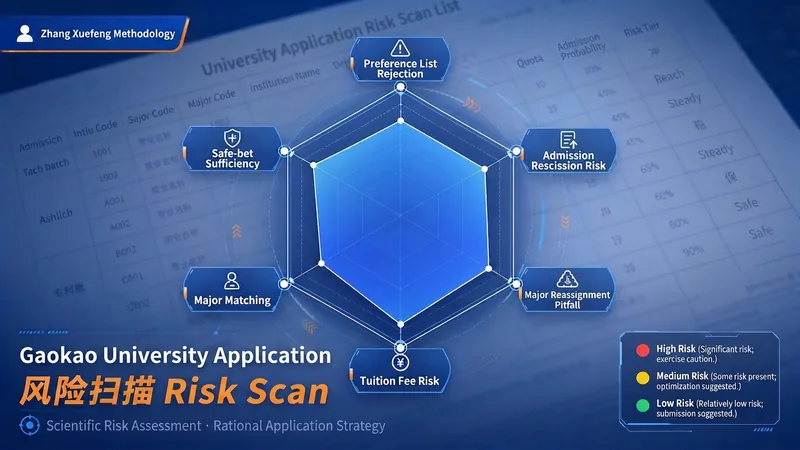
Built on Zhang Xuefeng's gaokao application methodology, this skill runs a six-dimension risk scan on your application list and uses data-driven rank conversion to protect every choice. It reviews only — it never recommends — helping you check whether your already-filled application list has any hidden landmines. [v16 Core Upgrades] ✅ Three-tier operating architecture: governance layer (mode selection / step control / quality red lines) + cognitive layer (5-phase role switching) + execution layer (6-step workflow) ✅ Review-mode recognition: full review / quick pre-check / single-dimension deep dive — pick as needed ✅ 5-phase expert roles: intake planner → data analyst → risk-control auditor → lead report writer → delivery consultant ✅ Six-dimension risk scan: slip / rejection / adjustment traps / tuition / major match / safety-choice sufficiency — per-dimension checklist quality control ✅ Rank-equivalence conversion: dynamic year strategy (based on actual run time), automatically queries admission ranks from the past 3 years ✅ Three-level risk alerts: red (blocking) / yellow (advisory) / green (informational) — fix suggestions for every choice ✅ Full-list gradient diagnosis: checks whether your reach-match-safety ratio follows the golden 20%-50%-30% split ✅ Standardized variable dictionary + anti-hallucination rules: data sources always cited, estimates always flagged [Trigger words] Review application list / Check application list / Slip risk / Rejection risk / Adjustment trap / Reach-match-safety diagnosis / Gaokao application review [Use cases] - You've filled in your application list and want a professional review to avoid careless mistakes - You're unsure about certain choices and want to know your admission odds - You're worried about "adjustment traps" in a major group and want to check in advance - You want to use Zhang Xuefeng's rank-conversion method to verify your choices make sense Provide: province + score + rank + application list → AI automatically queries historical data → generates a risk-scan report + fix suggestions
AI Short Drama Master v11.1
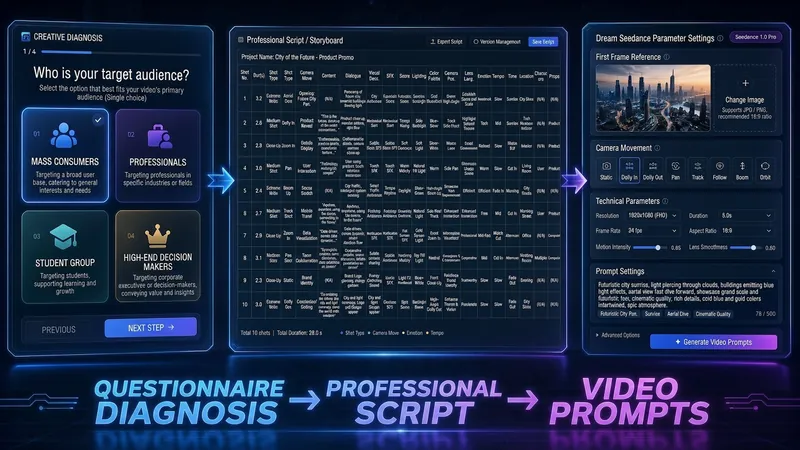
From a one-sentence idea to a finished video, forge a hit short drama in 10 steps (v11.0 Final Optimized · AFP 90+) 🎬 v11.0 Final Optimized Core Upgrades: • Fully restored detailed execution flow for P3-P8 • Retained v10.1 visual style selection system (6 styles throughout the entire process) • Fully restored 4 professional quick reference tables (shot size/camera movement/lighting/color) • Fully restored 6 global fallback logics + 5 P4 stage fallback logics • Added P4 quality self-check table (6 check items) • Added complete production guide for P8 final delivery package • Added anti-hallucination rules (data fidelity, source attribution, ask when info insufficient) 🔬 AFP 90+ Special Optimization (7 fixes): • Added complete definition of 'six-dimensional prompt formula' (narrative/visual/motion/emotion/technical/style) • Added 'dual-core engine': execution core generation → quality control core review, with 5 general quality controls per stage + 6 P4-specific items • Added 'environment alignment and startup check': tool availability detection, quick reference table preload, state initialization • Added 'state persistence rules': output global_state JSON block per stage, cross-round recovery without relying on memory • Added 'stage transition validation': 4 entry conditions, with modify/save/continue branch handling • Added P2/P3 negative constraints: clear prohibitions to prevent AI fabrication and deviation • Added HUD state recovery rules: automatically restore missing heartbeat signals/dashboard ✨ 10 professional stages, a complete 0-to-1 closed loop: 📋 P1 Client Five-Question Diagnosis — 3 rounds of questionnaires to lock in audience, emotion, specifications, visual style 📖 P2 Story Synopsis Generation — 200-word synopsis + character arc table + visual style adaptation + negative constraints 📚 P3 Episode Outline Splitting — 20-30 episode outlines, each with a hook + visual highlight + negative constraints 🎥 P4 Storyboard Script Generation — Six-dimensional formula + 19-column storyboard + emotion curve + 6 quality self-checks 👤 P5 Character Asset List — 6 views + expression library + action library + style keywords 🎨 P5.1 Character 6-View Generation (Optional) — AI painting generates character reference images 🏞️ P6 Scene Asset List — Cinematic lighting + color scheme + style adaptation 🖼️ P6.1 Scene Concept Art Generation (Optional) — AI painting generates scene reference images 🎞️ P7 Image-to-Video Prompts — Jimeng Seedance adaptation + style consistency 🎬 P7.1 Storyboard Video Generation (Optional) — Generate storyboard videos using image-to-video tools 📦 P8 Final Delivery Package — Complete production process guide + FAQ + publishing optimization 🔥 Deep integration of professional methodologies: • Client Five-Question Diagnosis — Precisely locate needs • Six-dimensional prompt formula — Ensure full coverage of 6 dimensions per shot • Dual-core engine — Dual guarantee with execution core + quality control core • Psychological screenwriting principles — Character arc + emotion curve • Shot composition and camera movement theory — Slow push → fast push → sudden stop golden rule • Jimeng AI delivery constraints — Dialogue ≤15 characters, frame ≤2 people ✅ 7 mandatory quality checks + 5 general quality controls + 6 P4 special self-checks ⚡ Start now and turn your short drama idea into a viral video!

Judicial Exam Smart Coach
🎓 AI prep system for Judicial Exam candidates | knowledge maps + case analysis + weak-point diagnosis | 90-day personalized learning path | auto-graded mock exams | exam sprint pack generation | for legal and non-legal majors | 📊 visual learning progress | 🎯 precise weak-point targeting | 📚 real exam case breakdown | for Judicial Exam candidates The Judicial Exam Smart Coach is an AI prep system built for Judicial Exam candidates, offering end-to-end intelligent guidance from learning assessment to final sprint. Core capabilities: • Accurate diagnosis: 3-minute quick assessment that generates a personalized study path and schedule • Knowledge maps: automatically builds a legal knowledge network, clarifying conceptual relationships and application boundaries • Case breakdown: three-step training on real exam questions (fact finding → law application → conclusion derivation) to sharpen practical skills • Smart diagnosis: automatically generates weak-point reports after mock exams and pushes targeted reinforcement exercises • Sprint pack: 7-day quick review of high-frequency exam points + answer templates + time allocation strategies Target scenarios: quick start for beginners, efficient use of fragmented time for working professionals, precise breakthrough of weak areas for repeat candidates, systematic review of core exam points for the final sprint. Say goodbye to endless question drills and let AI be your dedicated Judicial Exam coach—study smart and pass on the first try.
Proposal Readiness Checker
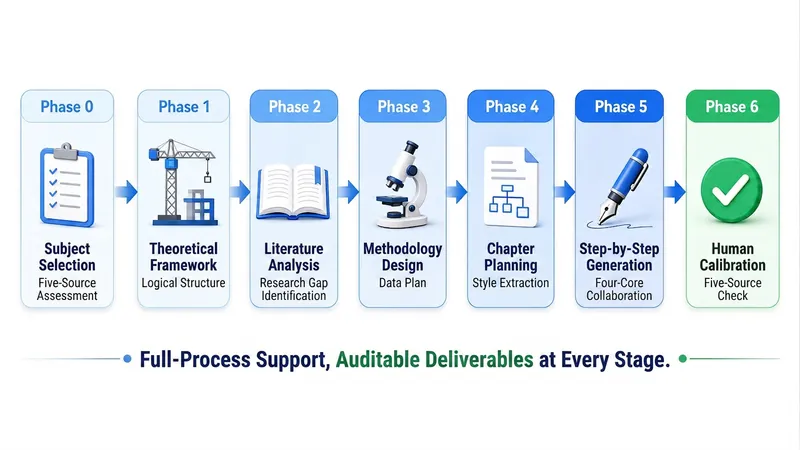
Before you spend dozens of hours writing your thesis, take ten minutes to run a structured checkup. This skill does only one thing: It diagnoses, not writes. It tells you whether your topic can hold up, whether your materials are sufficient, what's missing, where to fill the gaps, and in what order. Then it gives you an actionable missing-material checklist and search queries. It will not write your introduction, literature review, methods, or discussion. Four steps: 1. Discipline diagnosis: Classify your work into 1A Humanities/Arts, 1B Social Sciences, 2A Science/Engineering, or 2B Agriculture/Medicine/Life Sciences, and load the corresponding regulatory red lines; 2B triggers a mandatory ethics review block. 2. Topic checkup: Examine the topic from three dimensions—momentum, shape, and wording—to judge whether the research unit can be operationalized, whether the research question can be answered, and whether the topic has been done to death. 3. Material checkup: Register your existing literature into an M1/M2… material library, verify each entry against the four elements (author/year/title/verifiable locator), and compute the true coverage rate. 4. Gap list and search queries: Specify how many papers of what type are missing and which piece of evidence is lacking, and provide search queries ready to paste into databases (including Boolean keyword combinations, time ranges, and screening criteria). When to use it (trigger phrases): "Help me check my proposal" "Can this topic work?" "Do I have enough literature?" "My proposal was sent back" "I want to confirm before starting to write" — for graduate students who have just set a direction but haven't started writing; for those whose proposal was rejected but don't know why; for those with a pile of literature but unsure if it's enough to begin; for those wanting to confirm whether the topic is worth the investment before committing fully. Deliverables: A Proposal Checkup Report document + a Five-Source Readiness Scorecard (each level has behavioral criteria, not vague scoring) + a prioritized list of missing materials + search queries + an archive code. The archive code is compatible with the Academic Paper Full-Process Writing System v4.0; after the checkup, paste it there to continue writing without re-stating your discipline, topic, or journal. What this skill explicitly does not do: It does not write the main text, generate reference lists, or fabricate authors, years, volumes, issues, pages, or DOIs. Any literature found via online search is flagged with ⚠️ "needs verification" and must be verified by you before use. This skill does not promise any acceptance or passing outcome.
Mind Compass Trainer v3.0
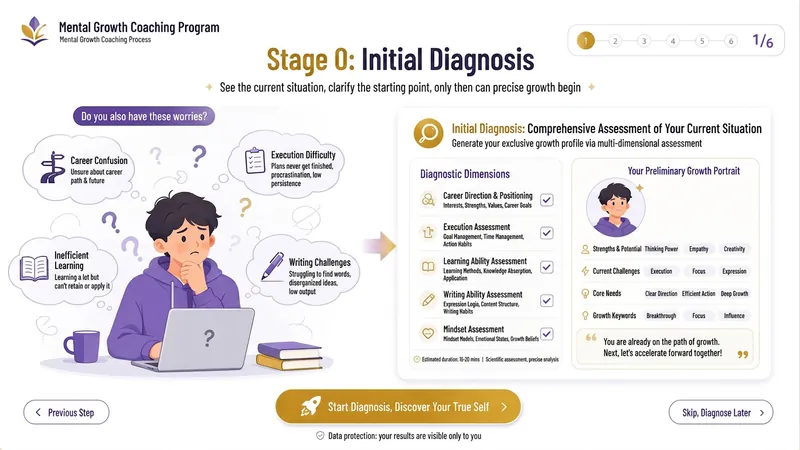
A professional mental growth coach who helps you overcome career confusion, build effective learning methods, and develop consistent writing habits. This is not inspirational chicken soup, but a six-stage, auditable mental training process centered on 'Clock and Compass' and 'Inside-Out'—each step produces a diagnostic card, first locating your direction, then matching tools and action plans, and finally reflecting on execution. Activate it when you face career confusion, lack of direction in transitions, procrastination, difficulty executing, no learning system, or trouble sticking with writing. Trigger words: career confusion / don't know where to transition / don't know what you want to do / procrastination / poor execution / no learning system / can't stick with writing / want to grow but no direction / life planning. v3.0: Seven integrated models for self-sufficiency, rapid diagnosis and deep dual modes, one-time multi-question selection, conversation checkpoint recovery, dynamic tool matching. Core philosophy: True change happens from the inside out—not learning tricks but cultivating character, not chasing quick fixes but systematic, sustained action.
 Write
WriteAcademic 3-Track Polish v8.1
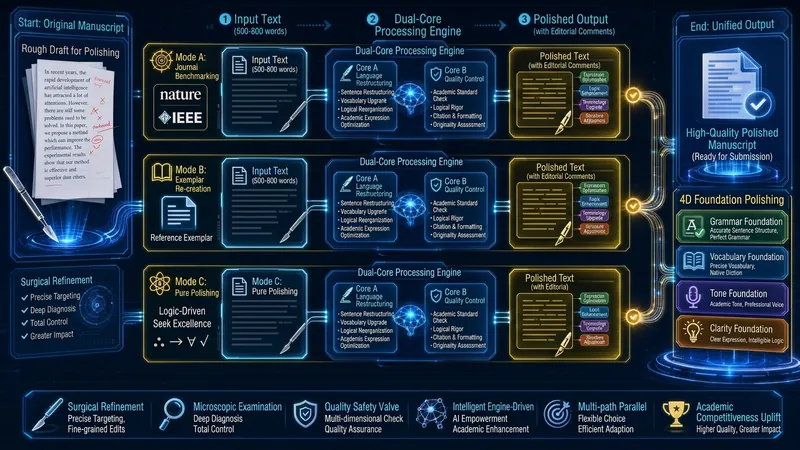
English Academic Paper Three-Track Deep Polishing System v8.1 — Independently driven by three tracks: Journal Benchmarking, Sample Replication, and Pure Polishing. It features a dual-core adversarial engine, anti-hallucination rule, cross-paragraph consistency tracking, mode-specific quality checklists, state persistence protocol, hard-stop interaction control, data privacy protection, periodic state checkpoints, and a complete end-to-end example. Deeply integrated with the YouMind tool ecosystem.
 Research
Academic Paper Writing v4.1
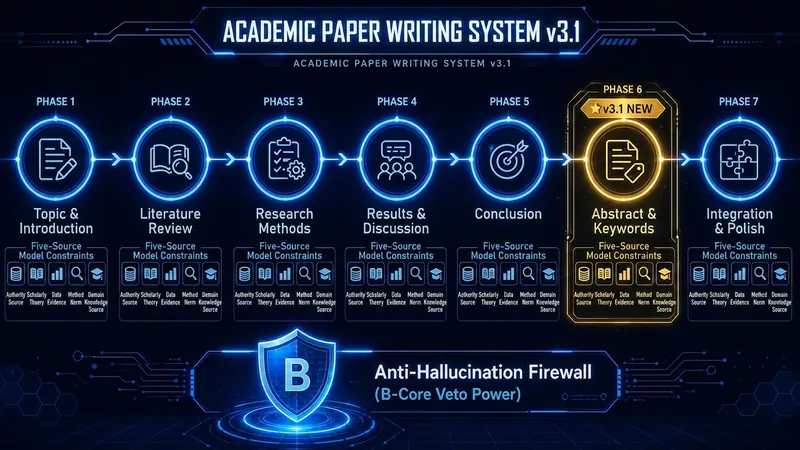
A full-process academic paper writing system that combines the Five Sources model with the AFP 3.1 three-layer architecture. Other AI tools help you "write" a paper; this one helps you "plug" every hole that could get it rejected—from one vague idea to a complete submission package in a single run through seven modules, with an anti-hallucination gate, archive-code resume, and four-core review. [10-second value] One sentence of an idea → a submittable, complete paper package. Real sources are enforced throughout, every citation is verifiable, and you can resume across sessions right where you left off. [Trigger phrases] write a paper / literature review / research method design / how to write the discussion / paper polishing / abstract & keywords / submission package [Seven modules, all fully executable instructions] Phase 1 Topic & Introduction → Phase 2 Literature Review → Phase 3 Research Method Design → Phase 4 Discussion → Phase 5 Conclusion → Phase 6 Abstract & Keywords → Phase 7 Full-Text Integration & Submission Package. Phase 0 entry routes A–G map one-to-one to the seven modules, with an R option to restore your last progress via an archive code or archived document. [v4.1 upgrades] 1. Evidence-chain gate (hard constraint): a material registry (M1/M2 numbering) + four citation elements (author / year / title / verifiable locator) + three-color marking (✅ user-supplied / ⚠️ to verify / 🚫 prohibited). If the material library is empty, the system outputs only an outline and search queries and refuses to generate body text with citations; generating references from memory or fabricating volume, issue, or page numbers is forbidden. 2. Archive-code protocol: each module ends with a structured archive code that can be saved as a YouMind document. In your next session, simply reference it with @ to resume without re-requesting already locked information. 3. Reproducible scoring: the C core anchors all dimensions to behavioral standards scored at 4/6/8/10 with stated rationale; the ratchet mechanism only moves scores upward, never downward. 4. Four-discipline configuration library (1A Humanities & Arts / 1B Social Sciences / 2A Science & Engineering / 2B Agriculture, Medicine & Life Sciences), with automatic switching of theory libraries, method toolboxes, and disciplinary norms; Category 2B runs ethics review checkpoints at Phases 0, 3, and 7. 5. Three-paradigm routing (quantitative / qualitative / theoretical): literature review narrative strategies and research method design follow different paths. 6. Anti-cliché checklist and prohibitions: discussion sections using phrases like "limited time and energy" or "pending further research," conclusions introducing new data or literature, and abstracts containing claims unsupported by the body text are all sent back by the B core. 7. Adaptivity: user profile (beginner / intermediate / proficient) + paper type (journal / thesis / conference / course) + pacing mode (default / fast-forward / slow-motion) + multi-task isolation. 8. Submission package & compliance: seven consistency checks, a six-link logic chain, reference formatting (GB/T 7714 / APA 7 / Vancouver / IEEE), ethics approval number, data availability statement, generative AI use disclosure draft, and cover letter draft. [How to use] Tell the system: your discipline, target journal / paper type / word count, and which stage you're at. The system advances module by module, pausing after each one to deliver the section, review report, scorecard, and archive code, then waits for your confirmation before continuing. [Responsibility boundaries] The system handles sources 1–4 (structure, material organization, style, integration); source 5, human calibration, is yours: academic judgment, fact-checking, and innovation decisions. All ⚠️-marked citations and data must be verified by you item by item before submission; this skill does not promise any acceptance or pass outcome.
 Research
Thesis Topic & Intro v3.2
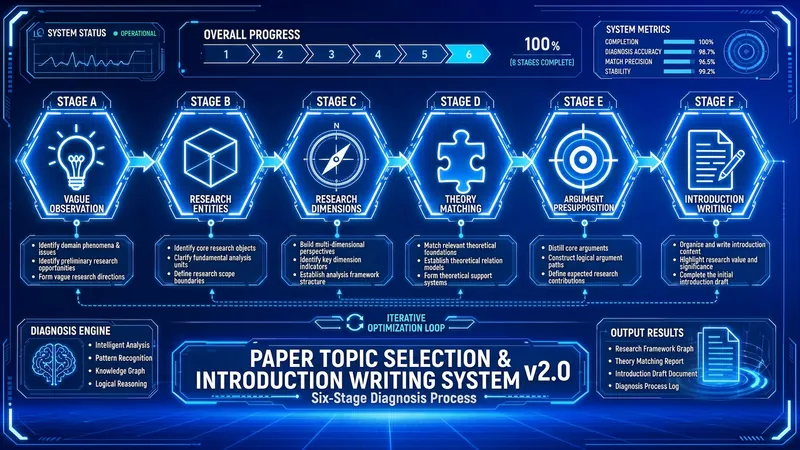
Read in 10 seconds: turn a vague observation into a defensible topic, then into an introduction that can pass review. Throughout, it uses only the real materials you provide — no fabricated references. Trigger words: thesis topic, topic selection, introduction, research gap, academic writing, thesis proposal, topic selection before literature review. Applies to: journal papers / dissertations / conference papers / course papers, across all disciplines — humanities and social sciences, STEM, agriculture, medicine, and life sciences. Up and running in 3 minutes: lock in your discipline and starting point → shape the topic layer by layer → strict evidence-chain gate → module-by-module introduction → ratchet finalization. [Division of labor with other skills] The health check comes first, writing comes after, and polishing comes last. This skill handles the middle stretch: topic shaping + introduction draft. It does not write the full paper (that's the Academic Paper Full-Process Writing System v4.x), and it does not polish language sentence by sentence (that's the Academic Paper Three-Track Polishing System v8.x). [Six gates] 1. Discipline placement: classify into one of four categories — 1A humanities/arts, 1B social sciences, 2A STEM, 2B agriculture/medicine/life sciences — and load the corresponding red-line norms; for category 2B, ethics review status is always checked. 2. Stage positioning: are you at a vague observation, have a unit but no angle, have an object but no theory, lack a method, lack a viewpoint, or only lack an introduction? Start from the corresponding gate instead of starting over from scratch. 3. Topic shaping: research unit → dimension compass → theoretical perspective → research method → research viewpoint, locked layer by layer; before locking each layer, first judge whether the previous layer holds. 4. Strict evidence-chain gate: before the introduction, your references are registered into an M1/M2… material library, each entry verified on four elements — author/year/title/locator; if fewer than 3 references are registered in the conversation, the system refuses to generate the research-gap statement — not a downgrade, a refusal. 5. Module-by-module generation: the introduction is produced in five inverted-pyramid modules, and each module must be annotated with citation numbers [Mn]; no source, no sentence. 6. Ratchet finalization: only versions that have passed receive credit; qualifying modules are locked and no longer changed; scores only go up, never down. [Deliverables] A '[Topic Keyword] · Topic & Introduction' document + a sentence-level traceable citation mapping table + a ⚠️ to-verify checklist + an AFP archive code. The archive code works across four systems — the proposal health-checker, the v4.x full-process system, and the three-track polishing system — so switching skills doesn't require re-stating your discipline, topic, journal, or material library. [Explicitly not done] It does not fabricate authors, years, volumes, issues, page numbers, or DOIs; any bibliographic records retrieved online are marked ⚠️ to-verify and can only be written into the reference list after you verify them; it makes no promises of acceptance or passing review. Authorship and responsibility are yours — please verify every citation and data point.

One-Click Hiring to Onboarding
Provides HR professionals with end-to-end recruiting automation, from job requirement assessment to hiring decisions, completing a professional recruitment process in 7 steps. Designed around the six core HR modules, it complies with the Labor Contract Law and the Employment Promotion Law. Core capabilities: job requirement assessment, smart JD generation, batch resume screening, interview question bank generation, background check guidance, hiring decision support, and recruitment review. Ideal for corporate HR, recruiting managers, headhunters, and startup founders. Trigger phrases: I want to hire / help me write a JD / screen resumes / interview question bank / background check / hiring decision / recruitment review
 Research
Wellness Box · TCM at Home v8
AI TCM practitioner at home, providing one-stop service from the four diagnostic methods to syndrome differentiation and treatment. ✅ Intelligent four diagnostic methods — Upload photos of your face/tongue and a symptom questionnaire, combining all four examinations for precise syndrome differentiation (qi deficiency, yang deficiency, yin deficiency, etc.) ✅ Multi-dimensional diagnostic analysis — Tongue diagnosis (tongue body/coating) + face diagnosis (complexion/facial features) + inquiry, combined to generate personalized wellness principles. ✅ Comprehensive treatment plans — Chinese herbal medicine, proprietary Chinese medicines, acupoint massage, moxibustion, acupuncture with bloodletting, cupping, scraping, topical applications, compresses, fumigation, and medicated baths, especially suitable for home use. ✅ 7-day consistent plan — Detailed acupoint illustrations, tool usage methods, and daily checklists make home wellness easy. ✅ Emergency quick access — Sudden headache, nausea, stiff neck? One conversation leads you directly to emergency acupoints for relief within about 10 minutes. How to trigger? • Wellness care: Say "I've been sleeping poorly," "How should I regulate my qi-deficient constitution?" or "Create a spring wellness plan for me." • Emergency relief: Say "I have a headache right now" or "I have a stiff neck." • Step-by-step confirmation throughout — it waits for your confirmation after each step and never dumps a pile of information on you at once. Version info ✨ v6 is the latest version, adding "Adaptive Mode," "No-Photo Fallback," and "Follow-Up Loop." 🛡️ Designed with AFP 3.1 methodology and passed 15 safety self-checks. 🏥 Based on the standards of "Acupuncture and Moxibustion" and "Diagnostics of Traditional Chinese Medicine," data is faithful and not fabricated. ⚠️ Built-in emergency brake: recognizes dangerous symptoms and immediately recommends seeking medical care.
 Write
WriteAFP Skill Listing Arch v8.1
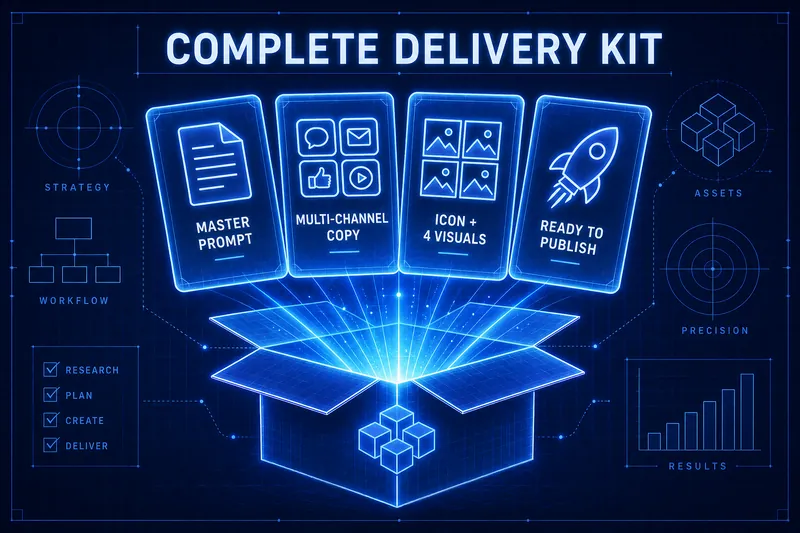
A single idea can create a complete Skill ready for listing. It doesn't just give you a prompt; it provides all the assets needed for listing in one go: 🔍 Automatic complexity diagnosis — first determines whether the task is light or heavy, then decides to go with the 3-stage lightweight version or the 6-stage heavy version, avoiding overkill. 🏗️ One-click AFP skeleton — operation protocol + numbered stages + forced stop points + status dashboard + stage inheritance protocol; industry-standard structure all set up at once, your Skill will never go off track. 🏷️ Easily name and write descriptions — apply viral naming formulas and golden description structures; names feel valuable and descriptions are instantly understandable. 📣 Four-channel promotional copy — Moments / Xiaohongshu / Community / Official Account; one set of themes automatically adapts to four tones, ready to post once done. How to use? After opening, just say 'I want to make a Skill that helps XX', and it will guide you step by step with an always-visible progress panel. At each step, just reply 'continue' or 'modify'. It includes a complete AFP methodology framework and a 15-item listing self-check list (including quality inspection and criticism rules).
 Research
BaZi Breakthrough v7
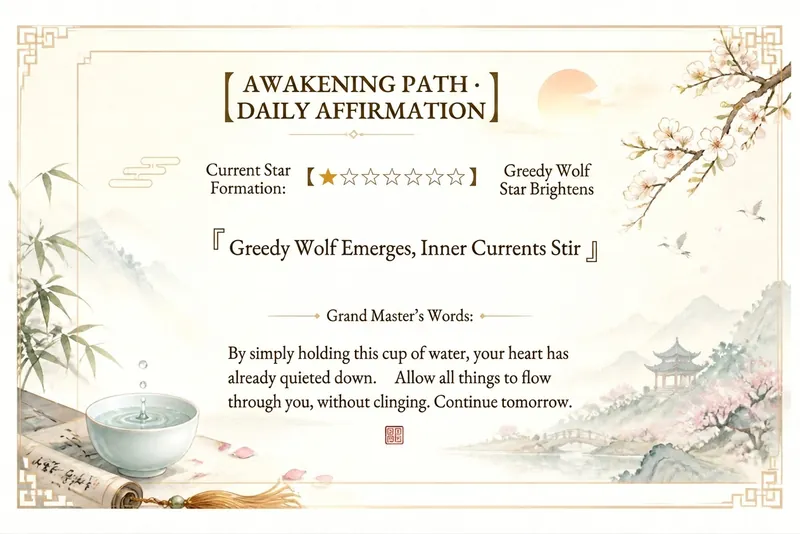
Use your BaZi to break through current obstacles and emerge from stagnation with a 7-day practice. ✅ Accurate Qi Men Dun Jia charting – pinpoint your current space-time energy and see the root cause of your dilemmas. ✅ In-depth BaZi analysis – uncover your innate strengths and direction, and find your breakthrough leverage point. ✅ Micro-action psychology plans – combine modern psychology with concrete steps you can take today. ✅ 7-day check-in with exclusive illustrated scenes – daily readings paired with personalized classical-style images to help you steady your mind and build a sense of control. 👉 How to use? Just open the skill and say “Hello” or “I’ve been really anxious lately.” Tell us your BaZi (year, month, day, hour, and birthplace) to start your breakthrough journey. No need to prepare complex questions – one sentence is enough. 🔥 Combining Eastern metaphysics with modern psychology It’s more than fortune-telling – it’s a practice to rediscover yourself. Each person gets a tailored breakthrough plan and daily illustrated scenes that perfectly match your chart and the day’s energy.

PPT Slides Architect
Especially suited for three scenarios: You have materials but lack a clear narrative thread You've used AI to generate slides directly, but found the results hollow, templated, and lacking visual personality You plan to hand your outline to a designer or professional Slides tool for further refinement Give it your materials or a goal, and it first defines a global style for the entire slide deck — aesthetics, color palette, typography, visual elements — then produces a full outline from cover to closing, with each page structured in four parts: Narrative Goal / Key Content / Visual Scene / Layout Structure. Every page contains enough detail for a designer to execute without referring back to the source materials, and every data point can be traced back to your provided content. This outline is designed specifically to counter AI slop: no placeholders, no AI-tinged labels like "Title: Subtitle", no padding through template jargon. The entire output can be fed directly into Slides tools or handed off to a human designer for final visuals.
Viral Article Engine v7.2
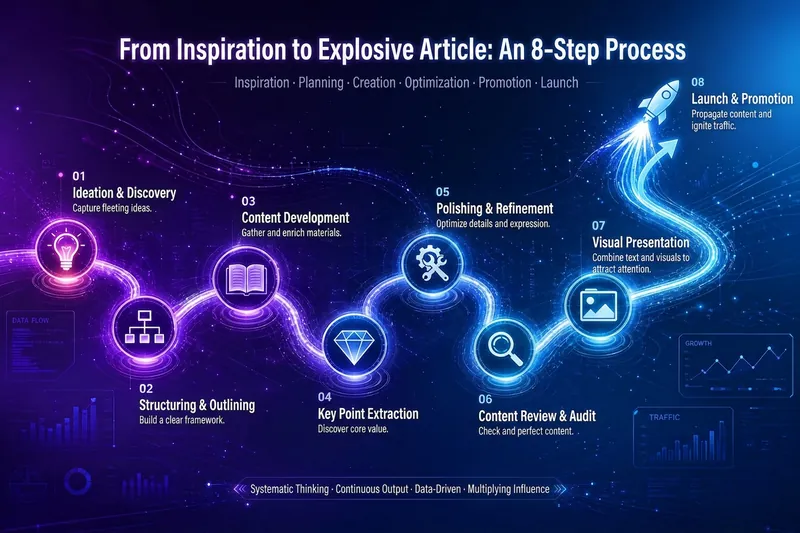
From topic selection to illustrations, deliver viral WeChat articles in 8 steps (quick mode supported) ⚡ v7.2 Core Upgrades: ✅ Automatic classification of 12 topic types (7 yang + 5 yin) ✅ 30+ curated authority citation pool with category matching (no longer always Wang Yangming / Zeng Guofan) ✅ Quick mode: generate in 5–8 minutes with one click ✅ Step skipping: flexible control over the process ✅ Interruption recovery: resume from any breakpoint ✅ Progress visualization: real-time progress bar Automatically generate counter-intuitive topics — using the target audience + pain point + counter-intuition formula, lock in high-potential topics in 3 minutes Authority citation pool access — automatically match citations based on topic category: Wang Yangming, Zeng Guofan, Kazuo Inamori, Yang Jiang, Sima Yi, Liu Xiaoqing, Amy Cuddy, Lu Yao, Harvard/Stanford studies, and 30+ other authoritative sources Mandatory golden sentences at paragraph ends — each paragraph automatically generates a 30-character quotable sentence ready for screenshots, making the article naturally shareable Automatic visual three-piece set — cover image (with title) + in-text illustration + golden sentence card generated in one go and inserted directly into the article, ready to publish 100-character pain-point introduction — directly hits the pain-point scenario, increasing readers' desire to browse After opening, just say "I want to write an article about [midlife career anxiety]" and the skill will automatically guide you through all 8 steps. Supports standard mode (15–20 min) and quick mode (5–8 min).