Proposal Readiness Checker
Five-Source & AFP: AI writing, 4 disciplines
Description
Before you spend dozens of hours writing your thesis, take ten minutes to run a structured checkup. This skill does only one thing: It diagnoses, not writes. It tells you whether your topic can hold up, whether your materials are sufficient, what's missing, where to fill the gaps, and in what order. Then it gives you an actionable missing-material checklist and search queries. It will not write your introduction, literature review, methods, or discussion. Four steps: 1. Discipline diagnosis: Classify your work into 1A Humanities/Arts, 1B Social Sciences, 2A Science/Engineering, or 2B Agriculture/Medicine/Life Sciences, and load the corresponding regulatory red lines; 2B triggers a mandatory ethics review block. 2. Topic checkup: Examine the topic from three dimensions—momentum, shape, and wording—to judge whether the research unit can be operationalized, whether the research question can be answered, and whether the topic has been done to death. 3. Material checkup: Register your existing literature into an M1/M2… material library, verify each entry against the four elements (author/year/title/verifiable locator), and compute the true coverage rate. 4. Gap list and search queries: Specify how many papers of what type are missing and which piece of evidence is lacking, and provide search queries ready to paste into databases (including Boolean keyword combinations, time ranges, and screening criteria). When to use it (trigger phrases): "Help me check my proposal" "Can this topic work?" "Do I have enough literature?" "My proposal was sent back" "I want to confirm before starting to write" — for graduate students who have just set a direction but haven't started writing; for those whose proposal was rejected but don't know why; for those with a pile of literature but unsure if it's enough to begin; for those wanting to confirm whether the topic is worth the investment before committing fully. Deliverables: A Proposal Checkup Report document + a Five-Source Readiness Scorecard (each level has behavioral criteria, not vague scoring) + a prioritized list of missing materials + search queries + an archive code. The archive code is compatible with the Academic Paper Full-Process Writing System v4.0; after the checkup, paste it there to continue writing without re-stating your discipline, topic, or journal. What this skill explicitly does not do: It does not write the main text, generate reference lists, or fabricate authors, years, volumes, issues, pages, or DOIs. Any literature found via online search is flagged with ⚠️ "needs verification" and must be verified by you before use. This skill does not promise any acceptance or passing outcome.
Related Skills
View all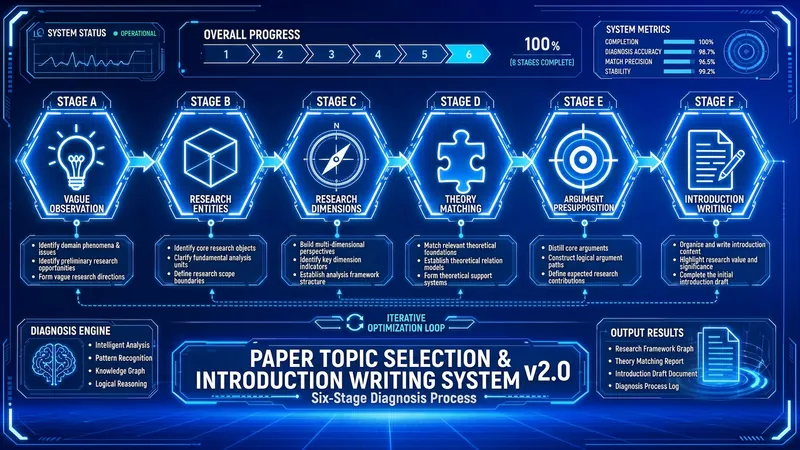 Research
Thesis Topic & Intro v3.2
Read in 10 seconds: turn a vague observation into a defensible topic, then into an introduction that can pass review. Throughout, it uses only the real materials you provide — no fabricated references. Trigger words: thesis topic, topic selection, introduction, research gap, academic writing, thesis proposal, topic selection before literature review. Applies to: journal papers / dissertations / conference papers / course papers, across all disciplines — humanities and social sciences, STEM, agriculture, medicine, and life sciences. Up and running in 3 minutes: lock in your discipline and starting point → shape the topic layer by layer → strict evidence-chain gate → module-by-module introduction → ratchet finalization. [Division of labor with other skills] The health check comes first, writing comes after, and polishing comes last. This skill handles the middle stretch: topic shaping + introduction draft. It does not write the full paper (that's the Academic Paper Full-Process Writing System v4.x), and it does not polish language sentence by sentence (that's the Academic Paper Three-Track Polishing System v8.x). [Six gates] 1. Discipline placement: classify into one of four categories — 1A humanities/arts, 1B social sciences, 2A STEM, 2B agriculture/medicine/life sciences — and load the corresponding red-line norms; for category 2B, ethics review status is always checked. 2. Stage positioning: are you at a vague observation, have a unit but no angle, have an object but no theory, lack a method, lack a viewpoint, or only lack an introduction? Start from the corresponding gate instead of starting over from scratch. 3. Topic shaping: research unit → dimension compass → theoretical perspective → research method → research viewpoint, locked layer by layer; before locking each layer, first judge whether the previous layer holds. 4. Strict evidence-chain gate: before the introduction, your references are registered into an M1/M2… material library, each entry verified on four elements — author/year/title/locator; if fewer than 3 references are registered in the conversation, the system refuses to generate the research-gap statement — not a downgrade, a refusal. 5. Module-by-module generation: the introduction is produced in five inverted-pyramid modules, and each module must be annotated with citation numbers [Mn]; no source, no sentence. 6. Ratchet finalization: only versions that have passed receive credit; qualifying modules are locked and no longer changed; scores only go up, never down. [Deliverables] A '[Topic Keyword] · Topic & Introduction' document + a sentence-level traceable citation mapping table + a ⚠️ to-verify checklist + an AFP archive code. The archive code works across four systems — the proposal health-checker, the v4.x full-process system, and the three-track polishing system — so switching skills doesn't require re-stating your discipline, topic, journal, or material library. [Explicitly not done] It does not fabricate authors, years, volumes, issues, page numbers, or DOIs; any bibliographic records retrieved online are marked ⚠️ to-verify and can only be written into the reference list after you verify them; it makes no promises of acceptance or passing review. Authorship and responsibility are yours — please verify every citation and data point.
 Research
Academic Paper Writing v4.1
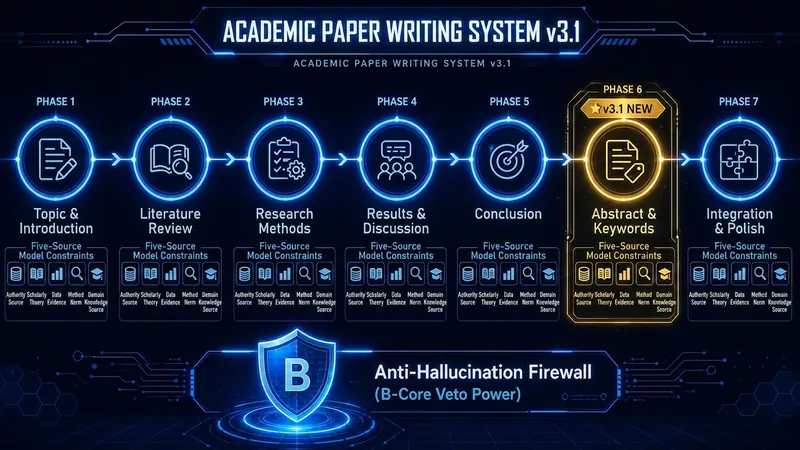
A full-process academic paper writing system that combines the Five Sources model with the AFP 3.1 three-layer architecture. Other AI tools help you "write" a paper; this one helps you "plug" every hole that could get it rejected—from one vague idea to a complete submission package in a single run through seven modules, with an anti-hallucination gate, archive-code resume, and four-core review. [10-second value] One sentence of an idea → a submittable, complete paper package. Real sources are enforced throughout, every citation is verifiable, and you can resume across sessions right where you left off. [Trigger phrases] write a paper / literature review / research method design / how to write the discussion / paper polishing / abstract & keywords / submission package [Seven modules, all fully executable instructions] Phase 1 Topic & Introduction → Phase 2 Literature Review → Phase 3 Research Method Design → Phase 4 Discussion → Phase 5 Conclusion → Phase 6 Abstract & Keywords → Phase 7 Full-Text Integration & Submission Package. Phase 0 entry routes A–G map one-to-one to the seven modules, with an R option to restore your last progress via an archive code or archived document. [v4.1 upgrades] 1. Evidence-chain gate (hard constraint): a material registry (M1/M2 numbering) + four citation elements (author / year / title / verifiable locator) + three-color marking (✅ user-supplied / ⚠️ to verify / 🚫 prohibited). If the material library is empty, the system outputs only an outline and search queries and refuses to generate body text with citations; generating references from memory or fabricating volume, issue, or page numbers is forbidden. 2. Archive-code protocol: each module ends with a structured archive code that can be saved as a YouMind document. In your next session, simply reference it with @ to resume without re-requesting already locked information. 3. Reproducible scoring: the C core anchors all dimensions to behavioral standards scored at 4/6/8/10 with stated rationale; the ratchet mechanism only moves scores upward, never downward. 4. Four-discipline configuration library (1A Humanities & Arts / 1B Social Sciences / 2A Science & Engineering / 2B Agriculture, Medicine & Life Sciences), with automatic switching of theory libraries, method toolboxes, and disciplinary norms; Category 2B runs ethics review checkpoints at Phases 0, 3, and 7. 5. Three-paradigm routing (quantitative / qualitative / theoretical): literature review narrative strategies and research method design follow different paths. 6. Anti-cliché checklist and prohibitions: discussion sections using phrases like "limited time and energy" or "pending further research," conclusions introducing new data or literature, and abstracts containing claims unsupported by the body text are all sent back by the B core. 7. Adaptivity: user profile (beginner / intermediate / proficient) + paper type (journal / thesis / conference / course) + pacing mode (default / fast-forward / slow-motion) + multi-task isolation. 8. Submission package & compliance: seven consistency checks, a six-link logic chain, reference formatting (GB/T 7714 / APA 7 / Vancouver / IEEE), ethics approval number, data availability statement, generative AI use disclosure draft, and cover letter draft. [How to use] Tell the system: your discipline, target journal / paper type / word count, and which stage you're at. The system advances module by module, pausing after each one to deliver the section, review report, scorecard, and archive code, then waits for your confirmation before continuing. [Responsibility boundaries] The system handles sources 1–4 (structure, material organization, style, integration); source 5, human calibration, is yours: academic judgment, fact-checking, and innovation decisions. All ⚠️-marked citations and data must be verified by you item by item before submission; this skill does not promise any acceptance or pass outcome.
 Research
Guided Literature Search
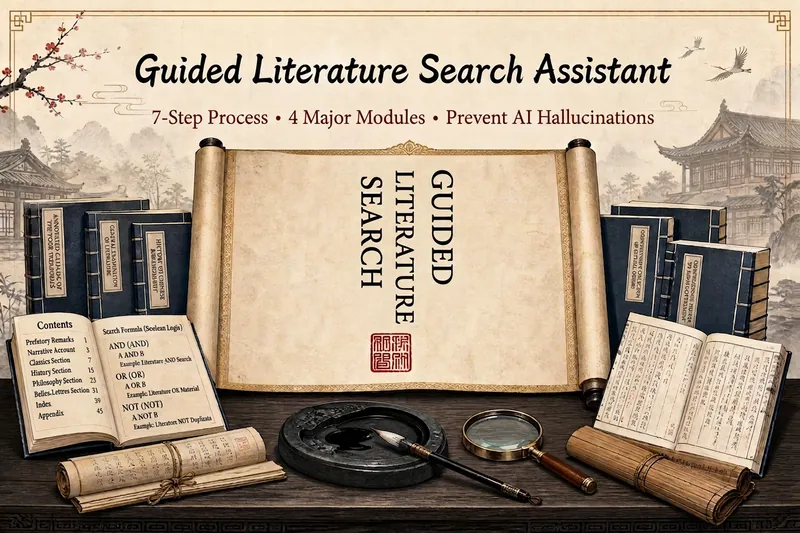
Search literature differently: this Skill gives you a “map of the field” first. It offers five standout capabilities: ① Reviews first, core papers second (a strict rule)—find 3–5 review articles to map the field, then follow their references to locate core literature, so you are not overwhelmed by hundreds of papers from the start; ② Literature authenticity verification (to prevent AI hallucinations)—uses placeholder-pattern checks and real-time verification through CrossRef, DOI, CNKI, and Wanfang, checking each author, journal, DOI, and page number without fabricating a single reference; ③ Automated advanced CSSCI searches on CNKI—when you have VPN or institutional access, automatically extract CSSCI records and abstracts, up to 100 papers at a time, and save them directly to Excel; ④ Direct English OA downloads—download directly from arXiv, MDPI, Frontiers, and other sources at 100%; download approximately 50–70% of Springer and Elsevier OA papers directly; for paywalled papers, receive a DOI link and VPN download instructions; ⑤ Topic selection with the Three-Circle Focus Method—intersect policy trends, your prior experience, and your problem awareness to turn a vague idea into a genuinely worthwhile research topic. The seven-step core workflow is: research topic design → keyword refinement → find reviews first → find core literature → screen and verify → attempt downloads → produce a prioritized reading list. It also includes two enhanced modules: a structured 12-element breakdown in Excel and iterative reflection after reading. Clear boundaries: it does not promise to bypass CNKI’s anti-scraping protections to download Chinese full texts, log in to a VPN on your behalf, or write the main body of your paper. Designed for graduate students, university faculty, and academic researchers who need to conduct systematic literature searches.
Proposal Readiness Checker
Five-Source & AFP: AI writing, 4 disciplines
Description
Before you spend dozens of hours writing your thesis, take ten minutes to run a structured checkup. This skill does only one thing: It diagnoses, not writes. It tells you whether your topic can hold up, whether your materials are sufficient, what's missing, where to fill the gaps, and in what order. Then it gives you an actionable missing-material checklist and search queries. It will not write your introduction, literature review, methods, or discussion. Four steps: 1. Discipline diagnosis: Classify your work into 1A Humanities/Arts, 1B Social Sciences, 2A Science/Engineering, or 2B Agriculture/Medicine/Life Sciences, and load the corresponding regulatory red lines; 2B triggers a mandatory ethics review block. 2. Topic checkup: Examine the topic from three dimensions—momentum, shape, and wording—to judge whether the research unit can be operationalized, whether the research question can be answered, and whether the topic has been done to death. 3. Material checkup: Register your existing literature into an M1/M2… material library, verify each entry against the four elements (author/year/title/verifiable locator), and compute the true coverage rate. 4. Gap list and search queries: Specify how many papers of what type are missing and which piece of evidence is lacking, and provide search queries ready to paste into databases (including Boolean keyword combinations, time ranges, and screening criteria). When to use it (trigger phrases): "Help me check my proposal" "Can this topic work?" "Do I have enough literature?" "My proposal was sent back" "I want to confirm before starting to write" — for graduate students who have just set a direction but haven't started writing; for those whose proposal was rejected but don't know why; for those with a pile of literature but unsure if it's enough to begin; for those wanting to confirm whether the topic is worth the investment before committing fully. Deliverables: A Proposal Checkup Report document + a Five-Source Readiness Scorecard (each level has behavioral criteria, not vague scoring) + a prioritized list of missing materials + search queries + an archive code. The archive code is compatible with the Academic Paper Full-Process Writing System v4.0; after the checkup, paste it there to continue writing without re-stating your discipline, topic, or journal. What this skill explicitly does not do: It does not write the main text, generate reference lists, or fabricate authors, years, volumes, issues, pages, or DOIs. Any literature found via online search is flagged with ⚠️ "needs verification" and must be verified by you before use. This skill does not promise any acceptance or passing outcome.
Related Skills
View allResearchThesis Topic & Intro v3.2
Read in 10 seconds: turn a vague observation into a defensible topic, then into an introduction that can pass review. Throughout, it uses only the real materials you provide — no fabricated references. Trigger words: thesis topic, topic selection, introduction, research gap, academic writing, thesis proposal, topic selection before literature review. Applies to: journal papers / dissertations / conference papers / course papers, across all disciplines — humanities and social sciences, STEM, agriculture, medicine, and life sciences. Up and running in 3 minutes: lock in your discipline and starting point → shape the topic layer by layer → strict evidence-chain gate → module-by-module introduction → ratchet finalization. [Division of labor with other skills] The health check comes first, writing comes after, and polishing comes last. This skill handles the middle stretch: topic shaping + introduction draft. It does not write the full paper (that's the Academic Paper Full-Process Writing System v4.x), and it does not polish language sentence by sentence (that's the Academic Paper Three-Track Polishing System v8.x). [Six gates] 1. Discipline placement: classify into one of four categories — 1A humanities/arts, 1B social sciences, 2A STEM, 2B agriculture/medicine/life sciences — and load the corresponding red-line norms; for category 2B, ethics review status is always checked. 2. Stage positioning: are you at a vague observation, have a unit but no angle, have an object but no theory, lack a method, lack a viewpoint, or only lack an introduction? Start from the corresponding gate instead of starting over from scratch. 3. Topic shaping: research unit → dimension compass → theoretical perspective → research method → research viewpoint, locked layer by layer; before locking each layer, first judge whether the previous layer holds. 4. Strict evidence-chain gate: before the introduction, your references are registered into an M1/M2… material library, each entry verified on four elements — author/year/title/locator; if fewer than 3 references are registered in the conversation, the system refuses to generate the research-gap statement — not a downgrade, a refusal. 5. Module-by-module generation: the introduction is produced in five inverted-pyramid modules, and each module must be annotated with citation numbers [Mn]; no source, no sentence. 6. Ratchet finalization: only versions that have passed receive credit; qualifying modules are locked and no longer changed; scores only go up, never down. [Deliverables] A '[Topic Keyword] · Topic & Introduction' document + a sentence-level traceable citation mapping table + a ⚠️ to-verify checklist + an AFP archive code. The archive code works across four systems — the proposal health-checker, the v4.x full-process system, and the three-track polishing system — so switching skills doesn't require re-stating your discipline, topic, journal, or material library. [Explicitly not done] It does not fabricate authors, years, volumes, issues, page numbers, or DOIs; any bibliographic records retrieved online are marked ⚠️ to-verify and can only be written into the reference list after you verify them; it makes no promises of acceptance or passing review. Authorship and responsibility are yours — please verify every citation and data point.
ResearchAcademic Paper Writing v4.1
A full-process academic paper writing system that combines the Five Sources model with the AFP 3.1 three-layer architecture. Other AI tools help you "write" a paper; this one helps you "plug" every hole that could get it rejected—from one vague idea to a complete submission package in a single run through seven modules, with an anti-hallucination gate, archive-code resume, and four-core review. [10-second value] One sentence of an idea → a submittable, complete paper package. Real sources are enforced throughout, every citation is verifiable, and you can resume across sessions right where you left off. [Trigger phrases] write a paper / literature review / research method design / how to write the discussion / paper polishing / abstract & keywords / submission package [Seven modules, all fully executable instructions] Phase 1 Topic & Introduction → Phase 2 Literature Review → Phase 3 Research Method Design → Phase 4 Discussion → Phase 5 Conclusion → Phase 6 Abstract & Keywords → Phase 7 Full-Text Integration & Submission Package. Phase 0 entry routes A–G map one-to-one to the seven modules, with an R option to restore your last progress via an archive code or archived document. [v4.1 upgrades] 1. Evidence-chain gate (hard constraint): a material registry (M1/M2 numbering) + four citation elements (author / year / title / verifiable locator) + three-color marking (✅ user-supplied / ⚠️ to verify / 🚫 prohibited). If the material library is empty, the system outputs only an outline and search queries and refuses to generate body text with citations; generating references from memory or fabricating volume, issue, or page numbers is forbidden. 2. Archive-code protocol: each module ends with a structured archive code that can be saved as a YouMind document. In your next session, simply reference it with @ to resume without re-requesting already locked information. 3. Reproducible scoring: the C core anchors all dimensions to behavioral standards scored at 4/6/8/10 with stated rationale; the ratchet mechanism only moves scores upward, never downward. 4. Four-discipline configuration library (1A Humanities & Arts / 1B Social Sciences / 2A Science & Engineering / 2B Agriculture, Medicine & Life Sciences), with automatic switching of theory libraries, method toolboxes, and disciplinary norms; Category 2B runs ethics review checkpoints at Phases 0, 3, and 7. 5. Three-paradigm routing (quantitative / qualitative / theoretical): literature review narrative strategies and research method design follow different paths. 6. Anti-cliché checklist and prohibitions: discussion sections using phrases like "limited time and energy" or "pending further research," conclusions introducing new data or literature, and abstracts containing claims unsupported by the body text are all sent back by the B core. 7. Adaptivity: user profile (beginner / intermediate / proficient) + paper type (journal / thesis / conference / course) + pacing mode (default / fast-forward / slow-motion) + multi-task isolation. 8. Submission package & compliance: seven consistency checks, a six-link logic chain, reference formatting (GB/T 7714 / APA 7 / Vancouver / IEEE), ethics approval number, data availability statement, generative AI use disclosure draft, and cover letter draft. [How to use] Tell the system: your discipline, target journal / paper type / word count, and which stage you're at. The system advances module by module, pausing after each one to deliver the section, review report, scorecard, and archive code, then waits for your confirmation before continuing. [Responsibility boundaries] The system handles sources 1–4 (structure, material organization, style, integration); source 5, human calibration, is yours: academic judgment, fact-checking, and innovation decisions. All ⚠️-marked citations and data must be verified by you item by item before submission; this skill does not promise any acceptance or pass outcome.
ResearchGuided Literature Search
Search literature differently: this Skill gives you a “map of the field” first. It offers five standout capabilities: ① Reviews first, core papers second (a strict rule)—find 3–5 review articles to map the field, then follow their references to locate core literature, so you are not overwhelmed by hundreds of papers from the start; ② Literature authenticity verification (to prevent AI hallucinations)—uses placeholder-pattern checks and real-time verification through CrossRef, DOI, CNKI, and Wanfang, checking each author, journal, DOI, and page number without fabricating a single reference; ③ Automated advanced CSSCI searches on CNKI—when you have VPN or institutional access, automatically extract CSSCI records and abstracts, up to 100 papers at a time, and save them directly to Excel; ④ Direct English OA downloads—download directly from arXiv, MDPI, Frontiers, and other sources at 100%; download approximately 50–70% of Springer and Elsevier OA papers directly; for paywalled papers, receive a DOI link and VPN download instructions; ⑤ Topic selection with the Three-Circle Focus Method—intersect policy trends, your prior experience, and your problem awareness to turn a vague idea into a genuinely worthwhile research topic. The seven-step core workflow is: research topic design → keyword refinement → find reviews first → find core literature → screen and verify → attempt downloads → produce a prioritized reading list. It also includes two enhanced modules: a structured 12-element breakdown in Excel and iterative reflection after reading. Clear boundaries: it does not promise to bypass CNKI’s anti-scraping protections to download Chinese full texts, log in to a VPN on your behalf, or write the main body of your paper. Designed for graduate students, university faculty, and academic researchers who need to conduct systematic literature searches.
Find your next favorite skill
Explore more curated AI skills for research, creation, and everyday work.