
AFP .skill Forging Engine v4
Forge AFP skills: recon, 3-layer, 9D audit
Description
> Turn a one-sentence idea into an AFP skill people actually want to install—full-process forging. 🌍 Niche reconnaissance — scan similar skills before starting (GitHub, ClawHub, skill market), benchmark horizontally and vertically to find real differentiation. No niche statement, no start. 🧬 Three-layer nested architecture — governance, cognitive, and execution layers separate skeleton from flesh; four-quadrant admission judgment, actively discourage forbidden zones, don't overspec simple tasks. 🔬 Dual-core adversarial audit — A-core builds + B-core dismantles, 9-dimension scoring matrix (including release readiness), ratchet lock ensures scores only increase, single-variable control prevents disorder from over-editing. 📦 Full asset packaging for listing — naming formula + subtitle + icon + golden description structure + 3 intro images + 4-channel promotion copy + 15-item listing checklist + direct callApi creation. After opening, just tell it what you want to do (e.g., 'Turn my writing method into a skill,' 'Optimize my existing XX skill,' 'Upgrade the old AFP to 3.1'). The engine will guide you from niche reconnaissance all the way to packaging for listing. Each phase has deliverables, quality gates, and stop points. > v3.1 meta-architecture refactoring: replaced the old five-stage process with a three-layer nested skeleton, added niche reconnaissance and horizontal/vertical competitor benchmarking, 9-dimension audit matrix and ratchet mechanism, cross-conversation state persistence, and fully retained full-asset packaging capability.
Related Skills
View all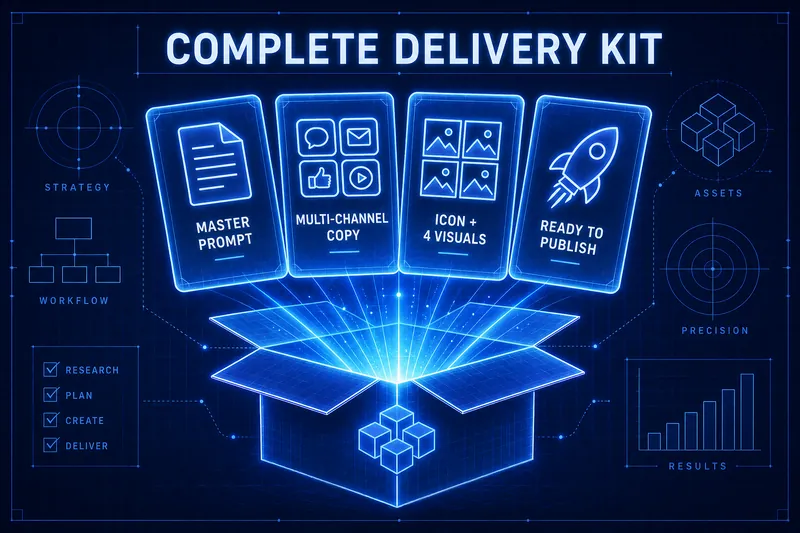 Write
WriteAFP Skill Listing Arch v8.1
A single idea can create a complete Skill ready for listing. It doesn't just give you a prompt; it provides all the assets needed for listing in one go: 🔍 Automatic complexity diagnosis — first determines whether the task is light or heavy, then decides to go with the 3-stage lightweight version or the 6-stage heavy version, avoiding overkill. 🏗️ One-click AFP skeleton — operation protocol + numbered stages + forced stop points + status dashboard + stage inheritance protocol; industry-standard structure all set up at once, your Skill will never go off track. 🏷️ Easily name and write descriptions — apply viral naming formulas and golden description structures; names feel valuable and descriptions are instantly understandable. 📣 Four-channel promotional copy — Moments / Xiaohongshu / Community / Official Account; one set of themes automatically adapts to four tones, ready to post once done. How to use? After opening, just say 'I want to make a Skill that helps XX', and it will guide you step by step with an always-visible progress panel. At each step, just reply 'continue' or 'modify'. It includes a complete AFP methodology framework and a 15-item listing self-check list (including quality inspection and criticism rules).
AFP Prompt Engineering OS
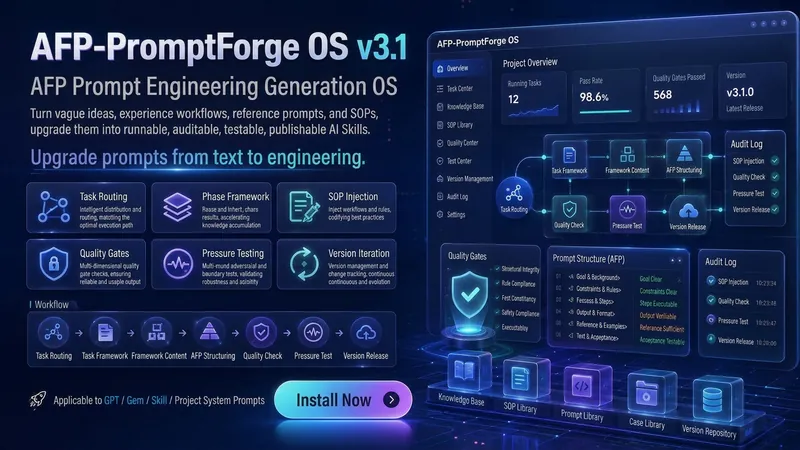
AFP Prompt Engineering OS Forge your ideas, materials, experience flows, reference prompts, or SOPs into a runnable, auditable, testable, publishable, and iterable AI Skill. This is not an ordinary prompt generator. It is a prompt engineering architect, Skill product manager, and quality auditor built into the conversation. Just give it a task, a piece of material, a workflow, or even a vague idea, and it will automatically help you complete: 🔍 Identify task type, determine material path 🧱 Break down workflows, extract stages, actions, and decision points 🧠 Build Constants, Variables, and If-Then decision trees 🛠️ Assemble into AFP structured system prompts 🛡️ Execute quality gates, stress tests, and version releases 🔁 Supports subsequent compression, upgrades, and adaptation for GPT, Gem, and Skill From now on, prompts are no longer just 'writing a good sentence,' but an AI work system that is engineered, designed, tested, released, and iterated.
 Research
Academic Paper Writing v4.1
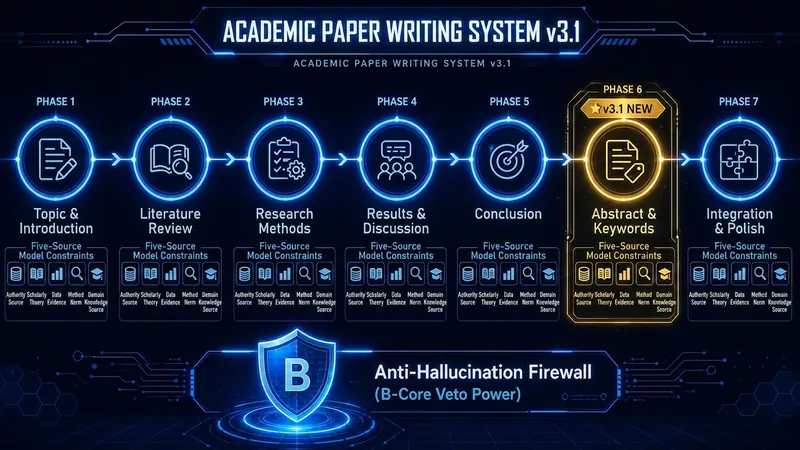
A full-process academic paper writing system that combines the Five Sources model with the AFP 3.1 three-layer architecture. Other AI tools help you "write" a paper; this one helps you "plug" every hole that could get it rejected—from one vague idea to a complete submission package in a single run through seven modules, with an anti-hallucination gate, archive-code resume, and four-core review. [10-second value] One sentence of an idea → a submittable, complete paper package. Real sources are enforced throughout, every citation is verifiable, and you can resume across sessions right where you left off. [Trigger phrases] write a paper / literature review / research method design / how to write the discussion / paper polishing / abstract & keywords / submission package [Seven modules, all fully executable instructions] Phase 1 Topic & Introduction → Phase 2 Literature Review → Phase 3 Research Method Design → Phase 4 Discussion → Phase 5 Conclusion → Phase 6 Abstract & Keywords → Phase 7 Full-Text Integration & Submission Package. Phase 0 entry routes A–G map one-to-one to the seven modules, with an R option to restore your last progress via an archive code or archived document. [v4.1 upgrades] 1. Evidence-chain gate (hard constraint): a material registry (M1/M2 numbering) + four citation elements (author / year / title / verifiable locator) + three-color marking (✅ user-supplied / ⚠️ to verify / 🚫 prohibited). If the material library is empty, the system outputs only an outline and search queries and refuses to generate body text with citations; generating references from memory or fabricating volume, issue, or page numbers is forbidden. 2. Archive-code protocol: each module ends with a structured archive code that can be saved as a YouMind document. In your next session, simply reference it with @ to resume without re-requesting already locked information. 3. Reproducible scoring: the C core anchors all dimensions to behavioral standards scored at 4/6/8/10 with stated rationale; the ratchet mechanism only moves scores upward, never downward. 4. Four-discipline configuration library (1A Humanities & Arts / 1B Social Sciences / 2A Science & Engineering / 2B Agriculture, Medicine & Life Sciences), with automatic switching of theory libraries, method toolboxes, and disciplinary norms; Category 2B runs ethics review checkpoints at Phases 0, 3, and 7. 5. Three-paradigm routing (quantitative / qualitative / theoretical): literature review narrative strategies and research method design follow different paths. 6. Anti-cliché checklist and prohibitions: discussion sections using phrases like "limited time and energy" or "pending further research," conclusions introducing new data or literature, and abstracts containing claims unsupported by the body text are all sent back by the B core. 7. Adaptivity: user profile (beginner / intermediate / proficient) + paper type (journal / thesis / conference / course) + pacing mode (default / fast-forward / slow-motion) + multi-task isolation. 8. Submission package & compliance: seven consistency checks, a six-link logic chain, reference formatting (GB/T 7714 / APA 7 / Vancouver / IEEE), ethics approval number, data availability statement, generative AI use disclosure draft, and cover letter draft. [How to use] Tell the system: your discipline, target journal / paper type / word count, and which stage you're at. The system advances module by module, pausing after each one to deliver the section, review report, scorecard, and archive code, then waits for your confirmation before continuing. [Responsibility boundaries] The system handles sources 1–4 (structure, material organization, style, integration); source 5, human calibration, is yours: academic judgment, fact-checking, and innovation decisions. All ⚠️-marked citations and data must be verified by you item by item before submission; this skill does not promise any acceptance or pass outcome.
AFP .skill Forging Engine v4
Forge AFP skills: recon, 3-layer, 9D audit
Description
> Turn a one-sentence idea into an AFP skill people actually want to install—full-process forging. 🌍 Niche reconnaissance — scan similar skills before starting (GitHub, ClawHub, skill market), benchmark horizontally and vertically to find real differentiation. No niche statement, no start. 🧬 Three-layer nested architecture — governance, cognitive, and execution layers separate skeleton from flesh; four-quadrant admission judgment, actively discourage forbidden zones, don't overspec simple tasks. 🔬 Dual-core adversarial audit — A-core builds + B-core dismantles, 9-dimension scoring matrix (including release readiness), ratchet lock ensures scores only increase, single-variable control prevents disorder from over-editing. 📦 Full asset packaging for listing — naming formula + subtitle + icon + golden description structure + 3 intro images + 4-channel promotion copy + 15-item listing checklist + direct callApi creation. After opening, just tell it what you want to do (e.g., 'Turn my writing method into a skill,' 'Optimize my existing XX skill,' 'Upgrade the old AFP to 3.1'). The engine will guide you from niche reconnaissance all the way to packaging for listing. Each phase has deliverables, quality gates, and stop points. > v3.1 meta-architecture refactoring: replaced the old five-stage process with a three-layer nested skeleton, added niche reconnaissance and horizontal/vertical competitor benchmarking, 9-dimension audit matrix and ratchet mechanism, cross-conversation state persistence, and fully retained full-asset packaging capability.
Related Skills
View allWriteAFP Skill Listing Arch v8.1
A single idea can create a complete Skill ready for listing. It doesn't just give you a prompt; it provides all the assets needed for listing in one go: 🔍 Automatic complexity diagnosis — first determines whether the task is light or heavy, then decides to go with the 3-stage lightweight version or the 6-stage heavy version, avoiding overkill. 🏗️ One-click AFP skeleton — operation protocol + numbered stages + forced stop points + status dashboard + stage inheritance protocol; industry-standard structure all set up at once, your Skill will never go off track. 🏷️ Easily name and write descriptions — apply viral naming formulas and golden description structures; names feel valuable and descriptions are instantly understandable. 📣 Four-channel promotional copy — Moments / Xiaohongshu / Community / Official Account; one set of themes automatically adapts to four tones, ready to post once done. How to use? After opening, just say 'I want to make a Skill that helps XX', and it will guide you step by step with an always-visible progress panel. At each step, just reply 'continue' or 'modify'. It includes a complete AFP methodology framework and a 15-item listing self-check list (including quality inspection and criticism rules).
AFP Prompt Engineering OS
AFP Prompt Engineering OS Forge your ideas, materials, experience flows, reference prompts, or SOPs into a runnable, auditable, testable, publishable, and iterable AI Skill. This is not an ordinary prompt generator. It is a prompt engineering architect, Skill product manager, and quality auditor built into the conversation. Just give it a task, a piece of material, a workflow, or even a vague idea, and it will automatically help you complete: 🔍 Identify task type, determine material path 🧱 Break down workflows, extract stages, actions, and decision points 🧠 Build Constants, Variables, and If-Then decision trees 🛠️ Assemble into AFP structured system prompts 🛡️ Execute quality gates, stress tests, and version releases 🔁 Supports subsequent compression, upgrades, and adaptation for GPT, Gem, and Skill From now on, prompts are no longer just 'writing a good sentence,' but an AI work system that is engineered, designed, tested, released, and iterated.
ResearchAcademic Paper Writing v4.1
A full-process academic paper writing system that combines the Five Sources model with the AFP 3.1 three-layer architecture. Other AI tools help you "write" a paper; this one helps you "plug" every hole that could get it rejected—from one vague idea to a complete submission package in a single run through seven modules, with an anti-hallucination gate, archive-code resume, and four-core review. [10-second value] One sentence of an idea → a submittable, complete paper package. Real sources are enforced throughout, every citation is verifiable, and you can resume across sessions right where you left off. [Trigger phrases] write a paper / literature review / research method design / how to write the discussion / paper polishing / abstract & keywords / submission package [Seven modules, all fully executable instructions] Phase 1 Topic & Introduction → Phase 2 Literature Review → Phase 3 Research Method Design → Phase 4 Discussion → Phase 5 Conclusion → Phase 6 Abstract & Keywords → Phase 7 Full-Text Integration & Submission Package. Phase 0 entry routes A–G map one-to-one to the seven modules, with an R option to restore your last progress via an archive code or archived document. [v4.1 upgrades] 1. Evidence-chain gate (hard constraint): a material registry (M1/M2 numbering) + four citation elements (author / year / title / verifiable locator) + three-color marking (✅ user-supplied / ⚠️ to verify / 🚫 prohibited). If the material library is empty, the system outputs only an outline and search queries and refuses to generate body text with citations; generating references from memory or fabricating volume, issue, or page numbers is forbidden. 2. Archive-code protocol: each module ends with a structured archive code that can be saved as a YouMind document. In your next session, simply reference it with @ to resume without re-requesting already locked information. 3. Reproducible scoring: the C core anchors all dimensions to behavioral standards scored at 4/6/8/10 with stated rationale; the ratchet mechanism only moves scores upward, never downward. 4. Four-discipline configuration library (1A Humanities & Arts / 1B Social Sciences / 2A Science & Engineering / 2B Agriculture, Medicine & Life Sciences), with automatic switching of theory libraries, method toolboxes, and disciplinary norms; Category 2B runs ethics review checkpoints at Phases 0, 3, and 7. 5. Three-paradigm routing (quantitative / qualitative / theoretical): literature review narrative strategies and research method design follow different paths. 6. Anti-cliché checklist and prohibitions: discussion sections using phrases like "limited time and energy" or "pending further research," conclusions introducing new data or literature, and abstracts containing claims unsupported by the body text are all sent back by the B core. 7. Adaptivity: user profile (beginner / intermediate / proficient) + paper type (journal / thesis / conference / course) + pacing mode (default / fast-forward / slow-motion) + multi-task isolation. 8. Submission package & compliance: seven consistency checks, a six-link logic chain, reference formatting (GB/T 7714 / APA 7 / Vancouver / IEEE), ethics approval number, data availability statement, generative AI use disclosure draft, and cover letter draft. [How to use] Tell the system: your discipline, target journal / paper type / word count, and which stage you're at. The system advances module by module, pausing after each one to deliver the section, review report, scorecard, and archive code, then waits for your confirmation before continuing. [Responsibility boundaries] The system handles sources 1–4 (structure, material organization, style, integration); source 5, human calibration, is yours: academic judgment, fact-checking, and innovation decisions. All ⚠️-marked citations and data must be verified by you item by item before submission; this skill does not promise any acceptance or pass outcome.
Find your next favorite skill
Explore more curated AI skills for research, creation, and everyday work.