珮
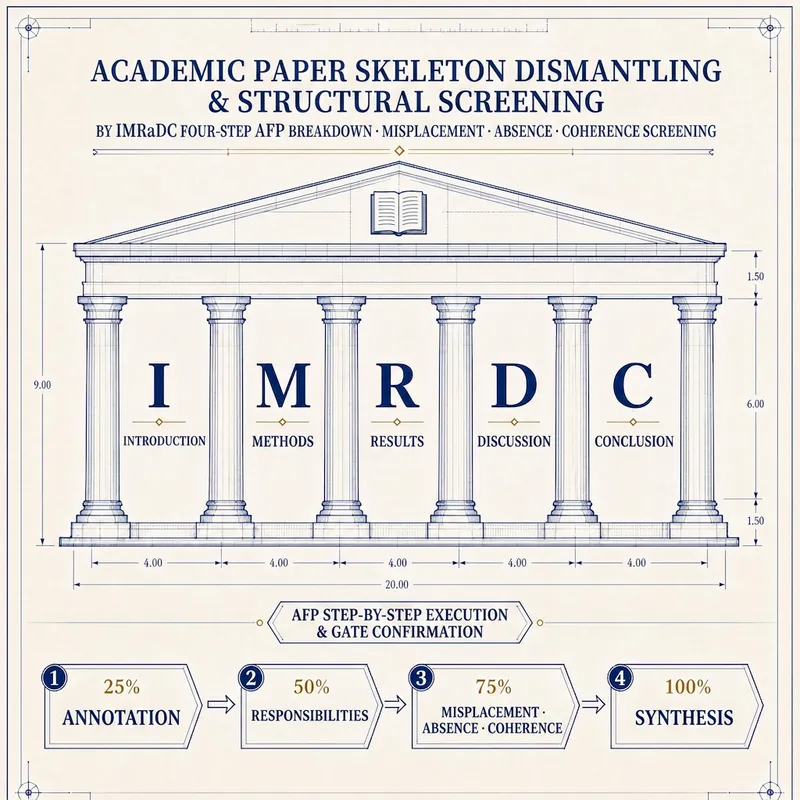
Paper Structure & Scope Audit
Break down the paper using a four-step IMRaDC AFP process: annotate → define each section’s role → check for overreach, gaps, and fit → summarize recommendations. Confirm a gate at each step, track progress at 25/50/75/100%, and produce an actionable checklist for structural revisions. Includes three IMRaDC mappings—quantitative, qualitative, and conceptual—along with standards for identifying gaps and setting priorities, integrating AFP and the underlying logic of IMRaDC.
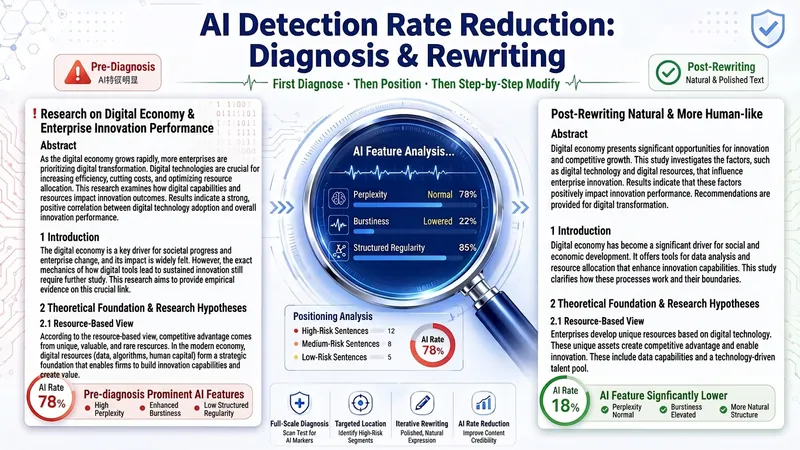
AI Reduction Diagnosis Rewrite
Intelligent assistant for reducing AI-generated content rate in academic papers. AI rate at 80%? Edited to collapse but still red? It won't help you blindly edit—it helps you diagnose, locate, and then modify in steps. Three-dimensional systematic diagnosis (perplexity, burstiness, structural regularity) scans and marks AI fingerprint positions dimension by dimension. Ten types of fingerprints are accurately classified, thirteen sentence restructuring techniques, and twenty high-frequency AI sentence blacklist items are cracked one by one. Risk maps for each chapter provide different treatments for different sections. One-step or step-by-step diagnosis: low-level users modify dimension by dimension, experts modify simultaneously. Supports pasting or uploading files of any length and any level. Outputs a complete diagnosis and rewriting report that is saved automatically. It's not about fooling the detector—it's about making your paper read like it was written by a real researcher with opinions, judgment, and style.
 Write
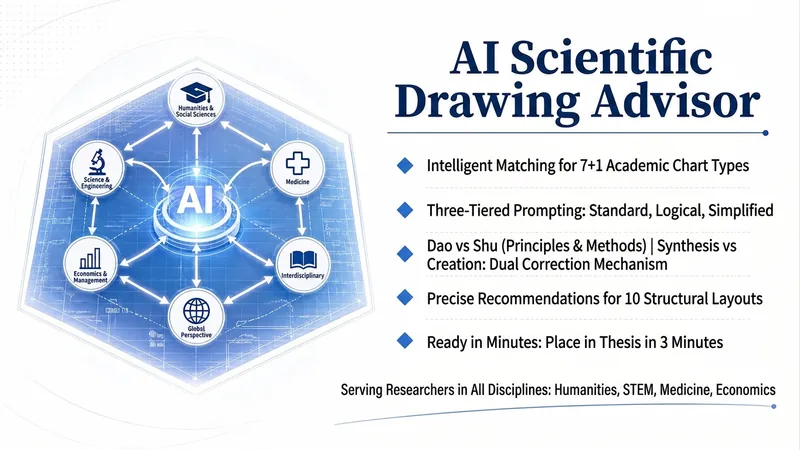
WriteAI Academic Chart Consultant
An AI chart generation consultant designed specifically for academic researchers. Input your research topic or paper paragraph, and it will automatically parse core variables and logical relationships, accurately matching from 7+1 types of academic chart types (content framework diagram, technical roadmap, research approach diagram, theoretical framework diagram, analysis framework diagram, research conclusion diagram, grounded theory model diagram), and then recommend the best solution from 10 structural layouts (linear process, closed-loop cycle, center-radial, matrix quadrant, etc.). Finally, it outputs three tiers of complete prompts: standard balanced, logical emphasis, and visual minimalism. Built-in dual corrections of 'Dao vs Shu' and 'Borrow vs Create' ensure you never confuse a technical roadmap with a research approach diagram.
 Research
Triple Deconstruction: Papers
Using the 'Identify Elements, Subcycles, Macrocycles' triple deconstruction method, automatically or interactively deconstruct the argument skeleton of any academic paper. Includes 14 AI prompt templates, suitable for all academic readers.
 Research
Reverse Onion Search
Enter a topic phrase, and it will automatically break down the structure using the Reverse Onion Method → expand synonym groups → generate four-layer search formulas (CNKI + WoS/Google Scholar), along with an execution checklist and filtering strategies. Suitable for all disciplines; search formulas can be directly copied and used. 🎯 What pain points does it solve? ❌ Entering a full sentence directly in the search box → 0 results ❌ Searching only one keyword → 5000 results, overwhelming ❌ Can't break down the topic → no direction for search terms ✅ Input 'Middle-class educational anxiety and shadow education practices' → outputs 30+ ready-to-paste search formulas + synonym table + layered execution checklist 📐 Core Method: Reverse Onion Method From inside out, from narrow to wide, three layers of progressive expansion – core layer precisely locks in 4 must-read papers, expansion layer finds 48 directly related studies, panoramic layer builds domain volume awareness. 🔧 Output includes: • Three-element topic breakdown (modifier + research unit + research dimension) • 5-8 synonym concepts per element, with Chinese-English pairs, superordinate/subordinate concepts • Layer 1: 8 groups of three-element combined search formulas (title → topic, tight → loose) • Layer 2: 3 types of two-element pairings (annotated core/background usage) • Layer 3: Single-element panoramic search formula • Layer 4: Superordinate concept expansion strategy • 📋 Six-step execution checklist + filtering criteria per layer (highly cited + most recent) 👥 Who is it for? Academic beginners, graduate students, early-career researchers – anyone who needs systematic literature search rather than keyword guessing.
 Write
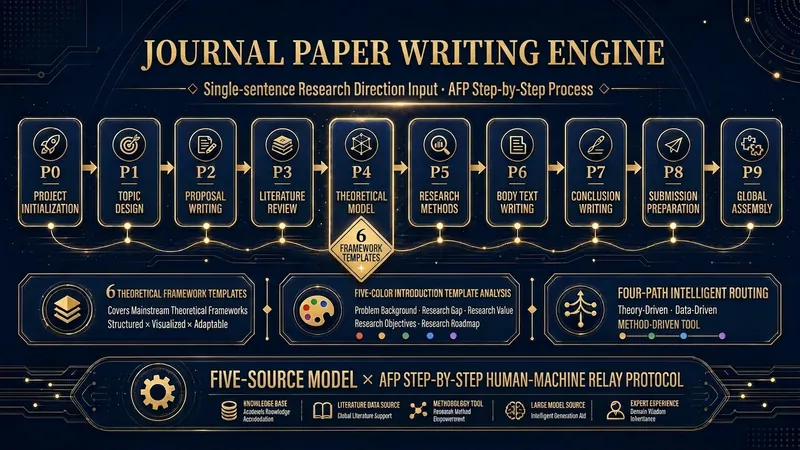
WriteJournal Paper Writing Engine
Input your research direction in one sentence, and the AFP step-by-step engine guides you through the entire process. P1 Topic Design — Davis Interesting Theory + Problematization’s Five-Level Topic Selection Method, extracting real problems from phenomena. P2 Introduction Writing — Five-Color Template Analysis Method, breaking down top journal model papers section by section: emotional appeal → knowledge gap → literature positioning → research space → value declaration, with embedded full deconstruction prompts. P3 Literature Review — Structured organization, distinguishing research threads and dialogue objects. P4 Theoretical Framework — Six theory integration templates embedded throughout (complementary, contrast, bridging, hierarchical, evolutionary, general), each containing six paragraphs: introduction → justification → sorting → premise → analysis → conclusion; plus a five-level deep-drill sentence skeleton for single-theory depth. P5 Research Methods — Automatically adapts strategies based on four paths: empirical quantitative, qualitative, speculative, and mixed. P6 Body Writing — 9-3-1 pyramid structure. P7 Conclusion Writing — Three-level conclusion processing (findings → dialogue → extension). P8 Submission Preparation — Eight methods to reduce AI detection rate. P9 Global Assembly — Compiles independent documents from each stage into a complete draft, supports cross-chapter bidirectional backfill, and allows interruption and iterative backtracking at any time. 🎯 Suitable for: Graduate students (master's and PhD) and early-career researchers aiming to submit to Chinese C-journals, core journals, or SSCI, especially those stuck on theoretical framework and introduction writing. ⚙️ Underlying Architecture: Five-Source Model × AFP Step-by-Step Human-Machine Relay Protocol, with heartbeat signals, mandatory stop points, and dual-core auditing.
Flash: Intro Story Gen(99 pts)
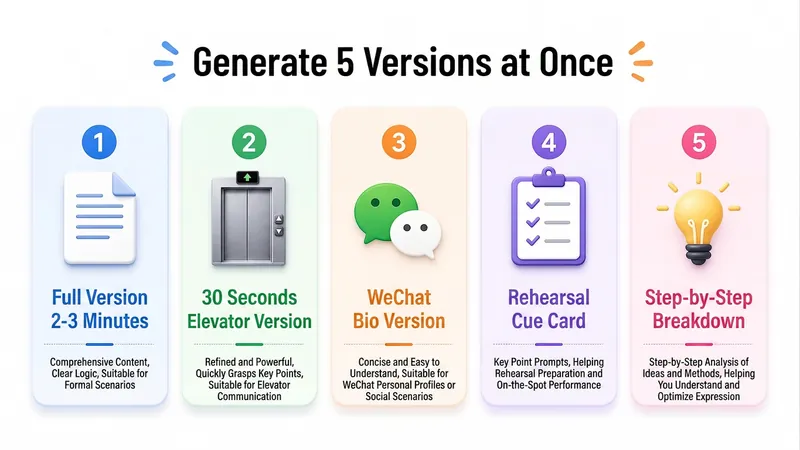
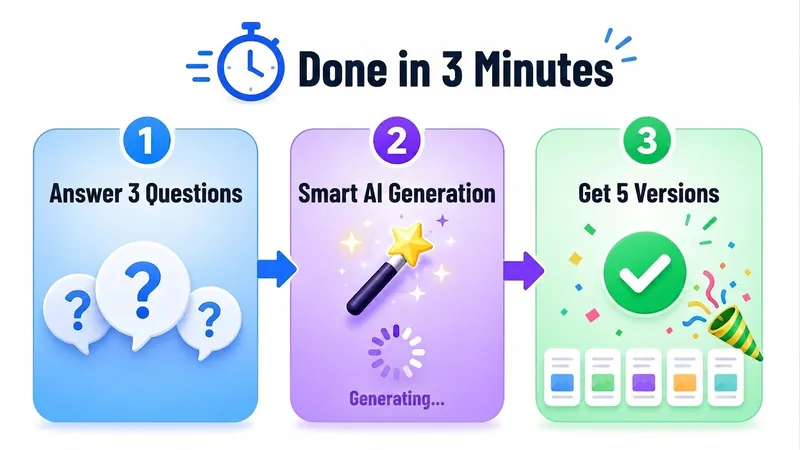
🔥 Flash sale price: 99 points! Original price 299 points Stop reading your resume—let stories make you memorable ✅ Generate 5 versions at once: Full version (3-5 min) + Elevator pitch (30 sec) + WeChat intro + Practice cue card ✅ Done in 3 minutes: Answer 3 questions, automatically match story templates, generate a memorable self-introduction ✅ Professional methodology: Based on narrative psychology, 3 story templates + 4 engagement engines Suitable for: Job interviews, promotion reviews, startup pitches, business networking, industry conferences, blind dates ⚡ Limited flash sale, first come first served!
Story-Based Self-Intro (3 min)
Stop reciting your resume—tell a story to make yourself memorable. ✅ Generate 5 versions at once: Full version (3-5 min) + Elevator pitch (30 sec) + WeChat bio + Practice cue card ✅ Done in 3 minutes: Answer 3 questions, auto-match story templates, generate a memorable self-introduction ✅ Professional methodology: Based on narrative psychology, 3 story templates + 4 engagement engines Suitable for: Job interviews, career change presentations, startup pitches, business networking, industry conferences, dating and social events
 Slides
Courseware to Highlight Video
Upload your courseware documents. The system automatically extracts the key points and generates a narrated explanatory video, suitable for review and quick learning.