
Triple Deconstruction: Papers
Identify Elements · Subcycles · Macrocycles
Description
Why we love this skill
This skill uses a unique "three-element decomposition method" to deeply analyze academic papers, progressing step by step from element identification to large and small cycles. It also features an interactive teaching mode to help you truly understand papers and improve your critical thinking.
Using the 'Identify Elements, Subcycles, Macrocycles' triple deconstruction method, automatically or interactively deconstruct the argument skeleton of any academic paper. Includes 14 AI prompt templates, suitable for all academic readers.
Related Skills
View all Research
Core Academic Paper Deep Dive
Deeply read the academic paper provided by the user. Through a three-stage process of 'paradigm identification → structured deconstruction → template extraction', it produces a comprehensive deconstruction report containing a logical argument map, writing template library, and critical audit comments.
Plain Paper Reading in 3 Steps
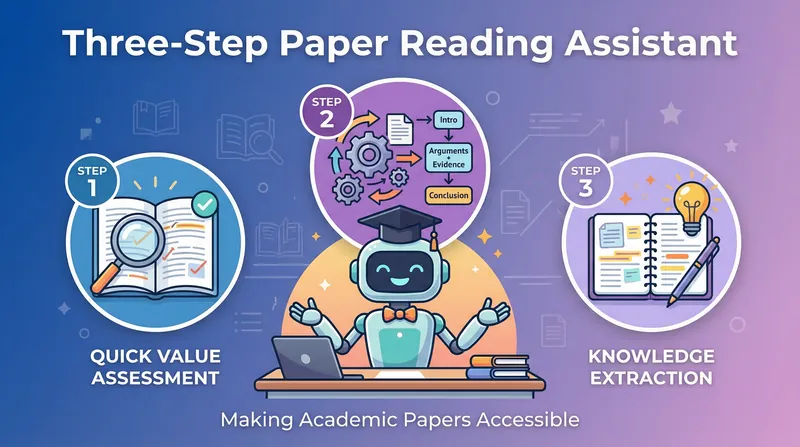
Helps non-experts understand professional papers using a three-step reading method, inspired by the 'three-pass reading technique.' The entire process uses a conversational interface that supports questions at any time, enabling laypeople to read highly specialized academic literature. Step 1: Grasp the core idea to quickly assess the paper's reading value. Step 2: Break down the core argument logic. Step 3: Extract key knowledge points and optionally generate personalized reading notes.
 Write
WriteJournal Paper Writing Engine
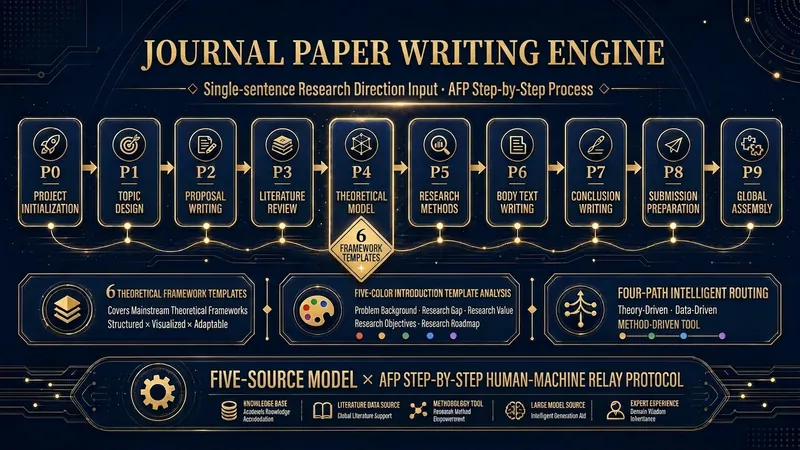
Input your research direction in one sentence, and the AFP step-by-step engine guides you through the entire process. P1 Topic Design — Davis Interesting Theory + Problematization’s Five-Level Topic Selection Method, extracting real problems from phenomena. P2 Introduction Writing — Five-Color Template Analysis Method, breaking down top journal model papers section by section: emotional appeal → knowledge gap → literature positioning → research space → value declaration, with embedded full deconstruction prompts. P3 Literature Review — Structured organization, distinguishing research threads and dialogue objects. P4 Theoretical Framework — Six theory integration templates embedded throughout (complementary, contrast, bridging, hierarchical, evolutionary, general), each containing six paragraphs: introduction → justification → sorting → premise → analysis → conclusion; plus a five-level deep-drill sentence skeleton for single-theory depth. P5 Research Methods — Automatically adapts strategies based on four paths: empirical quantitative, qualitative, speculative, and mixed. P6 Body Writing — 9-3-1 pyramid structure. P7 Conclusion Writing — Three-level conclusion processing (findings → dialogue → extension). P8 Submission Preparation — Eight methods to reduce AI detection rate. P9 Global Assembly — Compiles independent documents from each stage into a complete draft, supports cross-chapter bidirectional backfill, and allows interruption and iterative backtracking at any time. 🎯 Suitable for: Graduate students (master's and PhD) and early-career researchers aiming to submit to Chinese C-journals, core journals, or SSCI, especially those stuck on theoretical framework and introduction writing. ⚙️ Underlying Architecture: Five-Source Model × AFP Step-by-Step Human-Machine Relay Protocol, with heartbeat signals, mandatory stop points, and dual-core auditing.
Triple Deconstruction: Papers
Identify Elements · Subcycles · Macrocycles
Description
Why we love this skill
This skill uses a unique "three-element decomposition method" to deeply analyze academic papers, progressing step by step from element identification to large and small cycles. It also features an interactive teaching mode to help you truly understand papers and improve your critical thinking.
Using the 'Identify Elements, Subcycles, Macrocycles' triple deconstruction method, automatically or interactively deconstruct the argument skeleton of any academic paper. Includes 14 AI prompt templates, suitable for all academic readers.
Related Skills
View allResearchCore Academic Paper Deep Dive
Deeply read the academic paper provided by the user. Through a three-stage process of 'paradigm identification → structured deconstruction → template extraction', it produces a comprehensive deconstruction report containing a logical argument map, writing template library, and critical audit comments.
Plain Paper Reading in 3 Steps
Helps non-experts understand professional papers using a three-step reading method, inspired by the 'three-pass reading technique.' The entire process uses a conversational interface that supports questions at any time, enabling laypeople to read highly specialized academic literature. Step 1: Grasp the core idea to quickly assess the paper's reading value. Step 2: Break down the core argument logic. Step 3: Extract key knowledge points and optionally generate personalized reading notes.
WriteJournal Paper Writing Engine
Input your research direction in one sentence, and the AFP step-by-step engine guides you through the entire process. P1 Topic Design — Davis Interesting Theory + Problematization’s Five-Level Topic Selection Method, extracting real problems from phenomena. P2 Introduction Writing — Five-Color Template Analysis Method, breaking down top journal model papers section by section: emotional appeal → knowledge gap → literature positioning → research space → value declaration, with embedded full deconstruction prompts. P3 Literature Review — Structured organization, distinguishing research threads and dialogue objects. P4 Theoretical Framework — Six theory integration templates embedded throughout (complementary, contrast, bridging, hierarchical, evolutionary, general), each containing six paragraphs: introduction → justification → sorting → premise → analysis → conclusion; plus a five-level deep-drill sentence skeleton for single-theory depth. P5 Research Methods — Automatically adapts strategies based on four paths: empirical quantitative, qualitative, speculative, and mixed. P6 Body Writing — 9-3-1 pyramid structure. P7 Conclusion Writing — Three-level conclusion processing (findings → dialogue → extension). P8 Submission Preparation — Eight methods to reduce AI detection rate. P9 Global Assembly — Compiles independent documents from each stage into a complete draft, supports cross-chapter bidirectional backfill, and allows interruption and iterative backtracking at any time. 🎯 Suitable for: Graduate students (master's and PhD) and early-career researchers aiming to submit to Chinese C-journals, core journals, or SSCI, especially those stuck on theoretical framework and introduction writing. ⚙️ Underlying Architecture: Five-Source Model × AFP Step-by-Step Human-Machine Relay Protocol, with heartbeat signals, mandatory stop points, and dual-core auditing.
Find your next favorite skill
Explore more curated AI skills for research, creation, and everyday work.