
AI Reduction Diagnosis Rewrite
AI reduction: 3D diag. & rewrite. 10/13/20
Description
Intelligent assistant for reducing AI-generated content rate in academic papers. AI rate at 80%? Edited to collapse but still red? It won't help you blindly edit—it helps you diagnose, locate, and then modify in steps. Three-dimensional systematic diagnosis (perplexity, burstiness, structural regularity) scans and marks AI fingerprint positions dimension by dimension. Ten types of fingerprints are accurately classified, thirteen sentence restructuring techniques, and twenty high-frequency AI sentence blacklist items are cracked one by one. Risk maps for each chapter provide different treatments for different sections. One-step or step-by-step diagnosis: low-level users modify dimension by dimension, experts modify simultaneously. Supports pasting or uploading files of any length and any level. Outputs a complete diagnosis and rewriting report that is saved automatically. It's not about fooling the detector—it's about making your paper read like it was written by a real researcher with opinions, judgment, and style.
Related Skills
View all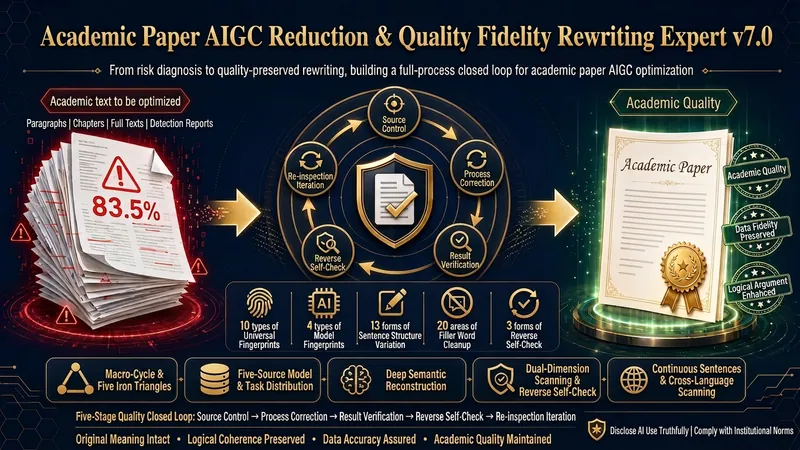 Write
WriteAIGC Reduction & Rewrite v7.0
📚 Academic Paper AIGC Reduction and Quality-Preserving Rewriting Expert v7.0 Designed for graduate students, researchers, and paper authors, this academic text optimization skill operates on a core closed loop of 'source control → process correction → result verification → reverse self-check → iterative re-check'. It systematically diagnoses and optimizes issues such as templated expressions, mechanical logic, vague content, inaccurate terminology, and style inconsistencies while preserving original meaning, technical terms, data, and core conclusions. 🔍📝 🌟 Core Capabilities 🔬 Multi-layer Risk Diagnosis Covers 10 types of universal text fingerprints and assists in identifying common expression patterns of models such as ChatGPT, Claude, DeepSeek, and Wenxin Yiyan. 🧠 Deep Semantic Restructuring Goes beyond synonym replacement to rebuild more natural and in-depth academic reasoning by adjusting proposition expression, information order, argument approach, and evidence organization. ✍️ Quality-Preserving Rewriting Comprehensively applies 13 sentence transformation strategies and 20 methods for cleaning high-frequency templated expressions, improving mechanical sentence structures, repetitive connectors, and overly rigid formatting. 📊 Full-text Structure Diagnosis Through macro-cycle and five key triangles, checks whether research problems, theory, literature review, methods, results, conclusions, and innovation form a complete closed loop. 🧩 Fine-grained Section Adaptation Develops differentiated diagnostic and rewriting strategies for abstract, introduction, literature review, research methods, results, discussion, and conclusion respectively. 🌐 Cross-language Risk Scanning Assists in identifying translationese, passive voice stacking, long sentence nesting, and mixed Chinese-English formatting abnormalities to make Chinese academic expression more natural and accurate. 🔄 Reverse Self-check Loop After rewriting, re-verifies from three aspects: technique distribution, new text fingerprints, and information integrity, to avoid 'becoming more templated' or losing key content. 🛡️ Academic Integrity Protection Does not fabricate literature, data, cases, or policy evidence; separately marks information requiring author verification and reminds users to honestly disclose AI usage. 🎯 Use Cases ✅ Single paragraph or partial section optimization ✅ Targeted modification of marked paragraphs from inspection reports ✅ Polishing of abstract, introduction, literature review, discussion, and conclusion ✅ Full-text AIGC risk feature diagnosis ✅ Language and structure adaptation for target journals ✅ Pre-submission quality review and consistency check 📦 Final Deliverables 📄 Quality-preserving rewritten text 🔎 Risk and issue diagnosis report 🛠️ Rewriting strategy and technique description ✅ Reverse self-check and information integrity report 💡 Items requiring author verification and subsequent revision suggestions 🎓 Original meaning preserved · Logic intact · No fabricated data · Academic quality maintained ⚠️ This skill aims to improve academic expression quality and reduce text risk features. It does not guarantee passage through any specific detection platform or achieving a particular detection score.
Proposal Readiness Checker
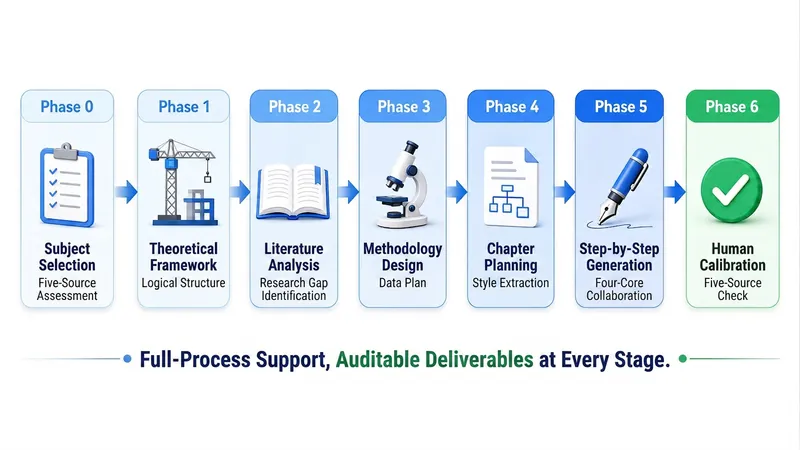
Before you spend dozens of hours writing your thesis, take ten minutes to run a structured checkup. This skill does only one thing: It diagnoses, not writes. It tells you whether your topic can hold up, whether your materials are sufficient, what's missing, where to fill the gaps, and in what order. Then it gives you an actionable missing-material checklist and search queries. It will not write your introduction, literature review, methods, or discussion. Four steps: 1. Discipline diagnosis: Classify your work into 1A Humanities/Arts, 1B Social Sciences, 2A Science/Engineering, or 2B Agriculture/Medicine/Life Sciences, and load the corresponding regulatory red lines; 2B triggers a mandatory ethics review block. 2. Topic checkup: Examine the topic from three dimensions—momentum, shape, and wording—to judge whether the research unit can be operationalized, whether the research question can be answered, and whether the topic has been done to death. 3. Material checkup: Register your existing literature into an M1/M2… material library, verify each entry against the four elements (author/year/title/verifiable locator), and compute the true coverage rate. 4. Gap list and search queries: Specify how many papers of what type are missing and which piece of evidence is lacking, and provide search queries ready to paste into databases (including Boolean keyword combinations, time ranges, and screening criteria). When to use it (trigger phrases): "Help me check my proposal" "Can this topic work?" "Do I have enough literature?" "My proposal was sent back" "I want to confirm before starting to write" — for graduate students who have just set a direction but haven't started writing; for those whose proposal was rejected but don't know why; for those with a pile of literature but unsure if it's enough to begin; for those wanting to confirm whether the topic is worth the investment before committing fully. Deliverables: A Proposal Checkup Report document + a Five-Source Readiness Scorecard (each level has behavioral criteria, not vague scoring) + a prioritized list of missing materials + search queries + an archive code. The archive code is compatible with the Academic Paper Full-Process Writing System v4.0; after the checkup, paste it there to continue writing without re-stating your discipline, topic, or journal. What this skill explicitly does not do: It does not write the main text, generate reference lists, or fabricate authors, years, volumes, issues, pages, or DOIs. Any literature found via online search is flagged with ⚠️ "needs verification" and must be verified by you before use. This skill does not promise any acceptance or passing outcome.

Textbook AI Bypass System 2.0
Core Principles for Reducing AI Detection Rate How AI Detectors Work 1. Perplexity: AI-generated text selects the most probable next word, resulting in low overall perplexity. Human writing chooses more uncommon but fitting words, leading to high perplexity. → Rewriting strategy: S4 Vocabulary destandardization. 2. Burstiness: AI-generated sentences have highly uniform length, resulting in low burstiness. Human writing shows great variation in sentence length, sometimes very short, sometimes very long, leading to high burstiness. → Rewriting strategy: S1 Sentence length mutation injection. 3. Transition word density: AI relies excessively on explicit transition words (e.g., 'furthermore', 'however', 'therefore', 'in conclusion'), with abnormally high density. Humans use more implicit semantic connections. → Rewriting strategy: S2 Template word removal. 4. Structural templating: AI tends to use 'general-specific-general' three-part structure, parallel items of equal length, and 'first-second-last' sequential structure. Human structure is more flexible and varied. → Rewriting strategy: S3 Structure breaking. 5. Lexical diversity (TTR): AI has high word repetition in long texts, resulting in low TTR. Natural human writing has a wider vocabulary range. → Rewriting strategy: S4 Vocabulary destandardization. 6. Information presentation linearity: AI tends to present information in a straightforward logical order with uniform density. Humans use nonlinear techniques such as flashback, interjection, contrast jumps, etc. → Rewriting strategy: S6 Information density reorganization. Special Constraints of Textbook Style • Academic rigor baseline: No internet slang, overly colloquial expressions, or emojis. • Terminology accuracy baseline: Subject-specific terms must remain unchanged; do not replace with inaccurate synonyms. • Logical integrity baseline: The logic of causal relationships, classification systems, and operational steps must not be altered by rewriting. • Citation standard baseline: References, regulations, and standard numbers must not be tampered with. • Teaching suitability baseline: Rewritten text must remain suitable for student comprehension; readability should not be sacrificed for lowering AI detection rate.
AI Reduction Diagnosis Rewrite
AI reduction: 3D diag. & rewrite. 10/13/20
Description
Intelligent assistant for reducing AI-generated content rate in academic papers. AI rate at 80%? Edited to collapse but still red? It won't help you blindly edit—it helps you diagnose, locate, and then modify in steps. Three-dimensional systematic diagnosis (perplexity, burstiness, structural regularity) scans and marks AI fingerprint positions dimension by dimension. Ten types of fingerprints are accurately classified, thirteen sentence restructuring techniques, and twenty high-frequency AI sentence blacklist items are cracked one by one. Risk maps for each chapter provide different treatments for different sections. One-step or step-by-step diagnosis: low-level users modify dimension by dimension, experts modify simultaneously. Supports pasting or uploading files of any length and any level. Outputs a complete diagnosis and rewriting report that is saved automatically. It's not about fooling the detector—it's about making your paper read like it was written by a real researcher with opinions, judgment, and style.
Related Skills
View allWriteAIGC Reduction & Rewrite v7.0
📚 Academic Paper AIGC Reduction and Quality-Preserving Rewriting Expert v7.0 Designed for graduate students, researchers, and paper authors, this academic text optimization skill operates on a core closed loop of 'source control → process correction → result verification → reverse self-check → iterative re-check'. It systematically diagnoses and optimizes issues such as templated expressions, mechanical logic, vague content, inaccurate terminology, and style inconsistencies while preserving original meaning, technical terms, data, and core conclusions. 🔍📝 🌟 Core Capabilities 🔬 Multi-layer Risk Diagnosis Covers 10 types of universal text fingerprints and assists in identifying common expression patterns of models such as ChatGPT, Claude, DeepSeek, and Wenxin Yiyan. 🧠 Deep Semantic Restructuring Goes beyond synonym replacement to rebuild more natural and in-depth academic reasoning by adjusting proposition expression, information order, argument approach, and evidence organization. ✍️ Quality-Preserving Rewriting Comprehensively applies 13 sentence transformation strategies and 20 methods for cleaning high-frequency templated expressions, improving mechanical sentence structures, repetitive connectors, and overly rigid formatting. 📊 Full-text Structure Diagnosis Through macro-cycle and five key triangles, checks whether research problems, theory, literature review, methods, results, conclusions, and innovation form a complete closed loop. 🧩 Fine-grained Section Adaptation Develops differentiated diagnostic and rewriting strategies for abstract, introduction, literature review, research methods, results, discussion, and conclusion respectively. 🌐 Cross-language Risk Scanning Assists in identifying translationese, passive voice stacking, long sentence nesting, and mixed Chinese-English formatting abnormalities to make Chinese academic expression more natural and accurate. 🔄 Reverse Self-check Loop After rewriting, re-verifies from three aspects: technique distribution, new text fingerprints, and information integrity, to avoid 'becoming more templated' or losing key content. 🛡️ Academic Integrity Protection Does not fabricate literature, data, cases, or policy evidence; separately marks information requiring author verification and reminds users to honestly disclose AI usage. 🎯 Use Cases ✅ Single paragraph or partial section optimization ✅ Targeted modification of marked paragraphs from inspection reports ✅ Polishing of abstract, introduction, literature review, discussion, and conclusion ✅ Full-text AIGC risk feature diagnosis ✅ Language and structure adaptation for target journals ✅ Pre-submission quality review and consistency check 📦 Final Deliverables 📄 Quality-preserving rewritten text 🔎 Risk and issue diagnosis report 🛠️ Rewriting strategy and technique description ✅ Reverse self-check and information integrity report 💡 Items requiring author verification and subsequent revision suggestions 🎓 Original meaning preserved · Logic intact · No fabricated data · Academic quality maintained ⚠️ This skill aims to improve academic expression quality and reduce text risk features. It does not guarantee passage through any specific detection platform or achieving a particular detection score.
Proposal Readiness Checker
Before you spend dozens of hours writing your thesis, take ten minutes to run a structured checkup. This skill does only one thing: It diagnoses, not writes. It tells you whether your topic can hold up, whether your materials are sufficient, what's missing, where to fill the gaps, and in what order. Then it gives you an actionable missing-material checklist and search queries. It will not write your introduction, literature review, methods, or discussion. Four steps: 1. Discipline diagnosis: Classify your work into 1A Humanities/Arts, 1B Social Sciences, 2A Science/Engineering, or 2B Agriculture/Medicine/Life Sciences, and load the corresponding regulatory red lines; 2B triggers a mandatory ethics review block. 2. Topic checkup: Examine the topic from three dimensions—momentum, shape, and wording—to judge whether the research unit can be operationalized, whether the research question can be answered, and whether the topic has been done to death. 3. Material checkup: Register your existing literature into an M1/M2… material library, verify each entry against the four elements (author/year/title/verifiable locator), and compute the true coverage rate. 4. Gap list and search queries: Specify how many papers of what type are missing and which piece of evidence is lacking, and provide search queries ready to paste into databases (including Boolean keyword combinations, time ranges, and screening criteria). When to use it (trigger phrases): "Help me check my proposal" "Can this topic work?" "Do I have enough literature?" "My proposal was sent back" "I want to confirm before starting to write" — for graduate students who have just set a direction but haven't started writing; for those whose proposal was rejected but don't know why; for those with a pile of literature but unsure if it's enough to begin; for those wanting to confirm whether the topic is worth the investment before committing fully. Deliverables: A Proposal Checkup Report document + a Five-Source Readiness Scorecard (each level has behavioral criteria, not vague scoring) + a prioritized list of missing materials + search queries + an archive code. The archive code is compatible with the Academic Paper Full-Process Writing System v4.0; after the checkup, paste it there to continue writing without re-stating your discipline, topic, or journal. What this skill explicitly does not do: It does not write the main text, generate reference lists, or fabricate authors, years, volumes, issues, pages, or DOIs. Any literature found via online search is flagged with ⚠️ "needs verification" and must be verified by you before use. This skill does not promise any acceptance or passing outcome.
Textbook AI Bypass System 2.0
Core Principles for Reducing AI Detection Rate How AI Detectors Work 1. Perplexity: AI-generated text selects the most probable next word, resulting in low overall perplexity. Human writing chooses more uncommon but fitting words, leading to high perplexity. → Rewriting strategy: S4 Vocabulary destandardization. 2. Burstiness: AI-generated sentences have highly uniform length, resulting in low burstiness. Human writing shows great variation in sentence length, sometimes very short, sometimes very long, leading to high burstiness. → Rewriting strategy: S1 Sentence length mutation injection. 3. Transition word density: AI relies excessively on explicit transition words (e.g., 'furthermore', 'however', 'therefore', 'in conclusion'), with abnormally high density. Humans use more implicit semantic connections. → Rewriting strategy: S2 Template word removal. 4. Structural templating: AI tends to use 'general-specific-general' three-part structure, parallel items of equal length, and 'first-second-last' sequential structure. Human structure is more flexible and varied. → Rewriting strategy: S3 Structure breaking. 5. Lexical diversity (TTR): AI has high word repetition in long texts, resulting in low TTR. Natural human writing has a wider vocabulary range. → Rewriting strategy: S4 Vocabulary destandardization. 6. Information presentation linearity: AI tends to present information in a straightforward logical order with uniform density. Humans use nonlinear techniques such as flashback, interjection, contrast jumps, etc. → Rewriting strategy: S6 Information density reorganization. Special Constraints of Textbook Style • Academic rigor baseline: No internet slang, overly colloquial expressions, or emojis. • Terminology accuracy baseline: Subject-specific terms must remain unchanged; do not replace with inaccurate synonyms. • Logical integrity baseline: The logic of causal relationships, classification systems, and operational steps must not be altered by rewriting. • Citation standard baseline: References, regulations, and standard numbers must not be tampered with. • Teaching suitability baseline: Rewritten text must remain suitable for student comprehension; readability should not be sacrificed for lowering AI detection rate.
Find your next favorite skill
Explore more curated AI skills for research, creation, and everyday work.