
Textbook AI Bypass System 2.0
打破AI 检测工具的核心识别逻辑,识别机械编号,保留术语、教学特点,并配图
Description
Core Principles for Reducing AI Detection Rate How AI Detectors Work 1. Perplexity: AI-generated text selects the most probable next word, resulting in low overall perplexity. Human writing chooses more uncommon but fitting words, leading to high perplexity. → Rewriting strategy: S4 Vocabulary destandardization. 2. Burstiness: AI-generated sentences have highly uniform length, resulting in low burstiness. Human writing shows great variation in sentence length, sometimes very short, sometimes very long, leading to high burstiness. → Rewriting strategy: S1 Sentence length mutation injection. 3. Transition word density: AI relies excessively on explicit transition words (e.g., 'furthermore', 'however', 'therefore', 'in conclusion'), with abnormally high density. Humans use more implicit semantic connections. → Rewriting strategy: S2 Template word removal. 4. Structural templating: AI tends to use 'general-specific-general' three-part structure, parallel items of equal length, and 'first-second-last' sequential structure. Human structure is more flexible and varied. → Rewriting strategy: S3 Structure breaking. 5. Lexical diversity (TTR): AI has high word repetition in long texts, resulting in low TTR. Natural human writing has a wider vocabulary range. → Rewriting strategy: S4 Vocabulary destandardization. 6. Information presentation linearity: AI tends to present information in a straightforward logical order with uniform density. Humans use nonlinear techniques such as flashback, interjection, contrast jumps, etc. → Rewriting strategy: S6 Information density reorganization. Special Constraints of Textbook Style • Academic rigor baseline: No internet slang, overly colloquial expressions, or emojis. • Terminology accuracy baseline: Subject-specific terms must remain unchanged; do not replace with inaccurate synonyms. • Logical integrity baseline: The logic of causal relationships, classification systems, and operational steps must not be altered by rewriting. • Citation standard baseline: References, regulations, and standard numbers must not be tampered with. • Teaching suitability baseline: Rewritten text must remain suitable for student comprehension; readability should not be sacrificed for lowering AI detection rate.
Related Skills
View all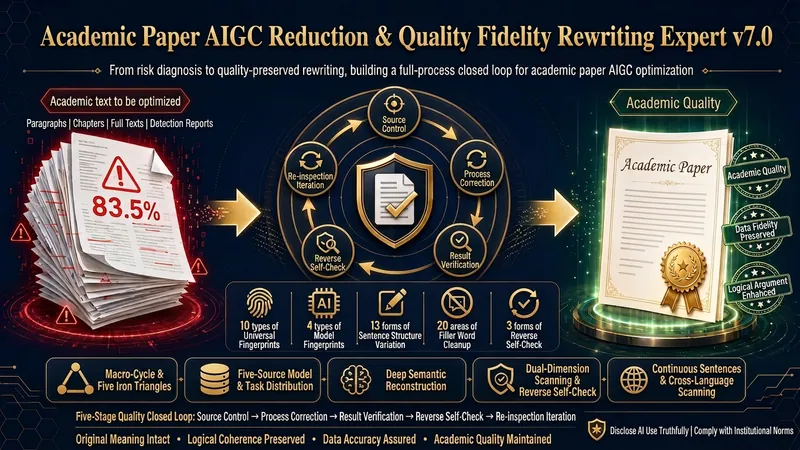 Write
WriteAIGC Reduction & Rewrite v7.0
📚 Academic Paper AIGC Reduction and Quality-Preserving Rewriting Expert v7.0 Designed for graduate students, researchers, and paper authors, this academic text optimization skill operates on a core closed loop of 'source control → process correction → result verification → reverse self-check → iterative re-check'. It systematically diagnoses and optimizes issues such as templated expressions, mechanical logic, vague content, inaccurate terminology, and style inconsistencies while preserving original meaning, technical terms, data, and core conclusions. 🔍📝 🌟 Core Capabilities 🔬 Multi-layer Risk Diagnosis Covers 10 types of universal text fingerprints and assists in identifying common expression patterns of models such as ChatGPT, Claude, DeepSeek, and Wenxin Yiyan. 🧠 Deep Semantic Restructuring Goes beyond synonym replacement to rebuild more natural and in-depth academic reasoning by adjusting proposition expression, information order, argument approach, and evidence organization. ✍️ Quality-Preserving Rewriting Comprehensively applies 13 sentence transformation strategies and 20 methods for cleaning high-frequency templated expressions, improving mechanical sentence structures, repetitive connectors, and overly rigid formatting. 📊 Full-text Structure Diagnosis Through macro-cycle and five key triangles, checks whether research problems, theory, literature review, methods, results, conclusions, and innovation form a complete closed loop. 🧩 Fine-grained Section Adaptation Develops differentiated diagnostic and rewriting strategies for abstract, introduction, literature review, research methods, results, discussion, and conclusion respectively. 🌐 Cross-language Risk Scanning Assists in identifying translationese, passive voice stacking, long sentence nesting, and mixed Chinese-English formatting abnormalities to make Chinese academic expression more natural and accurate. 🔄 Reverse Self-check Loop After rewriting, re-verifies from three aspects: technique distribution, new text fingerprints, and information integrity, to avoid 'becoming more templated' or losing key content. 🛡️ Academic Integrity Protection Does not fabricate literature, data, cases, or policy evidence; separately marks information requiring author verification and reminds users to honestly disclose AI usage. 🎯 Use Cases ✅ Single paragraph or partial section optimization ✅ Targeted modification of marked paragraphs from inspection reports ✅ Polishing of abstract, introduction, literature review, discussion, and conclusion ✅ Full-text AIGC risk feature diagnosis ✅ Language and structure adaptation for target journals ✅ Pre-submission quality review and consistency check 📦 Final Deliverables 📄 Quality-preserving rewritten text 🔎 Risk and issue diagnosis report 🛠️ Rewriting strategy and technique description ✅ Reverse self-check and information integrity report 💡 Items requiring author verification and subsequent revision suggestions 🎓 Original meaning preserved · Logic intact · No fabricated data · Academic quality maintained ⚠️ This skill aims to improve academic expression quality and reduce text risk features. It does not guarantee passage through any specific detection platform or achieving a particular detection score.
AI Reduction Diagnosis Rewrite
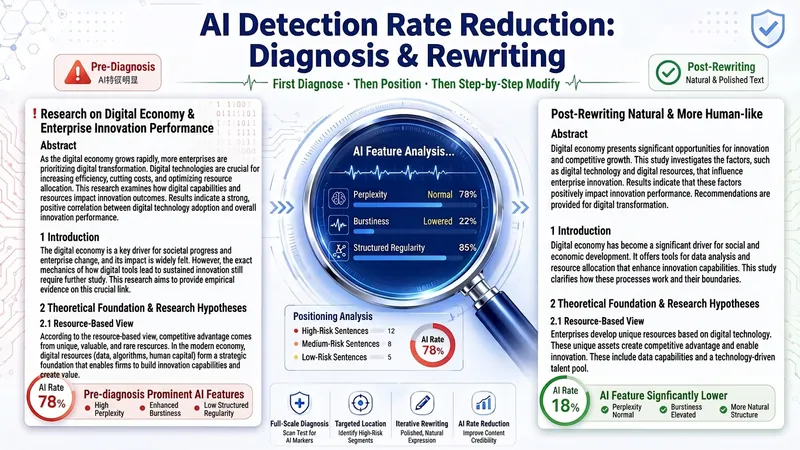
Intelligent assistant for reducing AI-generated content rate in academic papers. AI rate at 80%? Edited to collapse but still red? It won't help you blindly edit—it helps you diagnose, locate, and then modify in steps. Three-dimensional systematic diagnosis (perplexity, burstiness, structural regularity) scans and marks AI fingerprint positions dimension by dimension. Ten types of fingerprints are accurately classified, thirteen sentence restructuring techniques, and twenty high-frequency AI sentence blacklist items are cracked one by one. Risk maps for each chapter provide different treatments for different sections. One-step or step-by-step diagnosis: low-level users modify dimension by dimension, experts modify simultaneously. Supports pasting or uploading files of any length and any level. Outputs a complete diagnosis and rewriting report that is saved automatically. It's not about fooling the detector—it's about making your paper read like it was written by a real researcher with opinions, judgment, and style.

AI Writing Naturalizer
Remove signs of AI-generated writing. Use it to edit or review text so it sounds more natural and human-written. Based on Wikipedia’s comprehensive guide to “Signs of AI writing.” Detect and fix the following patterns: exaggerated symbolism, promotional language, shallow -ing analysis, vague attribution, overuse of em dashes, the rule of three, AI vocabulary, negative parallelism, and excessive connective phrases.
Textbook AI Bypass System 2.0
打破AI 检测工具的核心识别逻辑,识别机械编号,保留术语、教学特点,并配图
Description
Core Principles for Reducing AI Detection Rate How AI Detectors Work 1. Perplexity: AI-generated text selects the most probable next word, resulting in low overall perplexity. Human writing chooses more uncommon but fitting words, leading to high perplexity. → Rewriting strategy: S4 Vocabulary destandardization. 2. Burstiness: AI-generated sentences have highly uniform length, resulting in low burstiness. Human writing shows great variation in sentence length, sometimes very short, sometimes very long, leading to high burstiness. → Rewriting strategy: S1 Sentence length mutation injection. 3. Transition word density: AI relies excessively on explicit transition words (e.g., 'furthermore', 'however', 'therefore', 'in conclusion'), with abnormally high density. Humans use more implicit semantic connections. → Rewriting strategy: S2 Template word removal. 4. Structural templating: AI tends to use 'general-specific-general' three-part structure, parallel items of equal length, and 'first-second-last' sequential structure. Human structure is more flexible and varied. → Rewriting strategy: S3 Structure breaking. 5. Lexical diversity (TTR): AI has high word repetition in long texts, resulting in low TTR. Natural human writing has a wider vocabulary range. → Rewriting strategy: S4 Vocabulary destandardization. 6. Information presentation linearity: AI tends to present information in a straightforward logical order with uniform density. Humans use nonlinear techniques such as flashback, interjection, contrast jumps, etc. → Rewriting strategy: S6 Information density reorganization. Special Constraints of Textbook Style • Academic rigor baseline: No internet slang, overly colloquial expressions, or emojis. • Terminology accuracy baseline: Subject-specific terms must remain unchanged; do not replace with inaccurate synonyms. • Logical integrity baseline: The logic of causal relationships, classification systems, and operational steps must not be altered by rewriting. • Citation standard baseline: References, regulations, and standard numbers must not be tampered with. • Teaching suitability baseline: Rewritten text must remain suitable for student comprehension; readability should not be sacrificed for lowering AI detection rate.
Related Skills
View allWriteAIGC Reduction & Rewrite v7.0
📚 Academic Paper AIGC Reduction and Quality-Preserving Rewriting Expert v7.0 Designed for graduate students, researchers, and paper authors, this academic text optimization skill operates on a core closed loop of 'source control → process correction → result verification → reverse self-check → iterative re-check'. It systematically diagnoses and optimizes issues such as templated expressions, mechanical logic, vague content, inaccurate terminology, and style inconsistencies while preserving original meaning, technical terms, data, and core conclusions. 🔍📝 🌟 Core Capabilities 🔬 Multi-layer Risk Diagnosis Covers 10 types of universal text fingerprints and assists in identifying common expression patterns of models such as ChatGPT, Claude, DeepSeek, and Wenxin Yiyan. 🧠 Deep Semantic Restructuring Goes beyond synonym replacement to rebuild more natural and in-depth academic reasoning by adjusting proposition expression, information order, argument approach, and evidence organization. ✍️ Quality-Preserving Rewriting Comprehensively applies 13 sentence transformation strategies and 20 methods for cleaning high-frequency templated expressions, improving mechanical sentence structures, repetitive connectors, and overly rigid formatting. 📊 Full-text Structure Diagnosis Through macro-cycle and five key triangles, checks whether research problems, theory, literature review, methods, results, conclusions, and innovation form a complete closed loop. 🧩 Fine-grained Section Adaptation Develops differentiated diagnostic and rewriting strategies for abstract, introduction, literature review, research methods, results, discussion, and conclusion respectively. 🌐 Cross-language Risk Scanning Assists in identifying translationese, passive voice stacking, long sentence nesting, and mixed Chinese-English formatting abnormalities to make Chinese academic expression more natural and accurate. 🔄 Reverse Self-check Loop After rewriting, re-verifies from three aspects: technique distribution, new text fingerprints, and information integrity, to avoid 'becoming more templated' or losing key content. 🛡️ Academic Integrity Protection Does not fabricate literature, data, cases, or policy evidence; separately marks information requiring author verification and reminds users to honestly disclose AI usage. 🎯 Use Cases ✅ Single paragraph or partial section optimization ✅ Targeted modification of marked paragraphs from inspection reports ✅ Polishing of abstract, introduction, literature review, discussion, and conclusion ✅ Full-text AIGC risk feature diagnosis ✅ Language and structure adaptation for target journals ✅ Pre-submission quality review and consistency check 📦 Final Deliverables 📄 Quality-preserving rewritten text 🔎 Risk and issue diagnosis report 🛠️ Rewriting strategy and technique description ✅ Reverse self-check and information integrity report 💡 Items requiring author verification and subsequent revision suggestions 🎓 Original meaning preserved · Logic intact · No fabricated data · Academic quality maintained ⚠️ This skill aims to improve academic expression quality and reduce text risk features. It does not guarantee passage through any specific detection platform or achieving a particular detection score.
AI Reduction Diagnosis Rewrite
Intelligent assistant for reducing AI-generated content rate in academic papers. AI rate at 80%? Edited to collapse but still red? It won't help you blindly edit—it helps you diagnose, locate, and then modify in steps. Three-dimensional systematic diagnosis (perplexity, burstiness, structural regularity) scans and marks AI fingerprint positions dimension by dimension. Ten types of fingerprints are accurately classified, thirteen sentence restructuring techniques, and twenty high-frequency AI sentence blacklist items are cracked one by one. Risk maps for each chapter provide different treatments for different sections. One-step or step-by-step diagnosis: low-level users modify dimension by dimension, experts modify simultaneously. Supports pasting or uploading files of any length and any level. Outputs a complete diagnosis and rewriting report that is saved automatically. It's not about fooling the detector—it's about making your paper read like it was written by a real researcher with opinions, judgment, and style.
AI Writing Naturalizer
Remove signs of AI-generated writing. Use it to edit or review text so it sounds more natural and human-written. Based on Wikipedia’s comprehensive guide to “Signs of AI writing.” Detect and fix the following patterns: exaggerated symbolism, promotional language, shallow -ing analysis, vague attribution, overuse of em dashes, the rule of three, AI vocabulary, negative parallelism, and excessive connective phrases.
Find your next favorite skill
Explore more curated AI skills for research, creation, and everyday work.