SKILLS Refinement Workshop
Description
Seven processes, one closed loop. SkillForge Refinement Workshop transforms the gstack engineering sprint methodology open-sourced by YC leader Garry Tan into a full lifecycle management system for Claude Code Skills. From six soul-searching questions to verify demand authenticity, to architecture planning, SKILL.md forging, quality review, eval testing, release packaging, and finally review and iteration—each stage has dedicated AI roles, with confidence scores and anti-spam mechanisms. It also includes two additional processes: emergency diagnosis and security audit. No 'good ideas,' only evidence-based judgments. Every skill is tempered through seven processes.
Related Skills
View all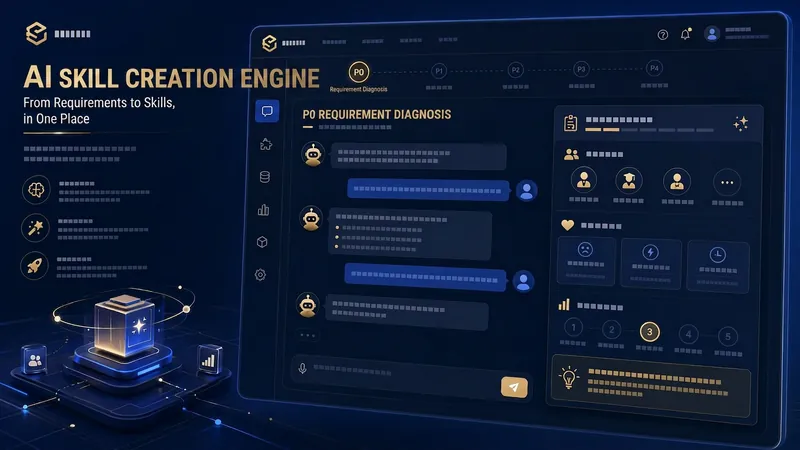
AFP .skill Forging Engine v4
> Turn a one-sentence idea into an AFP skill people actually want to install—full-process forging. 🌍 Niche reconnaissance — scan similar skills before starting (GitHub, ClawHub, skill market), benchmark horizontally and vertically to find real differentiation. No niche statement, no start. 🧬 Three-layer nested architecture — governance, cognitive, and execution layers separate skeleton from flesh; four-quadrant admission judgment, actively discourage forbidden zones, don't overspec simple tasks. 🔬 Dual-core adversarial audit — A-core builds + B-core dismantles, 9-dimension scoring matrix (including release readiness), ratchet lock ensures scores only increase, single-variable control prevents disorder from over-editing. 📦 Full asset packaging for listing — naming formula + subtitle + icon + golden description structure + 3 intro images + 4-channel promotion copy + 15-item listing checklist + direct callApi creation. After opening, just tell it what you want to do (e.g., 'Turn my writing method into a skill,' 'Optimize my existing XX skill,' 'Upgrade the old AFP to 3.1'). The engine will guide you from niche reconnaissance all the way to packaging for listing. Each phase has deliverables, quality gates, and stop points. > v3.1 meta-architecture refactoring: replaced the old five-stage process with a three-layer nested skeleton, added niche reconnaissance and horizontal/vertical competitor benchmarking, 9-dimension audit matrix and ratchet mechanism, cross-conversation state persistence, and fully retained full-asset packaging capability.
Skill Quality Audit (PDCA-QMS)
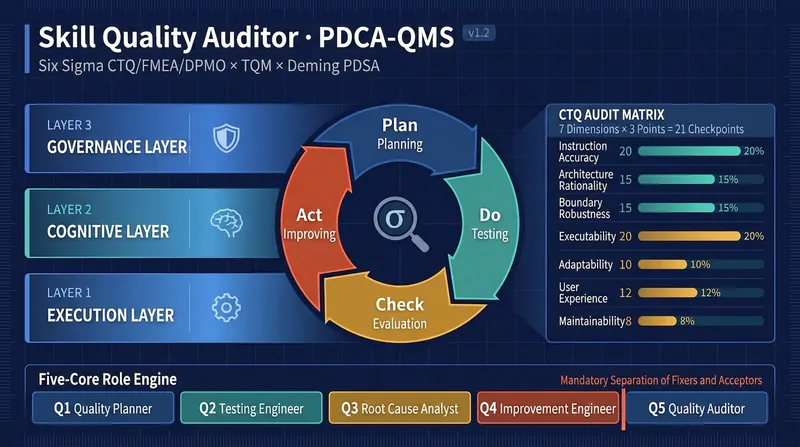
Evaluate Skills using a quality management system based on management science, not an off-the-cuff checklist. Based on Six Sigma CTQ/FMEA/DPMO × TQM × Deming PDSA cycle, through the Plan-Do-Check-Act four phases, it provides: a quality scorecard with Sigma level, a defect priority table ranked by RPN, root cause analysis down to the instruction design layer, and the full Skill text after Poka-Yoke correction. The fixer and reviewer are forcibly separated, and scores only increase, never decrease. v2.0 additions: ① Quantitative contract – closed enumeration of structural unit counting (only phase level), K-value gradient anti-scoring lock, Sigma table lookup with log axis interpolation, and full zero-padding to prevent division by zero, ensuring scores are reproducible and undistorted; ② Quality level × disposal path dual-axis gate, eliminating the contradiction of 'unqualified but recommended for release' labels; ③ Diagnostic mode – say 'only a report' or 'don't modify yet', then run through P-D-C and stop at Check, without modifying your script; ④ Output contract – pass/fail points fold, evidence limited to 50 characters, phase word count limits, values must include calculation process. When to use: evaluate whether a Skill is good, diagnose why its output is unstable, systematically optimize an existing Skill, benchmark multiple Skills, pre-release quality inspection of Skill drafts, or only want a diagnostic report without modifying the draft. Trigger words: detect skill quality, skill quality check, quality audit, rate a skill, PDCA optimize skill, skill health check, evaluate this skill, skill defect analysis, diagnose only without repair, pre-release skill quality check, skill benchmarking.
Skill Designer
Can't write a Skill? Just describe it in a sentence. Skill Designer is a 'Skill that teaches you to write Skills' — it uses a 7-layer meta-framework (Intent Definition → Input Classification → Workflow Design → Tool Strategy → Output Specification → Constraints and Boundaries → Composability & Testing) to turn your vague idea into a well-structured, immediately executable YouMind Skill. It supports two paths: Design from Scratch (describe your idea, it automatically asks for missing info, runs through the 7 layers, and directly creates the Skill) and Review & Improve (send an existing Skill draft, and it diagnoses issues layer by layer with improvement suggestions). When information is insufficient, it asks follow-up questions and offers choices rather than open-ended questions, reducing the effort to respond. Finally, it directly calls createSkill to create a usable Skill, no manual instruction writing needed. Ideal for creators who want to turn their experience into skills but don't know where to start.
SKILLS Refinement Workshop
Description
Seven processes, one closed loop. SkillForge Refinement Workshop transforms the gstack engineering sprint methodology open-sourced by YC leader Garry Tan into a full lifecycle management system for Claude Code Skills. From six soul-searching questions to verify demand authenticity, to architecture planning, SKILL.md forging, quality review, eval testing, release packaging, and finally review and iteration—each stage has dedicated AI roles, with confidence scores and anti-spam mechanisms. It also includes two additional processes: emergency diagnosis and security audit. No 'good ideas,' only evidence-based judgments. Every skill is tempered through seven processes.
Related Skills
View allAFP .skill Forging Engine v4
> Turn a one-sentence idea into an AFP skill people actually want to install—full-process forging. 🌍 Niche reconnaissance — scan similar skills before starting (GitHub, ClawHub, skill market), benchmark horizontally and vertically to find real differentiation. No niche statement, no start. 🧬 Three-layer nested architecture — governance, cognitive, and execution layers separate skeleton from flesh; four-quadrant admission judgment, actively discourage forbidden zones, don't overspec simple tasks. 🔬 Dual-core adversarial audit — A-core builds + B-core dismantles, 9-dimension scoring matrix (including release readiness), ratchet lock ensures scores only increase, single-variable control prevents disorder from over-editing. 📦 Full asset packaging for listing — naming formula + subtitle + icon + golden description structure + 3 intro images + 4-channel promotion copy + 15-item listing checklist + direct callApi creation. After opening, just tell it what you want to do (e.g., 'Turn my writing method into a skill,' 'Optimize my existing XX skill,' 'Upgrade the old AFP to 3.1'). The engine will guide you from niche reconnaissance all the way to packaging for listing. Each phase has deliverables, quality gates, and stop points. > v3.1 meta-architecture refactoring: replaced the old five-stage process with a three-layer nested skeleton, added niche reconnaissance and horizontal/vertical competitor benchmarking, 9-dimension audit matrix and ratchet mechanism, cross-conversation state persistence, and fully retained full-asset packaging capability.
Skill Quality Audit (PDCA-QMS)
Evaluate Skills using a quality management system based on management science, not an off-the-cuff checklist. Based on Six Sigma CTQ/FMEA/DPMO × TQM × Deming PDSA cycle, through the Plan-Do-Check-Act four phases, it provides: a quality scorecard with Sigma level, a defect priority table ranked by RPN, root cause analysis down to the instruction design layer, and the full Skill text after Poka-Yoke correction. The fixer and reviewer are forcibly separated, and scores only increase, never decrease. v2.0 additions: ① Quantitative contract – closed enumeration of structural unit counting (only phase level), K-value gradient anti-scoring lock, Sigma table lookup with log axis interpolation, and full zero-padding to prevent division by zero, ensuring scores are reproducible and undistorted; ② Quality level × disposal path dual-axis gate, eliminating the contradiction of 'unqualified but recommended for release' labels; ③ Diagnostic mode – say 'only a report' or 'don't modify yet', then run through P-D-C and stop at Check, without modifying your script; ④ Output contract – pass/fail points fold, evidence limited to 50 characters, phase word count limits, values must include calculation process. When to use: evaluate whether a Skill is good, diagnose why its output is unstable, systematically optimize an existing Skill, benchmark multiple Skills, pre-release quality inspection of Skill drafts, or only want a diagnostic report without modifying the draft. Trigger words: detect skill quality, skill quality check, quality audit, rate a skill, PDCA optimize skill, skill health check, evaluate this skill, skill defect analysis, diagnose only without repair, pre-release skill quality check, skill benchmarking.
Skill Designer
Can't write a Skill? Just describe it in a sentence. Skill Designer is a 'Skill that teaches you to write Skills' — it uses a 7-layer meta-framework (Intent Definition → Input Classification → Workflow Design → Tool Strategy → Output Specification → Constraints and Boundaries → Composability & Testing) to turn your vague idea into a well-structured, immediately executable YouMind Skill. It supports two paths: Design from Scratch (describe your idea, it automatically asks for missing info, runs through the 7 layers, and directly creates the Skill) and Review & Improve (send an existing Skill draft, and it diagnoses issues layer by layer with improvement suggestions). When information is insufficient, it asks follow-up questions and offers choices rather than open-ended questions, reducing the effort to respond. Finally, it directly calls createSkill to create a usable Skill, no manual instruction writing needed. Ideal for creators who want to turn their experience into skills but don't know where to start.
Find your next favorite skill
Explore more curated AI skills for research, creation, and everyday work.