
Course Values Case Assistant
Find, refine, and submit teaching cases
Course Values Case Assistant
Find, refine, and submit teaching cases
Showcase
Description
I. Core functions This is a professional case design tool for vocational college teachers, course leaders, and teaching teams. It focuses on developing and optimizing cases in course values education. II. What it can do 1. Case writing: Write a complete course values education case from scratch 2. Case revision: Polish, optimize, and improve existing cases 3. Case diagnosis: Identify issues in existing cases and uncover weak points in the integration of course values education 4. Case review: Evaluate case quality from a professional perspective 5. Evidence-chain design: Design the supporting evidence materials required for a case 6. Supplementary-material design: Generate charts, appendices, and other supporting materials related to the case III. When to use it 1. You need to write a course values education teaching case 2. You want to add greater depth of course values education to an existing teaching case 3. You are unsure about the quality of a case and want help diagnosing its issues 4. You need to prepare application materials for a case competition 5. You need supporting evidence and supplementary materials for a case
Related Skills
View all
Political Theory Course Design
A teaching design framework for college ideological and political theory instructors. Enter a course name, teaching topic or chapter, and number of class periods, with optional student profile and textbook edition, to generate a complete lesson-period teaching design document ready for preparation. It includes textbook logic and student profile analysis; knowledge, ability, and values-based objectives; key points and difficult points; a five-level progressive question chain; teaching stages and activity or case designs covering introduction, inquiry, analysis, synthesis, and summary; an integrated goals–activities–assessment plan; plus a slide outline, board plan, pre- and post-class assignments, and extension suggestions. Methodologically, it follows the “Eight Integrations” principle for ideological and political theory courses and covers major undergraduate courses, including Basic Principles of Marxism; Introduction to Mao Zedong Thought and the Theoretical System of Socialism with Chinese Characteristics; Outline of Modern Chinese History; Ideological, Moral, and Legal Education; Current Affairs and Policies; and Introduction to Xi Jinping Thought on Socialism with Chinese Characteristics for a New Era. This Skill provides only a framework for teaching design and activity methods. It does not generate positions, viewpoints, or political commentary inconsistent with the textbooks. Teachers are responsible for reviewing all case materials and value conclusions against Marxist Project and unified textbooks.
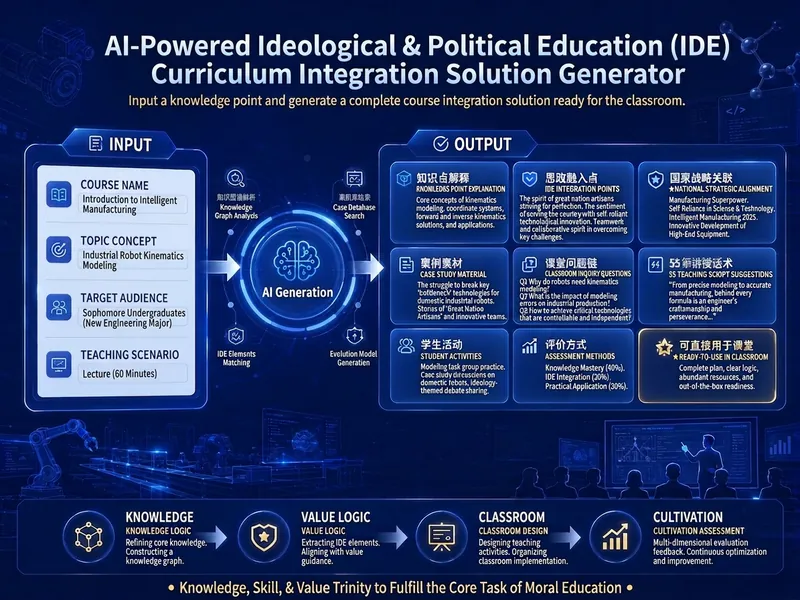
Ideological-Political Plan Generator
Enter the course name and professional knowledge points to automatically generate a complete new engineering curriculum ideological-political integration plan directly usable for lesson plans, PPTs, and classroom teaching. Applicable to professional courses such as smart manufacturing, smart materials, mechanical engineering, automation, computer science, artificial intelligence, electrical control, materials science, etc. Supports output of knowledge point explanation, ideological-political entry points, national strategy connections, case materials, classroom question chains, teacher lecture scripts, student activities, and three-dimensional evaluation methods. Before formal use, you can try the free version “新工科课程思政灵感生成器”. This tool is designed by an associate professor from the School of Marxism of an engineering university, based on practical experience in guiding the construction of curriculum ideological-political education in engineering colleges of the same university, emphasizing the natural integration of professional knowledge and value guidance.

HE Document Write&Review v3.0
🎯 Got your application rejected? Can't find the highlight for your proposal? Don't know where to start with review comments? Three real scenarios: 🔸 Scenario 1: Application season anxiety—Reviewer feedback: "Insufficient theoretical support, vague policy basis." Unsure which documents to cite or which theoretical framework to use. 🔸 Scenario 2: Proposal writing dilemma—In charge of course construction plan: objectives, tasks, pathways, evaluation… each part needs writing, but you feel the logic is not rigorous enough and worry about being questioned on "feasibility" during review. 🔸 Scenario 3: Review dilemma—Need to write peer review comments: must point out issues while maintaining professionalism, be well-founded but not too harsh. How to strike the balance? 💡 What can this system do for you? Not just give advice—it writes, revises, and reviews for you directly. 📝 Writing Mode: From topic to final document Enter your topic and existing materials. The system automatically identifies the document type (application/proposal/report/review). Automatically matches authoritative policy documents and theoretical support. Generates content chapter by chapter, each with evidence, logic, and facts. Key promise: Never fabricates data; clearly tells you what's missing. 🔍 Review Mode: Expert-level diagnosis Upload your text. Professional scoring across 7 dimensions (value, alignment, completeness, innovation, feasibility, support, expression quality). Precisely identifies problem areas. Provides specific revision suggestions + example rewrites. Not general advice, but paragraph-level specific guidance. ✏️ Revision Optimization Mode: Precision enhancement Strengthens arguments based on existing text. Optimizes expression, eliminates empty talk and clichés. Standardizes terminology and logic. Improves overall competitiveness. ⚡ Three Core Mechanisms (Unique) 🛡️ Firewall Mechanism Built-in "fact boundary": User-provided real data is never fabricated; policy basis must have sources; theoretical support cannot be misapplied. Every sentence you see can be traced back to its source. 🔄 Multi-core Adversarial Engine One core writes, another specifically checks for errors. Like having a strict auditor watching, ensuring no "unsubstantiated facts," "logic gaps," or "policy mismatches" occur. 📊 Stepwise Guidance Doesn't ask you 20 questions at once—identifies the most critical gaps and asks only the 3–5 most necessary questions. After each stage, clearly tells you "what's done," "what's missing," and "what to do next." 🎯 Scope of Application (All Higher Education Scenarios) ✅ Teaching achievement award applications (institutional/provincial/national) ✅ Quality engineering project applications (top courses/teaching teams/textbooks, etc.) ✅ Course construction plans, major construction plans ✅ Major self-assessment reports, course acceptance reports ✅ Expert review comments, peer reviews ✅ Education reform project applications, closing reports 🚀 User Experience Writing an application from scratch: Provide the topic and basic materials → System identifies document type, takes inventory, matches policies and theories → Generates outline → Writes chapter by chapter → Consolidates → Get a draft in 1 hour. Reviewing existing text: Upload document → System automatically scores → Lists main issues → Provides revision suggestions and example rewrites → Get review report in 20 minutes. Optimizing existing plan: Provide existing text and optimization direction → System diagnoses weaknesses → Strengthens arguments, optimizes expression → Get optimized version in 30 minutes. 👉 Try it now—make higher education document writing no longer a burden. This is not just a writing assistant; it's an intelligent engine that understands higher education rules, review standards, and professional expression.
Information
- Version
- v3
- Last updated
- Runtime credits
- Usage-based
- Models
- Auto
