xin Dai
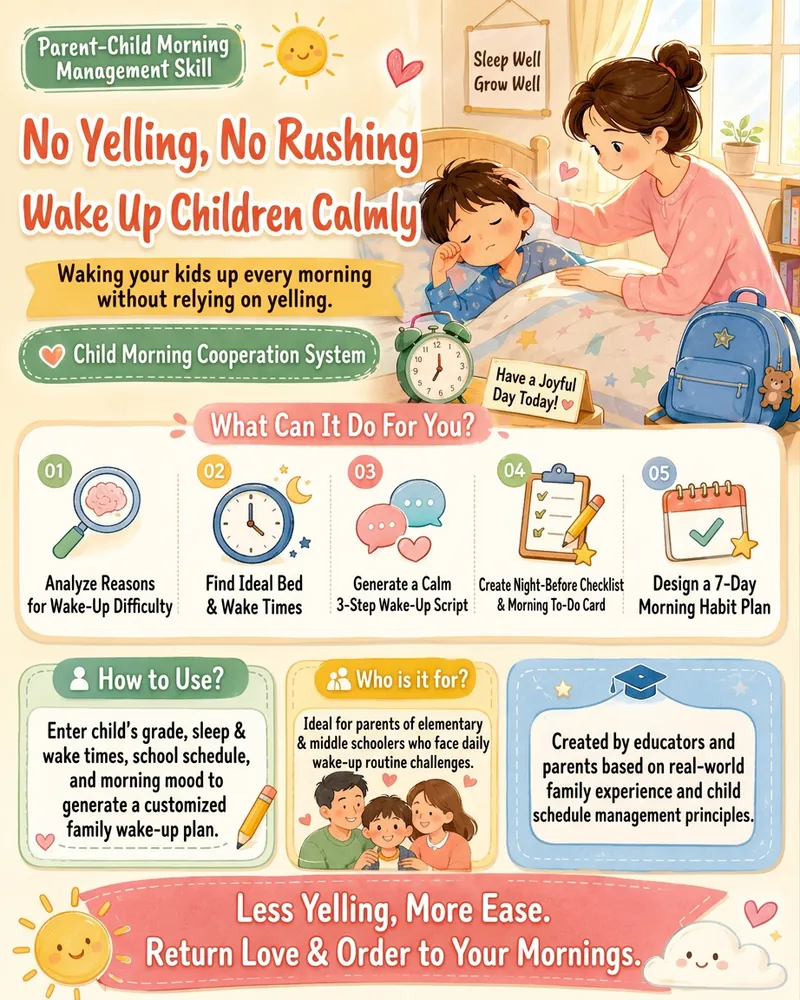
No-Yell Morning Wake-Up System
Does this sound like your morning? The first call to wake up gets no response. The second, a rollover. By the third call, you're losing your temper, and your child is already annoyed. Before you've even left the house, your relationship is strained. This Skill helps parents of school-aged children analyze the reasons behind their child's difficulty waking up and generates a ready-to-use morning improvement plan. You'll get: - Diagnosis of wake-up difficulties - No-yelling wake-up scripts - The night-before preparation checklist - Morning routine schedule - 7-day improvement plan - A screenshot-ready "Tomorrow Morning Wake-Up Card" Simply input your child's grade, bedtime, wake-up time, and morning behavior, and a customized plan for your family will be generated. Less yelling, more ease — let mornings be loving and orderly again.
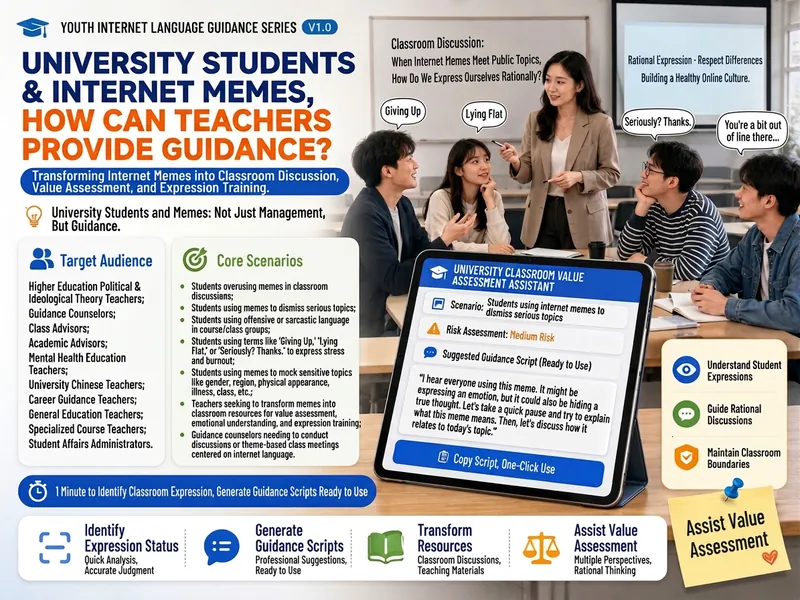
Meme Guidance for Faculty
College students' use of internet memes requires guidance, not just management. College students aren't ignorant of memes; they often use them to express attitudes, stress, sarcasm, doubt, and group identity. The problem is that some memes can overly trivialize serious discussions, some can mask real stress, and some may involve offensive expressions related to gender, region, appearance, illness, or class. Faced with such situations, college faculty cannot simply 'ban' them; they need to turn internet language into an entry point for classroom discussion, value analysis, and expression training. This Skill is designed for college ideological and political course teachers, counselors, class advisors, general education teachers, employment guidance teachers, and student affairs workers. This Skill integrates college classroom teaching experience, youth internet culture observation, and real educational communication practice. It does not simply view students' meme use as a 'classroom problem,' but helps teachers understand the underlying emotions, attitudes, and value tendencies, and transform them into more educationally valuable classroom resources.
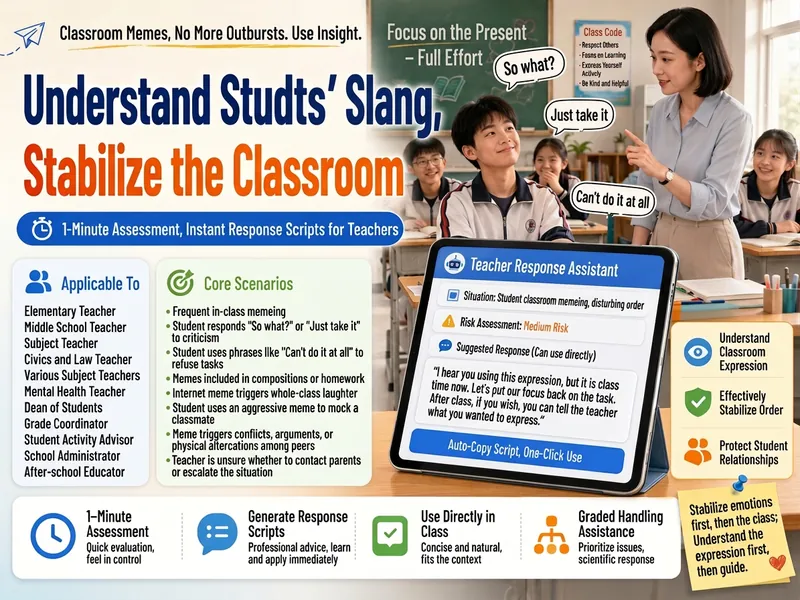
Teacher Meme Script Generator
Students using memes in class no longer require an immediate angry response. When a student suddenly says 'So what?', 'Just take it', or 'Can't do it', a teacher's angry outburst can cause laughter and confrontation; ignoring it can lead to classroom rules being broken. Student memes can sometimes lighten the mood, but may also be a way to avoid criticism, refuse tasks, disrupt the class, or even hurt peers. This Skill is designed for primary and secondary school homeroom teachers, subject teachers, moral education teachers, guidance counselors, and school administrators. Simply select the student's grade level, meme scenario, type of internet meme, number of students involved, frequency, and consequences, and the system will automatically generate: - Nature of the incident and risk level; - 10–30 second in-class immediate response scripts; - Outline for after-class individual conversation; - Alternative appropriate expression suggestions; - Home-school communication text; - Class language education activities; - Indication of peer harm or bullying risk. This Skill is developed from teaching experience, student communication observations, and real family education scenarios. It is not about simply 'controlling students,' but helping teachers quickly assess, maintain classroom order, guide after class, and identify peer harm risks when necessary.
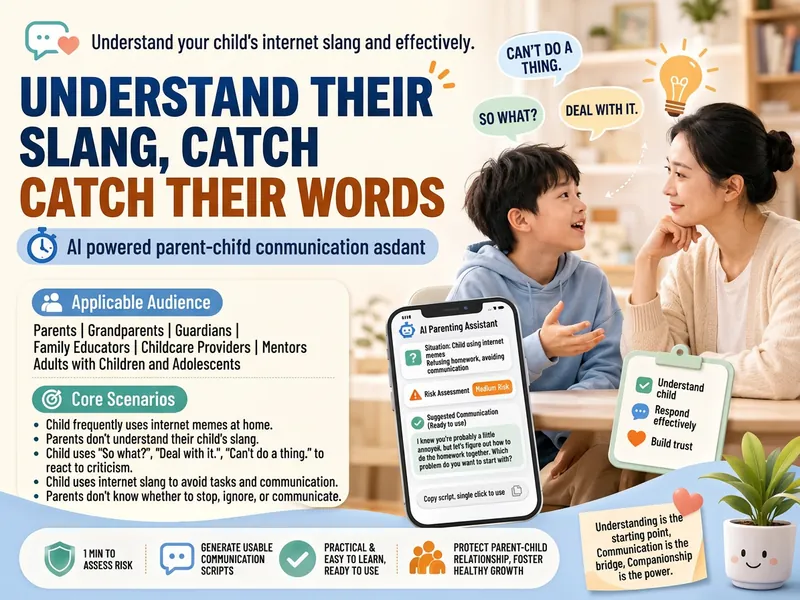
Kid Slang? | Parent Scripts
Select in order: your child's age, meme type, setting, frequency, and impact. If you don't know the meme, upload a screenshot or recording, or enter the original text.
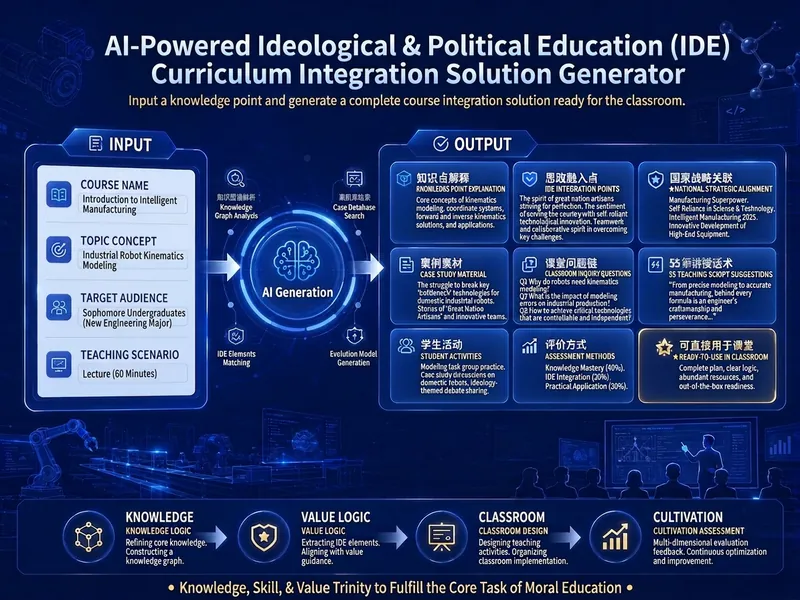
Ideological-Political Plan Generator
Enter the course name and professional knowledge points to automatically generate a complete new engineering curriculum ideological-political integration plan directly usable for lesson plans, PPTs, and classroom teaching. Applicable to professional courses such as smart manufacturing, smart materials, mechanical engineering, automation, computer science, artificial intelligence, electrical control, materials science, etc. Supports output of knowledge point explanation, ideological-political entry points, national strategy connections, case materials, classroom question chains, teacher lecture scripts, student activities, and three-dimensional evaluation methods. Before formal use, you can try the free version “新工科课程思政灵感生成器”. This tool is designed by an associate professor from the School of Marxism of an engineering university, based on practical experience in guiding the construction of curriculum ideological-political education in engineering colleges of the same university, emphasizing the natural integration of professional knowledge and value guidance.
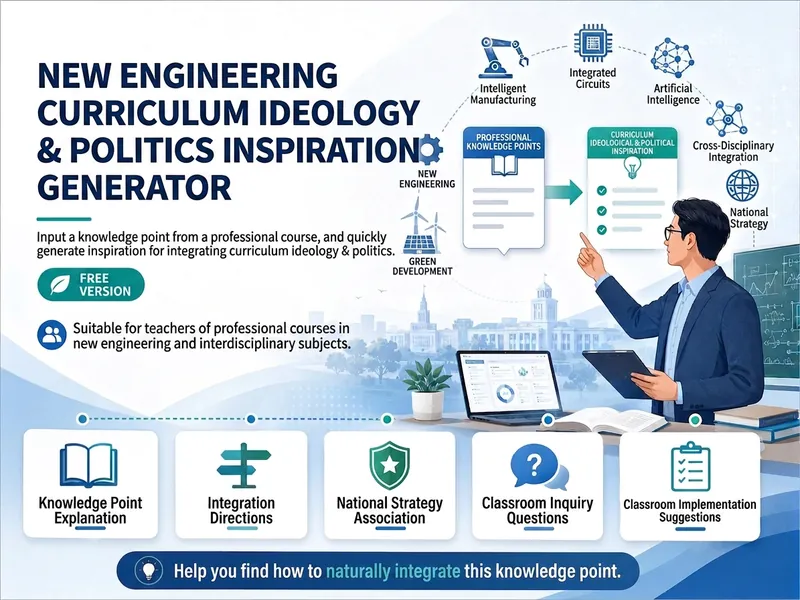
Course Ideological Inspiration
Many teachers of new engineering courses know the importance of ideological and political education in courses, but they don't know how to integrate it into their specific knowledge points, how to avoid forced elevation, or where to start in class. This Skill is designed for teachers of new engineering and interdisciplinary courses such as intelligent manufacturing, smart materials, mechanical engineering, automation, computer science, artificial intelligence, electrical control, and materials science. It helps you start from a specific knowledge point and quickly gain inspiration for ideological integration. Simply enter the course name, chapter/knowledge point, and target audience, and I will generate: - A brief explanation of the knowledge point; - 2-3 natural integration directions; - Related national strategies or real-world context; - 3 thought-provoking classroom questions; - A short suggestion for classroom use. This free version is suitable for teachers to quickly assess whether a knowledge point has room for ideological integration. If you need a complete plan including case materials, question chains, 1-minute/3-minute teaching scripts, student activities, lesson plan/PPT embedding suggestions, and three-dimensional evaluation methods, you can use the paid version: 'New Engineering Course Ideological Integration Plan Generator'. This Skill is suitable for: - Teachers of new engineering courses trying ideological integration for the first time; - University teachers revising lesson plans, PPTs, or instructional designs; - Teachers who want to quickly find an entry point for ideological integration but do not yet need a complete plan; - Teachers of courses in intelligent manufacturing, smart materials, mechanical engineering, automation, computer science, artificial intelligence, materials, etc.

Phone Argument Cooldown Script
This is a free parent-child communication skill designed for parents to use immediately after a conflict with their child about phone use. When a child can't stop watching short videos, won't stop playing games, checks their phone frequently while doing homework, or emotions escalate after a parental reminder, this Skill can help parents quickly generate a cool-down script they can say right away, along with a 30-minute cool-down process through a few structured choices. This Skill focuses on solving the problem of 'what to say first after an argument.' It does not perform complex analysis or replace a complete parenting plan. Its goal is to stop the conflict first, preventing parents from continuing to blame, threaten, snatch the phone, or repeatedly lecture, and to create conditions for genuine negotiation of rules later. If you have suggestions, questions, or real feedback while using it, please send to: 4934475@qq.com. If phone issues are recurring and a one-time cool-down script is not enough, you can also use the more systematic and complete paid version—"Phone Conflict Parent-Child Negotiation System." This system can further generate complete parent-child communication scripts, a two-way family phone agreement, and a 7-day execution review plan.
 Research
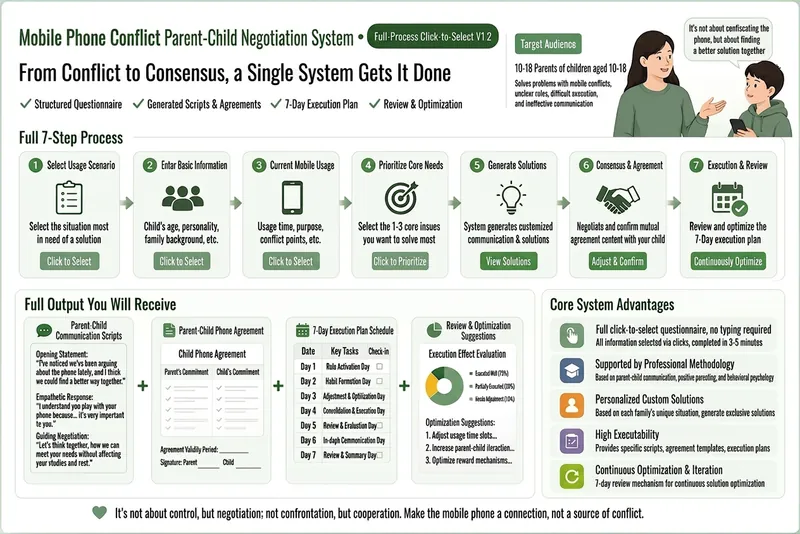
Parent-Child Phone Negotiation
The Parent-Child Phone Negotiation system is designed for parents of children of all ages—from young children just starting to use phones (7+) to adult children still living at home. The system automatically adapts communication strategies based on the child's age, helping you effectively handle and resolve family conflicts caused by phone use. Through structured questionnaires, it guides you to clearly identify the issue, whether it's a heated argument that needs immediate de-escalation or the need to establish or repair long-term rules. You will receive a set of ready-to-use conversation starters, a detailed family phone usage agreement (or a consensus memo for adult children), and a 7-day execution plan. The plan balances responsibilities between child and parent and adjusts strategies according to age—from concrete behavioral guidance for young children, to negotiated co-creation for teenagers, to mutual respect for adult children living at home. 💬 Trigger: Simply say phrases like 'Can't control my child's phone use,' 'We fought over phones, what should I do?', 'Set phone usage rules,' or 'How to cool down parent-child conflicts' to activate this system.