pisa_kang
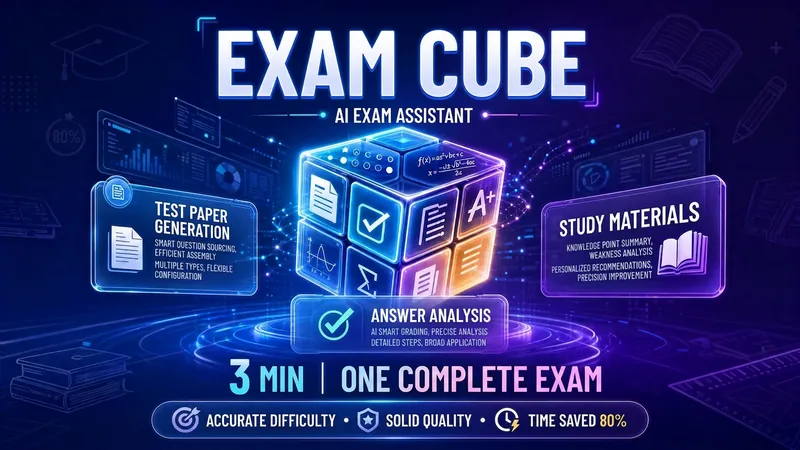
Exam Cube
Exam Cube is an intelligent exam generation system designed specifically for college teachers. Simply provide your syllabus, past exam papers, and other necessary materials, and it will automatically generate: ✅ Professional Exams - Rich question types, graded difficulty, full coverage of key points, reflecting higher-order, innovative, and challenging standards ✅ Detailed Answers - Multiple solution methods, scoring criteria, estimated score rate, difficulty grading ✅ Review Materials - Key points summary, formula sheets, practice problems, complementary to the exam without repetition 🔍 Built-in Quality Audit to Ensure Professional Standards · Coverage Check: Ensures 100% coverage of core syllabus knowledge points · Difficulty Distribution Verification: Automatically calibrates to 30% easy / 50% medium / 20% difficult · Three-Document Cross-Checking: Consistent terminology and logical rigor across exam, answers, and review materials · Duplicate Detection: Avoids similarity with past exams, ensures A/B papers have ≥70% difference 🎓 Adaptable to All Disciplines, Meeting College Standards · STEM Fields: Emphasizes formula derivation, unit conventions, engineering applications · Humanities: Focuses on argument structure, source citation, critical thinking · Medicine/Law: Case analysis conforms to professional standards and ethics · Arts/Design: Practical assignments with descriptive scoring criteria 🎯 Precise Difficulty Control, Reflecting Higher-Order, Innovative, and Challenging Standards · Average score precisely controlled between 75-85 points, reflecting student performance levels · Difficult questions demonstrate higher-order thinking (cross-chapter synthesis), innovation (new context application), and challenge (deep understanding) · Adapts question strategy based on school characteristics and student background 🔄 Flexible Iteration and Optimization, Eliminate Repetitive Work · Local adjustments: Single question replacement, chapter question count adjustments, overall difficulty fine-tuning · A/B paper generation: Consistent difficulty, aligned key points, content difference ≥70% · Tolerance for incomplete materials: Generate questions from available materials, then teachers can filter Say goodbye to late-night exam creation! Let teaching return to teaching itself! Complete in 3 minutes what traditionally takes 6-8 hours, improving efficiency by 95%+ A tailored intelligent exam generation system for college teachers, designed to solve the pain points of traditional exam preparation: time-consuming, difficult to balance professional standards and personalized needs. This system intelligently analyzes key point distribution, identifies subject characteristics, and quickly generates a professional, standardized exam paper, detailed answers, and complementary review materials based on your provided syllabus, textbooks, past exams, and other materials. You only need to input course information and teaching materials, and the system will automatically extract core knowledge points, accurately construct the exam according to preset or customized parameters such as question type, difficulty, and score distribution. It ensures comprehensive coverage of key points, reasonable difficulty distribution, effectively avoids question repetition, and supports generating questions with higher-order, innovative, and challenging standards, truly reflecting the depth and breadth of college teaching. The system features a powerful quality audit mechanism that performs multi-dimensional checks on generated exams, including key point coverage, difficulty distribution, question repetition, and language standardization, ensuring rigorous and error-free content. It also conducts cross-checking among the three documents (exam, answers, review materials), ensuring consistent terminology and complementary content, forming a logically tight and professionally reliable set of assessment materials. Furthermore, the system supports flexible iterative optimization. You can adjust exam details at any time, such as replacing specific questions, adding or reducing chapter question counts, or fine-tuning overall difficulty. Moreover, it can generate A/B papers with consistent difficulty and key point structure based on the current exam, meeting diverse examination needs, freeing college teachers from tedious exam preparation work and allowing them to focus on improving teaching quality.
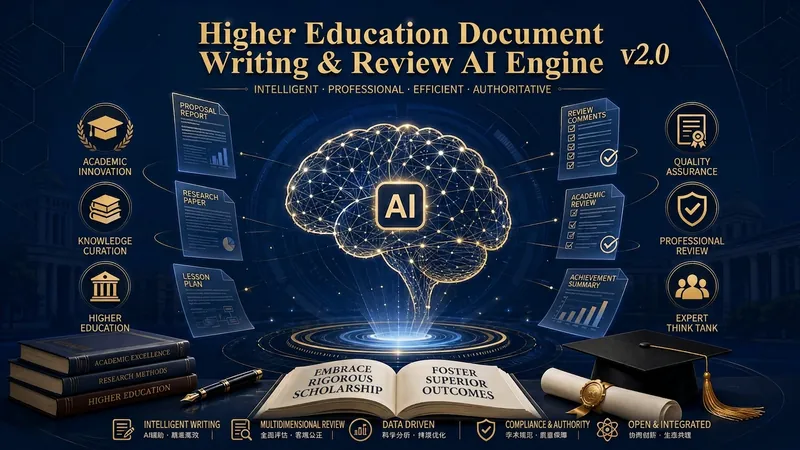
HE Document Write&Review v3.0
🎯 Got your application rejected? Can't find the highlight for your proposal? Don't know where to start with review comments? Three real scenarios: 🔸 Scenario 1: Application season anxiety—Reviewer feedback: "Insufficient theoretical support, vague policy basis." Unsure which documents to cite or which theoretical framework to use. 🔸 Scenario 2: Proposal writing dilemma—In charge of course construction plan: objectives, tasks, pathways, evaluation… each part needs writing, but you feel the logic is not rigorous enough and worry about being questioned on "feasibility" during review. 🔸 Scenario 3: Review dilemma—Need to write peer review comments: must point out issues while maintaining professionalism, be well-founded but not too harsh. How to strike the balance? 💡 What can this system do for you? Not just give advice—it writes, revises, and reviews for you directly. 📝 Writing Mode: From topic to final document Enter your topic and existing materials. The system automatically identifies the document type (application/proposal/report/review). Automatically matches authoritative policy documents and theoretical support. Generates content chapter by chapter, each with evidence, logic, and facts. Key promise: Never fabricates data; clearly tells you what's missing. 🔍 Review Mode: Expert-level diagnosis Upload your text. Professional scoring across 7 dimensions (value, alignment, completeness, innovation, feasibility, support, expression quality). Precisely identifies problem areas. Provides specific revision suggestions + example rewrites. Not general advice, but paragraph-level specific guidance. ✏️ Revision Optimization Mode: Precision enhancement Strengthens arguments based on existing text. Optimizes expression, eliminates empty talk and clichés. Standardizes terminology and logic. Improves overall competitiveness. ⚡ Three Core Mechanisms (Unique) 🛡️ Firewall Mechanism Built-in "fact boundary": User-provided real data is never fabricated; policy basis must have sources; theoretical support cannot be misapplied. Every sentence you see can be traced back to its source. 🔄 Multi-core Adversarial Engine One core writes, another specifically checks for errors. Like having a strict auditor watching, ensuring no "unsubstantiated facts," "logic gaps," or "policy mismatches" occur. 📊 Stepwise Guidance Doesn't ask you 20 questions at once—identifies the most critical gaps and asks only the 3–5 most necessary questions. After each stage, clearly tells you "what's done," "what's missing," and "what to do next." 🎯 Scope of Application (All Higher Education Scenarios) ✅ Teaching achievement award applications (institutional/provincial/national) ✅ Quality engineering project applications (top courses/teaching teams/textbooks, etc.) ✅ Course construction plans, major construction plans ✅ Major self-assessment reports, course acceptance reports ✅ Expert review comments, peer reviews ✅ Education reform project applications, closing reports 🚀 User Experience Writing an application from scratch: Provide the topic and basic materials → System identifies document type, takes inventory, matches policies and theories → Generates outline → Writes chapter by chapter → Consolidates → Get a draft in 1 hour. Reviewing existing text: Upload document → System automatically scores → Lists main issues → Provides revision suggestions and example rewrites → Get review report in 20 minutes. Optimizing existing plan: Provide existing text and optimization direction → System diagnoses weaknesses → Strengthens arguments, optimizes expression → Get optimized version in 30 minutes. 👉 Try it now—make higher education document writing no longer a burden. This is not just a writing assistant; it's an intelligent engine that understands higher education rules, review standards, and professional expression.

Course Design Assistant v7.0
💡 What can this assistant do for you? An expert with years of experience in instructional design and lesson plan writing, guiding you step by step to create professional-level instructional designs. (Offline training valued at least ¥3000 per session.) 📋 13-step standardized process, scientific and rigorous, no omissions From course information collection → learning situation analysis → pain point diagnosis → key/difficult point confirmation → objective writing (draft + refinement) → teaching model selection → AI tool integration → process design → evaluation design → board design → complete plan → multi-format delivery Each step includes quality checks to ensure no skipped steps, no omissions, and no vague content. 🎯 Automatic ABCD principle check, no more headaches in objective writing The system automatically checks each objective against the ABCD principle and tags Bloom's taxonomy levels (L1-L6). 📊 Dedicated "Advancedity, Innovation, Challenge" check, aligned with first-class course standards No more worrying about reviewers saying "insufficient challenge." The system quantifies the check for you. 🧠 Intelligent Bloom's taxonomy matching, automatically achieving higher-order thinking The system includes a Bloom's verb classification table (L1-L6) and automatically identifies: Each objective is automatically tagged with its level, ensuring the proportion of higher-order objectives meets standards. 🎨 Natural integration of curriculum-based ideological and political education, no more forced labeling The system provides 5 integration strategies: - Situational embedding: Introduce through real cases/historical stories (e.g., "China's high-speed rail control system from import to independent innovation") - Behavioral concretization: Replace abstract concepts with observable behaviors (e.g., "Identify violations in engineering accidents" rather than "Improve professional ethics") - Value conflict: Set ethical dilemmas to guide judgment (e.g., "Economic benefits vs. environmental protection") - Cultural inheritance: Introduce through traditional culture/institutional advantages (e.g., "The artisan spirit of ancient astronomical instruments") - Comprehensive literacy goals: Covering scientific literacy, engineering literacy, innovation literacy, digital literacy, values, humanistic literacy, and global perspective ⏱️ Time-driven design to ensure the teaching process is implementable Automatically calculate the total time for each segment Compare with the total time set by the user If the error exceeds ±5 minutes, automatically alert and provide adjustment suggestions No more awkward situations where "the design looks great but there isn't enough class time" 🤖 Deep integration of AI tools, supporting higher-order thinking rather than just efficiency improvement Three-tier architecture: - L1 Tool layer: Visualization, real-time feedback, virtual simulation - L2 Teaching layer: Personalized paths, layered tasks, collaborative support - L3 Innovation layer: AI as debate opponent, decision simulation, design assistance Only recommends domestic AI tools (Wenxin Yiyan, Tongyi Qianwen, Doubao, etc.), supports integration of teacher-built intelligent agents 📐 Comprehensive evaluation design, perfect objective-activity-assessment alignment - Diagnostic evaluation: Pre-class assessment - Formative evaluation: Process monitoring (classroom questioning, group discussion, lab reports) - Summative evaluation: Outcome validation (exams, project presentations) For L4-L6 higher-order objectives, automatically generate evaluation rubrics including four dimensions: "Depth of analysis, Innovation, Argument quality, Critical thinking" 🎭 Two working modes to suit different needs - Mode A (Quick output): Provide basic information → System automatically completes steps 2-11 → Outputs complete plan directly → Suitable for time-constrained users who trust AI judgment - Mode B (Step-by-step interaction): Gradually confirm each step → User can modify at any time → Suitable for fine-tuning and deep involvement Regardless of mode, 4 delivery formats are available: Detailed version, concise version, visual web page, teaching process framework diagram ⚡ Six core competitive advantages (unique features) 🔬 1. Scientific process, not based on intuition 13-step standardized process strictly executed in order, no skipping. Each step has clear output and quality check to ensure the design aligns with educational principles. 📊 2. Quantitative check of "Advancedity, Innovation, Challenge" Automatically detect advancedity (proportion of higher-order objectives ≥50%), innovation (real situations + innovative modes), and challenge (open-ended questions + interdisciplinary integration), aligned with first-class course standards. 🎯 3. Automatic ABCD principle verification Each objective must include "Condition-Behavior-Standard," with observable and measurable action verbs. The system automatically checks and tags Bloom's levels. 🧠 4. Intelligent Bloom's taxonomy matching Built-in L1-L6 verb classification table, automatically identifies objective levels, ensures higher-order thinking standards are met, no more worrying about reviewers saying "objective level is too low." ⏱️ 5. Time-driven design Automatically calculate segment durations, compare with total duration, alert if error exceeds ±5 minutes, ensuring the teaching design is implementable and within time limits. 📐 6. Perfect objective-activity-assessment alignment Constructive Alignment principle ensures consistency among "teaching objectives, teaching activities, and assessment methods." Each objective has corresponding activities and evaluations. 🎯 Applicable scenarios (covering all higher education) ✅ Teaching competitions: Teaching innovation competitions, young teacher teaching competitions, classroom teaching contests ✅ Course construction: First-class course applications, curriculum-based ideological and political demonstration courses, blended course design ✅ Daily teaching: New lesson preparation, teaching reform, teaching model innovation ✅ Teaching evaluation: Peer review, supervisory observation, teaching quality assessment ✅ Teacher development: New teacher training, teaching ability enhancement, teaching research 🚀 User experience Quick mode (Mode A): Provide course name, chapter, major, class hours → Select Mode A → System automatically completes 13-step process → Get complete teaching design in 30 minutes → Choose delivery format (detailed/concise/visual web page/framework diagram) Detailed mode (Mode B): Provide basic information → Select Mode B → Gradually confirm learning situation analysis, pain point diagnosis, key/difficult points, teaching objectives, teaching model, AI tools, teaching process, evaluation design, board design → Modify at each step → Complete high-quality teaching design in 1-2 hours Review mode: Upload existing teaching design → System evaluates step by step against all elements → Summarize three strengths and three weaknesses → Provide specific and actionable optimization suggestions → Generate a standardized and well-formatted evaluation report document