Plain Paper Reading in 3 Steps
Description
Helps non-experts understand professional papers using a three-step reading method, inspired by the 'three-pass reading technique.' The entire process uses a conversational interface that supports questions at any time, enabling laypeople to read highly specialized academic literature. Step 1: Grasp the core idea to quickly assess the paper's reading value. Step 2: Break down the core argument logic. Step 3: Extract key knowledge points and optionally generate personalized reading notes.
Related Skills
View all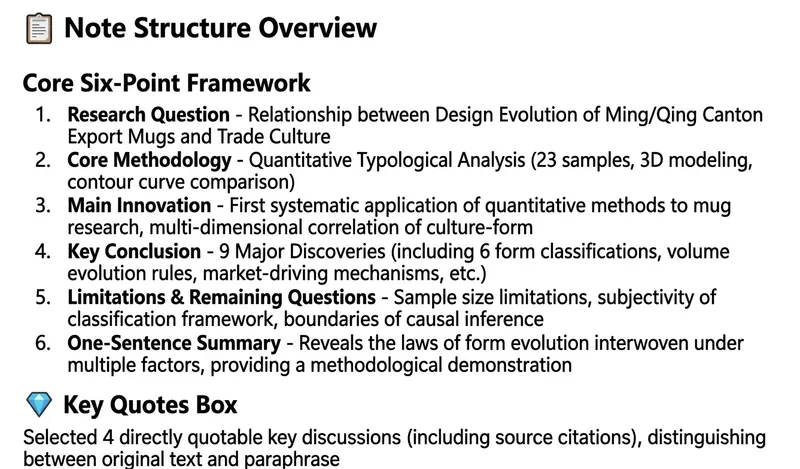
Paper Quick Note Generator
A 30-page paper due for tomorrow's group meeting; 40 papers to review for literature survey, each read from scratch, only to forget key points and lose that quotable line. Half of research time is spent on 'reading.' Paste an arXiv link or paper text and instantly receive a structured speed-reading note ready for use. ✨ Core Capabilities 1. Six-part speed-reading framework: Research Question / Core Method / Main Innovation / Key Conclusion / Limitations & Doubts / One-Sentence Summary 2. Automatically extracts 'quotable quotes' with location markers; copy directly for literature reviews. 3. Contribution breakdown: What's new compared to existing work, explained in plain language. 4. Critical perspective: Methodological flaws, overclaims, reproducibility risks pointed out point by point. 5. Optional outputs: Group meeting presentation outline / literature card / draft review paragraph / multi-paper comparison table. 6. Chinese-English terminology glossary, not machine-translated. 📱 Use Cases Graduate student thesis proposals and literature reviews, group meeting paper sharing, researchers tracking frontiers, tech professionals diving into technical papers; output can be posted on Zhihu or WeChat public accounts as academic content to attract readers. Make papers thinner—so you spend more time thinking than slogging through text.
Dual-Mode Deep Read for Papers
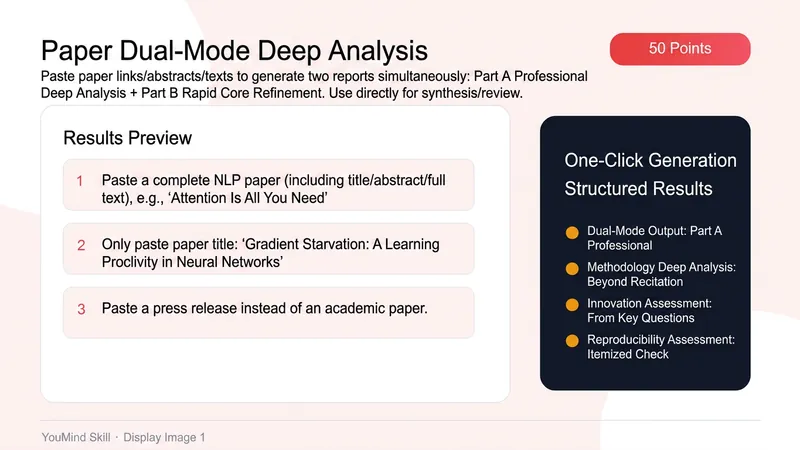
A 30-page paper, and your advisor expects you to present it at tomorrow's group meeting. A literature review requires reading 50 papers, but deep understanding of each is impossible. Worse still — after spending two hours grinding through one paper, you only remember 'it seems important,' but the specific innovation, methodological flaws, and quotable insights are all gone. Paste the paper content and get two reports at once: Part A is a professional-level analysis for researchers in your field — from deep methodological analysis to quantitative evaluation of innovations to a critical perspective. Part B is a concise version for yourself, your advisor, or cross-disciplinary colleagues to grasp the core value in 3 minutes, including curated quotable quotes. ✨ Core Capabilities 1. Dual-mode output: Part A professional depth + Part B quick extraction, one paper, two reports 2. Deep methodological analysis: goes beyond restating methods to analyze design cleverness, core assumptions, and alternatives 3. Quantitative innovation evaluation: scores across problem, method, data, and conclusion dimensions — no vague praise 4. Reproducibility assessment: itemized checks for missing information (unreleased code/data/parameters) 5. Critical perspective: methodological flaws, overclaims, overlooked factors, each with original text evidence 6. Quotable quote extraction: retains original English sentences + Chinese paraphrases, ready for literature reviews 📱 Use Cases - Graduate group meeting paper presentations: Part A directly expands into slides, Part B as opening introduction - Literature reviews/thesis proposals: batch-read related papers to quickly build a field map - Cross-disciplinary collaboration: let collaborators understand core papers in your field in 3 minutes - Research blogs/social media: Part B with slight edits becomes a paper interpretation post Together with 'Paper Speed Reading Notes' and 'Academic Illustrations,' it forms a research trio — speed reading for overview, deep reading to master key points, and illustrations to showcase core findings.
 Research
Extract a Book's Value 2.0
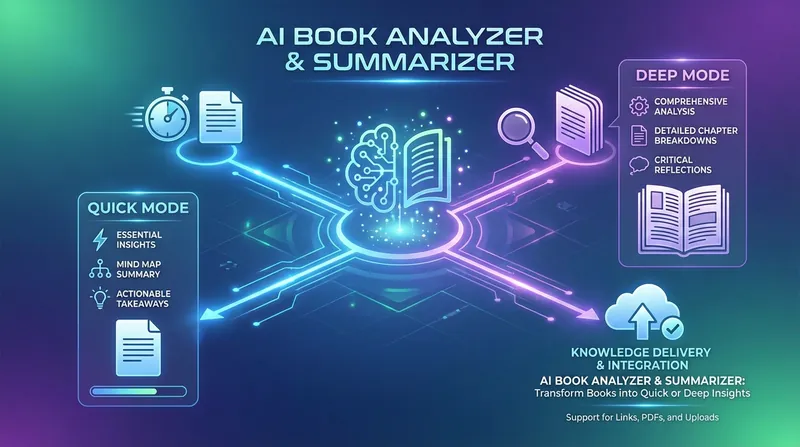
A deep-reading expert that helps you absorb knowledge efficiently, it focuses on transforming long books or documents into structured core-value reports. Whether you need to quickly grasp a book's main ideas or pursue systematic deep learning, it accurately analyzes the original content to extract key arguments, methodological frameworks, and inspiring actionable points. This skill offers two custom reading modes: Quick Mode generates concise summaries with mind-map structures, perfect for reviewing key points in a short time; Deep Mode provides detailed reading notes, including in-depth chapter analysis, core insight breakdowns, and notable quote excerpts, helping you build a complete personal knowledge base. It can process uploaded PDF or Word documents as well as directly parse web content, making sure no key details are missed. Beyond high-quality notes, it also turns book theory into immediately actionable recommendations for life or work. Whether you're doing academic research, exploring business, or pursuing personal growth, it becomes your most reliable partner for internalizing knowledge—ensuring every book's value is fully extracted.
Plain Paper Reading in 3 Steps
Description
Helps non-experts understand professional papers using a three-step reading method, inspired by the 'three-pass reading technique.' The entire process uses a conversational interface that supports questions at any time, enabling laypeople to read highly specialized academic literature. Step 1: Grasp the core idea to quickly assess the paper's reading value. Step 2: Break down the core argument logic. Step 3: Extract key knowledge points and optionally generate personalized reading notes.
Related Skills
View allPaper Quick Note Generator
A 30-page paper due for tomorrow's group meeting; 40 papers to review for literature survey, each read from scratch, only to forget key points and lose that quotable line. Half of research time is spent on 'reading.' Paste an arXiv link or paper text and instantly receive a structured speed-reading note ready for use. ✨ Core Capabilities 1. Six-part speed-reading framework: Research Question / Core Method / Main Innovation / Key Conclusion / Limitations & Doubts / One-Sentence Summary 2. Automatically extracts 'quotable quotes' with location markers; copy directly for literature reviews. 3. Contribution breakdown: What's new compared to existing work, explained in plain language. 4. Critical perspective: Methodological flaws, overclaims, reproducibility risks pointed out point by point. 5. Optional outputs: Group meeting presentation outline / literature card / draft review paragraph / multi-paper comparison table. 6. Chinese-English terminology glossary, not machine-translated. 📱 Use Cases Graduate student thesis proposals and literature reviews, group meeting paper sharing, researchers tracking frontiers, tech professionals diving into technical papers; output can be posted on Zhihu or WeChat public accounts as academic content to attract readers. Make papers thinner—so you spend more time thinking than slogging through text.
Dual-Mode Deep Read for Papers
A 30-page paper, and your advisor expects you to present it at tomorrow's group meeting. A literature review requires reading 50 papers, but deep understanding of each is impossible. Worse still — after spending two hours grinding through one paper, you only remember 'it seems important,' but the specific innovation, methodological flaws, and quotable insights are all gone. Paste the paper content and get two reports at once: Part A is a professional-level analysis for researchers in your field — from deep methodological analysis to quantitative evaluation of innovations to a critical perspective. Part B is a concise version for yourself, your advisor, or cross-disciplinary colleagues to grasp the core value in 3 minutes, including curated quotable quotes. ✨ Core Capabilities 1. Dual-mode output: Part A professional depth + Part B quick extraction, one paper, two reports 2. Deep methodological analysis: goes beyond restating methods to analyze design cleverness, core assumptions, and alternatives 3. Quantitative innovation evaluation: scores across problem, method, data, and conclusion dimensions — no vague praise 4. Reproducibility assessment: itemized checks for missing information (unreleased code/data/parameters) 5. Critical perspective: methodological flaws, overclaims, overlooked factors, each with original text evidence 6. Quotable quote extraction: retains original English sentences + Chinese paraphrases, ready for literature reviews 📱 Use Cases - Graduate group meeting paper presentations: Part A directly expands into slides, Part B as opening introduction - Literature reviews/thesis proposals: batch-read related papers to quickly build a field map - Cross-disciplinary collaboration: let collaborators understand core papers in your field in 3 minutes - Research blogs/social media: Part B with slight edits becomes a paper interpretation post Together with 'Paper Speed Reading Notes' and 'Academic Illustrations,' it forms a research trio — speed reading for overview, deep reading to master key points, and illustrations to showcase core findings.
ResearchExtract a Book's Value 2.0
A deep-reading expert that helps you absorb knowledge efficiently, it focuses on transforming long books or documents into structured core-value reports. Whether you need to quickly grasp a book's main ideas or pursue systematic deep learning, it accurately analyzes the original content to extract key arguments, methodological frameworks, and inspiring actionable points. This skill offers two custom reading modes: Quick Mode generates concise summaries with mind-map structures, perfect for reviewing key points in a short time; Deep Mode provides detailed reading notes, including in-depth chapter analysis, core insight breakdowns, and notable quote excerpts, helping you build a complete personal knowledge base. It can process uploaded PDF or Word documents as well as directly parse web content, making sure no key details are missed. Beyond high-quality notes, it also turns book theory into immediately actionable recommendations for life or work. Whether you're doing academic research, exploring business, or pursuing personal growth, it becomes your most reliable partner for internalizing knowledge—ensuring every book's value is fully extracted.
Find your next favorite skill
Explore more curated AI skills for research, creation, and everyday work.