Mgmt C-J Intr Expert v3.0
Draft mgmt C-jour intros w/ eval & revision
Description
Why we love this skill
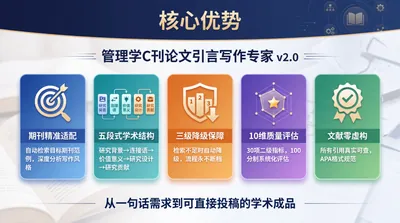
Designed specifically for management CSSCI journals, it uses a literature pool locking mechanism to strictly prevent academic hallucinations. Combined with target journal style analysis and a five-part structure, it accurately generates introduction drafts that meet top journal standards.
Writing the introduction for management C-journal papers is a challenging task for many researchers. This Skill v3.0 adopts the AFP 3.1 three-layer architecture, providing a closed-loop process from information collection to final delivery. Core capabilities: 1. Anti-hallucination engine—mandatory input + traceable verification: all references must come from the user's provided pool of real literature; the AI cannot supplement or fabricate. 2. Dual-dimension adaptation (discipline × research type)—four disciplines: strategic management, organizational behavior and human resources, public management, and information management, × three types: empirical quantitative, qualitative case, and theoretical construction. Automatically matches 12 introduction paradigms. 3. Precise journal style adaptation—uses googleSearch to retrieve examples from target journals in the last 3 years, with a three-level fallback strategy to ensure retrieval success. 4. Five-part introduction structure theory—research background → transition → research object → research value → research design, generating a blueprint paragraph by paragraph. 5. B-core nine-dimension quality audit—structure, logic, citation, adaptation, style, innovation, gap, theory, anti-hallucination. Delivery only if quantitative score ≥80. Suitable for: graduate students and early-career researchers in management who need to submit to CSSCI/Beijing University Core journals.
Related Skills
View all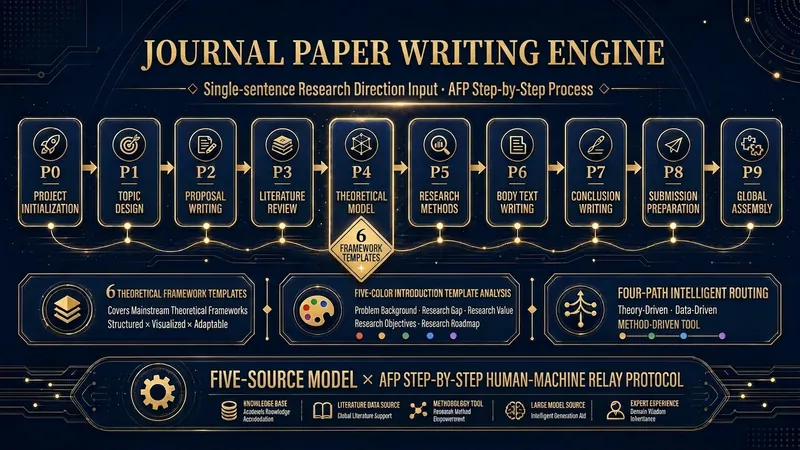 Write
WriteJournal Paper Writing Engine
Input your research direction in one sentence, and the AFP step-by-step engine guides you through the entire process. P1 Topic Design — Davis Interesting Theory + Problematization’s Five-Level Topic Selection Method, extracting real problems from phenomena. P2 Introduction Writing — Five-Color Template Analysis Method, breaking down top journal model papers section by section: emotional appeal → knowledge gap → literature positioning → research space → value declaration, with embedded full deconstruction prompts. P3 Literature Review — Structured organization, distinguishing research threads and dialogue objects. P4 Theoretical Framework — Six theory integration templates embedded throughout (complementary, contrast, bridging, hierarchical, evolutionary, general), each containing six paragraphs: introduction → justification → sorting → premise → analysis → conclusion; plus a five-level deep-drill sentence skeleton for single-theory depth. P5 Research Methods — Automatically adapts strategies based on four paths: empirical quantitative, qualitative, speculative, and mixed. P6 Body Writing — 9-3-1 pyramid structure. P7 Conclusion Writing — Three-level conclusion processing (findings → dialogue → extension). P8 Submission Preparation — Eight methods to reduce AI detection rate. P9 Global Assembly — Compiles independent documents from each stage into a complete draft, supports cross-chapter bidirectional backfill, and allows interruption and iterative backtracking at any time. 🎯 Suitable for: Graduate students (master's and PhD) and early-career researchers aiming to submit to Chinese C-journals, core journals, or SSCI, especially those stuck on theoretical framework and introduction writing. ⚙️ Underlying Architecture: Five-Source Model × AFP Step-by-Step Human-Machine Relay Protocol, with heartbeat signals, mandatory stop points, and dual-core auditing.
 Research
Academic Paper Writing v4.1
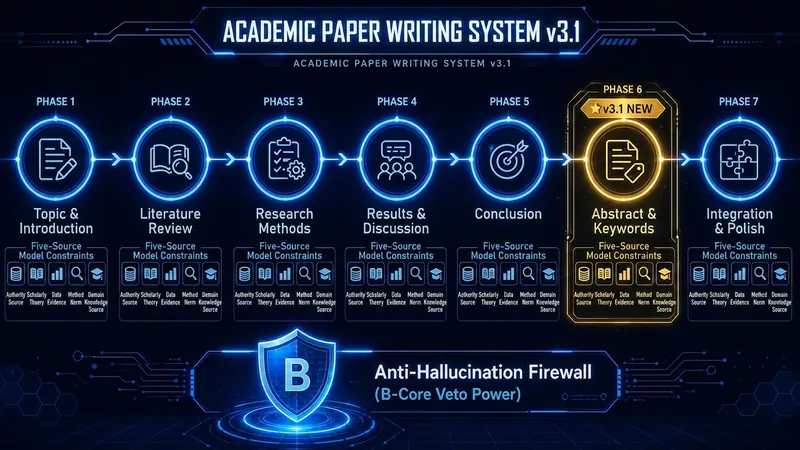
A full-process academic paper writing system that combines the Five Sources model with the AFP 3.1 three-layer architecture. Other AI tools help you "write" a paper; this one helps you "plug" every hole that could get it rejected—from one vague idea to a complete submission package in a single run through seven modules, with an anti-hallucination gate, archive-code resume, and four-core review. [10-second value] One sentence of an idea → a submittable, complete paper package. Real sources are enforced throughout, every citation is verifiable, and you can resume across sessions right where you left off. [Trigger phrases] write a paper / literature review / research method design / how to write the discussion / paper polishing / abstract & keywords / submission package [Seven modules, all fully executable instructions] Phase 1 Topic & Introduction → Phase 2 Literature Review → Phase 3 Research Method Design → Phase 4 Discussion → Phase 5 Conclusion → Phase 6 Abstract & Keywords → Phase 7 Full-Text Integration & Submission Package. Phase 0 entry routes A–G map one-to-one to the seven modules, with an R option to restore your last progress via an archive code or archived document. [v4.1 upgrades] 1. Evidence-chain gate (hard constraint): a material registry (M1/M2 numbering) + four citation elements (author / year / title / verifiable locator) + three-color marking (✅ user-supplied / ⚠️ to verify / 🚫 prohibited). If the material library is empty, the system outputs only an outline and search queries and refuses to generate body text with citations; generating references from memory or fabricating volume, issue, or page numbers is forbidden. 2. Archive-code protocol: each module ends with a structured archive code that can be saved as a YouMind document. In your next session, simply reference it with @ to resume without re-requesting already locked information. 3. Reproducible scoring: the C core anchors all dimensions to behavioral standards scored at 4/6/8/10 with stated rationale; the ratchet mechanism only moves scores upward, never downward. 4. Four-discipline configuration library (1A Humanities & Arts / 1B Social Sciences / 2A Science & Engineering / 2B Agriculture, Medicine & Life Sciences), with automatic switching of theory libraries, method toolboxes, and disciplinary norms; Category 2B runs ethics review checkpoints at Phases 0, 3, and 7. 5. Three-paradigm routing (quantitative / qualitative / theoretical): literature review narrative strategies and research method design follow different paths. 6. Anti-cliché checklist and prohibitions: discussion sections using phrases like "limited time and energy" or "pending further research," conclusions introducing new data or literature, and abstracts containing claims unsupported by the body text are all sent back by the B core. 7. Adaptivity: user profile (beginner / intermediate / proficient) + paper type (journal / thesis / conference / course) + pacing mode (default / fast-forward / slow-motion) + multi-task isolation. 8. Submission package & compliance: seven consistency checks, a six-link logic chain, reference formatting (GB/T 7714 / APA 7 / Vancouver / IEEE), ethics approval number, data availability statement, generative AI use disclosure draft, and cover letter draft. [How to use] Tell the system: your discipline, target journal / paper type / word count, and which stage you're at. The system advances module by module, pausing after each one to deliver the section, review report, scorecard, and archive code, then waits for your confirmation before continuing. [Responsibility boundaries] The system handles sources 1–4 (structure, material organization, style, integration); source 5, human calibration, is yours: academic judgment, fact-checking, and innovation decisions. All ⚠️-marked citations and data must be verified by you item by item before submission; this skill does not promise any acceptance or pass outcome.
Paper Imitation & Pub. Expert
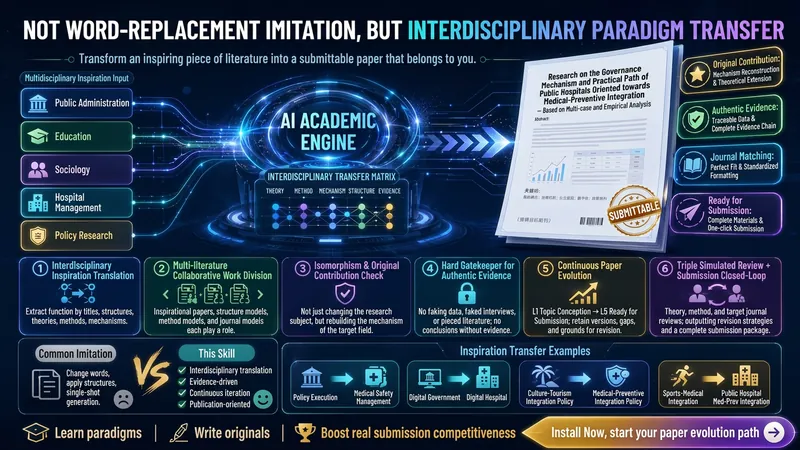
📚 Paper Imitation & Pub. Expert Develop an inspiring paper into your own high-quality original work step by step. Ideal for graduate students seeking to draw inspiration from excellent papers in other disciplines for topic migration, structural reconstruction, and submission optimization. 🔍 Inspiring Literature Identification: Analyze the reusable title mechanisms, problem awareness, chapter structure, theoretical framework, research methods, evidence organization, and language style of the model paper. 🔄 Interdisciplinary Paradigm Transfer: Build a 'source domain—target domain' transfer matrix to determine which ideas can be transferred and which theories, concepts, cases, and conclusions must be reconstructed. 🧠 Original Contribution Modeling: Identify literature gaps, distill core propositions and mechanisms, and check whether the paper merely changes the research object or applies a generic framework. 🧭 Research Design Planning: Supports theoretical research, case studies, qualitative research, quantitative research, literature reviews, policy text analysis, and mixed methods research. 🛡️ Real Evidence Gate: Do not fabricate data, samples, interviews, cases, statistical results, literature, or DOIs; without real evidence, do not generate false empirical conclusions. ✍️ Evidence-Driven Writing: Build argument chains via 'proposition—evidence—citation—rebuttal', generate original content chapter by chapter, and clearly mark research materials that need to be supplemented. 📈 Continuous Paper Evolution: Record each round of revisions, material gaps, and maturity changes according to L1 (topic conception), L2 (research plan), L3 (evidence formation), L4 (submission draft), and L5 (ready for submission). 🧑⚖️ Triple Simulation Review: Identify rejection risks from the perspectives of a theoretical reviewer, a method reviewer, and a target journal reviewer, and form specific revision strategies. 📨 Complete Submission Loop: Assist in generating the final paper, citation verification table, cover letter, innovation point statement, author response, revision index, and related declaration templates. ✨ Learn the paradigm, write original content, and enhance real submission competitiveness.
Mgmt C-J Intr Expert v3.0
Draft mgmt C-jour intros w/ eval & revision
Description
Why we love this skill
Designed specifically for management CSSCI journals, it uses a literature pool locking mechanism to strictly prevent academic hallucinations. Combined with target journal style analysis and a five-part structure, it accurately generates introduction drafts that meet top journal standards.
Writing the introduction for management C-journal papers is a challenging task for many researchers. This Skill v3.0 adopts the AFP 3.1 three-layer architecture, providing a closed-loop process from information collection to final delivery. Core capabilities: 1. Anti-hallucination engine—mandatory input + traceable verification: all references must come from the user's provided pool of real literature; the AI cannot supplement or fabricate. 2. Dual-dimension adaptation (discipline × research type)—four disciplines: strategic management, organizational behavior and human resources, public management, and information management, × three types: empirical quantitative, qualitative case, and theoretical construction. Automatically matches 12 introduction paradigms. 3. Precise journal style adaptation—uses googleSearch to retrieve examples from target journals in the last 3 years, with a three-level fallback strategy to ensure retrieval success. 4. Five-part introduction structure theory—research background → transition → research object → research value → research design, generating a blueprint paragraph by paragraph. 5. B-core nine-dimension quality audit—structure, logic, citation, adaptation, style, innovation, gap, theory, anti-hallucination. Delivery only if quantitative score ≥80. Suitable for: graduate students and early-career researchers in management who need to submit to CSSCI/Beijing University Core journals.
Related Skills
View allWriteJournal Paper Writing Engine
Input your research direction in one sentence, and the AFP step-by-step engine guides you through the entire process. P1 Topic Design — Davis Interesting Theory + Problematization’s Five-Level Topic Selection Method, extracting real problems from phenomena. P2 Introduction Writing — Five-Color Template Analysis Method, breaking down top journal model papers section by section: emotional appeal → knowledge gap → literature positioning → research space → value declaration, with embedded full deconstruction prompts. P3 Literature Review — Structured organization, distinguishing research threads and dialogue objects. P4 Theoretical Framework — Six theory integration templates embedded throughout (complementary, contrast, bridging, hierarchical, evolutionary, general), each containing six paragraphs: introduction → justification → sorting → premise → analysis → conclusion; plus a five-level deep-drill sentence skeleton for single-theory depth. P5 Research Methods — Automatically adapts strategies based on four paths: empirical quantitative, qualitative, speculative, and mixed. P6 Body Writing — 9-3-1 pyramid structure. P7 Conclusion Writing — Three-level conclusion processing (findings → dialogue → extension). P8 Submission Preparation — Eight methods to reduce AI detection rate. P9 Global Assembly — Compiles independent documents from each stage into a complete draft, supports cross-chapter bidirectional backfill, and allows interruption and iterative backtracking at any time. 🎯 Suitable for: Graduate students (master's and PhD) and early-career researchers aiming to submit to Chinese C-journals, core journals, or SSCI, especially those stuck on theoretical framework and introduction writing. ⚙️ Underlying Architecture: Five-Source Model × AFP Step-by-Step Human-Machine Relay Protocol, with heartbeat signals, mandatory stop points, and dual-core auditing.
ResearchAcademic Paper Writing v4.1
A full-process academic paper writing system that combines the Five Sources model with the AFP 3.1 three-layer architecture. Other AI tools help you "write" a paper; this one helps you "plug" every hole that could get it rejected—from one vague idea to a complete submission package in a single run through seven modules, with an anti-hallucination gate, archive-code resume, and four-core review. [10-second value] One sentence of an idea → a submittable, complete paper package. Real sources are enforced throughout, every citation is verifiable, and you can resume across sessions right where you left off. [Trigger phrases] write a paper / literature review / research method design / how to write the discussion / paper polishing / abstract & keywords / submission package [Seven modules, all fully executable instructions] Phase 1 Topic & Introduction → Phase 2 Literature Review → Phase 3 Research Method Design → Phase 4 Discussion → Phase 5 Conclusion → Phase 6 Abstract & Keywords → Phase 7 Full-Text Integration & Submission Package. Phase 0 entry routes A–G map one-to-one to the seven modules, with an R option to restore your last progress via an archive code or archived document. [v4.1 upgrades] 1. Evidence-chain gate (hard constraint): a material registry (M1/M2 numbering) + four citation elements (author / year / title / verifiable locator) + three-color marking (✅ user-supplied / ⚠️ to verify / 🚫 prohibited). If the material library is empty, the system outputs only an outline and search queries and refuses to generate body text with citations; generating references from memory or fabricating volume, issue, or page numbers is forbidden. 2. Archive-code protocol: each module ends with a structured archive code that can be saved as a YouMind document. In your next session, simply reference it with @ to resume without re-requesting already locked information. 3. Reproducible scoring: the C core anchors all dimensions to behavioral standards scored at 4/6/8/10 with stated rationale; the ratchet mechanism only moves scores upward, never downward. 4. Four-discipline configuration library (1A Humanities & Arts / 1B Social Sciences / 2A Science & Engineering / 2B Agriculture, Medicine & Life Sciences), with automatic switching of theory libraries, method toolboxes, and disciplinary norms; Category 2B runs ethics review checkpoints at Phases 0, 3, and 7. 5. Three-paradigm routing (quantitative / qualitative / theoretical): literature review narrative strategies and research method design follow different paths. 6. Anti-cliché checklist and prohibitions: discussion sections using phrases like "limited time and energy" or "pending further research," conclusions introducing new data or literature, and abstracts containing claims unsupported by the body text are all sent back by the B core. 7. Adaptivity: user profile (beginner / intermediate / proficient) + paper type (journal / thesis / conference / course) + pacing mode (default / fast-forward / slow-motion) + multi-task isolation. 8. Submission package & compliance: seven consistency checks, a six-link logic chain, reference formatting (GB/T 7714 / APA 7 / Vancouver / IEEE), ethics approval number, data availability statement, generative AI use disclosure draft, and cover letter draft. [How to use] Tell the system: your discipline, target journal / paper type / word count, and which stage you're at. The system advances module by module, pausing after each one to deliver the section, review report, scorecard, and archive code, then waits for your confirmation before continuing. [Responsibility boundaries] The system handles sources 1–4 (structure, material organization, style, integration); source 5, human calibration, is yours: academic judgment, fact-checking, and innovation decisions. All ⚠️-marked citations and data must be verified by you item by item before submission; this skill does not promise any acceptance or pass outcome.
Paper Imitation & Pub. Expert
📚 Paper Imitation & Pub. Expert Develop an inspiring paper into your own high-quality original work step by step. Ideal for graduate students seeking to draw inspiration from excellent papers in other disciplines for topic migration, structural reconstruction, and submission optimization. 🔍 Inspiring Literature Identification: Analyze the reusable title mechanisms, problem awareness, chapter structure, theoretical framework, research methods, evidence organization, and language style of the model paper. 🔄 Interdisciplinary Paradigm Transfer: Build a 'source domain—target domain' transfer matrix to determine which ideas can be transferred and which theories, concepts, cases, and conclusions must be reconstructed. 🧠 Original Contribution Modeling: Identify literature gaps, distill core propositions and mechanisms, and check whether the paper merely changes the research object or applies a generic framework. 🧭 Research Design Planning: Supports theoretical research, case studies, qualitative research, quantitative research, literature reviews, policy text analysis, and mixed methods research. 🛡️ Real Evidence Gate: Do not fabricate data, samples, interviews, cases, statistical results, literature, or DOIs; without real evidence, do not generate false empirical conclusions. ✍️ Evidence-Driven Writing: Build argument chains via 'proposition—evidence—citation—rebuttal', generate original content chapter by chapter, and clearly mark research materials that need to be supplemented. 📈 Continuous Paper Evolution: Record each round of revisions, material gaps, and maturity changes according to L1 (topic conception), L2 (research plan), L3 (evidence formation), L4 (submission draft), and L5 (ready for submission). 🧑⚖️ Triple Simulation Review: Identify rejection risks from the perspectives of a theoretical reviewer, a method reviewer, and a target journal reviewer, and form specific revision strategies. 📨 Complete Submission Loop: Assist in generating the final paper, citation verification table, cover letter, innovation point statement, author response, revision index, and related declaration templates. ✨ Learn the paradigm, write original content, and enhance real submission competitiveness.
Find your next favorite skill
Explore more curated AI skills for research, creation, and everyday work.