
Where's the AI?
Marks AI tone, explains, guides—no rewrite
Description
Recommended by
nene@YouMind
Why we love this skill
This skill doesn't rewrite text directly; it diagnoses AI writing's 'fingerprint vocabulary' and 'syntactic patterns', fundamentally improving your Chinese writing's distinctiveness.
Note: This skill is a diagnostic tool, not an automatic rewriter. It provides rewrite suggestions instead of directly modifying your text. Diagnose and correct AI flavor in Chinese writing. At the lexical level, it marks high-frequency AI words and vague modifiers. At the syntactic level, it identifies issues like equal-length parallelism, excessive conjunctions, and monotonous rhythm. Output: diagnostic report + specific rewrite suggestions. No automatic rewriting. Triggered when users mention 'AI flavor', 'de-AI', 'reads like AI', 'too robotic', 'reduce AI rate', 'too smooth', 'no human touch', or when requesting review, polishing, or style improvement. Also applicable for self-check after AI-assisted drafting.
Related Skills
View all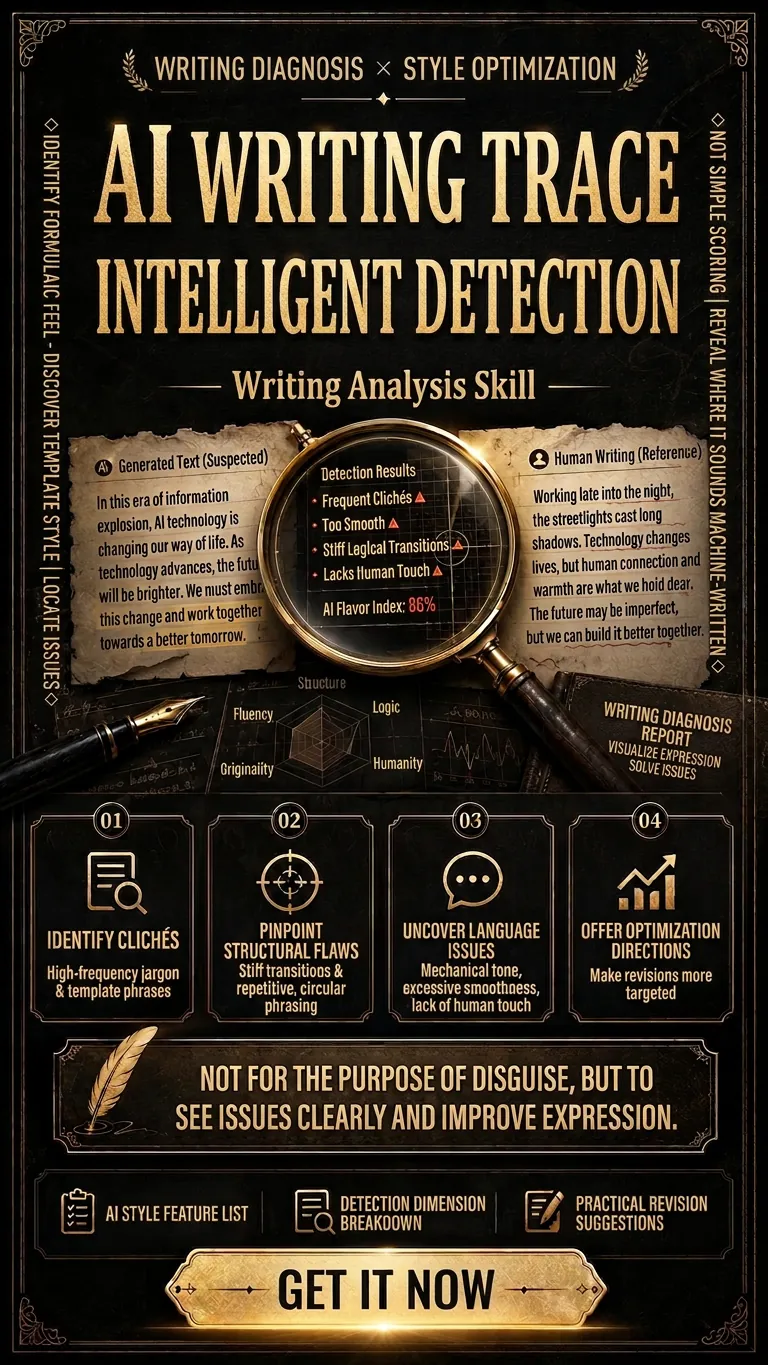 Write
WriteAI Writing Trace Detector
Want your writing to be free of AI traces and read like a product of genuine human thought? This intelligent assistant precisely identifies and eliminates possible AI-generated traces in your text. It deeply analyzes your writing from four core dimensions: structure, language, thought, and rhythm, ensuring your expression is full of judgment, personality, and authentic hesitation, rather than the machine's pursuit of 'correct and comprehensive'. After submitting your text, you will receive a detailed AI trace detection report. The report clearly marks high, medium, and low risk trace types, and provides original text citations and an overall diagnosis, giving you a clear view of the AI feel's source. Whether it's mechanically symmetrical paragraphs, frequently occurring AI high-frequency words, thought patterns lacking personal imprint, or overly uniform sentence rhythms, nothing will escape detection. Going further, it provides specific correction suggestions for each high and medium risk trace. These suggestions not only include correction examples, but also explain the rationale, helping you understand how to break uniformity, replace AI language, add traces of human thought, and create rhythm changes to make your writing radiate 'human touch'. Finally, it can output a fully corrected version and list key changes compared to the original, helping you create truly engaging and personalized content.
AI Reduction Diagnosis Rewrite
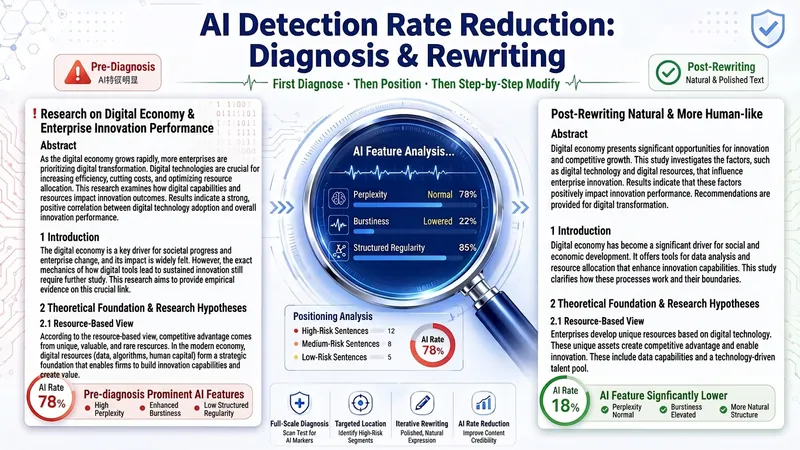
Intelligent assistant for reducing AI-generated content rate in academic papers. AI rate at 80%? Edited to collapse but still red? It won't help you blindly edit—it helps you diagnose, locate, and then modify in steps. Three-dimensional systematic diagnosis (perplexity, burstiness, structural regularity) scans and marks AI fingerprint positions dimension by dimension. Ten types of fingerprints are accurately classified, thirteen sentence restructuring techniques, and twenty high-frequency AI sentence blacklist items are cracked one by one. Risk maps for each chapter provide different treatments for different sections. One-step or step-by-step diagnosis: low-level users modify dimension by dimension, experts modify simultaneously. Supports pasting or uploading files of any length and any level. Outputs a complete diagnosis and rewriting report that is saved automatically. It's not about fooling the detector—it's about making your paper read like it was written by a real researcher with opinions, judgment, and style.
AI Prompt Architect MAX
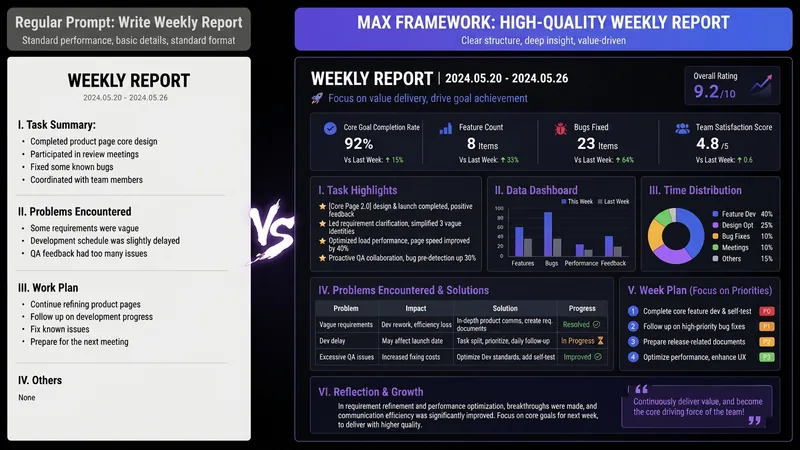
Have you ever had moments like these— You ask AI to write a weekly report, and it gives you a childish play-by-play; you ask it to revise a résumé, and it serves up “teamwork, diligence, and a strong sense of responsibility”; you ask it to analyze data, and it starts with, “As an AI, I’m happy to help you…” It’s not that AI is incapable—the problem is that your instructions are too amateurish. There are already plenty of Prompt templates teaching you how to write Prompts. But even after using them, you still can’t write your own—because what you’re missing isn’t a template. It’s the ability to compile requirements. This SKILL is my Prompt compiler: a condensed version of the Prompt architecture methodology I use every day as an AI OPC—someone working on the front lines of AI implementation—to write Prompts for teams. You explain what you need in plain language, and it gives you a top-tier architecture. Input: “Help me write a monthly report” Output: a complete eight-module Prompt architecture—role, task, audience, process, constraints, format, self-check, and examples, all locked in. Copy and paste it into ChatGPT / Claude / DeepSeek / Kimi, and the first output will be ready to use. Even better, it will tell you: ✓ Which model is best for this Prompt ✓ Which variables you can change directly next time (learn once, reuse repeatedly) ✓ Which one missing piece of information could take the output to the next level How is it different from an ordinary Prompt template SKILL? Other SKILLs give you a fish—one finished Prompt. This SKILL gives you a compiler—the ability to compile any requirement into a Prompt. Install it once, and every AI use case you have will improve—writing, reporting, analysis, translation, customer service, content creation, and more. Who should install it: People who use AI every day but are never satisfied with the output People who want to learn Prompt engineering without spending thousands on a course Team leaders who want to standardize AI use but don’t know where to start Content creators, researchers, students, job seekers, and side-hustle builders How well you use AI doesn’t depend on which model you choose. It depends on whether you can compile your requirements. Install it today, and the quality of your conversations with AI will take a dramatic leap forward.
Where's the AI?
Marks AI tone, explains, guides—no rewrite
Description
Recommended by
nene@YouMind
Why we love this skill
This skill doesn't rewrite text directly; it diagnoses AI writing's 'fingerprint vocabulary' and 'syntactic patterns', fundamentally improving your Chinese writing's distinctiveness.
Note: This skill is a diagnostic tool, not an automatic rewriter. It provides rewrite suggestions instead of directly modifying your text. Diagnose and correct AI flavor in Chinese writing. At the lexical level, it marks high-frequency AI words and vague modifiers. At the syntactic level, it identifies issues like equal-length parallelism, excessive conjunctions, and monotonous rhythm. Output: diagnostic report + specific rewrite suggestions. No automatic rewriting. Triggered when users mention 'AI flavor', 'de-AI', 'reads like AI', 'too robotic', 'reduce AI rate', 'too smooth', 'no human touch', or when requesting review, polishing, or style improvement. Also applicable for self-check after AI-assisted drafting.
Related Skills
View allWriteAI Writing Trace Detector
Want your writing to be free of AI traces and read like a product of genuine human thought? This intelligent assistant precisely identifies and eliminates possible AI-generated traces in your text. It deeply analyzes your writing from four core dimensions: structure, language, thought, and rhythm, ensuring your expression is full of judgment, personality, and authentic hesitation, rather than the machine's pursuit of 'correct and comprehensive'. After submitting your text, you will receive a detailed AI trace detection report. The report clearly marks high, medium, and low risk trace types, and provides original text citations and an overall diagnosis, giving you a clear view of the AI feel's source. Whether it's mechanically symmetrical paragraphs, frequently occurring AI high-frequency words, thought patterns lacking personal imprint, or overly uniform sentence rhythms, nothing will escape detection. Going further, it provides specific correction suggestions for each high and medium risk trace. These suggestions not only include correction examples, but also explain the rationale, helping you understand how to break uniformity, replace AI language, add traces of human thought, and create rhythm changes to make your writing radiate 'human touch'. Finally, it can output a fully corrected version and list key changes compared to the original, helping you create truly engaging and personalized content.
AI Reduction Diagnosis Rewrite
Intelligent assistant for reducing AI-generated content rate in academic papers. AI rate at 80%? Edited to collapse but still red? It won't help you blindly edit—it helps you diagnose, locate, and then modify in steps. Three-dimensional systematic diagnosis (perplexity, burstiness, structural regularity) scans and marks AI fingerprint positions dimension by dimension. Ten types of fingerprints are accurately classified, thirteen sentence restructuring techniques, and twenty high-frequency AI sentence blacklist items are cracked one by one. Risk maps for each chapter provide different treatments for different sections. One-step or step-by-step diagnosis: low-level users modify dimension by dimension, experts modify simultaneously. Supports pasting or uploading files of any length and any level. Outputs a complete diagnosis and rewriting report that is saved automatically. It's not about fooling the detector—it's about making your paper read like it was written by a real researcher with opinions, judgment, and style.
AI Prompt Architect MAX
Have you ever had moments like these— You ask AI to write a weekly report, and it gives you a childish play-by-play; you ask it to revise a résumé, and it serves up “teamwork, diligence, and a strong sense of responsibility”; you ask it to analyze data, and it starts with, “As an AI, I’m happy to help you…” It’s not that AI is incapable—the problem is that your instructions are too amateurish. There are already plenty of Prompt templates teaching you how to write Prompts. But even after using them, you still can’t write your own—because what you’re missing isn’t a template. It’s the ability to compile requirements. This SKILL is my Prompt compiler: a condensed version of the Prompt architecture methodology I use every day as an AI OPC—someone working on the front lines of AI implementation—to write Prompts for teams. You explain what you need in plain language, and it gives you a top-tier architecture. Input: “Help me write a monthly report” Output: a complete eight-module Prompt architecture—role, task, audience, process, constraints, format, self-check, and examples, all locked in. Copy and paste it into ChatGPT / Claude / DeepSeek / Kimi, and the first output will be ready to use. Even better, it will tell you: ✓ Which model is best for this Prompt ✓ Which variables you can change directly next time (learn once, reuse repeatedly) ✓ Which one missing piece of information could take the output to the next level How is it different from an ordinary Prompt template SKILL? Other SKILLs give you a fish—one finished Prompt. This SKILL gives you a compiler—the ability to compile any requirement into a Prompt. Install it once, and every AI use case you have will improve—writing, reporting, analysis, translation, customer service, content creation, and more. Who should install it: People who use AI every day but are never satisfied with the output People who want to learn Prompt engineering without spending thousands on a course Team leaders who want to standardize AI use but don’t know where to start Content creators, researchers, students, job seekers, and side-hustle builders How well you use AI doesn’t depend on which model you choose. It depends on whether you can compile your requirements. Install it today, and the quality of your conversations with AI will take a dramatic leap forward.
Find your next favorite skill
Explore more curated AI skills for research, creation, and everyday work.