Qi Li
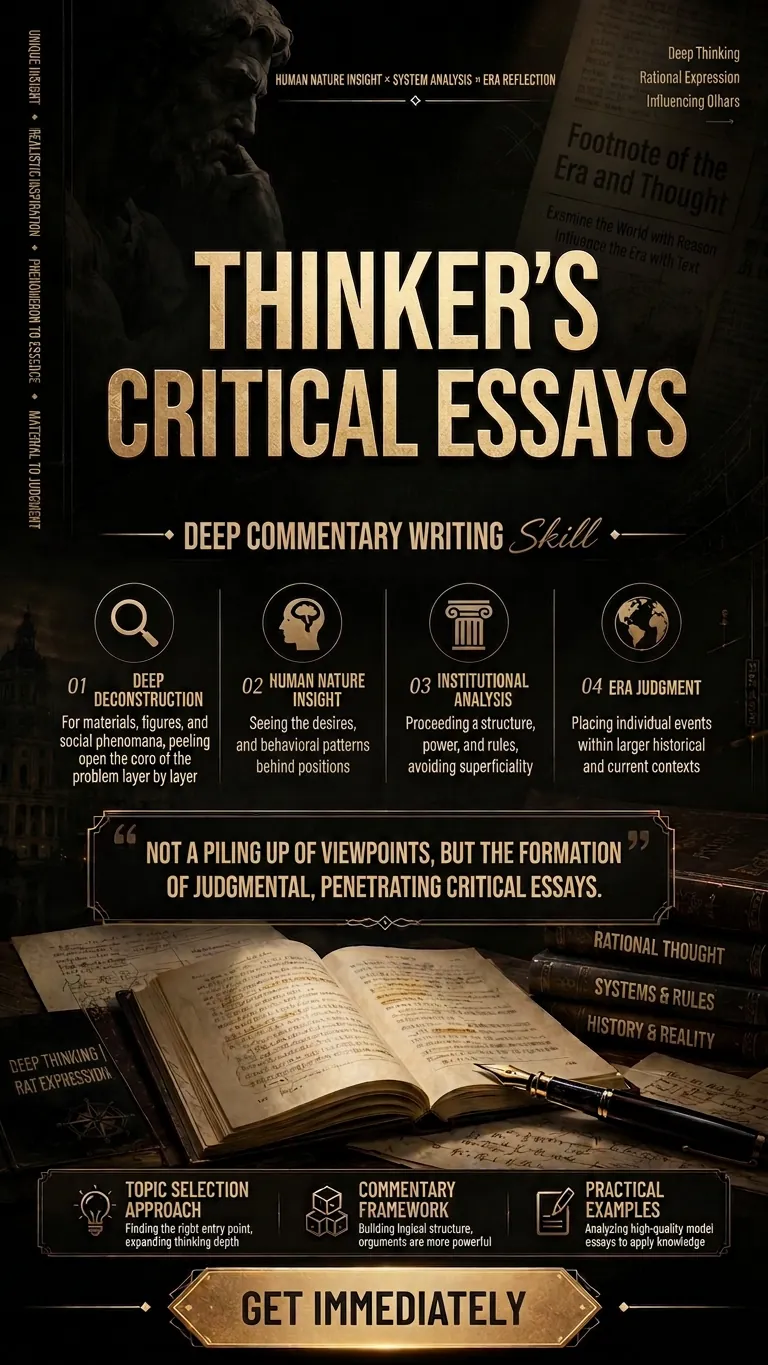
Deep Insight Commentary
The Sage's Commentary helps you deeply analyze materials, people, or social phenomena, going beyond the surface to reach the core. Based on reading, it integrates insights from history, institutions, human nature, and inner depth to provide unique perspectives and practical inspiration. Whether you're taking book notes, analyzing historical figures, commenting on social phenomena, or deconstructing political power structures, this tool helps you start from the text, deconstruct common sense, and deeply analyze structure, human nature, institutions, and the trends of the era, ultimately forming personal judgments that guide action. It advocates learning from history and breaking attachments with the heart, not blindly following authority or being trapped by emotions—seek the truth first, then judge. You can use it to organize scattered ideas into layered long-form writing or elevate ordinary material into thought-dense articles. It's especially suited for analyzing literary character psychology, reinterpreting classical ideas in modern contexts, and reflecting on personal situations and creative challenges, as well as deep discussions on topics like AI and knowledge production in the information age. In the end, it provides judgments that are both sharp and restrained, rather than empty slogans or feel-good platitudes.
 Write
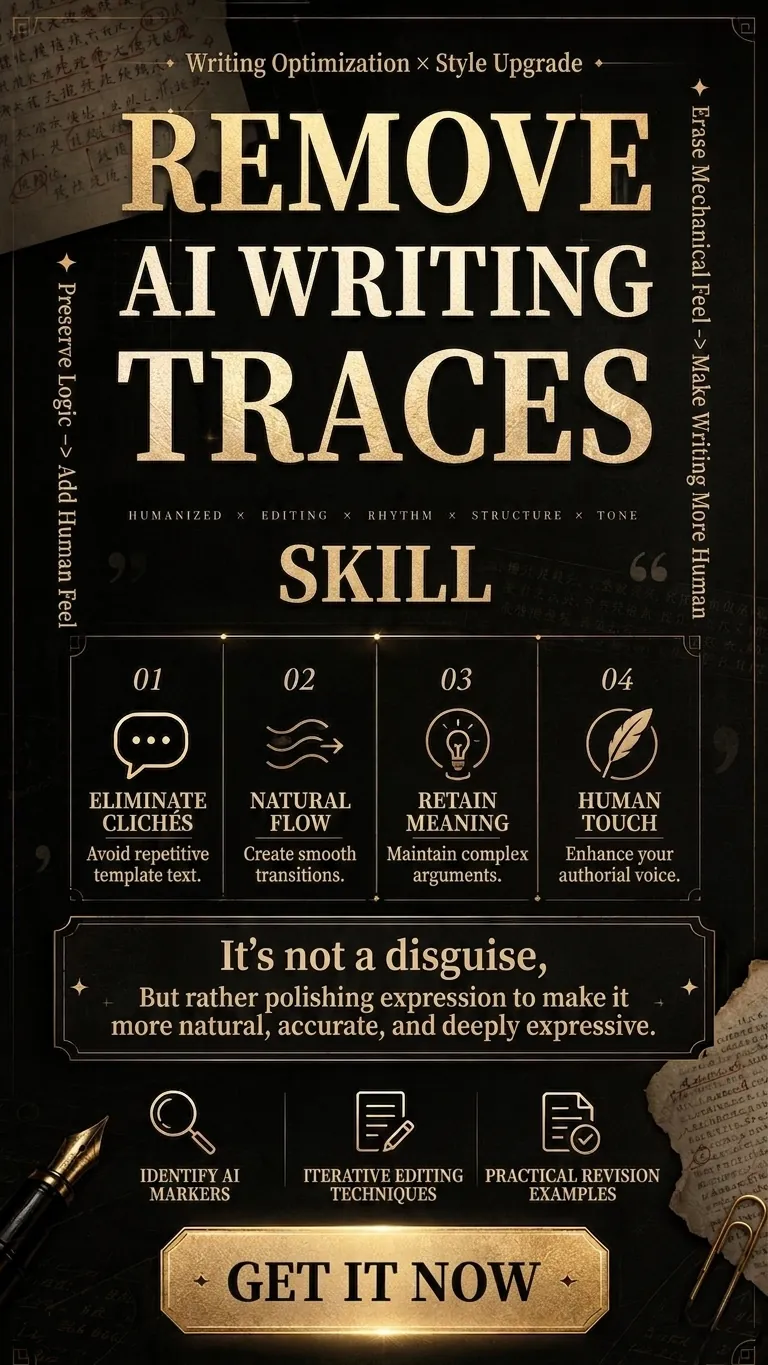
WriteAI Writing Humanizer
Want to eliminate the common 'industrialized' traces in Chinese AI text, giving your writing genuine human warmth and depth? This skill focuses on removing formulaic expressions in AI writing, injecting lively judgment, natural rhythm, unique emphasis, rich details, and authentic tone. It is especially adept at handling in-depth content such as comments, personal essays, historical analysis, political philosophy, social observations, reading notes, and long-form WeChat articles. By identifying and rewriting rigid aspects—from word choice and sentence structure to overall argumentation—this skill helps you transform grand, universally correct narratives into specific, nuanced insights, giving your writing a smooth and natural flow. Without altering the original meaning, it carefully diagnoses AI traces, such as identifying vague clichés, repetitive sentence patterns, and overly balanced tones. It replaces these mechanical elements with more concrete and insightful expressions, infusing your article with the author's personal thoughts and judgments rather than a cold logical construct. Additionally, for issues that mere polishing cannot solve, it points out where facts, examples, or arguments are needed, ensuring both depth and breadth. The result is a Chinese article that is not only clear in viewpoint but also full of human touch and personalized expression. It retains necessary professionalism while removing exaggerated adjectives and stiff connectors, making the text as natural as breathing—powerful yet warm, and far from being 'correct nonsense'.
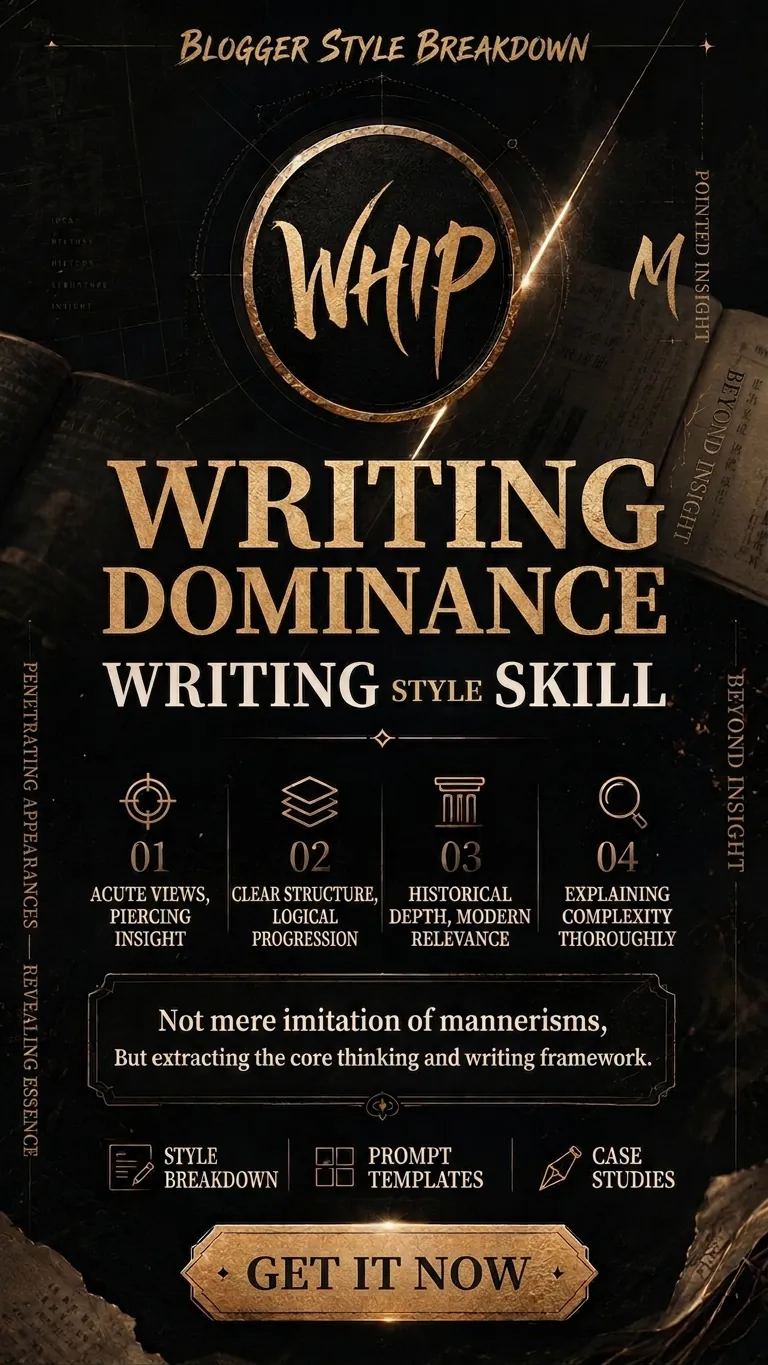
Bianlin Tianxia Writing Style
Skill Name: Writing Methodology of Zhihu Blogger "Bianlin Tianxia" Reference: Summarized from readable samples by Zhihu blogger "Bianlin Tianxia" Nature: Writing methodology, not personality imitation or speech pattern cloning Applicable Language: Chinese Core Uses: Historical commentary, institutional analysis, social observation, long-form Zhihu answers, WeChat public account articles, book review notes, public issue analysis
 Write
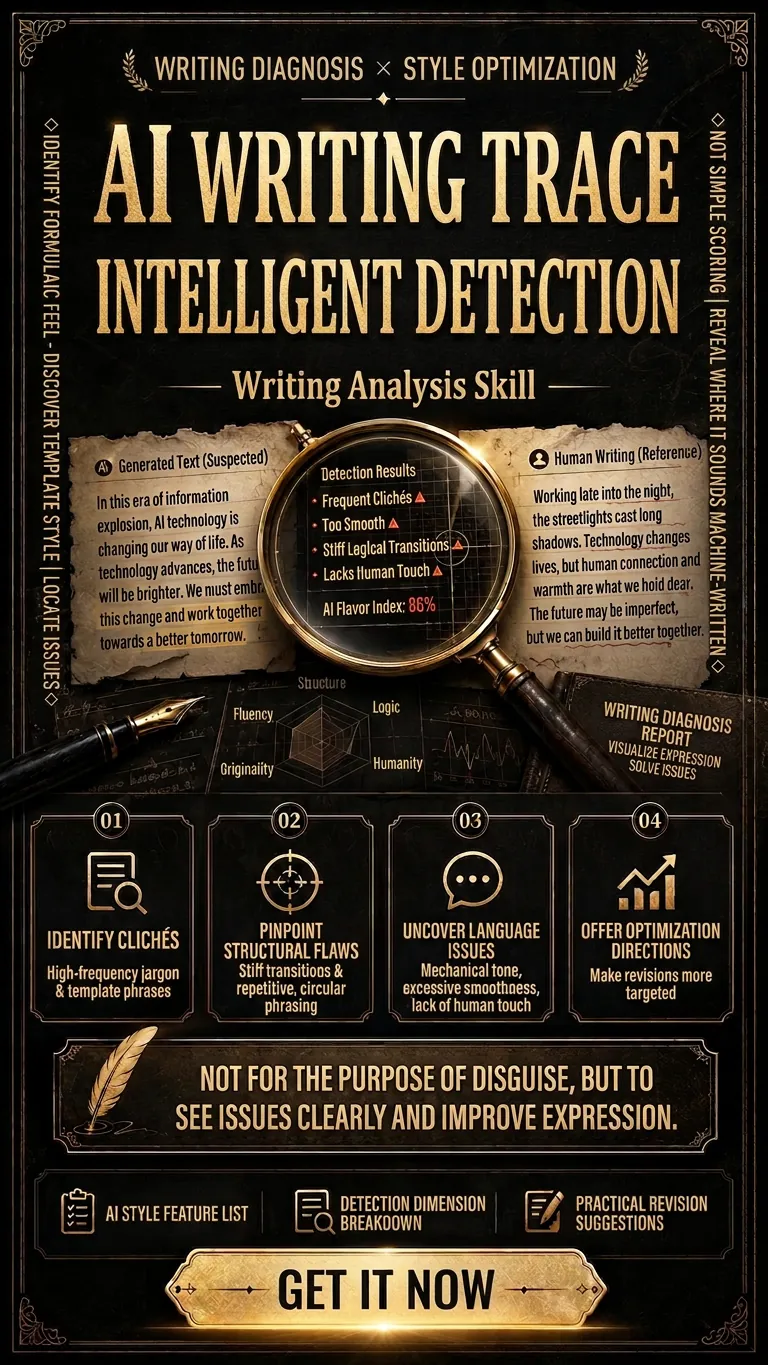
WriteAI Writing Trace Detector
Want your writing to be free of AI traces and read like a product of genuine human thought? This intelligent assistant precisely identifies and eliminates possible AI-generated traces in your text. It deeply analyzes your writing from four core dimensions: structure, language, thought, and rhythm, ensuring your expression is full of judgment, personality, and authentic hesitation, rather than the machine's pursuit of 'correct and comprehensive'. After submitting your text, you will receive a detailed AI trace detection report. The report clearly marks high, medium, and low risk trace types, and provides original text citations and an overall diagnosis, giving you a clear view of the AI feel's source. Whether it's mechanically symmetrical paragraphs, frequently occurring AI high-frequency words, thought patterns lacking personal imprint, or overly uniform sentence rhythms, nothing will escape detection. Going further, it provides specific correction suggestions for each high and medium risk trace. These suggestions not only include correction examples, but also explain the rationale, helping you understand how to break uniformity, replace AI language, add traces of human thought, and create rhythm changes to make your writing radiate 'human touch'. Finally, it can output a fully corrected version and list key changes compared to the original, helping you create truly engaging and personalized content.