
AI Writing Humanizer
Remove AI industrial traces, humanize text.
Description
Recommended by
Nico@YouMind
Why we love this skill
It removes industrial traces from AI text, injecting human judgment, rhythm, and details, making your writing insightful rather than generically correct.
Want to eliminate the common 'industrialized' traces in Chinese AI text, giving your writing genuine human warmth and depth? This skill focuses on removing formulaic expressions in AI writing, injecting lively judgment, natural rhythm, unique emphasis, rich details, and authentic tone. It is especially adept at handling in-depth content such as comments, personal essays, historical analysis, political philosophy, social observations, reading notes, and long-form WeChat articles. By identifying and rewriting rigid aspects—from word choice and sentence structure to overall argumentation—this skill helps you transform grand, universally correct narratives into specific, nuanced insights, giving your writing a smooth and natural flow. Without altering the original meaning, it carefully diagnoses AI traces, such as identifying vague clichés, repetitive sentence patterns, and overly balanced tones. It replaces these mechanical elements with more concrete and insightful expressions, infusing your article with the author's personal thoughts and judgments rather than a cold logical construct. Additionally, for issues that mere polishing cannot solve, it points out where facts, examples, or arguments are needed, ensuring both depth and breadth. The result is a Chinese article that is not only clear in viewpoint but also full of human touch and personalized expression. It retains necessary professionalism while removing exaggerated adjectives and stiff connectors, making the text as natural as breathing—powerful yet warm, and far from being 'correct nonsense'.
Related Skills
View all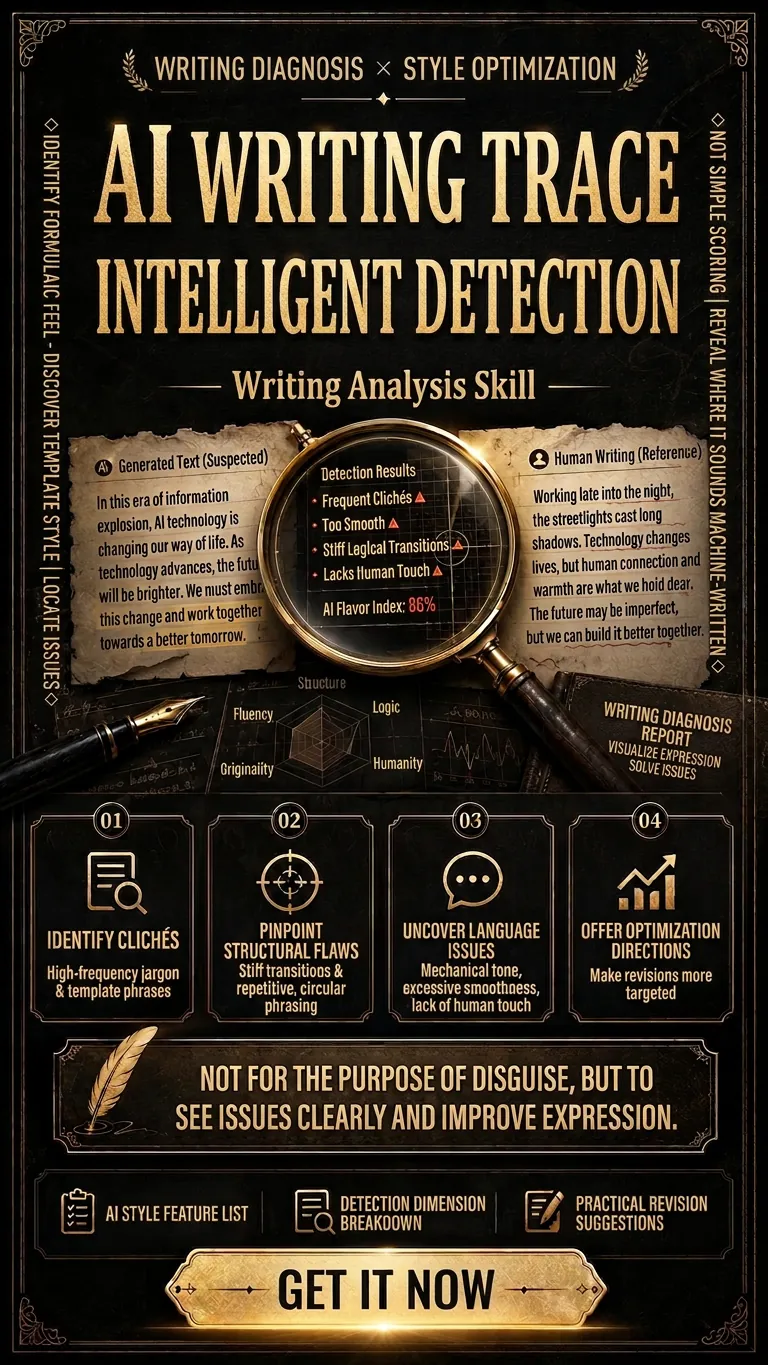 Write
WriteAI Writing Trace Detector
Want your writing to be free of AI traces and read like a product of genuine human thought? This intelligent assistant precisely identifies and eliminates possible AI-generated traces in your text. It deeply analyzes your writing from four core dimensions: structure, language, thought, and rhythm, ensuring your expression is full of judgment, personality, and authentic hesitation, rather than the machine's pursuit of 'correct and comprehensive'. After submitting your text, you will receive a detailed AI trace detection report. The report clearly marks high, medium, and low risk trace types, and provides original text citations and an overall diagnosis, giving you a clear view of the AI feel's source. Whether it's mechanically symmetrical paragraphs, frequently occurring AI high-frequency words, thought patterns lacking personal imprint, or overly uniform sentence rhythms, nothing will escape detection. Going further, it provides specific correction suggestions for each high and medium risk trace. These suggestions not only include correction examples, but also explain the rationale, helping you understand how to break uniformity, replace AI language, add traces of human thought, and create rhythm changes to make your writing radiate 'human touch'. Finally, it can output a fully corrected version and list key changes compared to the original, helping you create truly engaging and personalized content.
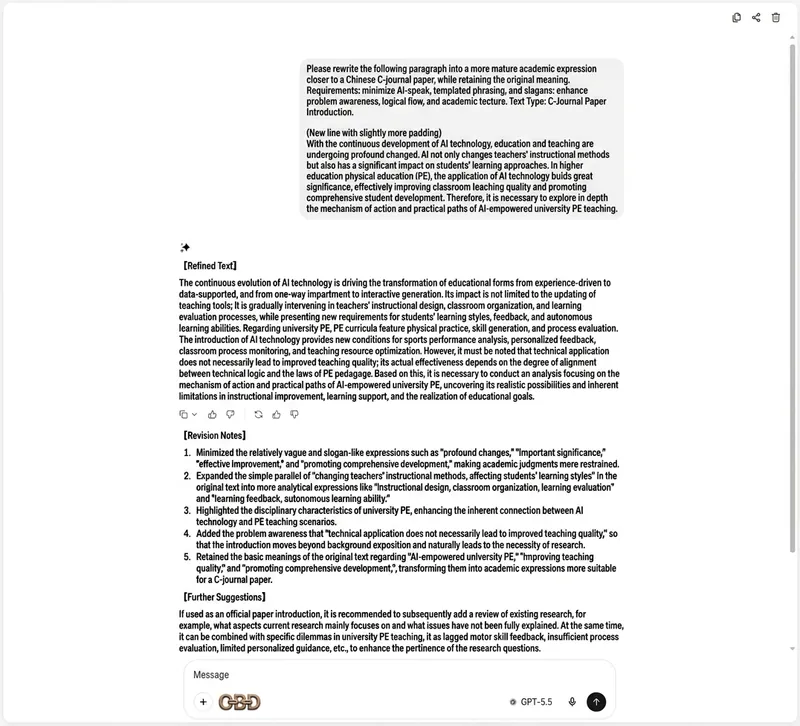
Mimic CSSCI Expert Writing
This AI assistant can polish your Chinese academic texts—such as papers, project proposals, or academic reviews—to the mature expression standards of CSSCI and core journals. It focuses on strengthening the text's problem awareness, theoretical rigor, logical coherence, and concise expression, aiming to reduce AI writing traces, avoid empty clichés, mechanical parallelism, and unsupported exaggerated expressions, making your research outputs more academically distinctive and rigorous. Whether you are writing an academic paper, preparing a project proposal, or conducting an academic review, this tool can adjust its polishing style according to the text type. It ensures that core arguments, data, reference numbers, and specialized terms remain unchanged, while optimizing sentence structure and improving conceptual accuracy and judgment restraint, making your expression more aligned with the norms and habits of high-level Chinese academic writing. By refining common and formulaic expressions and transforming them into more profound and insightful academic language, this tool helps your text present stronger professionalism and persuasiveness. It not only enhances the academic quality of the writing but also ensures that your research outcomes are clearer in logic and more refined in expression, enabling them to stand out in academic communication and review.
 Write
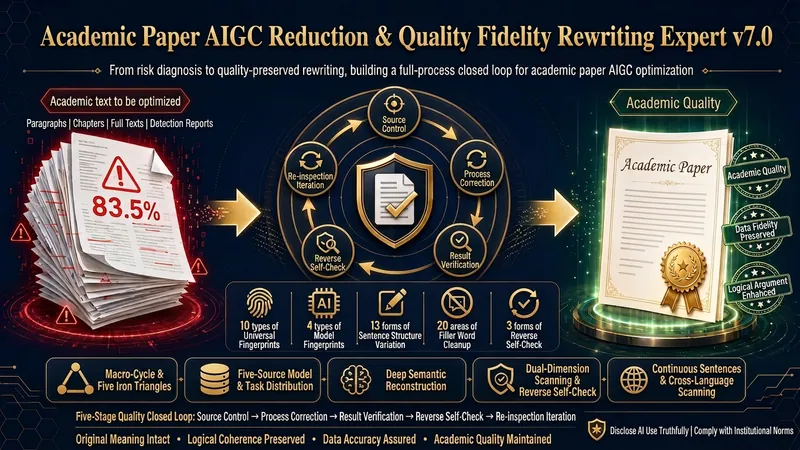
WriteAIGC Reduction & Rewrite v7.0
📚 Academic Paper AIGC Reduction and Quality-Preserving Rewriting Expert v7.0 Designed for graduate students, researchers, and paper authors, this academic text optimization skill operates on a core closed loop of 'source control → process correction → result verification → reverse self-check → iterative re-check'. It systematically diagnoses and optimizes issues such as templated expressions, mechanical logic, vague content, inaccurate terminology, and style inconsistencies while preserving original meaning, technical terms, data, and core conclusions. 🔍📝 🌟 Core Capabilities 🔬 Multi-layer Risk Diagnosis Covers 10 types of universal text fingerprints and assists in identifying common expression patterns of models such as ChatGPT, Claude, DeepSeek, and Wenxin Yiyan. 🧠 Deep Semantic Restructuring Goes beyond synonym replacement to rebuild more natural and in-depth academic reasoning by adjusting proposition expression, information order, argument approach, and evidence organization. ✍️ Quality-Preserving Rewriting Comprehensively applies 13 sentence transformation strategies and 20 methods for cleaning high-frequency templated expressions, improving mechanical sentence structures, repetitive connectors, and overly rigid formatting. 📊 Full-text Structure Diagnosis Through macro-cycle and five key triangles, checks whether research problems, theory, literature review, methods, results, conclusions, and innovation form a complete closed loop. 🧩 Fine-grained Section Adaptation Develops differentiated diagnostic and rewriting strategies for abstract, introduction, literature review, research methods, results, discussion, and conclusion respectively. 🌐 Cross-language Risk Scanning Assists in identifying translationese, passive voice stacking, long sentence nesting, and mixed Chinese-English formatting abnormalities to make Chinese academic expression more natural and accurate. 🔄 Reverse Self-check Loop After rewriting, re-verifies from three aspects: technique distribution, new text fingerprints, and information integrity, to avoid 'becoming more templated' or losing key content. 🛡️ Academic Integrity Protection Does not fabricate literature, data, cases, or policy evidence; separately marks information requiring author verification and reminds users to honestly disclose AI usage. 🎯 Use Cases ✅ Single paragraph or partial section optimization ✅ Targeted modification of marked paragraphs from inspection reports ✅ Polishing of abstract, introduction, literature review, discussion, and conclusion ✅ Full-text AIGC risk feature diagnosis ✅ Language and structure adaptation for target journals ✅ Pre-submission quality review and consistency check 📦 Final Deliverables 📄 Quality-preserving rewritten text 🔎 Risk and issue diagnosis report 🛠️ Rewriting strategy and technique description ✅ Reverse self-check and information integrity report 💡 Items requiring author verification and subsequent revision suggestions 🎓 Original meaning preserved · Logic intact · No fabricated data · Academic quality maintained ⚠️ This skill aims to improve academic expression quality and reduce text risk features. It does not guarantee passage through any specific detection platform or achieving a particular detection score.
AI Writing Humanizer
Remove AI industrial traces, humanize text.
Description
Recommended by
Nico@YouMind
Why we love this skill
It removes industrial traces from AI text, injecting human judgment, rhythm, and details, making your writing insightful rather than generically correct.
Want to eliminate the common 'industrialized' traces in Chinese AI text, giving your writing genuine human warmth and depth? This skill focuses on removing formulaic expressions in AI writing, injecting lively judgment, natural rhythm, unique emphasis, rich details, and authentic tone. It is especially adept at handling in-depth content such as comments, personal essays, historical analysis, political philosophy, social observations, reading notes, and long-form WeChat articles. By identifying and rewriting rigid aspects—from word choice and sentence structure to overall argumentation—this skill helps you transform grand, universally correct narratives into specific, nuanced insights, giving your writing a smooth and natural flow. Without altering the original meaning, it carefully diagnoses AI traces, such as identifying vague clichés, repetitive sentence patterns, and overly balanced tones. It replaces these mechanical elements with more concrete and insightful expressions, infusing your article with the author's personal thoughts and judgments rather than a cold logical construct. Additionally, for issues that mere polishing cannot solve, it points out where facts, examples, or arguments are needed, ensuring both depth and breadth. The result is a Chinese article that is not only clear in viewpoint but also full of human touch and personalized expression. It retains necessary professionalism while removing exaggerated adjectives and stiff connectors, making the text as natural as breathing—powerful yet warm, and far from being 'correct nonsense'.
Related Skills
View allWriteAI Writing Trace Detector
Want your writing to be free of AI traces and read like a product of genuine human thought? This intelligent assistant precisely identifies and eliminates possible AI-generated traces in your text. It deeply analyzes your writing from four core dimensions: structure, language, thought, and rhythm, ensuring your expression is full of judgment, personality, and authentic hesitation, rather than the machine's pursuit of 'correct and comprehensive'. After submitting your text, you will receive a detailed AI trace detection report. The report clearly marks high, medium, and low risk trace types, and provides original text citations and an overall diagnosis, giving you a clear view of the AI feel's source. Whether it's mechanically symmetrical paragraphs, frequently occurring AI high-frequency words, thought patterns lacking personal imprint, or overly uniform sentence rhythms, nothing will escape detection. Going further, it provides specific correction suggestions for each high and medium risk trace. These suggestions not only include correction examples, but also explain the rationale, helping you understand how to break uniformity, replace AI language, add traces of human thought, and create rhythm changes to make your writing radiate 'human touch'. Finally, it can output a fully corrected version and list key changes compared to the original, helping you create truly engaging and personalized content.
Mimic CSSCI Expert Writing
This AI assistant can polish your Chinese academic texts—such as papers, project proposals, or academic reviews—to the mature expression standards of CSSCI and core journals. It focuses on strengthening the text's problem awareness, theoretical rigor, logical coherence, and concise expression, aiming to reduce AI writing traces, avoid empty clichés, mechanical parallelism, and unsupported exaggerated expressions, making your research outputs more academically distinctive and rigorous. Whether you are writing an academic paper, preparing a project proposal, or conducting an academic review, this tool can adjust its polishing style according to the text type. It ensures that core arguments, data, reference numbers, and specialized terms remain unchanged, while optimizing sentence structure and improving conceptual accuracy and judgment restraint, making your expression more aligned with the norms and habits of high-level Chinese academic writing. By refining common and formulaic expressions and transforming them into more profound and insightful academic language, this tool helps your text present stronger professionalism and persuasiveness. It not only enhances the academic quality of the writing but also ensures that your research outcomes are clearer in logic and more refined in expression, enabling them to stand out in academic communication and review.
WriteAIGC Reduction & Rewrite v7.0
📚 Academic Paper AIGC Reduction and Quality-Preserving Rewriting Expert v7.0 Designed for graduate students, researchers, and paper authors, this academic text optimization skill operates on a core closed loop of 'source control → process correction → result verification → reverse self-check → iterative re-check'. It systematically diagnoses and optimizes issues such as templated expressions, mechanical logic, vague content, inaccurate terminology, and style inconsistencies while preserving original meaning, technical terms, data, and core conclusions. 🔍📝 🌟 Core Capabilities 🔬 Multi-layer Risk Diagnosis Covers 10 types of universal text fingerprints and assists in identifying common expression patterns of models such as ChatGPT, Claude, DeepSeek, and Wenxin Yiyan. 🧠 Deep Semantic Restructuring Goes beyond synonym replacement to rebuild more natural and in-depth academic reasoning by adjusting proposition expression, information order, argument approach, and evidence organization. ✍️ Quality-Preserving Rewriting Comprehensively applies 13 sentence transformation strategies and 20 methods for cleaning high-frequency templated expressions, improving mechanical sentence structures, repetitive connectors, and overly rigid formatting. 📊 Full-text Structure Diagnosis Through macro-cycle and five key triangles, checks whether research problems, theory, literature review, methods, results, conclusions, and innovation form a complete closed loop. 🧩 Fine-grained Section Adaptation Develops differentiated diagnostic and rewriting strategies for abstract, introduction, literature review, research methods, results, discussion, and conclusion respectively. 🌐 Cross-language Risk Scanning Assists in identifying translationese, passive voice stacking, long sentence nesting, and mixed Chinese-English formatting abnormalities to make Chinese academic expression more natural and accurate. 🔄 Reverse Self-check Loop After rewriting, re-verifies from three aspects: technique distribution, new text fingerprints, and information integrity, to avoid 'becoming more templated' or losing key content. 🛡️ Academic Integrity Protection Does not fabricate literature, data, cases, or policy evidence; separately marks information requiring author verification and reminds users to honestly disclose AI usage. 🎯 Use Cases ✅ Single paragraph or partial section optimization ✅ Targeted modification of marked paragraphs from inspection reports ✅ Polishing of abstract, introduction, literature review, discussion, and conclusion ✅ Full-text AIGC risk feature diagnosis ✅ Language and structure adaptation for target journals ✅ Pre-submission quality review and consistency check 📦 Final Deliverables 📄 Quality-preserving rewritten text 🔎 Risk and issue diagnosis report 🛠️ Rewriting strategy and technique description ✅ Reverse self-check and information integrity report 💡 Items requiring author verification and subsequent revision suggestions 🎓 Original meaning preserved · Logic intact · No fabricated data · Academic quality maintained ⚠️ This skill aims to improve academic expression quality and reduce text risk features. It does not guarantee passage through any specific detection platform or achieving a particular detection score.
Find your next favorite skill
Explore more curated AI skills for research, creation, and everyday work.