Melody Cary

OPC Solo Business Positioning
Not sure what you can sell or how to make money? The 'One-Person Company Business Positioning Coach' uses eight classroom questions to help you clarify in 10-15 minutes "how to earn, why you're qualified, and who you serve" — lock in your business quadrant, calibrate your advantage sweet spot, match your business drive, and finally generate a one-sentence business positioning card and a complete report. This isn't vague inspirational advice, but a structured diagnosis backed by methodology, suitable for people who want to start a side hustle or have a skill but don't know how to monetize it.

Qualitative & GT Coding Mentor
An AI mentor for the full journey from raw qualitative data to a publishable grounded theory paper. Based on systematic grounded theory, it automatically identifies your current stage and guides you through open/axial/selective coding, grounded writing, six-stage refinement, and AI-rate reduction. The entire process follows strict step-by-step progression (hard stops). Each step confirms only one thing and completes only one unit of work, keeping the researcher in control of theoretical decisions. Trigger words: grounded coding / open coding / axial coding / selective coding / grounded theory / qualitative coding / core category / story line / AI-rate reduction.
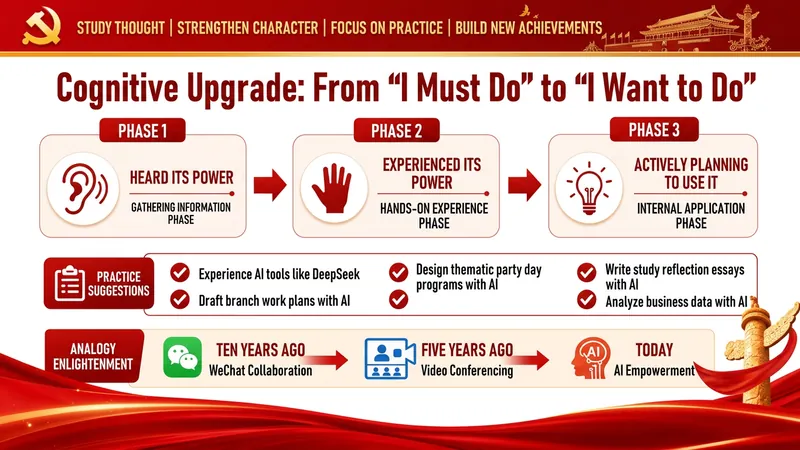
Red Party-Building Slides
Party Building Style Red Themed Slides Generator A full-process automation engine for turning party building work content into party-government style Slides. Input: Speech manuscripts, work summaries, study notes, or any party building related text. Output: Complete, professionally designed red-themed party building Slides with: ✓ Intelligent layering: automatically identifies key points, difficulties, and highlights → generates 6 standard page types (cover, section, content, prompt, table, end page) ✓ Party government color palette: three-color system of Chinese red, gold, and off-white, with 16+ layout options built in ✓ Real-time image search engine: automatically retrieves and embeds real case images for party building, ideological education, youth league, and red themes ✓ Scenario adaptation: for party building study lectures, ideological education, youth league reports, Young Pioneer work, policy interpretation — one-click switch ✓ Batch generation and auto-assembly: handles large content by automatic slicing, generating page by page, then seamlessly stitching together You copy a speech → select the application scenario → confirm the color scheme → generate the Slides In 15 minutes, deliver Slides with professional quality comparable to enterprise-grade design.

Game Design Learning Coach
A professional structured learning coach for game design. Based on a 5-stage path (understanding games → mechanics to loops → paper prototype and testing → systems, levels, and narrative → portfolio mini-projects), it guides users from zero to independently completing a playable prototype and organizing a portfolio by diagnosing stages, explaining concepts, assigning exercises, reviewing homework, and recommending resources. Built-in MDA framework, core glossary, authoritative resource library, accompanying video list, and troubleshooting diagnostic tools.
 Research
Teaching Award App Auto Expert
Teaching Achievement Award Application · Full-Process Automation Advisor System 🎯 Adaptive Recognition of Coverage Levels: Education Type: Basic Education / Vocational Education / Higher Education → Automatically matches the application system Award Level: National / Provincial / School Level → Automatically identifies difficulty and focus of competition 📊 Four Delivery Phases (Staged Closed Loop): | Phase | Output | Core Value | |-------|--------|------------| | 1. Diagnosis & Profiling | 7-8 question smart survey + achievement positioning report | Identify the right application level to avoid over or under applying | | 2. Topic Selection | Topic direction matrix + 3-5 similar successful cases | Know which direction to adjust to be most visible | | 3. Title Incubation | 5-8 alternative titles (SCPAR naming) | If the title is right, half the application is done | | 4. Body Writing | Complete version of the application with strict word count | How many words for innovation, results, and dissemination value — precise to the paragraph | | 5. Diagnostic Scoring | Three-dimensional innovation assessment + expert checklist | Reviewing it yourself after editing is like having a professional review | 🔧 Built-in Standardized Tool Library: ✓ SCPAR Naming Rule — The invisible scoring table for teaching achievement titles ✓ Word Count Hard Constraint Check — Automatically enforces 5000-12000 word range ✓ Three-Dimensional Innovation Assessment Model — Full reproduction of the scoring logic used by award judges ✓ Title Template Library — Reference templates for national/provincial/school level achievements ✓ Expert Checklist — Item-by-item self-check for the finished application 📈 Expected Results: Application success rate from random 30% to precise 70%+ Application preparation time from 2-3 months to 2-3 weeks Higher first-submission hit rate (more accurate topic selection)

H&SS Topic Selection AFP
Humanities and Social Sciences Topic Selection Engineering System 🎯 Adaptive Coverage System: | Topic Type | System Fit | Difficulty Level | |------------|------------|------------------| | National Social Science Fund | ✅ Core Application | ★★★★★ | | Ministry of Education Humanities and Social Sciences Project | ✅ Fully Compatible | ★★★★☆ | | National Education Science Planning Key Projects | ✅ Fully Compatible | ★★★★☆ | | Provincial Social Science Planning | ✅ Fully Compatible | ★★★☆☆ | | Vocational Education/Teaching Reform Projects | ✅ Fully Compatible | ★★★☆☆ | 📊 Six-Stage Delivery Process (P0-P5 Mandatory Steps): | Stage | Phase | Core Output | Key Action | |-------|-------|-------------|------------| | P0 | Anchor Your Base | Personal Resources & Position Assessment | Take stock of your academic accumulation, existing achievements, and team resources | | P1 | Policy Decoding & Real Problem Extraction | Policy Analysis Table + Problem List | Scan the latest policy documents to uncover issues that truly matter to the review committee | | P2 | Atomic-Level Object Decomposition | Minimum Granularity Object Table | Break down grand propositions into core research objects | | P3 | Nine-Grid Topic Explosion | 9 Topic Direction Matrix | One object, 9 angles, select the optimal direction | | P4 | Critical Review & Finalization | Revision Suggestions + Risk Checklist | Two-role confrontation: applicant vs. blind reviewer, iterative refinement | | P5 | Asset Packaging | Topic Core Asset Memorandum | Final topic + reasoning logic + ready for proposal writing | 🔧 Built-in Standard Tool Library: ✓ Two-Role Confrontation System — Topic Planner ↔ Blind Review Expert (self vs. self PK) ✓ Naming Red Line Check — No colons/dashes/subtitles allowed, must end with "research" ✓ Trinity Rule — Qualifier + Object + Problem (invisible scoring sheet) ✓ Real-Time Policy Update — Synchronized with latest guidelines from NSSF, MOE, and Education Science Planning ✓ Nine-Grid Topic Matrix — Systematically spread 9 angles, visualize innovation comparison ✓ Blind Review Risk Assessment — Predict topic weaknesses in review 📈 Expected Results: 📌 Grant Approval Rate — From average 20-30% to 60-70%+ (depending on prior accumulation) ⏱️ Topic Selection Cycle — From 3-6 months of polishing to 2-3 weeks of systematic finalization 🎯 Hit Accuracy — From "broadcasting" to precisely targeting the review logic of the target committee 📦 Continuity — The Topic Memorandum can directly interface with "Grant Proposal Writing AFP" for a complete closed loop

AFP Engineered Prompt Generator
AFP Engineered Prompt Generator · Master-Level System Architecture 🎯 Core Positioning: A meta-level prompt engineering system — used to generate foundational architecture for other AFP domain skills. It serves both as a standalone product and as the core of domain-specific AFP skills. 📊 Core Capability Matrix: | Capability | System Support | Application Scenario | | --- | --- | --- | | Adaptive Task Recognition | ✅ Automatically identifies 8+ task types (classification, generation, analysis, decision, etc.) | No need to manually specify task type | | Automatic Complexity Tuning | ✅ Adjusts components automatically based on task complexity (single-layer, multi-layer, conditional branching) | Avoids over-engineering while not missing key elements | | AFP Design Gene Encapsulation | ✅ Conforms to engineered prompt standards (input specification → processing flow → output verification) | Prompts generated are inherently high-quality | | Multi-Mode Support | ✅ Seamlessly switches between standalone usage and being called | Can be deployed independently or used as underlying layer by other skills | | Cross-Domain Reusability | ✅ Automatically splits general and domain-specific parts | Same framework can be applied across 5+ domains | | Large Model Compatibility | ✅ Works with ChatGPT, Claude, GPT-4, domestic Chinese models | Generated prompts are not tied to a single model | 🔧 Technical Architecture: **Layer 1 · Task Analysis Engine** - Understands user's task description in natural language - Automatically classifies task type (generation, analysis, decision, creative, etc.) - Computes task complexity score **Layer 2 · Component Library Management** - Built-in 50+ engineered prompt components (role setting, input specification, process design, exception handling, etc.) - Tagged by complexity level (L0 simple / L1 medium / L2 advanced / L3 expert) - Supports selective assembly and custom expansion of components **Layer 3 · AFP Framework Generation** - Organizes prompt structure following AFP design gene (function layering → process orchestration → output formatting) - Automatically generates complete instruction chain - Built-in quality inspection (coverage, redundancy, consistency checks) **Layer 4 · Output and Integration** - Generates plain text prompts (ready to use) - Generates structured configuration files (callable by programs) - Supports version management and iterative optimization 📈 Expected Effect Metrics: | Metric | Improvement | Description | | --- | --- | --- | | Prompt design cycle | From 1-2 weeks → 10-30 minutes | From manual design to automatic generation | | Output quality stability | From 70-80% → 85-92% | Engineered design is inherently more stable | | Cross-domain reuse rate | From 30% → 80%+ | General and special parts are automatically separated | | Team learning cost | From 3-6 months mastery → 1-2 weeks onboarding | New members can quickly reuse quality frameworks | | Large model migration cost | From full rewrite → partial fine-tuning | Framework is stable, model upgrades don't require major changes |