
Kid Slang? | Parent Scripts
Youth Slang Guide: Decode Memes, Get Scripts
Description
Select in order: your child's age, meme type, setting, frequency, and impact. If you don't know the meme, upload a screenshot or recording, or enter the original text.
Related Skills
View all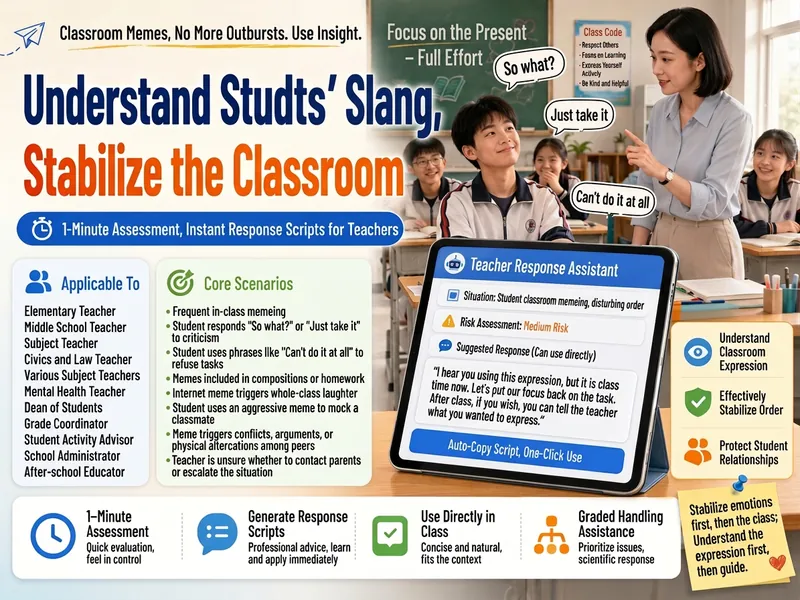
Teacher Meme Script Generator
Students using memes in class no longer require an immediate angry response. When a student suddenly says 'So what?', 'Just take it', or 'Can't do it', a teacher's angry outburst can cause laughter and confrontation; ignoring it can lead to classroom rules being broken. Student memes can sometimes lighten the mood, but may also be a way to avoid criticism, refuse tasks, disrupt the class, or even hurt peers. This Skill is designed for primary and secondary school homeroom teachers, subject teachers, moral education teachers, guidance counselors, and school administrators. Simply select the student's grade level, meme scenario, type of internet meme, number of students involved, frequency, and consequences, and the system will automatically generate: - Nature of the incident and risk level; - 10–30 second in-class immediate response scripts; - Outline for after-class individual conversation; - Alternative appropriate expression suggestions; - Home-school communication text; - Class language education activities; - Indication of peer harm or bullying risk. This Skill is developed from teaching experience, student communication observations, and real family education scenarios. It is not about simply 'controlling students,' but helping teachers quickly assess, maintain classroom order, guide after class, and identify peer harm risks when necessary.

Tailored Parenting Dialogues
Waking up, sulking, seeing a news article... everyday little things are opportunities for seamless guidance. It helps you see the opportunity and know how to start a conversation. ⚡ Review Past Events 「My child came home today and said a classmate took his eraser and hasn't returned it. He's angry but afraid to tell the teacher.」 → We'll walk through: spot the opportunity, create the dialogue, listen attentively, respond effectively. A virtual practice so you'll feel confident next time in a similar situation; practice more and you'll be able to handle new scenarios on your own. 🔮 Anticipate What Hasn't Happened Yet 「Next week is parent-teacher conference; your child's grades have dropped — that conversation on the way home is a perfect opportunity for seamless guidance.」 → Prepare in advance how to say it, turning everyday moments (including possibly negative situations) into conversations your child can actually hear. Each Output ⚡ 30-Second Overview — A quick glance when you're busy shows you how to start. 📋 Complete Dialogue Plan — Spot, Create, Listen, Respond: four steps. Includes: three opening phrases (each with the exact words and rationale), branched contingency plans for listening and responding (possible child reactions + how you respond), and extrapolation. About the Author She has a natural sensitivity to the countless parenting situations in daily life. Where others see a child sulking, she sees a complete path: spot the opportunity, create the dialogue, listen attentively, respond effectively. For over two decades, this path has been refined through three identities: a mother's dedicated practice, a researcher's continuous observation, and a family education teacher's repeated reflection. The fusion of these three has given her mature and practical judgment on 'when and how to talk.' The logic behind this Skill comes from her over 20 years of dedicated observation and personal validation. Her own child left home early for studies, with little togetherness over the past decade, yet they have an excellent parent-child relationship that friends envy. It turns out that conversations nurtured with heart, emotion, and love withstand any separation. A good parent-child relationship doesn't rely on being together every day, but on speaking and listening the right way at the right moment. We're glad you've opened this Skill. Let's practice together step by step. :) 💡 Complementary Usage Suggestions: - Want to know how to say it? → Use this Skill. - Child doesn't want to do anything, no interest? → Use with 'Motivation Engine: What to do when your child is not proactive'. - Child's emotions out of control, explosive? → Use with 'Emotion Engine: What to do when your child is emotionally out of control'.
 Research
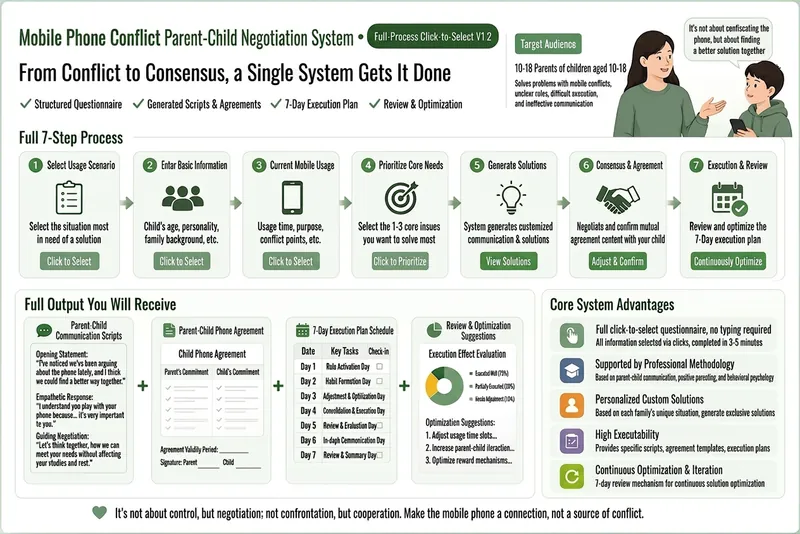
Parent-Child Phone Negotiation
The Parent-Child Phone Negotiation system is designed for parents of children of all ages—from young children just starting to use phones (7+) to adult children still living at home. The system automatically adapts communication strategies based on the child's age, helping you effectively handle and resolve family conflicts caused by phone use. Through structured questionnaires, it guides you to clearly identify the issue, whether it's a heated argument that needs immediate de-escalation or the need to establish or repair long-term rules. You will receive a set of ready-to-use conversation starters, a detailed family phone usage agreement (or a consensus memo for adult children), and a 7-day execution plan. The plan balances responsibilities between child and parent and adjusts strategies according to age—from concrete behavioral guidance for young children, to negotiated co-creation for teenagers, to mutual respect for adult children living at home. 💬 Trigger: Simply say phrases like 'Can't control my child's phone use,' 'We fought over phones, what should I do?', 'Set phone usage rules,' or 'How to cool down parent-child conflicts' to activate this system.
Kid Slang? | Parent Scripts
Youth Slang Guide: Decode Memes, Get Scripts
Description
Select in order: your child's age, meme type, setting, frequency, and impact. If you don't know the meme, upload a screenshot or recording, or enter the original text.
Related Skills
View allTeacher Meme Script Generator
Students using memes in class no longer require an immediate angry response. When a student suddenly says 'So what?', 'Just take it', or 'Can't do it', a teacher's angry outburst can cause laughter and confrontation; ignoring it can lead to classroom rules being broken. Student memes can sometimes lighten the mood, but may also be a way to avoid criticism, refuse tasks, disrupt the class, or even hurt peers. This Skill is designed for primary and secondary school homeroom teachers, subject teachers, moral education teachers, guidance counselors, and school administrators. Simply select the student's grade level, meme scenario, type of internet meme, number of students involved, frequency, and consequences, and the system will automatically generate: - Nature of the incident and risk level; - 10–30 second in-class immediate response scripts; - Outline for after-class individual conversation; - Alternative appropriate expression suggestions; - Home-school communication text; - Class language education activities; - Indication of peer harm or bullying risk. This Skill is developed from teaching experience, student communication observations, and real family education scenarios. It is not about simply 'controlling students,' but helping teachers quickly assess, maintain classroom order, guide after class, and identify peer harm risks when necessary.
Tailored Parenting Dialogues
Waking up, sulking, seeing a news article... everyday little things are opportunities for seamless guidance. It helps you see the opportunity and know how to start a conversation. ⚡ Review Past Events 「My child came home today and said a classmate took his eraser and hasn't returned it. He's angry but afraid to tell the teacher.」 → We'll walk through: spot the opportunity, create the dialogue, listen attentively, respond effectively. A virtual practice so you'll feel confident next time in a similar situation; practice more and you'll be able to handle new scenarios on your own. 🔮 Anticipate What Hasn't Happened Yet 「Next week is parent-teacher conference; your child's grades have dropped — that conversation on the way home is a perfect opportunity for seamless guidance.」 → Prepare in advance how to say it, turning everyday moments (including possibly negative situations) into conversations your child can actually hear. Each Output ⚡ 30-Second Overview — A quick glance when you're busy shows you how to start. 📋 Complete Dialogue Plan — Spot, Create, Listen, Respond: four steps. Includes: three opening phrases (each with the exact words and rationale), branched contingency plans for listening and responding (possible child reactions + how you respond), and extrapolation. About the Author She has a natural sensitivity to the countless parenting situations in daily life. Where others see a child sulking, she sees a complete path: spot the opportunity, create the dialogue, listen attentively, respond effectively. For over two decades, this path has been refined through three identities: a mother's dedicated practice, a researcher's continuous observation, and a family education teacher's repeated reflection. The fusion of these three has given her mature and practical judgment on 'when and how to talk.' The logic behind this Skill comes from her over 20 years of dedicated observation and personal validation. Her own child left home early for studies, with little togetherness over the past decade, yet they have an excellent parent-child relationship that friends envy. It turns out that conversations nurtured with heart, emotion, and love withstand any separation. A good parent-child relationship doesn't rely on being together every day, but on speaking and listening the right way at the right moment. We're glad you've opened this Skill. Let's practice together step by step. :) 💡 Complementary Usage Suggestions: - Want to know how to say it? → Use this Skill. - Child doesn't want to do anything, no interest? → Use with 'Motivation Engine: What to do when your child is not proactive'. - Child's emotions out of control, explosive? → Use with 'Emotion Engine: What to do when your child is emotionally out of control'.
ResearchParent-Child Phone Negotiation
The Parent-Child Phone Negotiation system is designed for parents of children of all ages—from young children just starting to use phones (7+) to adult children still living at home. The system automatically adapts communication strategies based on the child's age, helping you effectively handle and resolve family conflicts caused by phone use. Through structured questionnaires, it guides you to clearly identify the issue, whether it's a heated argument that needs immediate de-escalation or the need to establish or repair long-term rules. You will receive a set of ready-to-use conversation starters, a detailed family phone usage agreement (or a consensus memo for adult children), and a 7-day execution plan. The plan balances responsibilities between child and parent and adjusts strategies according to age—from concrete behavioral guidance for young children, to negotiated co-creation for teenagers, to mutual respect for adult children living at home. 💬 Trigger: Simply say phrases like 'Can't control my child's phone use,' 'We fought over phones, what should I do?', 'Set phone usage rules,' or 'How to cool down parent-child conflicts' to activate this system.
Find your next favorite skill
Explore more curated AI skills for research, creation, and everyday work.