Fact Check
Verify claims, data, and opinions online
Description
Hand any opinion, conclusion, data point, or proposal to an AI fact-checker: online source tracing, five-level credibility ratings, and reasoning-chain analysis—followed by a fact-check report you can share directly. 【What it does】Paste any claim, and the skill completes three checks automatically: 🔍 Break it down—separates the claim into “verifiable facts / inferred conclusions / value judgments,” keeping positions distinct from facts 🌐 Trace sources online—verifies sources, samples, statistical definitions, dates, and full context point by point, with cross-checking across multiple channels 🧩 Check the reasoning chain—identifies hidden assumptions, correlation-versus-causation errors, omitted alternative explanations, and the conditions under which the conclusion holds or fails 【Why choose it】 ✅ Five-level credibility ratings: Confirmed / Generally sound but should be narrowed / Contested / Insufficient evidence / Clearly false, with source links for every item ✅ Four-part report: Reliable facts and corrections / The most critical flaws in the reasoning chain / The strongest revised version / How much you can trust it ✅ No made-up answers: When a claim cannot be verified, it is honestly marked “Insufficient evidence” instead of being passed off as “possibly true” ✅ Report-ready output: Share it directly with readers, clients, or your community 【Who it’s for】Independent media and content creators, investors and analysts, students and researchers, and anyone who needs to quickly decide whether a statement can be trusted. 【How to use it】Paste the claim you want checked—anything from one sentence to a paragraph. For example, enter “People with Hashimoto’s thyroiditis often have low energy” to get a source-backed, tiered fact-check report. ⚠️ For medical, legal, investment, and other professional questions, use this for information verification only and rely on qualified professionals for advice.
Related Skills
View all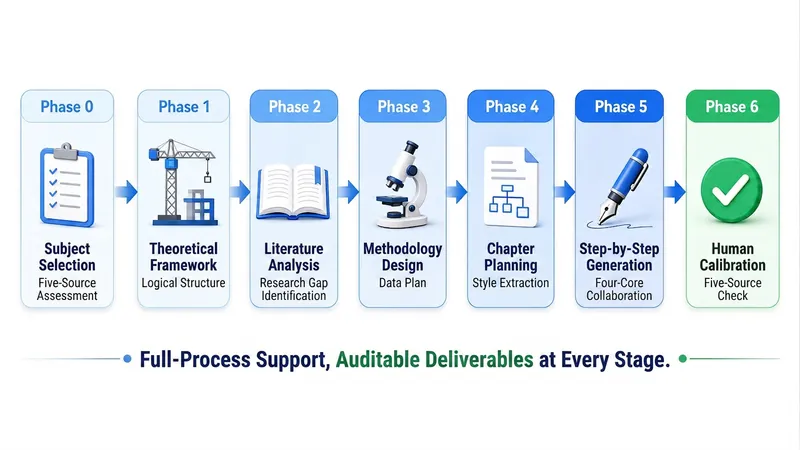
Proposal Readiness Checker
Before you spend dozens of hours writing your thesis, take ten minutes to run a structured checkup. This skill does only one thing: It diagnoses, not writes. It tells you whether your topic can hold up, whether your materials are sufficient, what's missing, where to fill the gaps, and in what order. Then it gives you an actionable missing-material checklist and search queries. It will not write your introduction, literature review, methods, or discussion. Four steps: 1. Discipline diagnosis: Classify your work into 1A Humanities/Arts, 1B Social Sciences, 2A Science/Engineering, or 2B Agriculture/Medicine/Life Sciences, and load the corresponding regulatory red lines; 2B triggers a mandatory ethics review block. 2. Topic checkup: Examine the topic from three dimensions—momentum, shape, and wording—to judge whether the research unit can be operationalized, whether the research question can be answered, and whether the topic has been done to death. 3. Material checkup: Register your existing literature into an M1/M2… material library, verify each entry against the four elements (author/year/title/verifiable locator), and compute the true coverage rate. 4. Gap list and search queries: Specify how many papers of what type are missing and which piece of evidence is lacking, and provide search queries ready to paste into databases (including Boolean keyword combinations, time ranges, and screening criteria). When to use it (trigger phrases): "Help me check my proposal" "Can this topic work?" "Do I have enough literature?" "My proposal was sent back" "I want to confirm before starting to write" — for graduate students who have just set a direction but haven't started writing; for those whose proposal was rejected but don't know why; for those with a pile of literature but unsure if it's enough to begin; for those wanting to confirm whether the topic is worth the investment before committing fully. Deliverables: A Proposal Checkup Report document + a Five-Source Readiness Scorecard (each level has behavioral criteria, not vague scoring) + a prioritized list of missing materials + search queries + an archive code. The archive code is compatible with the Academic Paper Full-Process Writing System v4.0; after the checkup, paste it there to continue writing without re-stating your discipline, topic, or journal. What this skill explicitly does not do: It does not write the main text, generate reference lists, or fabricate authors, years, volumes, issues, pages, or DOIs. Any literature found via online search is flagged with ⚠️ "needs verification" and must be verified by you before use. This skill does not promise any acceptance or passing outcome.
Sprout | Thesis Auditor
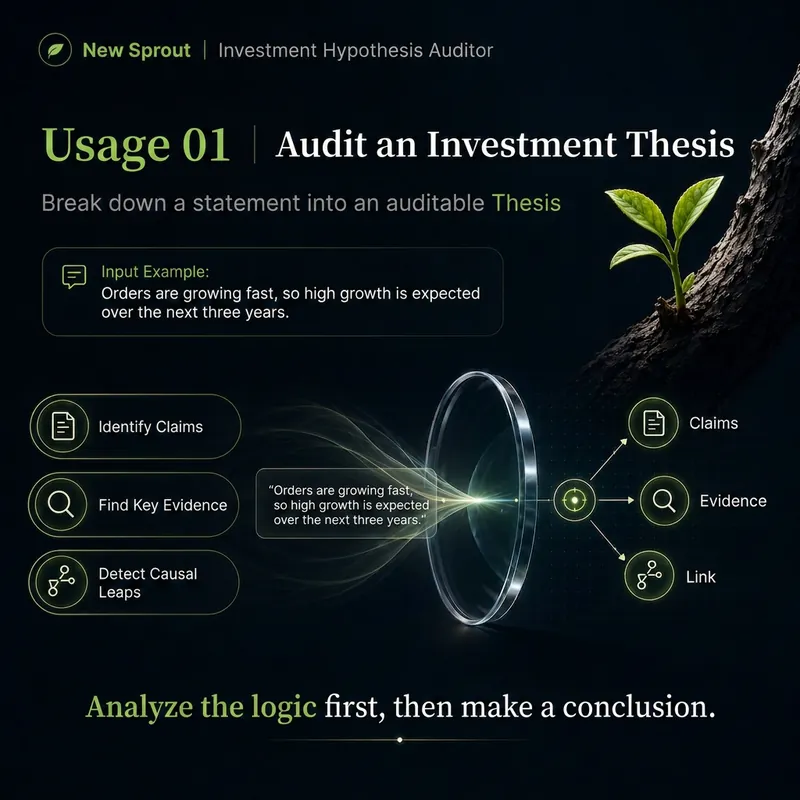
Don’t help me prove my thesis. Help me audit it. Many investment judgments go wrong not because the data is entirely incorrect, but because accurate data is used to support an overextended conclusion. For example: “AI orders are growing rapidly, so profits are certain to grow quickly over the next three years.” “The company’s business is strong, so the stock must be cheap right now.” “Customers keep increasing, so the company has already achieved network effects.” “Management says the technology is leading, and it’s included in the financial reports, so the moat has been proven.” 「Sprout | Thesis Auditor」doesn’t search for more reasons to prove you’re right. It breaks your investment thesis into an auditable Critical Path and examines it layer by layer: Facts → Evidence → Causal Relationships → Hidden Assumptions → Commercialization → Economic Outcomes → Valuation By prioritizing first-party sources, it answers several questions that truly matter: Which parts have already been supported by evidence? Which are merely reasonable inferences? Which necessary link is the most fragile? Is there counterevidence that genuinely attacks the Thesis? What evidence is most likely to change the conclusion? It ultimately provides one of five ratings: SUPPORTED / PARTIALLY SUPPORTED / FRAGILE / BROKEN / INSUFFICIENT DATA Every conclusion must be traceable to specific Necessary Claims and evidence—not a vague “on balance” assessment.

Career Experience Analyzer
After years of work, the real challenge is often not a lack of experience, but knowing which parts are facts, which are your interpretations, and which experiences are still worth validating outside your original company. This Skill works with one anonymized, real-life experience: it organizes evidence cards, explains what the current material can and cannot prove, identifies the earliest evidence gap, and provides one low-cost validation path, one thing to hold off on, and a 7-day action plan. It is not a psychological test and does not assign an overall experience-asset score. It does not use your job title, years of experience, salary, certifications, praise from colleagues, or a single internal success as substitutes for external demand and payment evidence. When the material is insufficient, it will say directly: “Insufficient material; no judgment for now.” Please do not submit names, companies, clients, phone numbers, WeChat IDs, email addresses, government ID numbers, contracts, or unpublished business data. If identifiable information is detected, the Skill will stop the analysis and ask you to anonymize the material locally before resubmitting it. This is a preliminary self-guided assessment. It does not replace a professional evaluation, does not include manual review by Kevin, and does not promise income, traffic, career transitions, or business results.
Fact Check
Verify claims, data, and opinions online
Description
Hand any opinion, conclusion, data point, or proposal to an AI fact-checker: online source tracing, five-level credibility ratings, and reasoning-chain analysis—followed by a fact-check report you can share directly. 【What it does】Paste any claim, and the skill completes three checks automatically: 🔍 Break it down—separates the claim into “verifiable facts / inferred conclusions / value judgments,” keeping positions distinct from facts 🌐 Trace sources online—verifies sources, samples, statistical definitions, dates, and full context point by point, with cross-checking across multiple channels 🧩 Check the reasoning chain—identifies hidden assumptions, correlation-versus-causation errors, omitted alternative explanations, and the conditions under which the conclusion holds or fails 【Why choose it】 ✅ Five-level credibility ratings: Confirmed / Generally sound but should be narrowed / Contested / Insufficient evidence / Clearly false, with source links for every item ✅ Four-part report: Reliable facts and corrections / The most critical flaws in the reasoning chain / The strongest revised version / How much you can trust it ✅ No made-up answers: When a claim cannot be verified, it is honestly marked “Insufficient evidence” instead of being passed off as “possibly true” ✅ Report-ready output: Share it directly with readers, clients, or your community 【Who it’s for】Independent media and content creators, investors and analysts, students and researchers, and anyone who needs to quickly decide whether a statement can be trusted. 【How to use it】Paste the claim you want checked—anything from one sentence to a paragraph. For example, enter “People with Hashimoto’s thyroiditis often have low energy” to get a source-backed, tiered fact-check report. ⚠️ For medical, legal, investment, and other professional questions, use this for information verification only and rely on qualified professionals for advice.
Related Skills
View allProposal Readiness Checker
Before you spend dozens of hours writing your thesis, take ten minutes to run a structured checkup. This skill does only one thing: It diagnoses, not writes. It tells you whether your topic can hold up, whether your materials are sufficient, what's missing, where to fill the gaps, and in what order. Then it gives you an actionable missing-material checklist and search queries. It will not write your introduction, literature review, methods, or discussion. Four steps: 1. Discipline diagnosis: Classify your work into 1A Humanities/Arts, 1B Social Sciences, 2A Science/Engineering, or 2B Agriculture/Medicine/Life Sciences, and load the corresponding regulatory red lines; 2B triggers a mandatory ethics review block. 2. Topic checkup: Examine the topic from three dimensions—momentum, shape, and wording—to judge whether the research unit can be operationalized, whether the research question can be answered, and whether the topic has been done to death. 3. Material checkup: Register your existing literature into an M1/M2… material library, verify each entry against the four elements (author/year/title/verifiable locator), and compute the true coverage rate. 4. Gap list and search queries: Specify how many papers of what type are missing and which piece of evidence is lacking, and provide search queries ready to paste into databases (including Boolean keyword combinations, time ranges, and screening criteria). When to use it (trigger phrases): "Help me check my proposal" "Can this topic work?" "Do I have enough literature?" "My proposal was sent back" "I want to confirm before starting to write" — for graduate students who have just set a direction but haven't started writing; for those whose proposal was rejected but don't know why; for those with a pile of literature but unsure if it's enough to begin; for those wanting to confirm whether the topic is worth the investment before committing fully. Deliverables: A Proposal Checkup Report document + a Five-Source Readiness Scorecard (each level has behavioral criteria, not vague scoring) + a prioritized list of missing materials + search queries + an archive code. The archive code is compatible with the Academic Paper Full-Process Writing System v4.0; after the checkup, paste it there to continue writing without re-stating your discipline, topic, or journal. What this skill explicitly does not do: It does not write the main text, generate reference lists, or fabricate authors, years, volumes, issues, pages, or DOIs. Any literature found via online search is flagged with ⚠️ "needs verification" and must be verified by you before use. This skill does not promise any acceptance or passing outcome.
Sprout | Thesis Auditor
Don’t help me prove my thesis. Help me audit it. Many investment judgments go wrong not because the data is entirely incorrect, but because accurate data is used to support an overextended conclusion. For example: “AI orders are growing rapidly, so profits are certain to grow quickly over the next three years.” “The company’s business is strong, so the stock must be cheap right now.” “Customers keep increasing, so the company has already achieved network effects.” “Management says the technology is leading, and it’s included in the financial reports, so the moat has been proven.” 「Sprout | Thesis Auditor」doesn’t search for more reasons to prove you’re right. It breaks your investment thesis into an auditable Critical Path and examines it layer by layer: Facts → Evidence → Causal Relationships → Hidden Assumptions → Commercialization → Economic Outcomes → Valuation By prioritizing first-party sources, it answers several questions that truly matter: Which parts have already been supported by evidence? Which are merely reasonable inferences? Which necessary link is the most fragile? Is there counterevidence that genuinely attacks the Thesis? What evidence is most likely to change the conclusion? It ultimately provides one of five ratings: SUPPORTED / PARTIALLY SUPPORTED / FRAGILE / BROKEN / INSUFFICIENT DATA Every conclusion must be traceable to specific Necessary Claims and evidence—not a vague “on balance” assessment.
Career Experience Analyzer
After years of work, the real challenge is often not a lack of experience, but knowing which parts are facts, which are your interpretations, and which experiences are still worth validating outside your original company. This Skill works with one anonymized, real-life experience: it organizes evidence cards, explains what the current material can and cannot prove, identifies the earliest evidence gap, and provides one low-cost validation path, one thing to hold off on, and a 7-day action plan. It is not a psychological test and does not assign an overall experience-asset score. It does not use your job title, years of experience, salary, certifications, praise from colleagues, or a single internal success as substitutes for external demand and payment evidence. When the material is insufficient, it will say directly: “Insufficient material; no judgment for now.” Please do not submit names, companies, clients, phone numbers, WeChat IDs, email addresses, government ID numbers, contracts, or unpublished business data. If identifiable information is detected, the Skill will stop the analysis and ask you to anonymize the material locally before resubmitting it. This is a preliminary self-guided assessment. It does not replace a professional evaluation, does not include manual review by Kevin, and does not promise income, traffic, career transitions, or business results.
Find your next favorite skill
Explore more curated AI skills for research, creation, and everyday work.