
App Opportunity Radar
Spot & validate app ideas from market signals
Description
App Opportunity Radar is an AI-powered topic selection and market validation skill for indie developers. When you don't know what your next app should be, it first discovers candidate opportunities from real market signals such as app stores, user reviews, Product Hunt, Reddit, pricing pages, and competitor websites, filters out weak ideas unsuitable for indie developers, and then performs competitor, pricing, pain point, MVP, risk, and go/no-go analysis on the most promising directions. Ideal for indie developers who open Cursor, Claude Code, or Codex but don't know what product to build.
Related Skills
View all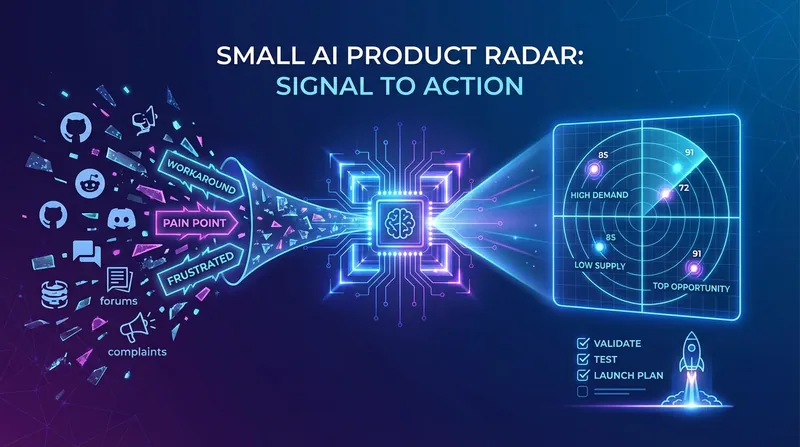 Research
Niche AI Product Radar
A systematic engine for discovering niche AI product opportunities, v3.1. It combines the mathematical rigor of v2.0 with the execution methodology of App Gold Mining: a five-level anchor scale and logarithmic demand-intensity scoring, category-weighted supply scarcity, signal time-decay functions, competitive response and platform-risk game analysis, and a Bayesian prior-to-posterior validation framework. v3.1 adds the SonarPing supply-side detection layer, incorporating its daily scans of new AI products, elimination of wrapper and lookalike products, hands-on testing, and time-series snapshot data. It filters out ineffective competitors from nominal supply, calculates the effective supply rate, new-product entry speed, and deactivation speed, and upgrades the static half-life into a dynamic opportunity window driven by real supply flows. It integrates data from 130+ Chinese Twitter creators, Chinese-language communities, and payment behavior as high-quality demand signals, helping indie developers identify low-competition, high-pain-density opportunities in AaaS and B2C subscription products, and produces actionable radar reports and promotion-channel matrices.
AI Opportunity Radar (Ongoing)
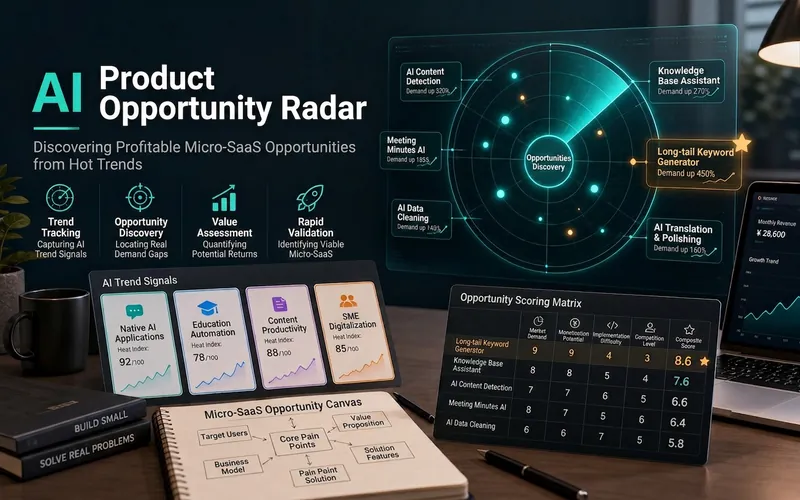
Every day, dig out product opportunities from AI hotspots that can actually make money. There's a lot of AI news, but few opportunities that can turn into real products. This Skill helps you filter out the noise and turn 'new models, new tools, new open-source projects, user complaints, competitor changes' into a startup radar: - What's the most worth-watching opportunity today? - Which users are really willing to pay? - Which direction can deliver an MVP in 1-2 weeks? - Where to find the first batch of customers? - How to decide whether to continue or give up within 7 days? Suitable for: - Indie developers wanting to build micro-SaaS - Entrepreneurs looking for AI startup directions - AI self-media/knowledge bloggers needing continuous topics - Product managers doing product strategy, competitive research, market insights - Investors/researchers wanting to turn industry data into actionable plans

Startup Opportunity Radar
Turn “I think this could make money” into “What evidence is worth testing?” Discover and screen early-stage business opportunities suited to solo businesses, micro-SaaS, AI tools, digital products, data products, physical goods based on supply chains, and transaction services. It starts with real user friction, substitute behaviors, payment actions, and industry changes, helping you avoid mistaking popular trends, search volume, or scattered complaints for genuine demand. You can ask it to scan for new startup directions, or submit a product idea, market, link, screenshot, plan, sales feedback, or historical opportunity list for an individual health check, validation design, or periodic review. The analysis distinguishes facts, inferences, assumptions, and opposing evidence. It examines buyers, use cases, competitive gaps, data and supply chain legality, customer acquisition channels, standardization potential, maintenance costs, and related liability risks. When evidence is insufficient, it states that clearly instead of inventing market size or purchase intent. You will receive a clear opportunity assessment, an evaluation of opportunity quality and user adoption readiness, and a minimum validation plan focused on the riskiest assumptions. This includes validation actions, a stage budget, the maximum acceptable loss, and criteria for proceeding or stopping. It helps you decide which opportunities are worth investigating further while allowing conclusions such as “monitor,” “gather more evidence,” or “do not pursue this cycle,” making startup investment more manageable and gradually building repeatably sellable products and long-term assets.
App Opportunity Radar
Spot & validate app ideas from market signals
Description
App Opportunity Radar is an AI-powered topic selection and market validation skill for indie developers. When you don't know what your next app should be, it first discovers candidate opportunities from real market signals such as app stores, user reviews, Product Hunt, Reddit, pricing pages, and competitor websites, filters out weak ideas unsuitable for indie developers, and then performs competitor, pricing, pain point, MVP, risk, and go/no-go analysis on the most promising directions. Ideal for indie developers who open Cursor, Claude Code, or Codex but don't know what product to build.
Related Skills
View allResearchNiche AI Product Radar
A systematic engine for discovering niche AI product opportunities, v3.1. It combines the mathematical rigor of v2.0 with the execution methodology of App Gold Mining: a five-level anchor scale and logarithmic demand-intensity scoring, category-weighted supply scarcity, signal time-decay functions, competitive response and platform-risk game analysis, and a Bayesian prior-to-posterior validation framework. v3.1 adds the SonarPing supply-side detection layer, incorporating its daily scans of new AI products, elimination of wrapper and lookalike products, hands-on testing, and time-series snapshot data. It filters out ineffective competitors from nominal supply, calculates the effective supply rate, new-product entry speed, and deactivation speed, and upgrades the static half-life into a dynamic opportunity window driven by real supply flows. It integrates data from 130+ Chinese Twitter creators, Chinese-language communities, and payment behavior as high-quality demand signals, helping indie developers identify low-competition, high-pain-density opportunities in AaaS and B2C subscription products, and produces actionable radar reports and promotion-channel matrices.
AI Opportunity Radar (Ongoing)
Every day, dig out product opportunities from AI hotspots that can actually make money. There's a lot of AI news, but few opportunities that can turn into real products. This Skill helps you filter out the noise and turn 'new models, new tools, new open-source projects, user complaints, competitor changes' into a startup radar: - What's the most worth-watching opportunity today? - Which users are really willing to pay? - Which direction can deliver an MVP in 1-2 weeks? - Where to find the first batch of customers? - How to decide whether to continue or give up within 7 days? Suitable for: - Indie developers wanting to build micro-SaaS - Entrepreneurs looking for AI startup directions - AI self-media/knowledge bloggers needing continuous topics - Product managers doing product strategy, competitive research, market insights - Investors/researchers wanting to turn industry data into actionable plans
Startup Opportunity Radar
Turn “I think this could make money” into “What evidence is worth testing?” Discover and screen early-stage business opportunities suited to solo businesses, micro-SaaS, AI tools, digital products, data products, physical goods based on supply chains, and transaction services. It starts with real user friction, substitute behaviors, payment actions, and industry changes, helping you avoid mistaking popular trends, search volume, or scattered complaints for genuine demand. You can ask it to scan for new startup directions, or submit a product idea, market, link, screenshot, plan, sales feedback, or historical opportunity list for an individual health check, validation design, or periodic review. The analysis distinguishes facts, inferences, assumptions, and opposing evidence. It examines buyers, use cases, competitive gaps, data and supply chain legality, customer acquisition channels, standardization potential, maintenance costs, and related liability risks. When evidence is insufficient, it states that clearly instead of inventing market size or purchase intent. You will receive a clear opportunity assessment, an evaluation of opportunity quality and user adoption readiness, and a minimum validation plan focused on the riskiest assumptions. This includes validation actions, a stage budget, the maximum acceptable loss, and criteria for proceeding or stopping. It helps you decide which opportunities are worth investigating further while allowing conclusions such as “monitor,” “gather more evidence,” or “do not pursue this cycle,” making startup investment more manageable and gradually building repeatably sellable products and long-term assets.
Find your next favorite skill
Explore more curated AI skills for research, creation, and everyday work.