Niche AI Product Radar
Description
Recommended by
nene@YouMind
Why we love this skill
Aligns community complaints, payment behavior, local signals, and tested supply dynamics into a trackable, decaying, self-correcting opportunity radar.
A systematic engine for discovering niche AI product opportunities, v3.1. It combines the mathematical rigor of v2.0 with the execution methodology of App Gold Mining: a five-level anchor scale and logarithmic demand-intensity scoring, category-weighted supply scarcity, signal time-decay functions, competitive response and platform-risk game analysis, and a Bayesian prior-to-posterior validation framework. v3.1 adds the SonarPing supply-side detection layer, incorporating its daily scans of new AI products, elimination of wrapper and lookalike products, hands-on testing, and time-series snapshot data. It filters out ineffective competitors from nominal supply, calculates the effective supply rate, new-product entry speed, and deactivation speed, and upgrades the static half-life into a dynamic opportunity window driven by real supply flows. It integrates data from 130+ Chinese Twitter creators, Chinese-language communities, and payment behavior as high-quality demand signals, helping indie developers identify low-competition, high-pain-density opportunities in AaaS and B2C subscription products, and produces actionable radar reports and promotion-channel matrices.
Related Skills
View all
Startup Opportunity Radar
Turn “I think this could make money” into “What evidence is worth testing?” Discover and screen early-stage business opportunities suited to solo businesses, micro-SaaS, AI tools, digital products, data products, physical goods based on supply chains, and transaction services. It starts with real user friction, substitute behaviors, payment actions, and industry changes, helping you avoid mistaking popular trends, search volume, or scattered complaints for genuine demand. You can ask it to scan for new startup directions, or submit a product idea, market, link, screenshot, plan, sales feedback, or historical opportunity list for an individual health check, validation design, or periodic review. The analysis distinguishes facts, inferences, assumptions, and opposing evidence. It examines buyers, use cases, competitive gaps, data and supply chain legality, customer acquisition channels, standardization potential, maintenance costs, and related liability risks. When evidence is insufficient, it states that clearly instead of inventing market size or purchase intent. You will receive a clear opportunity assessment, an evaluation of opportunity quality and user adoption readiness, and a minimum validation plan focused on the riskiest assumptions. This includes validation actions, a stage budget, the maximum acceptable loss, and criteria for proceeding or stopping. It helps you decide which opportunities are worth investigating further while allowing conclusions such as “monitor,” “gather more evidence,” or “do not pursue this cycle,” making startup investment more manageable and gradually building repeatably sellable products and long-term assets.
App Opportunity Radar
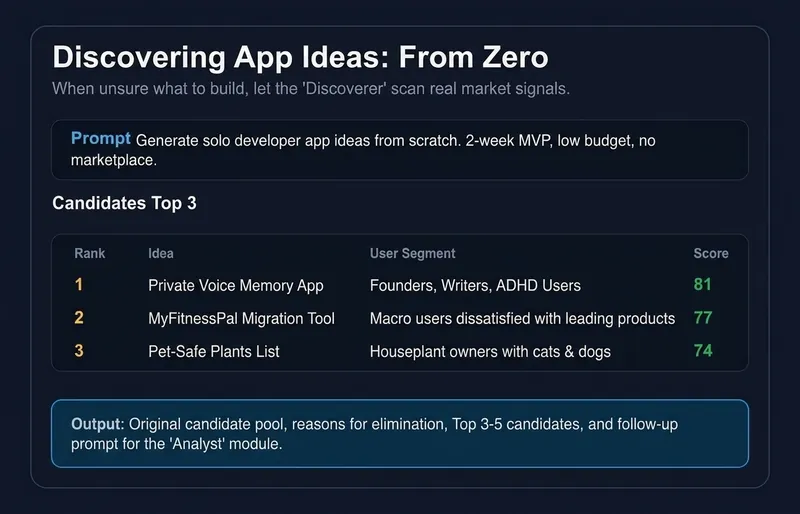
App Opportunity Radar is an AI-powered topic selection and market validation skill for indie developers. When you don't know what your next app should be, it first discovers candidate opportunities from real market signals such as app stores, user reviews, Product Hunt, Reddit, pricing pages, and competitor websites, filters out weak ideas unsuitable for indie developers, and then performs competitor, pricing, pain point, MVP, risk, and go/no-go analysis on the most promising directions. Ideal for indie developers who open Cursor, Claude Code, or Codex but don't know what product to build.
 Research
Multi-Agent: A-Share Pick & IC
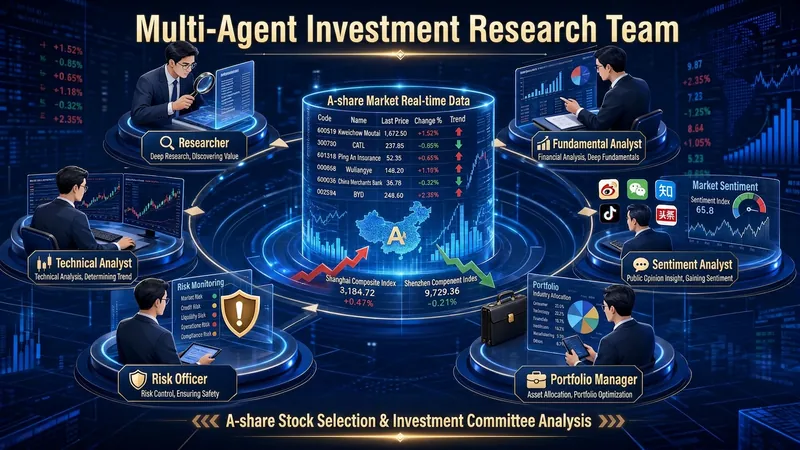
It's not an AI assistant, but a virtual investment research team. Common AI stock-picking tools suffer from three problems: fabricating financial figures and target prices, giving vague "bullish/bearish" remarks, and offering "buy" recommendations without clear reasoning. The Multi-Agent Investment Research Team tackles these with a three-pronged approach: 6 parallel roles, cross-validation, and mandatory source attribution. It convenes researchers, fundamental analysts, technical analysts, sentiment analysts, risk officers, and investment managers to work in parallel, deliberating like a real investment committee. What you get is not fuzzy opinions, but a professional research document with facts, signals, disagreements, risks, and every number traceable to its source. Two modes covering "researching a single stock" and "screening a batch of stocks" Mode A: Single-Stock Committee Deep Analysis — Just provide a stock (e.g., "Analyze BYD 002594"), and the skill automatically convenes a full investment committee: the researcher aggregates market data, financial reports, research reports, and industry chain positioning, presenting only objective facts; the fundamental analyst issues a financial health scorecard, key changes in the three financial statements, and PEG valuation; the technical analyst evaluates trends, moving averages, MACD, support and resistance levels, and provides a five-point buy signal hit table; the sentiment analyst scans institutional divergence, retail investor sentiment, and potential misinterpretations; the risk officer digs up counter-evidence, systematically refuting optimistic conclusions from other roles; finally, the investment manager, without adding new data, integrates everything to produce committee minutes and a one-page summary. Mode B: Multi-Condition Stock Screening — From a specified universe (e.g., CSI 300, a sector/theme basket, or your own stock pool), apply a three-layer funnel: L1 financial hard screen (three consecutive quarters of growth, ample cash flow, PEG<1 or huge increase in contract liabilities), L2 technical timing (base breakout, moving average golden cross, volume breakout, strong pullback on low volume, MACD crossing above zero line), L3 information validation (research report ratings and industry chain logic, eliminating "pure technical without fundamental basis" picks). After obtaining a candidate list, the top N stocks can automatically proceed to Mode A for deep analysis. What you will get Mode A delivers a fixed "five-piece set": ① Full analysis report integrating all six roles; ② Data source and evidence table, with each key conclusion mapped to "data → source → date"; ③ Meeting-style committee minutes (agenda → each role's view → disagreements → consensus → variables to track); ④ Risk list sorted by high/medium/low severity; ⑤ One-page investment manager summary condensing core logic, key variables, verification points, and confidence level. Mode B delivers: Candidate stock list table (ticker | name | triggered conditions | key data | source | trigger date) plus screening criteria and methodology description, optionally with the full five-piece set for top candidates. All outputs are saved as files with ticker and date in the filename for easy reuse and archiving.
Niche AI Product Radar
Description
Recommended by
nene@YouMind
Why we love this skill
Aligns community complaints, payment behavior, local signals, and tested supply dynamics into a trackable, decaying, self-correcting opportunity radar.
A systematic engine for discovering niche AI product opportunities, v3.1. It combines the mathematical rigor of v2.0 with the execution methodology of App Gold Mining: a five-level anchor scale and logarithmic demand-intensity scoring, category-weighted supply scarcity, signal time-decay functions, competitive response and platform-risk game analysis, and a Bayesian prior-to-posterior validation framework. v3.1 adds the SonarPing supply-side detection layer, incorporating its daily scans of new AI products, elimination of wrapper and lookalike products, hands-on testing, and time-series snapshot data. It filters out ineffective competitors from nominal supply, calculates the effective supply rate, new-product entry speed, and deactivation speed, and upgrades the static half-life into a dynamic opportunity window driven by real supply flows. It integrates data from 130+ Chinese Twitter creators, Chinese-language communities, and payment behavior as high-quality demand signals, helping indie developers identify low-competition, high-pain-density opportunities in AaaS and B2C subscription products, and produces actionable radar reports and promotion-channel matrices.
Related Skills
View allStartup Opportunity Radar
Turn “I think this could make money” into “What evidence is worth testing?” Discover and screen early-stage business opportunities suited to solo businesses, micro-SaaS, AI tools, digital products, data products, physical goods based on supply chains, and transaction services. It starts with real user friction, substitute behaviors, payment actions, and industry changes, helping you avoid mistaking popular trends, search volume, or scattered complaints for genuine demand. You can ask it to scan for new startup directions, or submit a product idea, market, link, screenshot, plan, sales feedback, or historical opportunity list for an individual health check, validation design, or periodic review. The analysis distinguishes facts, inferences, assumptions, and opposing evidence. It examines buyers, use cases, competitive gaps, data and supply chain legality, customer acquisition channels, standardization potential, maintenance costs, and related liability risks. When evidence is insufficient, it states that clearly instead of inventing market size or purchase intent. You will receive a clear opportunity assessment, an evaluation of opportunity quality and user adoption readiness, and a minimum validation plan focused on the riskiest assumptions. This includes validation actions, a stage budget, the maximum acceptable loss, and criteria for proceeding or stopping. It helps you decide which opportunities are worth investigating further while allowing conclusions such as “monitor,” “gather more evidence,” or “do not pursue this cycle,” making startup investment more manageable and gradually building repeatably sellable products and long-term assets.
App Opportunity Radar
App Opportunity Radar is an AI-powered topic selection and market validation skill for indie developers. When you don't know what your next app should be, it first discovers candidate opportunities from real market signals such as app stores, user reviews, Product Hunt, Reddit, pricing pages, and competitor websites, filters out weak ideas unsuitable for indie developers, and then performs competitor, pricing, pain point, MVP, risk, and go/no-go analysis on the most promising directions. Ideal for indie developers who open Cursor, Claude Code, or Codex but don't know what product to build.
ResearchMulti-Agent: A-Share Pick & IC
It's not an AI assistant, but a virtual investment research team. Common AI stock-picking tools suffer from three problems: fabricating financial figures and target prices, giving vague "bullish/bearish" remarks, and offering "buy" recommendations without clear reasoning. The Multi-Agent Investment Research Team tackles these with a three-pronged approach: 6 parallel roles, cross-validation, and mandatory source attribution. It convenes researchers, fundamental analysts, technical analysts, sentiment analysts, risk officers, and investment managers to work in parallel, deliberating like a real investment committee. What you get is not fuzzy opinions, but a professional research document with facts, signals, disagreements, risks, and every number traceable to its source. Two modes covering "researching a single stock" and "screening a batch of stocks" Mode A: Single-Stock Committee Deep Analysis — Just provide a stock (e.g., "Analyze BYD 002594"), and the skill automatically convenes a full investment committee: the researcher aggregates market data, financial reports, research reports, and industry chain positioning, presenting only objective facts; the fundamental analyst issues a financial health scorecard, key changes in the three financial statements, and PEG valuation; the technical analyst evaluates trends, moving averages, MACD, support and resistance levels, and provides a five-point buy signal hit table; the sentiment analyst scans institutional divergence, retail investor sentiment, and potential misinterpretations; the risk officer digs up counter-evidence, systematically refuting optimistic conclusions from other roles; finally, the investment manager, without adding new data, integrates everything to produce committee minutes and a one-page summary. Mode B: Multi-Condition Stock Screening — From a specified universe (e.g., CSI 300, a sector/theme basket, or your own stock pool), apply a three-layer funnel: L1 financial hard screen (three consecutive quarters of growth, ample cash flow, PEG<1 or huge increase in contract liabilities), L2 technical timing (base breakout, moving average golden cross, volume breakout, strong pullback on low volume, MACD crossing above zero line), L3 information validation (research report ratings and industry chain logic, eliminating "pure technical without fundamental basis" picks). After obtaining a candidate list, the top N stocks can automatically proceed to Mode A for deep analysis. What you will get Mode A delivers a fixed "five-piece set": ① Full analysis report integrating all six roles; ② Data source and evidence table, with each key conclusion mapped to "data → source → date"; ③ Meeting-style committee minutes (agenda → each role's view → disagreements → consensus → variables to track); ④ Risk list sorted by high/medium/low severity; ⑤ One-page investment manager summary condensing core logic, key variables, verification points, and confidence level. Mode B delivers: Candidate stock list table (ticker | name | triggered conditions | key data | source | trigger date) plus screening criteria and methodology description, optionally with the full five-piece set for top candidates. All outputs are saved as files with ticker and date in the filename for easy reuse and archiving.
Find your next favorite skill
Explore more curated AI skills for research, creation, and everyday work.