
Mimic CSSCI Expert Writing
CSSCI-level polish for academic writing
Description
This AI assistant can polish your Chinese academic texts—such as papers, project proposals, or academic reviews—to the mature expression standards of CSSCI and core journals. It focuses on strengthening the text's problem awareness, theoretical rigor, logical coherence, and concise expression, aiming to reduce AI writing traces, avoid empty clichés, mechanical parallelism, and unsupported exaggerated expressions, making your research outputs more academically distinctive and rigorous. Whether you are writing an academic paper, preparing a project proposal, or conducting an academic review, this tool can adjust its polishing style according to the text type. It ensures that core arguments, data, reference numbers, and specialized terms remain unchanged, while optimizing sentence structure and improving conceptual accuracy and judgment restraint, making your expression more aligned with the norms and habits of high-level Chinese academic writing. By refining common and formulaic expressions and transforming them into more profound and insightful academic language, this tool helps your text present stronger professionalism and persuasiveness. It not only enhances the academic quality of the writing but also ensures that your research outcomes are clearer in logic and more refined in expression, enabling them to stand out in academic communication and review.
Related Skills
View all
CSSCI & Core Journal Paper Polish
When writing academic papers, have you ever been troubled by how to eliminate AI writing traces and enhance the academic professionalism of the text? This tool is specifically designed for users submitting to Chinese core journals and CSSCI journals, aiming to provide journal-level deep refinement services. It systematically addresses common issues in papers such as AI tone, colloquial expressions, policy document style, low-level logical prompts, and unstable concepts, ensuring your manuscript is closer to the expression standard of mature scholars in core journal papers. Whether you submit the full paper, specific sections, abstract, title system, or typical problem sentences, this tool systematically optimizes around academic problem awareness, title system, concept stability, mechanism analysis, and argument chain. It restructures work-plan-style titles into conceptual, mechanistic, and structured academic expressions, unifies core terminology to avoid polysemy, and strengthens the argument chain, presenting a rigorous logical progression: "Problem Formulation—Theoretical Foundation—Intension Structure—Generation Mechanism—Analytical Framework—Action Field—Implementation Mechanism—Governance Boundary." This tool focuses on improving the academic quality of the paper, not simple text polishing. It will delete or rewrite AI meta-discourse, colloquial transitions, and self-explanatory writing processes, transforming material-style expressions like "service, empowerment, promotion" into academic mechanism analysis. During the refinement process, the tool strictly retains your original research topic, literature basis, and factual materials, never fabricating data or conclusions, ensuring academic integrity. Finally, you will obtain an academic manuscript with rigorous logic, precise expression, and meeting core journal publication requirements, effectively enhancing the competitiveness of your paper for publication.
 Write
WriteFull-Process Academic Writing
"Full-Process Academic Writing" is an intelligent assistant tool designed for researchers, aimed at covering every stage of academic paper writing from initial conception to final submission. Whether you have just a vague research direction or have a draft that needs polishing, this tool provides systematic support to help you efficiently produce high-quality academic work. This tool guides you through four key stages. First is **Topic Planning**, which helps you refine preliminary ideas into concrete, feasible research topics and questions, and generates a comprehensive Topic Evaluation Report covering research framework, method matching, timeline planning, and resource bottleneck identification. Next is the **Literature Review** stage, assisting you in building search strategies, organizing core literature, and writing a logically rigorous literature review draft that identifies research gaps. The third stage is **Structured Writing**, where the tool designs a detailed paper outline based on your topic and literature review, and drafts the introduction, methods, body, and conclusions chapter by chapter, while also providing scientific chart code to ensure a complete structure and rigorous argumentation. Finally, the **Polishing and Revision** stage performs a comprehensive academic standard check, six-dimensional language polishing, and logical coherence review, and embeds an AI-assisted writing statement to ensure your final draft meets publishable professional standards. Throughout the writing process, this tool always adheres to academic ethics standards. All citations will be clearly flagged for verification and will never be fabricated. Output from each stage proceeds only after your confirmation, ensuring every step aligns with your research intent, allowing you to focus on expressing your ideas while leaving tedious formatting and standards to AI.
 Write
WriteAIGC Reduction & Rewrite v7.0
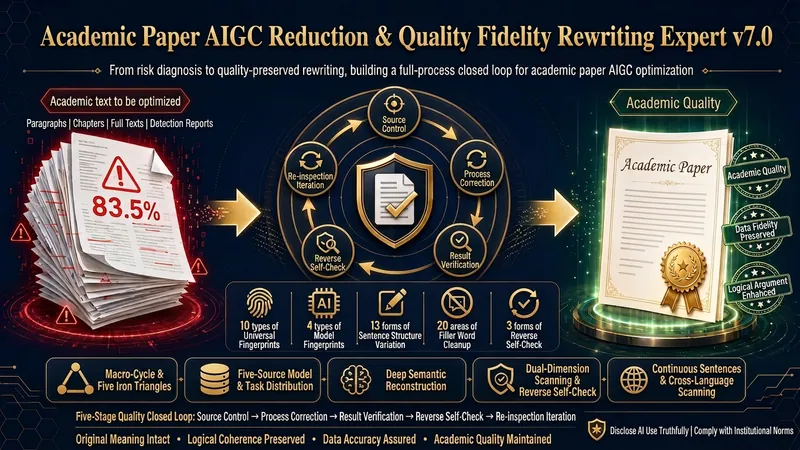
📚 Academic Paper AIGC Reduction and Quality-Preserving Rewriting Expert v7.0 Designed for graduate students, researchers, and paper authors, this academic text optimization skill operates on a core closed loop of 'source control → process correction → result verification → reverse self-check → iterative re-check'. It systematically diagnoses and optimizes issues such as templated expressions, mechanical logic, vague content, inaccurate terminology, and style inconsistencies while preserving original meaning, technical terms, data, and core conclusions. 🔍📝 🌟 Core Capabilities 🔬 Multi-layer Risk Diagnosis Covers 10 types of universal text fingerprints and assists in identifying common expression patterns of models such as ChatGPT, Claude, DeepSeek, and Wenxin Yiyan. 🧠 Deep Semantic Restructuring Goes beyond synonym replacement to rebuild more natural and in-depth academic reasoning by adjusting proposition expression, information order, argument approach, and evidence organization. ✍️ Quality-Preserving Rewriting Comprehensively applies 13 sentence transformation strategies and 20 methods for cleaning high-frequency templated expressions, improving mechanical sentence structures, repetitive connectors, and overly rigid formatting. 📊 Full-text Structure Diagnosis Through macro-cycle and five key triangles, checks whether research problems, theory, literature review, methods, results, conclusions, and innovation form a complete closed loop. 🧩 Fine-grained Section Adaptation Develops differentiated diagnostic and rewriting strategies for abstract, introduction, literature review, research methods, results, discussion, and conclusion respectively. 🌐 Cross-language Risk Scanning Assists in identifying translationese, passive voice stacking, long sentence nesting, and mixed Chinese-English formatting abnormalities to make Chinese academic expression more natural and accurate. 🔄 Reverse Self-check Loop After rewriting, re-verifies from three aspects: technique distribution, new text fingerprints, and information integrity, to avoid 'becoming more templated' or losing key content. 🛡️ Academic Integrity Protection Does not fabricate literature, data, cases, or policy evidence; separately marks information requiring author verification and reminds users to honestly disclose AI usage. 🎯 Use Cases ✅ Single paragraph or partial section optimization ✅ Targeted modification of marked paragraphs from inspection reports ✅ Polishing of abstract, introduction, literature review, discussion, and conclusion ✅ Full-text AIGC risk feature diagnosis ✅ Language and structure adaptation for target journals ✅ Pre-submission quality review and consistency check 📦 Final Deliverables 📄 Quality-preserving rewritten text 🔎 Risk and issue diagnosis report 🛠️ Rewriting strategy and technique description ✅ Reverse self-check and information integrity report 💡 Items requiring author verification and subsequent revision suggestions 🎓 Original meaning preserved · Logic intact · No fabricated data · Academic quality maintained ⚠️ This skill aims to improve academic expression quality and reduce text risk features. It does not guarantee passage through any specific detection platform or achieving a particular detection score.
Mimic CSSCI Expert Writing
CSSCI-level polish for academic writing
Description
This AI assistant can polish your Chinese academic texts—such as papers, project proposals, or academic reviews—to the mature expression standards of CSSCI and core journals. It focuses on strengthening the text's problem awareness, theoretical rigor, logical coherence, and concise expression, aiming to reduce AI writing traces, avoid empty clichés, mechanical parallelism, and unsupported exaggerated expressions, making your research outputs more academically distinctive and rigorous. Whether you are writing an academic paper, preparing a project proposal, or conducting an academic review, this tool can adjust its polishing style according to the text type. It ensures that core arguments, data, reference numbers, and specialized terms remain unchanged, while optimizing sentence structure and improving conceptual accuracy and judgment restraint, making your expression more aligned with the norms and habits of high-level Chinese academic writing. By refining common and formulaic expressions and transforming them into more profound and insightful academic language, this tool helps your text present stronger professionalism and persuasiveness. It not only enhances the academic quality of the writing but also ensures that your research outcomes are clearer in logic and more refined in expression, enabling them to stand out in academic communication and review.
Related Skills
View allCSSCI & Core Journal Paper Polish
When writing academic papers, have you ever been troubled by how to eliminate AI writing traces and enhance the academic professionalism of the text? This tool is specifically designed for users submitting to Chinese core journals and CSSCI journals, aiming to provide journal-level deep refinement services. It systematically addresses common issues in papers such as AI tone, colloquial expressions, policy document style, low-level logical prompts, and unstable concepts, ensuring your manuscript is closer to the expression standard of mature scholars in core journal papers. Whether you submit the full paper, specific sections, abstract, title system, or typical problem sentences, this tool systematically optimizes around academic problem awareness, title system, concept stability, mechanism analysis, and argument chain. It restructures work-plan-style titles into conceptual, mechanistic, and structured academic expressions, unifies core terminology to avoid polysemy, and strengthens the argument chain, presenting a rigorous logical progression: "Problem Formulation—Theoretical Foundation—Intension Structure—Generation Mechanism—Analytical Framework—Action Field—Implementation Mechanism—Governance Boundary." This tool focuses on improving the academic quality of the paper, not simple text polishing. It will delete or rewrite AI meta-discourse, colloquial transitions, and self-explanatory writing processes, transforming material-style expressions like "service, empowerment, promotion" into academic mechanism analysis. During the refinement process, the tool strictly retains your original research topic, literature basis, and factual materials, never fabricating data or conclusions, ensuring academic integrity. Finally, you will obtain an academic manuscript with rigorous logic, precise expression, and meeting core journal publication requirements, effectively enhancing the competitiveness of your paper for publication.
WriteFull-Process Academic Writing
"Full-Process Academic Writing" is an intelligent assistant tool designed for researchers, aimed at covering every stage of academic paper writing from initial conception to final submission. Whether you have just a vague research direction or have a draft that needs polishing, this tool provides systematic support to help you efficiently produce high-quality academic work. This tool guides you through four key stages. First is **Topic Planning**, which helps you refine preliminary ideas into concrete, feasible research topics and questions, and generates a comprehensive Topic Evaluation Report covering research framework, method matching, timeline planning, and resource bottleneck identification. Next is the **Literature Review** stage, assisting you in building search strategies, organizing core literature, and writing a logically rigorous literature review draft that identifies research gaps. The third stage is **Structured Writing**, where the tool designs a detailed paper outline based on your topic and literature review, and drafts the introduction, methods, body, and conclusions chapter by chapter, while also providing scientific chart code to ensure a complete structure and rigorous argumentation. Finally, the **Polishing and Revision** stage performs a comprehensive academic standard check, six-dimensional language polishing, and logical coherence review, and embeds an AI-assisted writing statement to ensure your final draft meets publishable professional standards. Throughout the writing process, this tool always adheres to academic ethics standards. All citations will be clearly flagged for verification and will never be fabricated. Output from each stage proceeds only after your confirmation, ensuring every step aligns with your research intent, allowing you to focus on expressing your ideas while leaving tedious formatting and standards to AI.
WriteAIGC Reduction & Rewrite v7.0
📚 Academic Paper AIGC Reduction and Quality-Preserving Rewriting Expert v7.0 Designed for graduate students, researchers, and paper authors, this academic text optimization skill operates on a core closed loop of 'source control → process correction → result verification → reverse self-check → iterative re-check'. It systematically diagnoses and optimizes issues such as templated expressions, mechanical logic, vague content, inaccurate terminology, and style inconsistencies while preserving original meaning, technical terms, data, and core conclusions. 🔍📝 🌟 Core Capabilities 🔬 Multi-layer Risk Diagnosis Covers 10 types of universal text fingerprints and assists in identifying common expression patterns of models such as ChatGPT, Claude, DeepSeek, and Wenxin Yiyan. 🧠 Deep Semantic Restructuring Goes beyond synonym replacement to rebuild more natural and in-depth academic reasoning by adjusting proposition expression, information order, argument approach, and evidence organization. ✍️ Quality-Preserving Rewriting Comprehensively applies 13 sentence transformation strategies and 20 methods for cleaning high-frequency templated expressions, improving mechanical sentence structures, repetitive connectors, and overly rigid formatting. 📊 Full-text Structure Diagnosis Through macro-cycle and five key triangles, checks whether research problems, theory, literature review, methods, results, conclusions, and innovation form a complete closed loop. 🧩 Fine-grained Section Adaptation Develops differentiated diagnostic and rewriting strategies for abstract, introduction, literature review, research methods, results, discussion, and conclusion respectively. 🌐 Cross-language Risk Scanning Assists in identifying translationese, passive voice stacking, long sentence nesting, and mixed Chinese-English formatting abnormalities to make Chinese academic expression more natural and accurate. 🔄 Reverse Self-check Loop After rewriting, re-verifies from three aspects: technique distribution, new text fingerprints, and information integrity, to avoid 'becoming more templated' or losing key content. 🛡️ Academic Integrity Protection Does not fabricate literature, data, cases, or policy evidence; separately marks information requiring author verification and reminds users to honestly disclose AI usage. 🎯 Use Cases ✅ Single paragraph or partial section optimization ✅ Targeted modification of marked paragraphs from inspection reports ✅ Polishing of abstract, introduction, literature review, discussion, and conclusion ✅ Full-text AIGC risk feature diagnosis ✅ Language and structure adaptation for target journals ✅ Pre-submission quality review and consistency check 📦 Final Deliverables 📄 Quality-preserving rewritten text 🔎 Risk and issue diagnosis report 🛠️ Rewriting strategy and technique description ✅ Reverse self-check and information integrity report 💡 Items requiring author verification and subsequent revision suggestions 🎓 Original meaning preserved · Logic intact · No fabricated data · Academic quality maintained ⚠️ This skill aims to improve academic expression quality and reduce text risk features. It does not guarantee passage through any specific detection platform or achieving a particular detection score.
Find your next favorite skill
Explore more curated AI skills for research, creation, and everyday work.