
Phoebe English Polisher
Error-free English, more authentic language
Description
Why we love this skill
This skill offers deep editing for English articles by native Chinese speakers, correcting not only language errors but also optimizing at cultural and logical levels to ensure authentic, internationally impactful content.
Designed for native Chinese authors or Chinese translations, it elevates your articles to international publishing standards while preserving the original meaning and Chinese perspective, giving you a final polish before submission. This Skill has multiple editing capabilities, including correcting spelling, grammar, and punctuation errors; optimizing word choice and sentence structure; and eliminating translationese to ensure the article conforms to English readers' reading habits. It also evaluates the article's arguments, evidence, structure, and reasoning, identifying potential logical gaps or areas needing additional context. 1. Polish paragraph by paragraph, marking each change clearly in bold. 2. Attach Chinese translation and revision notes for each paragraph, explaining why the change was made. 3. Overall analysis of article structure, logic, and argument strength. 4. Extract a glossary for easy reuse. Suitable for: policy commentary, international current affairs, columns, academic submissions, and international communication pieces. Special note: It does not automatically output a clean version; you need to decide whether to accept changes to avoid version confusion.
Related Skills
View all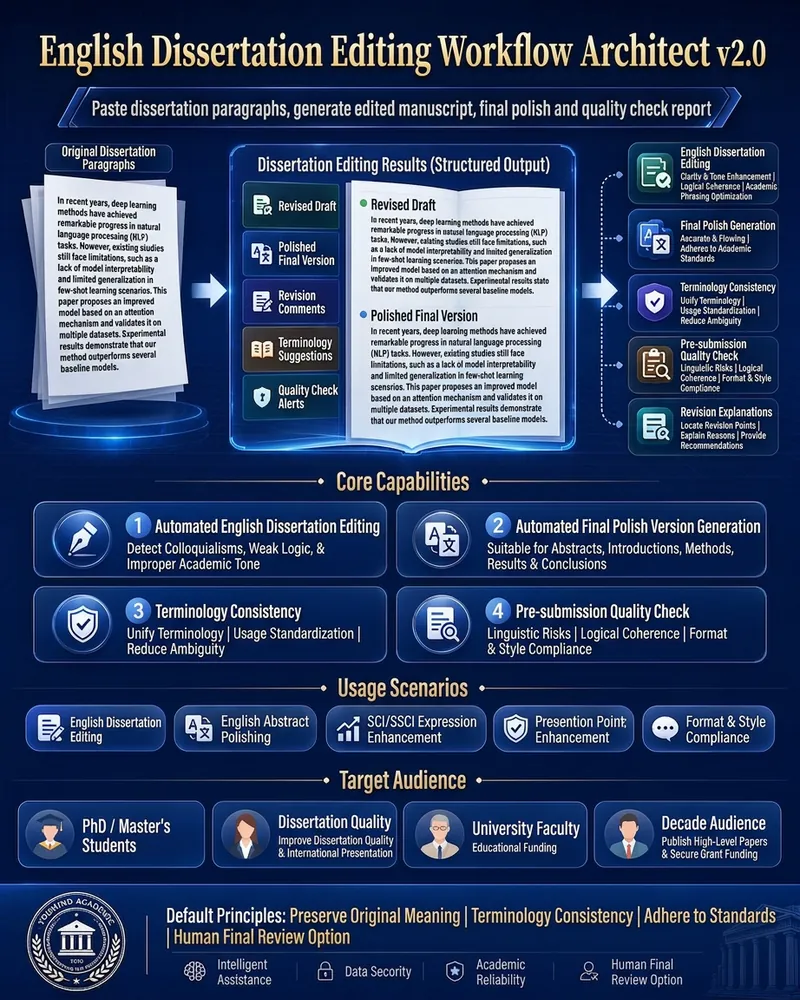 Write
WriteAcademic Paper Editor
Paste a paper paragraph to generate a polished version, an English translation, and a quality-check report. It can help you: 1. Automatically polish Chinese academic papers Identify conversational wording, loose expression, logical jumps, and insufficiently academic tone, then produce more standardized and clearer academic Chinese. 2. Automatically generate an English translation Translate Chinese paper paragraphs into English that follows academic writing conventions while preserving terminology, logical relationships, and the tone of the research. 3. Automatically perform bilingual quality checks Check terminology consistency, logical flow, semantic deviations, grammar issues, long-sentence risks, and whether the academic phrasing is sound. 4. Automatically explain revisions In addition to providing the results, explain what was changed and why, making it easier to continue revising the full paper. Suitable for: PhD students, master's students, university instructors, researchers, paper submission authors, research group members, and writers of English abstracts and SCI/SSCI papers. How to use: Paste a paper paragraph and say what you want to do: “Please polish this Chinese academic paragraph.” “Please translate it into English.” “Please polish the Chinese first, then translate it into English.” “Please check whether this English paragraph fits academic writing conventions.” If you do not specify a mode, I will default to “Chinese polishing + English translation + quality-check report.”
 Write
WriteAI Writing Humanizer
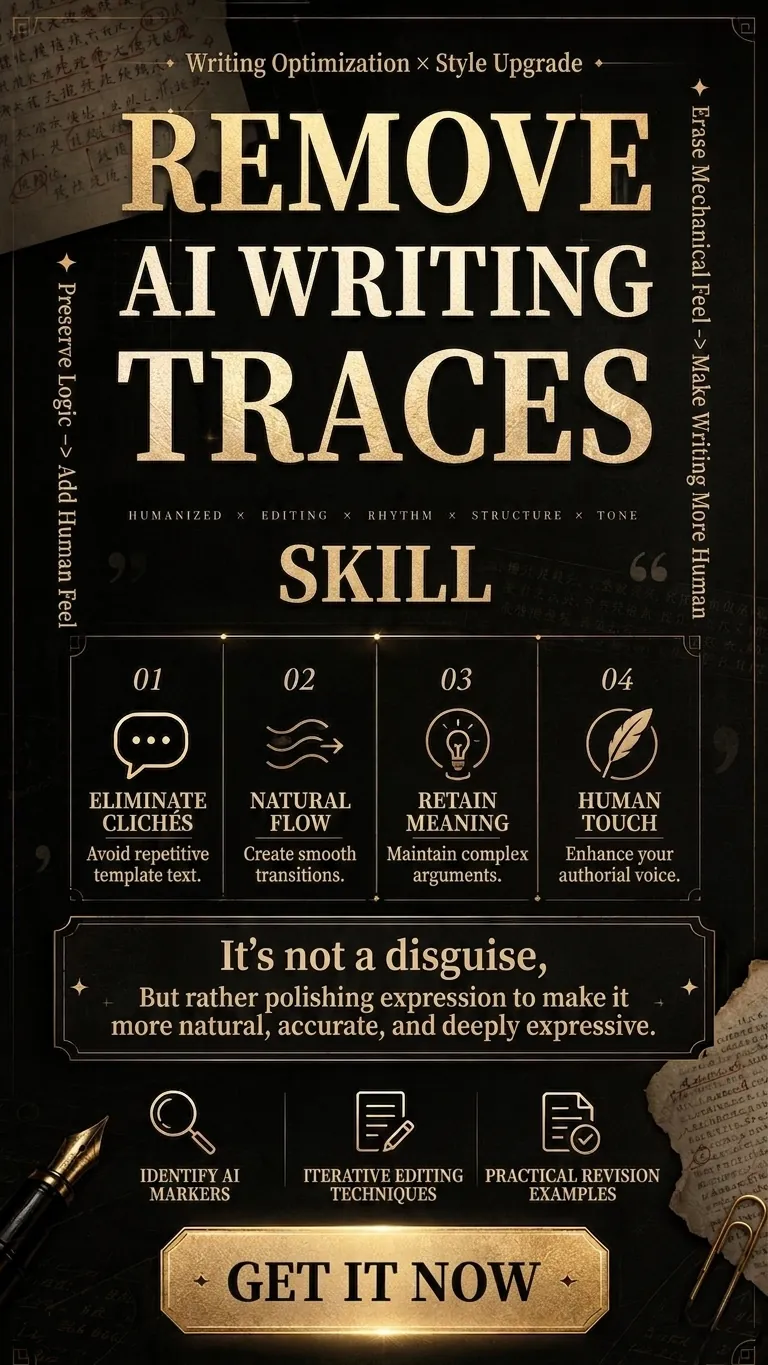
Want to eliminate the common 'industrialized' traces in Chinese AI text, giving your writing genuine human warmth and depth? This skill focuses on removing formulaic expressions in AI writing, injecting lively judgment, natural rhythm, unique emphasis, rich details, and authentic tone. It is especially adept at handling in-depth content such as comments, personal essays, historical analysis, political philosophy, social observations, reading notes, and long-form WeChat articles. By identifying and rewriting rigid aspects—from word choice and sentence structure to overall argumentation—this skill helps you transform grand, universally correct narratives into specific, nuanced insights, giving your writing a smooth and natural flow. Without altering the original meaning, it carefully diagnoses AI traces, such as identifying vague clichés, repetitive sentence patterns, and overly balanced tones. It replaces these mechanical elements with more concrete and insightful expressions, infusing your article with the author's personal thoughts and judgments rather than a cold logical construct. Additionally, for issues that mere polishing cannot solve, it points out where facts, examples, or arguments are needed, ensuring both depth and breadth. The result is a Chinese article that is not only clear in viewpoint but also full of human touch and personalized expression. It retains necessary professionalism while removing exaggerated adjectives and stiff connectors, making the text as natural as breathing—powerful yet warm, and far from being 'correct nonsense'.
 Write
WriteAIGC Reduction & Rewrite v7.0
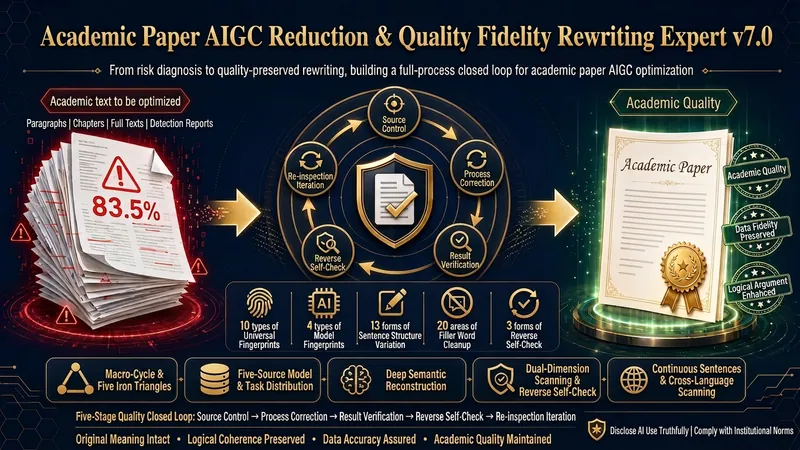
📚 Academic Paper AIGC Reduction and Quality-Preserving Rewriting Expert v7.0 Designed for graduate students, researchers, and paper authors, this academic text optimization skill operates on a core closed loop of 'source control → process correction → result verification → reverse self-check → iterative re-check'. It systematically diagnoses and optimizes issues such as templated expressions, mechanical logic, vague content, inaccurate terminology, and style inconsistencies while preserving original meaning, technical terms, data, and core conclusions. 🔍📝 🌟 Core Capabilities 🔬 Multi-layer Risk Diagnosis Covers 10 types of universal text fingerprints and assists in identifying common expression patterns of models such as ChatGPT, Claude, DeepSeek, and Wenxin Yiyan. 🧠 Deep Semantic Restructuring Goes beyond synonym replacement to rebuild more natural and in-depth academic reasoning by adjusting proposition expression, information order, argument approach, and evidence organization. ✍️ Quality-Preserving Rewriting Comprehensively applies 13 sentence transformation strategies and 20 methods for cleaning high-frequency templated expressions, improving mechanical sentence structures, repetitive connectors, and overly rigid formatting. 📊 Full-text Structure Diagnosis Through macro-cycle and five key triangles, checks whether research problems, theory, literature review, methods, results, conclusions, and innovation form a complete closed loop. 🧩 Fine-grained Section Adaptation Develops differentiated diagnostic and rewriting strategies for abstract, introduction, literature review, research methods, results, discussion, and conclusion respectively. 🌐 Cross-language Risk Scanning Assists in identifying translationese, passive voice stacking, long sentence nesting, and mixed Chinese-English formatting abnormalities to make Chinese academic expression more natural and accurate. 🔄 Reverse Self-check Loop After rewriting, re-verifies from three aspects: technique distribution, new text fingerprints, and information integrity, to avoid 'becoming more templated' or losing key content. 🛡️ Academic Integrity Protection Does not fabricate literature, data, cases, or policy evidence; separately marks information requiring author verification and reminds users to honestly disclose AI usage. 🎯 Use Cases ✅ Single paragraph or partial section optimization ✅ Targeted modification of marked paragraphs from inspection reports ✅ Polishing of abstract, introduction, literature review, discussion, and conclusion ✅ Full-text AIGC risk feature diagnosis ✅ Language and structure adaptation for target journals ✅ Pre-submission quality review and consistency check 📦 Final Deliverables 📄 Quality-preserving rewritten text 🔎 Risk and issue diagnosis report 🛠️ Rewriting strategy and technique description ✅ Reverse self-check and information integrity report 💡 Items requiring author verification and subsequent revision suggestions 🎓 Original meaning preserved · Logic intact · No fabricated data · Academic quality maintained ⚠️ This skill aims to improve academic expression quality and reduce text risk features. It does not guarantee passage through any specific detection platform or achieving a particular detection score.
Phoebe English Polisher
Error-free English, more authentic language
Description
Why we love this skill
This skill offers deep editing for English articles by native Chinese speakers, correcting not only language errors but also optimizing at cultural and logical levels to ensure authentic, internationally impactful content.
Designed for native Chinese authors or Chinese translations, it elevates your articles to international publishing standards while preserving the original meaning and Chinese perspective, giving you a final polish before submission. This Skill has multiple editing capabilities, including correcting spelling, grammar, and punctuation errors; optimizing word choice and sentence structure; and eliminating translationese to ensure the article conforms to English readers' reading habits. It also evaluates the article's arguments, evidence, structure, and reasoning, identifying potential logical gaps or areas needing additional context. 1. Polish paragraph by paragraph, marking each change clearly in bold. 2. Attach Chinese translation and revision notes for each paragraph, explaining why the change was made. 3. Overall analysis of article structure, logic, and argument strength. 4. Extract a glossary for easy reuse. Suitable for: policy commentary, international current affairs, columns, academic submissions, and international communication pieces. Special note: It does not automatically output a clean version; you need to decide whether to accept changes to avoid version confusion.
Related Skills
View allWriteAcademic Paper Editor
Paste a paper paragraph to generate a polished version, an English translation, and a quality-check report. It can help you: 1. Automatically polish Chinese academic papers Identify conversational wording, loose expression, logical jumps, and insufficiently academic tone, then produce more standardized and clearer academic Chinese. 2. Automatically generate an English translation Translate Chinese paper paragraphs into English that follows academic writing conventions while preserving terminology, logical relationships, and the tone of the research. 3. Automatically perform bilingual quality checks Check terminology consistency, logical flow, semantic deviations, grammar issues, long-sentence risks, and whether the academic phrasing is sound. 4. Automatically explain revisions In addition to providing the results, explain what was changed and why, making it easier to continue revising the full paper. Suitable for: PhD students, master's students, university instructors, researchers, paper submission authors, research group members, and writers of English abstracts and SCI/SSCI papers. How to use: Paste a paper paragraph and say what you want to do: “Please polish this Chinese academic paragraph.” “Please translate it into English.” “Please polish the Chinese first, then translate it into English.” “Please check whether this English paragraph fits academic writing conventions.” If you do not specify a mode, I will default to “Chinese polishing + English translation + quality-check report.”
WriteAI Writing Humanizer
Want to eliminate the common 'industrialized' traces in Chinese AI text, giving your writing genuine human warmth and depth? This skill focuses on removing formulaic expressions in AI writing, injecting lively judgment, natural rhythm, unique emphasis, rich details, and authentic tone. It is especially adept at handling in-depth content such as comments, personal essays, historical analysis, political philosophy, social observations, reading notes, and long-form WeChat articles. By identifying and rewriting rigid aspects—from word choice and sentence structure to overall argumentation—this skill helps you transform grand, universally correct narratives into specific, nuanced insights, giving your writing a smooth and natural flow. Without altering the original meaning, it carefully diagnoses AI traces, such as identifying vague clichés, repetitive sentence patterns, and overly balanced tones. It replaces these mechanical elements with more concrete and insightful expressions, infusing your article with the author's personal thoughts and judgments rather than a cold logical construct. Additionally, for issues that mere polishing cannot solve, it points out where facts, examples, or arguments are needed, ensuring both depth and breadth. The result is a Chinese article that is not only clear in viewpoint but also full of human touch and personalized expression. It retains necessary professionalism while removing exaggerated adjectives and stiff connectors, making the text as natural as breathing—powerful yet warm, and far from being 'correct nonsense'.
WriteAIGC Reduction & Rewrite v7.0
📚 Academic Paper AIGC Reduction and Quality-Preserving Rewriting Expert v7.0 Designed for graduate students, researchers, and paper authors, this academic text optimization skill operates on a core closed loop of 'source control → process correction → result verification → reverse self-check → iterative re-check'. It systematically diagnoses and optimizes issues such as templated expressions, mechanical logic, vague content, inaccurate terminology, and style inconsistencies while preserving original meaning, technical terms, data, and core conclusions. 🔍📝 🌟 Core Capabilities 🔬 Multi-layer Risk Diagnosis Covers 10 types of universal text fingerprints and assists in identifying common expression patterns of models such as ChatGPT, Claude, DeepSeek, and Wenxin Yiyan. 🧠 Deep Semantic Restructuring Goes beyond synonym replacement to rebuild more natural and in-depth academic reasoning by adjusting proposition expression, information order, argument approach, and evidence organization. ✍️ Quality-Preserving Rewriting Comprehensively applies 13 sentence transformation strategies and 20 methods for cleaning high-frequency templated expressions, improving mechanical sentence structures, repetitive connectors, and overly rigid formatting. 📊 Full-text Structure Diagnosis Through macro-cycle and five key triangles, checks whether research problems, theory, literature review, methods, results, conclusions, and innovation form a complete closed loop. 🧩 Fine-grained Section Adaptation Develops differentiated diagnostic and rewriting strategies for abstract, introduction, literature review, research methods, results, discussion, and conclusion respectively. 🌐 Cross-language Risk Scanning Assists in identifying translationese, passive voice stacking, long sentence nesting, and mixed Chinese-English formatting abnormalities to make Chinese academic expression more natural and accurate. 🔄 Reverse Self-check Loop After rewriting, re-verifies from three aspects: technique distribution, new text fingerprints, and information integrity, to avoid 'becoming more templated' or losing key content. 🛡️ Academic Integrity Protection Does not fabricate literature, data, cases, or policy evidence; separately marks information requiring author verification and reminds users to honestly disclose AI usage. 🎯 Use Cases ✅ Single paragraph or partial section optimization ✅ Targeted modification of marked paragraphs from inspection reports ✅ Polishing of abstract, introduction, literature review, discussion, and conclusion ✅ Full-text AIGC risk feature diagnosis ✅ Language and structure adaptation for target journals ✅ Pre-submission quality review and consistency check 📦 Final Deliverables 📄 Quality-preserving rewritten text 🔎 Risk and issue diagnosis report 🛠️ Rewriting strategy and technique description ✅ Reverse self-check and information integrity report 💡 Items requiring author verification and subsequent revision suggestions 🎓 Original meaning preserved · Logic intact · No fabricated data · Academic quality maintained ⚠️ This skill aims to improve academic expression quality and reduce text risk features. It does not guarantee passage through any specific detection platform or achieving a particular detection score.
Find your next favorite skill
Explore more curated AI skills for research, creation, and everyday work.