Cognition Expander
Description
Starting from a vague interest or information point, automatically expand it into searchable knowledge structures and dimensions of understanding, helping to quickly build a knowledge exploration path (suitable for tools like NotebookLM).
Related Skills
View all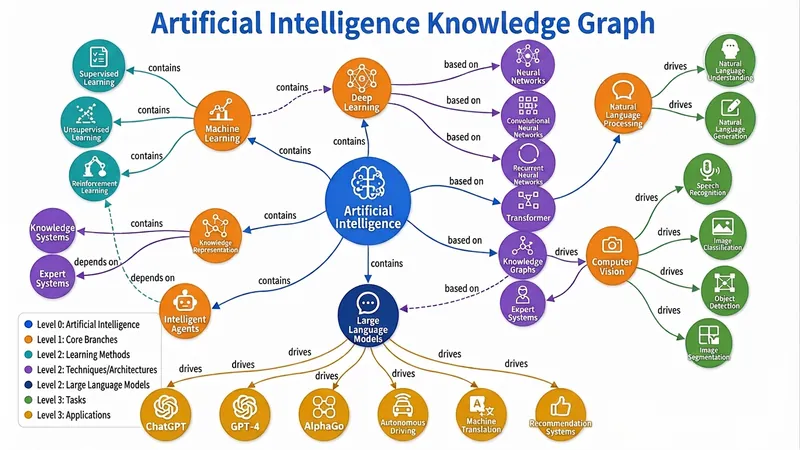
Knowledge Graph Engine
Automatically build five types of diagrams (Knowledge Graph, Mind Map, Concept Map, Flowchart/Architecture Diagram, Relation Diagram) from text, files, or topics, and output an interactive web page, static image, and visualization code all in one — a triple-threat solution built to the highest standards. Combines best practices from knowledge graph engineering and information visualization, supporting dynamic granularity control, disambiguation and deduplication, and multi-source cross-validation. Turn your words, files, or even a thought into a draggable, zoomable, searchable interactive knowledge graph in seconds, and export high-definition images and ready-to-use code with one click — this is the knowledge visualization "triple-threat" engine you've never experienced before. 🧠 What is the Knowledge Graph Engine? It's not the simple drawing tool you've seen before. It's a knowledge engineer + visualization expert hidden in your browser. Give it a textbook passage, a thesis, a PDF, or just a keyword, and it will automatically: 🔍 Extract core entities and clarify deep relationships 🧱 Build structured graph JSON (Knowledge Graph / Mind Map / Concept Map / Flowchart / Relation Diagram) 🎨 Output three top-tier forms: interactive web page + high-definition static image + Markdown/Mermaid/Graphviz code From now on, information organization doesn't rely on manual box drawing, and knowledge presentation is no longer just a static picture. ⚡ Why is it "top-tier"? 1. Fully automatic "text-to-graph" pipeline: No need to learn any modeling language or manually define nodes and connections. Just input content, and the engine automatically determines the graph type: Subject knowledge system? → Generates a semantically rich knowledge graph Reading notes deconstruction? → Generates a clear hierarchical mind map Process and decision? → Generates a flowchart/architecture diagram with branches Character relationship network? → Generates a multi-dimensional relation diagram Even if you just throw a topic word, it can independently gather information, fill in the content, and then generate the graph. 2. Triple-threat output covering all use cases: 🖱️ Interactive D3.js web page: Drag nodes, scroll to zoom, click for details, highlight related paths, keyword search... like operating a living map. Single-file HTML, no backend, can be embedded directly into any page or sent to anyone. 🖼️ High-definition static graph: Force-directed layout, color-coded categories, directly usable for thesis illustrations, PPT presentations, teaching materials — every label is sharp and readable. 📜 Visualization code: Generates both Mermaid and Graphviz source code simultaneously. Developers can directly insert into documentation, wiki, Notion, with unlimited expandability for secondary editing. 3. Ultimate user experience design: 🎨 Colors automatically mapped by entity type, hierarchy expressed intuitively by node size 🔗 Relationship labels displayed directly on curves — instantly see 'contains', 'causes', 'supports' 💡 Click any node, non-related parts auto-fade to focus on the thought path 🔄 Reset layout, search positioning, zoom and pan... all operations smooth as silk 4. Engineering wisdom balancing 'breadth' and 'depth': From entity disambiguation and deduplication to multi-source cross-validation; from hierarchical granularity control to dotted-line connections supporting cross-domain relationships — behind this are the best practices of knowledge graph engineering, not a toy but a productivity tool. 👥 Who needs it most? Teachers & Educational Content Creators: Turn entire textbook chapters into an interactive knowledge map — students click to understand concept relationships. Researchers & Students: Literature reviews no longer rely on text walls — one diagram clarifies the theoretical threads of dozens of papers. Product Managers & Enterprise Architects: System architecture, business processes, feature breakdown — instantly generate architecture diagrams, doubling communication efficiency. Readers & Lifelong Learners: Notes are no longer just outlines but explorable thought networks, letting knowledge truly 'grow' together. 🚀 Now, let your knowledge 'come alive' You give content, it gives insights. You give a topic, it gives a system. You give a requirement, it gives a complete deliverable of web pages, images, and code. This is not a feature; it's a workflow that elevates information into cognition. Let the Knowledge Graph Engine become an extension of your thinking, visualize your expertise, and reach every audience's 'aha moment.' — From today, don't 'draw' graphs, 'generate' graphs.
CogMirror|YouMind ThinkPrint
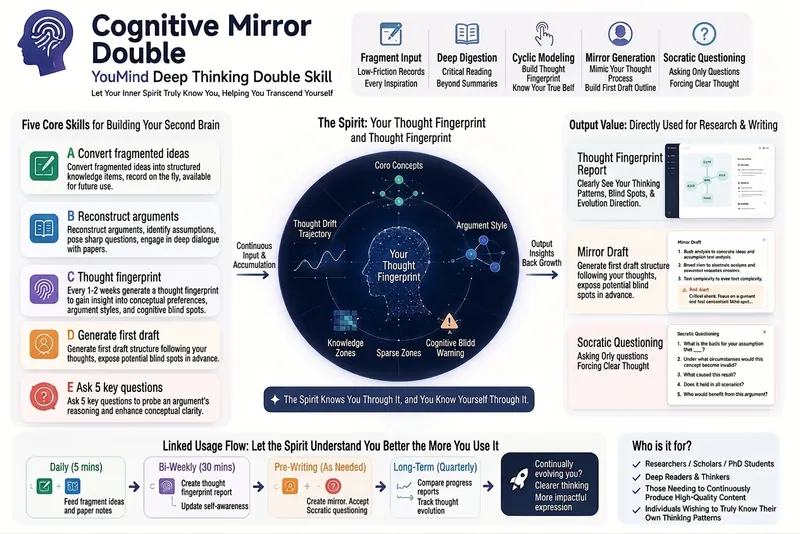
Cognitive Mirror is not just an ordinary note-taking tool; it is a personal cognitive modeling Skill for deep thinkers. It uses 'low-friction input, periodic modeling, mirror generation, and Socratic questioning' as its core mechanisms to help you continuously turn daily fragmented thoughts, paper reading notes, research judgments, and writing inspiration into personal knowledge assets that can be accumulated, reflected upon, and recalled. The system has five built-in lightweight Skills: Fragmented Note Digester: structures scattered ideas; Paper Critical Reader: helps you reconstruct arguments, identify assumptions, and ask sharp questions; Thinking Fingerprint Generator: periodically analyzes your conceptual preferences, argumentation style, and cognitive blind spots; Mirror Draft Generator: generates initial frameworks that 'read like you wrote them' based on your thinking patterns; Socratic Questioner: specifically attacks the weakest points of an argument. It does not think for you, but continuously trains your second brain, allowing your knowledge base to gradually develop its own judgment, problem awareness, and writing style.

Mind Startup Assistant
Amid the flood of information, we need an assistant to update our 'brain operating system', letting article expressions flow through our brain and body, improving reading and thinking efficiency. The human brain has 86 billion neurons, and any knowledge is dynamically present in local network structures. In the future, when alone, we should develop the habit of interacting with our own brain network. This skill is especially suitable for learners, researchers, and thinkers who want to transform from passive information reception to active knowledge construction. It uses three thinking networks—Concept Network, Relationship Network, and Process Network—to finely break down article content, and applies four basic thinking actions—Define, Classify, Compare, Cause and Effect—to help users build clear cognitive structures. Ultimately, it encourages users to integrate mind and body, connecting abstract knowledge with embodied experience.
Cognition Expander
Description
Starting from a vague interest or information point, automatically expand it into searchable knowledge structures and dimensions of understanding, helping to quickly build a knowledge exploration path (suitable for tools like NotebookLM).
Related Skills
View allKnowledge Graph Engine
Automatically build five types of diagrams (Knowledge Graph, Mind Map, Concept Map, Flowchart/Architecture Diagram, Relation Diagram) from text, files, or topics, and output an interactive web page, static image, and visualization code all in one — a triple-threat solution built to the highest standards. Combines best practices from knowledge graph engineering and information visualization, supporting dynamic granularity control, disambiguation and deduplication, and multi-source cross-validation. Turn your words, files, or even a thought into a draggable, zoomable, searchable interactive knowledge graph in seconds, and export high-definition images and ready-to-use code with one click — this is the knowledge visualization "triple-threat" engine you've never experienced before. 🧠 What is the Knowledge Graph Engine? It's not the simple drawing tool you've seen before. It's a knowledge engineer + visualization expert hidden in your browser. Give it a textbook passage, a thesis, a PDF, or just a keyword, and it will automatically: 🔍 Extract core entities and clarify deep relationships 🧱 Build structured graph JSON (Knowledge Graph / Mind Map / Concept Map / Flowchart / Relation Diagram) 🎨 Output three top-tier forms: interactive web page + high-definition static image + Markdown/Mermaid/Graphviz code From now on, information organization doesn't rely on manual box drawing, and knowledge presentation is no longer just a static picture. ⚡ Why is it "top-tier"? 1. Fully automatic "text-to-graph" pipeline: No need to learn any modeling language or manually define nodes and connections. Just input content, and the engine automatically determines the graph type: Subject knowledge system? → Generates a semantically rich knowledge graph Reading notes deconstruction? → Generates a clear hierarchical mind map Process and decision? → Generates a flowchart/architecture diagram with branches Character relationship network? → Generates a multi-dimensional relation diagram Even if you just throw a topic word, it can independently gather information, fill in the content, and then generate the graph. 2. Triple-threat output covering all use cases: 🖱️ Interactive D3.js web page: Drag nodes, scroll to zoom, click for details, highlight related paths, keyword search... like operating a living map. Single-file HTML, no backend, can be embedded directly into any page or sent to anyone. 🖼️ High-definition static graph: Force-directed layout, color-coded categories, directly usable for thesis illustrations, PPT presentations, teaching materials — every label is sharp and readable. 📜 Visualization code: Generates both Mermaid and Graphviz source code simultaneously. Developers can directly insert into documentation, wiki, Notion, with unlimited expandability for secondary editing. 3. Ultimate user experience design: 🎨 Colors automatically mapped by entity type, hierarchy expressed intuitively by node size 🔗 Relationship labels displayed directly on curves — instantly see 'contains', 'causes', 'supports' 💡 Click any node, non-related parts auto-fade to focus on the thought path 🔄 Reset layout, search positioning, zoom and pan... all operations smooth as silk 4. Engineering wisdom balancing 'breadth' and 'depth': From entity disambiguation and deduplication to multi-source cross-validation; from hierarchical granularity control to dotted-line connections supporting cross-domain relationships — behind this are the best practices of knowledge graph engineering, not a toy but a productivity tool. 👥 Who needs it most? Teachers & Educational Content Creators: Turn entire textbook chapters into an interactive knowledge map — students click to understand concept relationships. Researchers & Students: Literature reviews no longer rely on text walls — one diagram clarifies the theoretical threads of dozens of papers. Product Managers & Enterprise Architects: System architecture, business processes, feature breakdown — instantly generate architecture diagrams, doubling communication efficiency. Readers & Lifelong Learners: Notes are no longer just outlines but explorable thought networks, letting knowledge truly 'grow' together. 🚀 Now, let your knowledge 'come alive' You give content, it gives insights. You give a topic, it gives a system. You give a requirement, it gives a complete deliverable of web pages, images, and code. This is not a feature; it's a workflow that elevates information into cognition. Let the Knowledge Graph Engine become an extension of your thinking, visualize your expertise, and reach every audience's 'aha moment.' — From today, don't 'draw' graphs, 'generate' graphs.
CogMirror|YouMind ThinkPrint
Cognitive Mirror is not just an ordinary note-taking tool; it is a personal cognitive modeling Skill for deep thinkers. It uses 'low-friction input, periodic modeling, mirror generation, and Socratic questioning' as its core mechanisms to help you continuously turn daily fragmented thoughts, paper reading notes, research judgments, and writing inspiration into personal knowledge assets that can be accumulated, reflected upon, and recalled. The system has five built-in lightweight Skills: Fragmented Note Digester: structures scattered ideas; Paper Critical Reader: helps you reconstruct arguments, identify assumptions, and ask sharp questions; Thinking Fingerprint Generator: periodically analyzes your conceptual preferences, argumentation style, and cognitive blind spots; Mirror Draft Generator: generates initial frameworks that 'read like you wrote them' based on your thinking patterns; Socratic Questioner: specifically attacks the weakest points of an argument. It does not think for you, but continuously trains your second brain, allowing your knowledge base to gradually develop its own judgment, problem awareness, and writing style.
Mind Startup Assistant
Amid the flood of information, we need an assistant to update our 'brain operating system', letting article expressions flow through our brain and body, improving reading and thinking efficiency. The human brain has 86 billion neurons, and any knowledge is dynamically present in local network structures. In the future, when alone, we should develop the habit of interacting with our own brain network. This skill is especially suitable for learners, researchers, and thinkers who want to transform from passive information reception to active knowledge construction. It uses three thinking networks—Concept Network, Relationship Network, and Process Network—to finely break down article content, and applies four basic thinking actions—Define, Classify, Compare, Cause and Effect—to help users build clear cognitive structures. Ultimately, it encourages users to integrate mind and body, connecting abstract knowledge with embodied experience.
Find your next favorite skill
Explore more curated AI skills for research, creation, and everyday work.