Enterprise Investment Research Expert
Description
An enterprise-level analysis framework designed for product investment research. Systematically research any product from zero to one, outputting a complete analysis system including design deconstruction, competitive matrix analysis, market prospect evaluation, interaction experience simulation, and professional investment research reports. Suitable for investors, product managers, and strategic analysts.
Related Skills
View all
Product Philosophy Deep Dive
Using the Product Philosophy Analysis Framework v3.0, this skill conducts a systematic nine-dimensional deep analysis of any product: belief tracing, philosophical extraction, decision mapping, competitive strategy, business model, user validation, team culture, evolutionary analysis, and core insights. It generates a comprehensive analysis report of 10,000-15,000 words, including a one-sentence philosophy statement, success factor score, and philosophy consistency scorecard. This is ideal for product managers performing competitive analysis, entrepreneurs refining product positioning, and investors assessing potential.

Competitive Intel Analyst
Start with a broad view to build a persuasive competitor database, then focus the output on the company’s core business and decision-making needs. This elevates competitor research from “case hunting” to a decision basis that can be verified, compared, and acted on. This is not a prompt that merely lists a few competitors and stitches together webpage screenshots, nor one that crams every database detail into a PPT. “Competitive Intel Analyst” is suitable for consumer goods, technology products, software services, healthcare, education, retail, manufacturing, and other industries. It first defines the research scope and builds a multidimensional search framework covering markets, companies, products/services, user value, technology paths, business models, pricing and channels, intellectual property, partners, and evidence sources. It then creates a continuously updateable, deduplicated, traceable competitor database. Finally, based on the company’s core business, intended use cases, and leadership’s decision questions, it selects a small number of highly relevant benchmarks and produces a conclusion-first leadership briefing PPT, opportunity gaps, and an action roadmap. Suitable for: Panoramic scans of new markets or product categories Product planning, technology planning, and annual strategy research Tracking key competitors, patents, suppliers, or partner ecosystems Adding to, cleaning, and updating evidence in existing competitor databases or PPTs Investment, business development, and management decision briefings Condensing large volumes of material into conclusions that leaders can understand and teams can act on Typical deliverables include a complete competitor database, a shortlist of core competitors, a leadership briefing PPT, technology/patent/ecosystem maps (as needed), an opportunity and risk list, 90/180/365-day action roadmaps, and a source index.
 Research
Product People's Business Canvas
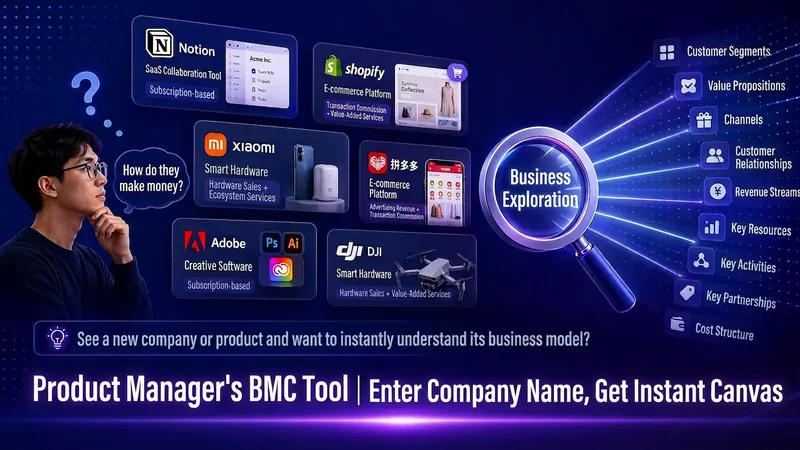
Enter a company name and instantly get a business model canvas with 9 grids. Still opening ten tabs to piece together competitor analysis? Enter a company name, and this skill automatically searches online, cross-validates sources, and outputs a structured analysis report based on the 9 BMC modules. 🎯 Smart matching for 5 scenarios: Competitor research, learning about an interesting company, job application reference, investment reference, entrepreneurial inspiration—different purposes, different focus insights. 📊 3 output formats: Text document, canvas table, PPT presentation. 🔍 3 levels of analysis depth auto-adapt: From a quick question to a formal report. ✅ Strict source verification: Each citation is verified via actual access; invalid links are directly discarded, eliminating hallucinations. 🏷️ Information credibility labels: Each piece of info is marked as "Confirmed" or "Inferred", with traceable sources. 🚫 Zero fabrication commitment: If a company is not found, inform directly; do not fabricate or invent. From fragmented information to structured insights, product people instantly understand any company's business logic.
Enterprise Investment Research Expert
Description
An enterprise-level analysis framework designed for product investment research. Systematically research any product from zero to one, outputting a complete analysis system including design deconstruction, competitive matrix analysis, market prospect evaluation, interaction experience simulation, and professional investment research reports. Suitable for investors, product managers, and strategic analysts.
Related Skills
View allProduct Philosophy Deep Dive
Using the Product Philosophy Analysis Framework v3.0, this skill conducts a systematic nine-dimensional deep analysis of any product: belief tracing, philosophical extraction, decision mapping, competitive strategy, business model, user validation, team culture, evolutionary analysis, and core insights. It generates a comprehensive analysis report of 10,000-15,000 words, including a one-sentence philosophy statement, success factor score, and philosophy consistency scorecard. This is ideal for product managers performing competitive analysis, entrepreneurs refining product positioning, and investors assessing potential.
Competitive Intel Analyst
Start with a broad view to build a persuasive competitor database, then focus the output on the company’s core business and decision-making needs. This elevates competitor research from “case hunting” to a decision basis that can be verified, compared, and acted on. This is not a prompt that merely lists a few competitors and stitches together webpage screenshots, nor one that crams every database detail into a PPT. “Competitive Intel Analyst” is suitable for consumer goods, technology products, software services, healthcare, education, retail, manufacturing, and other industries. It first defines the research scope and builds a multidimensional search framework covering markets, companies, products/services, user value, technology paths, business models, pricing and channels, intellectual property, partners, and evidence sources. It then creates a continuously updateable, deduplicated, traceable competitor database. Finally, based on the company’s core business, intended use cases, and leadership’s decision questions, it selects a small number of highly relevant benchmarks and produces a conclusion-first leadership briefing PPT, opportunity gaps, and an action roadmap. Suitable for: Panoramic scans of new markets or product categories Product planning, technology planning, and annual strategy research Tracking key competitors, patents, suppliers, or partner ecosystems Adding to, cleaning, and updating evidence in existing competitor databases or PPTs Investment, business development, and management decision briefings Condensing large volumes of material into conclusions that leaders can understand and teams can act on Typical deliverables include a complete competitor database, a shortlist of core competitors, a leadership briefing PPT, technology/patent/ecosystem maps (as needed), an opportunity and risk list, 90/180/365-day action roadmaps, and a source index.
ResearchProduct People's Business Canvas
Enter a company name and instantly get a business model canvas with 9 grids. Still opening ten tabs to piece together competitor analysis? Enter a company name, and this skill automatically searches online, cross-validates sources, and outputs a structured analysis report based on the 9 BMC modules. 🎯 Smart matching for 5 scenarios: Competitor research, learning about an interesting company, job application reference, investment reference, entrepreneurial inspiration—different purposes, different focus insights. 📊 3 output formats: Text document, canvas table, PPT presentation. 🔍 3 levels of analysis depth auto-adapt: From a quick question to a formal report. ✅ Strict source verification: Each citation is verified via actual access; invalid links are directly discarded, eliminating hallucinations. 🏷️ Information credibility labels: Each piece of info is marked as "Confirmed" or "Inferred", with traceable sources. 🚫 Zero fabrication commitment: If a company is not found, inform directly; do not fabricate or invent. From fragmented information to structured insights, product people instantly understand any company's business logic.
Find your next favorite skill
Explore more curated AI skills for research, creation, and everyday work.