
Competitive Intel Analyst
Competitor research for strategy decisions
Description
Start with a broad view to build a persuasive competitor database, then focus the output on the company’s core business and decision-making needs. This elevates competitor research from “case hunting” to a decision basis that can be verified, compared, and acted on. This is not a prompt that merely lists a few competitors and stitches together webpage screenshots, nor one that crams every database detail into a PPT. “Competitive Intel Analyst” is suitable for consumer goods, technology products, software services, healthcare, education, retail, manufacturing, and other industries. It first defines the research scope and builds a multidimensional search framework covering markets, companies, products/services, user value, technology paths, business models, pricing and channels, intellectual property, partners, and evidence sources. It then creates a continuously updateable, deduplicated, traceable competitor database. Finally, based on the company’s core business, intended use cases, and leadership’s decision questions, it selects a small number of highly relevant benchmarks and produces a conclusion-first leadership briefing PPT, opportunity gaps, and an action roadmap. Suitable for: Panoramic scans of new markets or product categories Product planning, technology planning, and annual strategy research Tracking key competitors, patents, suppliers, or partner ecosystems Adding to, cleaning, and updating evidence in existing competitor databases or PPTs Investment, business development, and management decision briefings Condensing large volumes of material into conclusions that leaders can understand and teams can act on Typical deliverables include a complete competitor database, a shortlist of core competitors, a leadership briefing PPT, technology/patent/ecosystem maps (as needed), an opportunity and risk list, 90/180/365-day action roadmaps, and a source index.
Related Skills
View all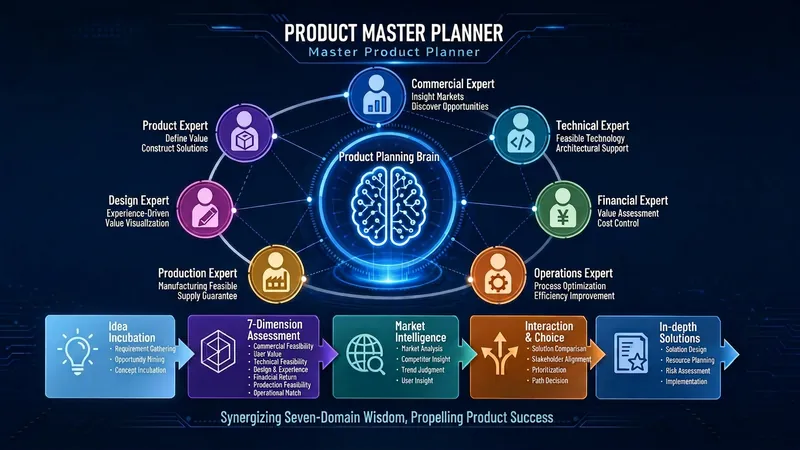
Master Product Planner
Based on the AFP architecture, this seven-dimensional product planning system integrates expertise from business, product, technology, design, finance, production, and operations to turn vague ideas into actionable product plans. Core capabilities: 1. Five-stage workflow: idea incubation → seven-dimensional expert evaluation (principles, methods, tools, practices) → market and competitive analysis → interactive selection → in-depth planning 2. Anti-AI hallucination engine: six defense lines (separating facts from inference, traceable sources, confidence labeling, locked expert boundaries, uncertainty statements, conflict marking) 3. Visual illustration: leverages the Create image skill to automatically embed graphics into the planning document 4. Three-core adversarial engine: execution core + audit core + user alignment core, with B-core audit weight set to Max 5. Pull interaction mode: AI proactively pulls key variables; the user only needs to provide materials or confirm choices Use cases: Transform pain points, ideas, or challenges into product plans, especially suitable for 0-to-1 planning of complex products (hardware-software integrated, platform-based, industry vertical). Trigger words: product planning, product plan, product concept, 0-to-1, MVP definition, product evaluation

B2B Collaboration Feasibility
Input a client name, output a deal feasibility report ready for decision meetings. Process: Company profiling research → Value chain breakdown (including in-house/outsourcing assessment) → Scenario matching matrix → Hard constraint veto → Six-dimension weighted scoring (1-10) → Decision chain and 30/60/90-day action plan → Verification checklist. Produces both YouMind document and web report. Three key differences from ordinary client analysis: ① Will say 'no'. Things your solution cannot do are recorded in the 'Solution Profile', and boundary-crossing scenarios are directly vetoed, without masking through rhetoric. ② First determine whether the process is in-house or outsourced. No matter how painful the client's problem is, if that process has already been outsourced, the buyer is their supplier; the client entity has changed, and it must be assessed separately. ③ Check if value metrics can align. You talk about defect rate, the client talks about government assessment scores; proposals without a 'conversion rate' between the two languages will be rejected during financial review. Our capabilities are injected once via the 'Solution Profile' and reused long-term, applicable to any industry and any B2B solution (hardware/software/service/integration). Built-in value chain decomposition for seven types of industries: discrete manufacturing, retail chain, software/internet, B2B services & finance, energy & infrastructure, healthcare/education/government, and project-based integration, along with a mixed-ownership decision chain template. Every key piece of information is required to be labeled as fact/inference/unknown to avoid using inference as fact. Trigger words: client assessment, cooperation feasibility, client analysis, deal assessment, worth pursuing, can we take it, client screening.
 Research
Multi-Agent: A-Share Pick & IC
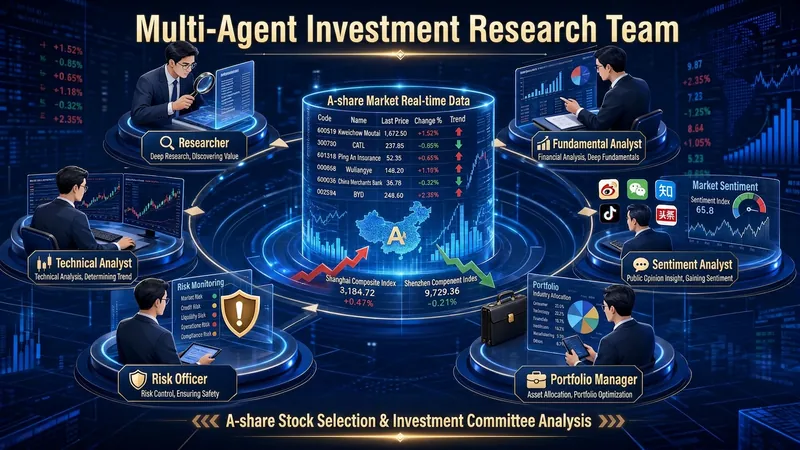
It's not an AI assistant, but a virtual investment research team. Common AI stock-picking tools suffer from three problems: fabricating financial figures and target prices, giving vague "bullish/bearish" remarks, and offering "buy" recommendations without clear reasoning. The Multi-Agent Investment Research Team tackles these with a three-pronged approach: 6 parallel roles, cross-validation, and mandatory source attribution. It convenes researchers, fundamental analysts, technical analysts, sentiment analysts, risk officers, and investment managers to work in parallel, deliberating like a real investment committee. What you get is not fuzzy opinions, but a professional research document with facts, signals, disagreements, risks, and every number traceable to its source. Two modes covering "researching a single stock" and "screening a batch of stocks" Mode A: Single-Stock Committee Deep Analysis — Just provide a stock (e.g., "Analyze BYD 002594"), and the skill automatically convenes a full investment committee: the researcher aggregates market data, financial reports, research reports, and industry chain positioning, presenting only objective facts; the fundamental analyst issues a financial health scorecard, key changes in the three financial statements, and PEG valuation; the technical analyst evaluates trends, moving averages, MACD, support and resistance levels, and provides a five-point buy signal hit table; the sentiment analyst scans institutional divergence, retail investor sentiment, and potential misinterpretations; the risk officer digs up counter-evidence, systematically refuting optimistic conclusions from other roles; finally, the investment manager, without adding new data, integrates everything to produce committee minutes and a one-page summary. Mode B: Multi-Condition Stock Screening — From a specified universe (e.g., CSI 300, a sector/theme basket, or your own stock pool), apply a three-layer funnel: L1 financial hard screen (three consecutive quarters of growth, ample cash flow, PEG<1 or huge increase in contract liabilities), L2 technical timing (base breakout, moving average golden cross, volume breakout, strong pullback on low volume, MACD crossing above zero line), L3 information validation (research report ratings and industry chain logic, eliminating "pure technical without fundamental basis" picks). After obtaining a candidate list, the top N stocks can automatically proceed to Mode A for deep analysis. What you will get Mode A delivers a fixed "five-piece set": ① Full analysis report integrating all six roles; ② Data source and evidence table, with each key conclusion mapped to "data → source → date"; ③ Meeting-style committee minutes (agenda → each role's view → disagreements → consensus → variables to track); ④ Risk list sorted by high/medium/low severity; ⑤ One-page investment manager summary condensing core logic, key variables, verification points, and confidence level. Mode B delivers: Candidate stock list table (ticker | name | triggered conditions | key data | source | trigger date) plus screening criteria and methodology description, optionally with the full five-piece set for top candidates. All outputs are saved as files with ticker and date in the filename for easy reuse and archiving.
Competitive Intel Analyst
Competitor research for strategy decisions
Description
Start with a broad view to build a persuasive competitor database, then focus the output on the company’s core business and decision-making needs. This elevates competitor research from “case hunting” to a decision basis that can be verified, compared, and acted on. This is not a prompt that merely lists a few competitors and stitches together webpage screenshots, nor one that crams every database detail into a PPT. “Competitive Intel Analyst” is suitable for consumer goods, technology products, software services, healthcare, education, retail, manufacturing, and other industries. It first defines the research scope and builds a multidimensional search framework covering markets, companies, products/services, user value, technology paths, business models, pricing and channels, intellectual property, partners, and evidence sources. It then creates a continuously updateable, deduplicated, traceable competitor database. Finally, based on the company’s core business, intended use cases, and leadership’s decision questions, it selects a small number of highly relevant benchmarks and produces a conclusion-first leadership briefing PPT, opportunity gaps, and an action roadmap. Suitable for: Panoramic scans of new markets or product categories Product planning, technology planning, and annual strategy research Tracking key competitors, patents, suppliers, or partner ecosystems Adding to, cleaning, and updating evidence in existing competitor databases or PPTs Investment, business development, and management decision briefings Condensing large volumes of material into conclusions that leaders can understand and teams can act on Typical deliverables include a complete competitor database, a shortlist of core competitors, a leadership briefing PPT, technology/patent/ecosystem maps (as needed), an opportunity and risk list, 90/180/365-day action roadmaps, and a source index.
Related Skills
View allMaster Product Planner
Based on the AFP architecture, this seven-dimensional product planning system integrates expertise from business, product, technology, design, finance, production, and operations to turn vague ideas into actionable product plans. Core capabilities: 1. Five-stage workflow: idea incubation → seven-dimensional expert evaluation (principles, methods, tools, practices) → market and competitive analysis → interactive selection → in-depth planning 2. Anti-AI hallucination engine: six defense lines (separating facts from inference, traceable sources, confidence labeling, locked expert boundaries, uncertainty statements, conflict marking) 3. Visual illustration: leverages the Create image skill to automatically embed graphics into the planning document 4. Three-core adversarial engine: execution core + audit core + user alignment core, with B-core audit weight set to Max 5. Pull interaction mode: AI proactively pulls key variables; the user only needs to provide materials or confirm choices Use cases: Transform pain points, ideas, or challenges into product plans, especially suitable for 0-to-1 planning of complex products (hardware-software integrated, platform-based, industry vertical). Trigger words: product planning, product plan, product concept, 0-to-1, MVP definition, product evaluation
B2B Collaboration Feasibility
Input a client name, output a deal feasibility report ready for decision meetings. Process: Company profiling research → Value chain breakdown (including in-house/outsourcing assessment) → Scenario matching matrix → Hard constraint veto → Six-dimension weighted scoring (1-10) → Decision chain and 30/60/90-day action plan → Verification checklist. Produces both YouMind document and web report. Three key differences from ordinary client analysis: ① Will say 'no'. Things your solution cannot do are recorded in the 'Solution Profile', and boundary-crossing scenarios are directly vetoed, without masking through rhetoric. ② First determine whether the process is in-house or outsourced. No matter how painful the client's problem is, if that process has already been outsourced, the buyer is their supplier; the client entity has changed, and it must be assessed separately. ③ Check if value metrics can align. You talk about defect rate, the client talks about government assessment scores; proposals without a 'conversion rate' between the two languages will be rejected during financial review. Our capabilities are injected once via the 'Solution Profile' and reused long-term, applicable to any industry and any B2B solution (hardware/software/service/integration). Built-in value chain decomposition for seven types of industries: discrete manufacturing, retail chain, software/internet, B2B services & finance, energy & infrastructure, healthcare/education/government, and project-based integration, along with a mixed-ownership decision chain template. Every key piece of information is required to be labeled as fact/inference/unknown to avoid using inference as fact. Trigger words: client assessment, cooperation feasibility, client analysis, deal assessment, worth pursuing, can we take it, client screening.
ResearchMulti-Agent: A-Share Pick & IC
It's not an AI assistant, but a virtual investment research team. Common AI stock-picking tools suffer from three problems: fabricating financial figures and target prices, giving vague "bullish/bearish" remarks, and offering "buy" recommendations without clear reasoning. The Multi-Agent Investment Research Team tackles these with a three-pronged approach: 6 parallel roles, cross-validation, and mandatory source attribution. It convenes researchers, fundamental analysts, technical analysts, sentiment analysts, risk officers, and investment managers to work in parallel, deliberating like a real investment committee. What you get is not fuzzy opinions, but a professional research document with facts, signals, disagreements, risks, and every number traceable to its source. Two modes covering "researching a single stock" and "screening a batch of stocks" Mode A: Single-Stock Committee Deep Analysis — Just provide a stock (e.g., "Analyze BYD 002594"), and the skill automatically convenes a full investment committee: the researcher aggregates market data, financial reports, research reports, and industry chain positioning, presenting only objective facts; the fundamental analyst issues a financial health scorecard, key changes in the three financial statements, and PEG valuation; the technical analyst evaluates trends, moving averages, MACD, support and resistance levels, and provides a five-point buy signal hit table; the sentiment analyst scans institutional divergence, retail investor sentiment, and potential misinterpretations; the risk officer digs up counter-evidence, systematically refuting optimistic conclusions from other roles; finally, the investment manager, without adding new data, integrates everything to produce committee minutes and a one-page summary. Mode B: Multi-Condition Stock Screening — From a specified universe (e.g., CSI 300, a sector/theme basket, or your own stock pool), apply a three-layer funnel: L1 financial hard screen (three consecutive quarters of growth, ample cash flow, PEG<1 or huge increase in contract liabilities), L2 technical timing (base breakout, moving average golden cross, volume breakout, strong pullback on low volume, MACD crossing above zero line), L3 information validation (research report ratings and industry chain logic, eliminating "pure technical without fundamental basis" picks). After obtaining a candidate list, the top N stocks can automatically proceed to Mode A for deep analysis. What you will get Mode A delivers a fixed "five-piece set": ① Full analysis report integrating all six roles; ② Data source and evidence table, with each key conclusion mapped to "data → source → date"; ③ Meeting-style committee minutes (agenda → each role's view → disagreements → consensus → variables to track); ④ Risk list sorted by high/medium/low severity; ⑤ One-page investment manager summary condensing core logic, key variables, verification points, and confidence level. Mode B delivers: Candidate stock list table (ticker | name | triggered conditions | key data | source | trigger date) plus screening criteria and methodology description, optionally with the full five-piece set for top candidates. All outputs are saved as files with ticker and date in the filename for easy reuse and archiving.
Find your next favorite skill
Explore more curated AI skills for research, creation, and everyday work.