
Multi-Framework Analysis
Structure complex decisions and debates
Multi-Framework Analysis
Structure complex decisions and debates
Showcase
Description
Turn complex problems into structured, multi-perspective analyses that can be reviewed, verified, and used to support next steps. Whether you are evaluating career choices, business and product decisions, social phenomena, controversial issues, trending topics, innovations, or abstract concepts, this Skill first clarifies the subject, goals, constraints, known information, and key unknowns. It then selects complementary cognitive frameworks based on the task, avoiding a pileup of concepts or repeated versions of the same conclusion. The analysis clearly distinguishes between information provided by the user, verified facts, general principles, assumptions, inferences, and content that still needs validation. It places evidence, mechanisms, counterevidence, alternative explanations, and uncertainty within a clear chain of reasoning. For time-sensitive, controversial, specialized, or high-risk facts, it can use targeted web searches and verify original sources. When sources conflict, it preserves the differences rather than filling gaps with unverified data or overly certain claims. The final output typically includes a problem profile; the framework selection and analysis of each framework; areas of agreement and disagreement across perspectives; sensitive variables; blind spots and failure conditions; and conditional conclusions with confidence levels. It does not replace professional medical, legal, investment, tax, or other advice. Instead, it helps you identify the factors that truly affect judgment and design minimal validation steps, information-gathering plans, decision gates, or reversible next steps. Simple questions can be condensed into a brief assessment, while complex or multi-subject tasks can be developed into a complete analytical report.
Best for
For anyone who needs to clarify the basis for judgment and plan next steps in complex decisions, controversial issues, or multifactor phenomena.
How to use this Skill
Provide your input
Provide a complex problem, options, goals, constraints, and known information for in-depth analysis. You can also explain what you want to compare, understand, or support next.
Run the Skill
The Skill organizes facts, assumptions, evidence, and uncertainty from multiple complementary perspectives, highlighting consensus, disagreements, counterevidence, and key variables.
Review your result
Receive a reviewable structured analysis with conditional conclusions, applicable boundaries, and actionable validation or follow-up recommendations.
Related Skills
View all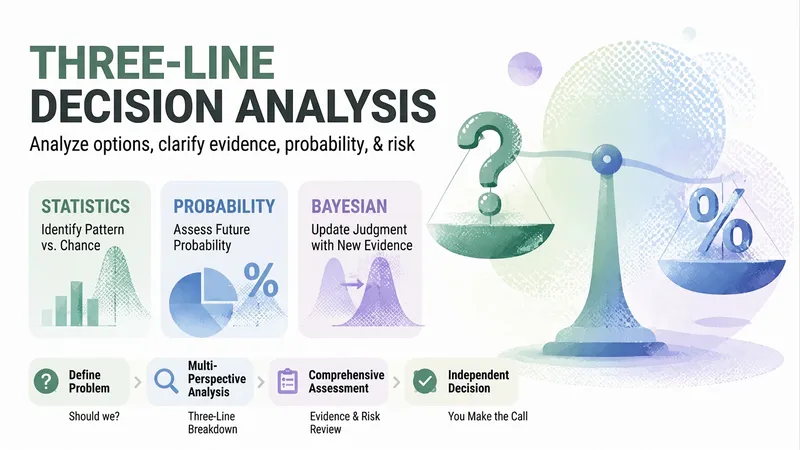
Should I Do It? Analysis
Turn the vague uncertainty of “Should I do X?” into a clearly bounded decision analysis that can be checked and updated over time. Whether you’re considering leaving your job to start a business, investing in a project, buying an asset, or making a career or life choice, you can provide text, tables, documents, or screenshots to organize your options, time horizon, major costs, how much risk you’re willing to accept, and how much confidence you need before acting. The analysis examines the question through statistics, probability theory, and Bayesian reasoning: checking whether samples are reliable and whether an observed pattern is more likely a real trend or a coincidence; breaking down possible future scenarios and comparing probabilities, expected returns, and tail risks; then combining prior beliefs with new evidence to determine which information is truly discriminating and how your judgment should be updated. User-provided facts, public information, and analytical assumptions are clearly separated. When reliable data is lacking, uncertainty is not concealed behind false precision. You’ll receive a replayable decision framework that includes new information worth verifying, actionable next steps, triggers for reassessment, and key evidence still needed. It won’t make the decision for you or present assumptions as facts. Instead, it helps you see the evidence, probabilities, costs, and risks clearly, leaving the decision in your hands.
How the World Works
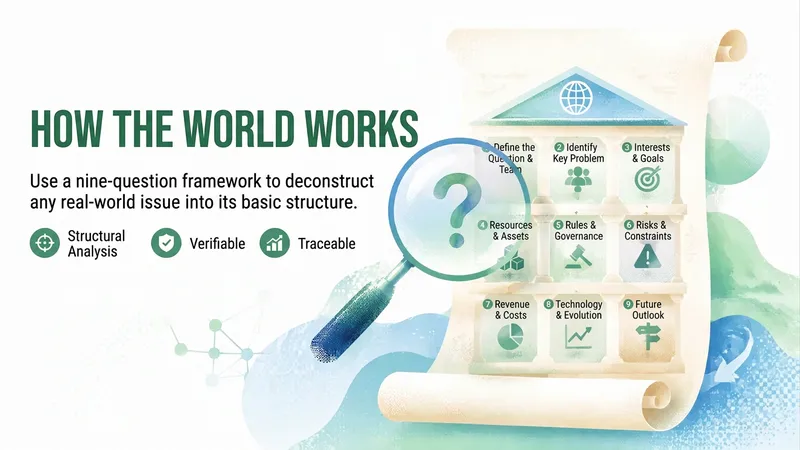
Breaks complex real-world issues down into verifiable underlying structures, helping you see the relationships among participants, interests, resource allocation, rules, risks, returns, and technological change. Whether you are examining cross-border payment costs, the platform economy, stablecoins and monetary sovereignty, or capital cycles in computing power and electricity, you can start with a specific question, an abstract concept, or the current landscape and establish clear analytical boundaries. The skill selects a diagnostic, teaching, or observation path based on your needs, while defining the timeframe, geographic or market scope, key actors, and required data. Throughout the analysis, it distinguishes verified facts, evidence-based inferences, and participant narratives, and records dates, sources, and uncertainty. When sources conflict, it preserves the disagreement rather than replacing facts with promotional messaging. The result is a traceable structural analysis document. It examines the key mechanisms behind an issue layer by layer—from scarcity and choice, property rights, and rules to organizations, finance, the macro environment, and changes in technology costs—and brings each core question to a clear conclusion. It is suited to researching business models, institutional arrangements, financial infrastructure, technology industry cycles, and other real-world issues that require looking beneath the surface.
Public Opinion Risk Monitor
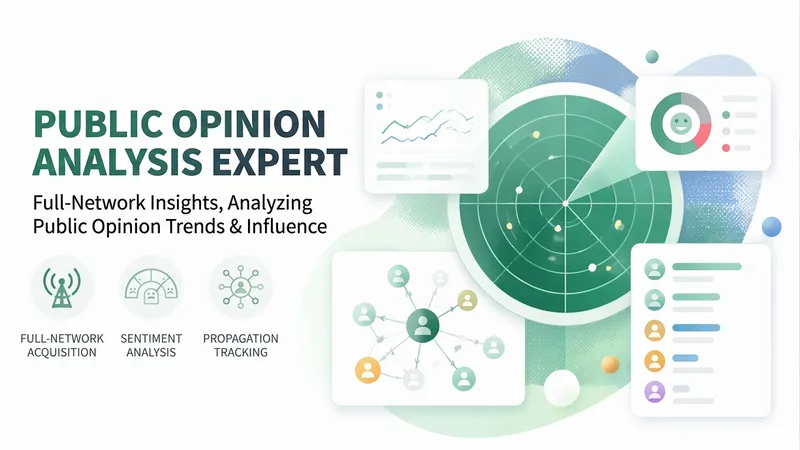
Turn vague monitoring needs involving a company, brand, person, product, event, or industry issue into a clear, actionable public opinion analysis plan. It defines the subjects, monitoring mode, time range, region, and output format; expands core terms, aliases, related entities, and industry risk terms; and lists the planned coverage across news media, social platforms, video platforms, forums and communities, review and complaint sites, official announcements, and regulatory and judicial sources. You confirm the scope before collection begins; if direct execution is authorized, the complete plan and its criteria are still retained. Based on public information, it creates a source-backed materials list with timestamps, platforms, and coverage notes. It distinguishes reposts, promotional content, and verifiable facts, avoiding claims that results from a single platform represent the entire internet. Analysis includes volume trends, sentiment, topic clusters, peak drivers, propagation paths, key communicators, and risk levels, while clearly separating facts, inferences, and recommendations. For competitor monitoring, it supports multidimensional comparisons of product features, service capabilities, advertising, marketing campaigns, user sentiment, and profitability, explaining the basis for each rating and the sources of differences. The results can be organized into a decision-maker-friendly public opinion report with an executive summary, trends and visual maps, risk alerts, response messaging, data sources, and uncovered channels. It can also generate a visual webpage, an executive presentation version, or a recurring monitoring plan as needed.
Information
- Version
- v4
- Last updated
- Runtime credits
- Usage-based
- Models
- Auto
- Use cases
- Research & analysisBusiness & strategyCareer development
- What you get
- ReportPlan
