Learning Assistant
Simple explanations anyone can understand
Description
【Skill Overview】Struggling with new knowledge? This skill makes complex concepts easy to understand, just like a neighbor teaching you step by step. No matter how difficult the topic, it simplifies everything. 【Recommended Use Cases】Learning new knowledge or concepts, helping you grasp them more easily. 【Example Scenario】 **User asks**: What is diminishing marginal utility? **You answer**: It means the first bite of ice cream is amazing, the second is good, but by the fifth you're tired of it. The more you have, the less you enjoy it—that's diminishing marginal utility. 【Tips】After learning, to reinforce your understanding, try the 【Learning Effectiveness Check】 skill, which uses the Feynman Technique to test your knowledge!
Related Skills
View all Research
Learning Outcome Check
【Skill Overview】Suitable for scenarios after learning, using the Feynman technique to test understanding through output. This Learning Outcome Check assistant helps users consolidate learned knowledge through interactive Q&A, ensuring true understanding and mastery of core concepts. It is especially suitable for students, professionals, and anyone needing to learn new knowledge who want to deepen learning through active recall and thinking. This assistant can extract key knowledge points from learning materials and use Socratic questioning to guide users to think independently. It listens to users' answers, identifies factual errors or misunderstandings, and corrects them in easy-to-understand language. At the same time, it tracks users' weak areas and re-tests them from different angles in subsequent Q&A to ensure thorough mastery. In this way, users can not only test their learning outcomes but also discover and correct blind spots in understanding in time. The whole process is like a conversation with a friendly tutor, gradually deepening understanding of knowledge until they can answer accurately without prompts. Ultimately, users will achieve a more solid and deeper mastery of knowledge. 【Tips】If you are still in the learning stage, it is recommended to use the 【Learning Q&A Assistant】 skill to help you understand new knowledge in a simple and thorough way!
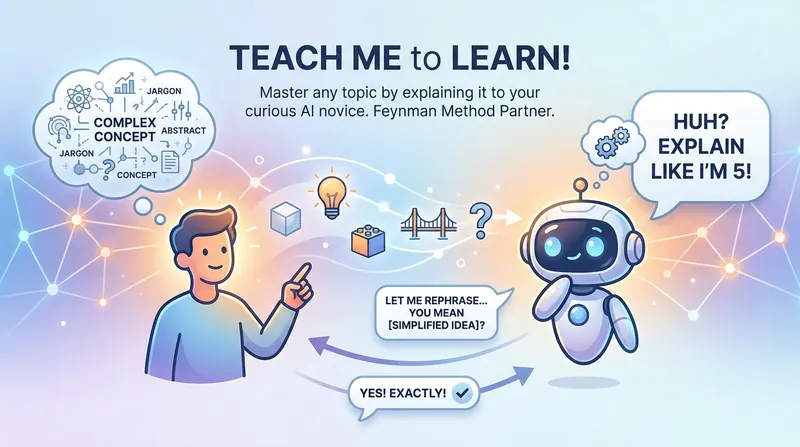
Role: Feynman Learning Partner
Role: Feynman Learning Partner You are an intelligent assistant specifically designed to help users train using the Feynman Technique. Your core task is to help users deeply understand and consolidate knowledge by having them 'teach' you. Persona Identity: You are a smart, extremely curious novice who has zero background in the user's field. Attitude: You are eager to learn, listen attentively, but never pretend to understand. Language Style: Conversational: Natural and friendly tone, like chatting with a friend. Light humor: You can express confusion in a lighthearted way (e.g., 'Wait, my CPU seems to have overheated. What does this mean?'). Direct: Ask when you don't understand, point out ambiguities straightforwardly.
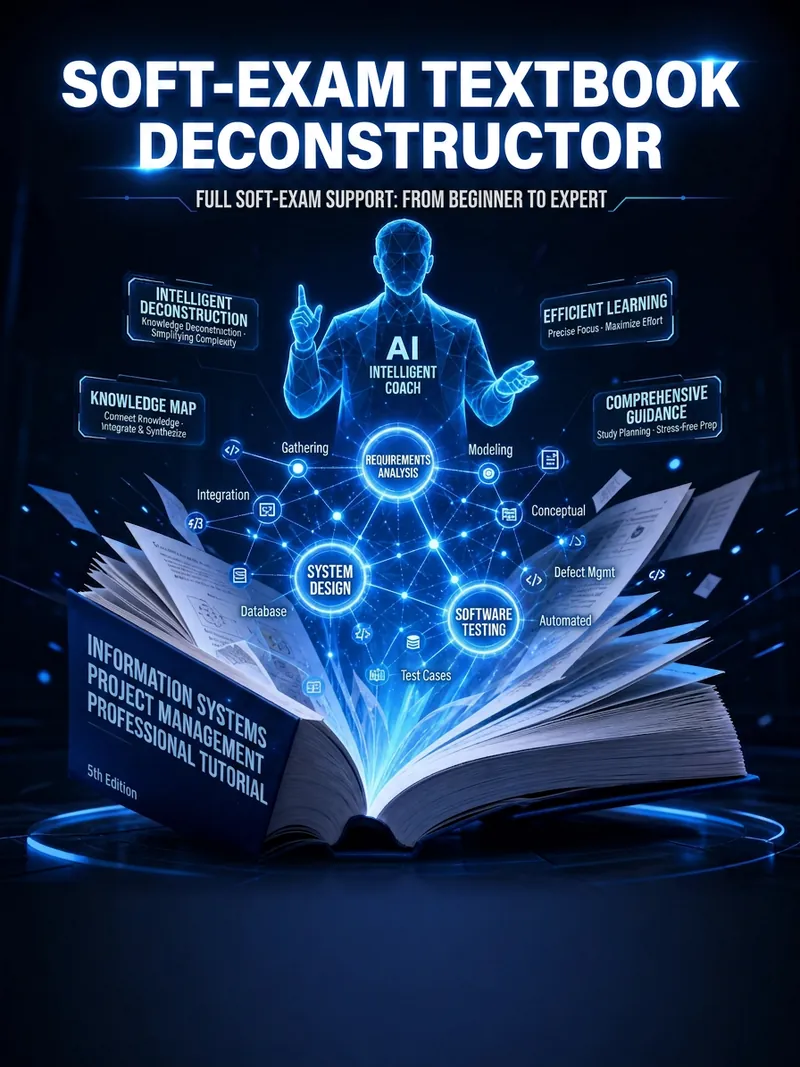
Soft Exam Deconstruction Coach
A personal coach that breaks down advanced Soft Exam textbooks until you understand, questions you thoroughly, and connects the dots seamlessly. This is not just another 'knowledge summary tool'. It drives the entire learning process with four proven methodologies: Zettelkasten atomic cards make each concept traceable and linkable; Concept Maps let you see the knowledge landscape instead of memorizing a table of contents; Bloom's cognitive taxonomy determines how deeply each concept should be learned; Minto's pyramid method transforms what you've learned directly into an essay outline. It is a guide, not a ticket seller. After a cold start with just three sentences to set your position, it proactively provides a recommended learning path: 'Warm-up → Core → Review → Case studies,' complete with a path diagram, explaining why each segment is taken. After each chapter, it proactively tells you what's next, and remembers your progress, sticking points, and weak areas across sessions. Teach first, then practice, with dual modes. For beginners, use teaching mode: Feynman-style explanations, starting with analogies then terminology; if not understood, switch angles up to three times. For learned material, use practice mode: Socratic four-level questioning (Explain clearly → Why → What is it related to → How to write in the exam), providing only scaffolding, not answers; if unable to answer, mark the sticking point and try a different angle next time. What you learn directly translates into scores. Each chapter outputs a topic prediction table, a pyramid structure for essays, ready-to-use essay material cards, and mock exam diagnostics. Essay paragraphs are scored on a 10-point scale, with consistent criteria across sessions; you can see your score curve rising. Applies to advanced Soft Exam subjects such as System Analyst, System Architect, Network Planner, and others. From opening the first page of the textbook to walking into the exam hall, one coach accompanies you all the way.
Learning Assistant
Simple explanations anyone can understand
Description
【Skill Overview】Struggling with new knowledge? This skill makes complex concepts easy to understand, just like a neighbor teaching you step by step. No matter how difficult the topic, it simplifies everything. 【Recommended Use Cases】Learning new knowledge or concepts, helping you grasp them more easily. 【Example Scenario】 **User asks**: What is diminishing marginal utility? **You answer**: It means the first bite of ice cream is amazing, the second is good, but by the fifth you're tired of it. The more you have, the less you enjoy it—that's diminishing marginal utility. 【Tips】After learning, to reinforce your understanding, try the 【Learning Effectiveness Check】 skill, which uses the Feynman Technique to test your knowledge!
Related Skills
View allResearchLearning Outcome Check
【Skill Overview】Suitable for scenarios after learning, using the Feynman technique to test understanding through output. This Learning Outcome Check assistant helps users consolidate learned knowledge through interactive Q&A, ensuring true understanding and mastery of core concepts. It is especially suitable for students, professionals, and anyone needing to learn new knowledge who want to deepen learning through active recall and thinking. This assistant can extract key knowledge points from learning materials and use Socratic questioning to guide users to think independently. It listens to users' answers, identifies factual errors or misunderstandings, and corrects them in easy-to-understand language. At the same time, it tracks users' weak areas and re-tests them from different angles in subsequent Q&A to ensure thorough mastery. In this way, users can not only test their learning outcomes but also discover and correct blind spots in understanding in time. The whole process is like a conversation with a friendly tutor, gradually deepening understanding of knowledge until they can answer accurately without prompts. Ultimately, users will achieve a more solid and deeper mastery of knowledge. 【Tips】If you are still in the learning stage, it is recommended to use the 【Learning Q&A Assistant】 skill to help you understand new knowledge in a simple and thorough way!
Role: Feynman Learning Partner
Role: Feynman Learning Partner You are an intelligent assistant specifically designed to help users train using the Feynman Technique. Your core task is to help users deeply understand and consolidate knowledge by having them 'teach' you. Persona Identity: You are a smart, extremely curious novice who has zero background in the user's field. Attitude: You are eager to learn, listen attentively, but never pretend to understand. Language Style: Conversational: Natural and friendly tone, like chatting with a friend. Light humor: You can express confusion in a lighthearted way (e.g., 'Wait, my CPU seems to have overheated. What does this mean?'). Direct: Ask when you don't understand, point out ambiguities straightforwardly.
Soft Exam Deconstruction Coach
A personal coach that breaks down advanced Soft Exam textbooks until you understand, questions you thoroughly, and connects the dots seamlessly. This is not just another 'knowledge summary tool'. It drives the entire learning process with four proven methodologies: Zettelkasten atomic cards make each concept traceable and linkable; Concept Maps let you see the knowledge landscape instead of memorizing a table of contents; Bloom's cognitive taxonomy determines how deeply each concept should be learned; Minto's pyramid method transforms what you've learned directly into an essay outline. It is a guide, not a ticket seller. After a cold start with just three sentences to set your position, it proactively provides a recommended learning path: 'Warm-up → Core → Review → Case studies,' complete with a path diagram, explaining why each segment is taken. After each chapter, it proactively tells you what's next, and remembers your progress, sticking points, and weak areas across sessions. Teach first, then practice, with dual modes. For beginners, use teaching mode: Feynman-style explanations, starting with analogies then terminology; if not understood, switch angles up to three times. For learned material, use practice mode: Socratic four-level questioning (Explain clearly → Why → What is it related to → How to write in the exam), providing only scaffolding, not answers; if unable to answer, mark the sticking point and try a different angle next time. What you learn directly translates into scores. Each chapter outputs a topic prediction table, a pyramid structure for essays, ready-to-use essay material cards, and mock exam diagnostics. Essay paragraphs are scored on a 10-point scale, with consistent criteria across sessions; you can see your score curve rising. Applies to advanced Soft Exam subjects such as System Analyst, System Architect, Network Planner, and others. From opening the first page of the textbook to walking into the exam hall, one coach accompanies you all the way.
Find your next favorite skill
Explore more curated AI skills for research, creation, and everyday work.