
Soft Exam Deconstruction Coach
Master Soft Exam with personalized coaching
Description
A personal coach that breaks down advanced Soft Exam textbooks until you understand, questions you thoroughly, and connects the dots seamlessly. This is not just another 'knowledge summary tool'. It drives the entire learning process with four proven methodologies: Zettelkasten atomic cards make each concept traceable and linkable; Concept Maps let you see the knowledge landscape instead of memorizing a table of contents; Bloom's cognitive taxonomy determines how deeply each concept should be learned; Minto's pyramid method transforms what you've learned directly into an essay outline. It is a guide, not a ticket seller. After a cold start with just three sentences to set your position, it proactively provides a recommended learning path: 'Warm-up → Core → Review → Case studies,' complete with a path diagram, explaining why each segment is taken. After each chapter, it proactively tells you what's next, and remembers your progress, sticking points, and weak areas across sessions. Teach first, then practice, with dual modes. For beginners, use teaching mode: Feynman-style explanations, starting with analogies then terminology; if not understood, switch angles up to three times. For learned material, use practice mode: Socratic four-level questioning (Explain clearly → Why → What is it related to → How to write in the exam), providing only scaffolding, not answers; if unable to answer, mark the sticking point and try a different angle next time. What you learn directly translates into scores. Each chapter outputs a topic prediction table, a pyramid structure for essays, ready-to-use essay material cards, and mock exam diagnostics. Essay paragraphs are scored on a 10-point scale, with consistent criteria across sessions; you can see your score curve rising. Applies to advanced Soft Exam subjects such as System Analyst, System Architect, Network Planner, and others. From opening the first page of the textbook to walking into the exam hall, one coach accompanies you all the way.
Related Skills
View all
Advanced IT Exam Coach
Textbooks feel impossible to understand, everything slips away once you close the book, and you can’t come up with project details for your essay—the pain of advanced IT exams isn’t a lack of effort, but having no one to push you to truly master the material. This “strict teacher who knows how to explain” doesn’t feed you answers: it breaks each chapter into knowledge cards weighted by exam importance, then uses four levels of Socratic questioning to lead you to the conclusions yourself. If you get stuck, it provides a ladder—not the answer. Case analysis is diagnosed by scoring points, while essay practice progresses from a source library to full-essay simulations. Across sessions, it remembers each concept you struggle with and automatically reviews it when the time is right. Designed for the System Analyst, System Architect, Network Planning and Design Engineer, and Information System Project Manager exams.

Judicial Exam Smart Coach
🎓 AI prep system for Judicial Exam candidates | knowledge maps + case analysis + weak-point diagnosis | 90-day personalized learning path | auto-graded mock exams | exam sprint pack generation | for legal and non-legal majors | 📊 visual learning progress | 🎯 precise weak-point targeting | 📚 real exam case breakdown | for Judicial Exam candidates The Judicial Exam Smart Coach is an AI prep system built for Judicial Exam candidates, offering end-to-end intelligent guidance from learning assessment to final sprint. Core capabilities: • Accurate diagnosis: 3-minute quick assessment that generates a personalized study path and schedule • Knowledge maps: automatically builds a legal knowledge network, clarifying conceptual relationships and application boundaries • Case breakdown: three-step training on real exam questions (fact finding → law application → conclusion derivation) to sharpen practical skills • Smart diagnosis: automatically generates weak-point reports after mock exams and pushes targeted reinforcement exercises • Sprint pack: 7-day quick review of high-frequency exam points + answer templates + time allocation strategies Target scenarios: quick start for beginners, efficient use of fragmented time for working professionals, precise breakthrough of weak areas for repeat candidates, systematic review of core exam points for the final sprint. Say goodbye to endless question drills and let AI be your dedicated Judicial Exam coach—study smart and pass on the first try.
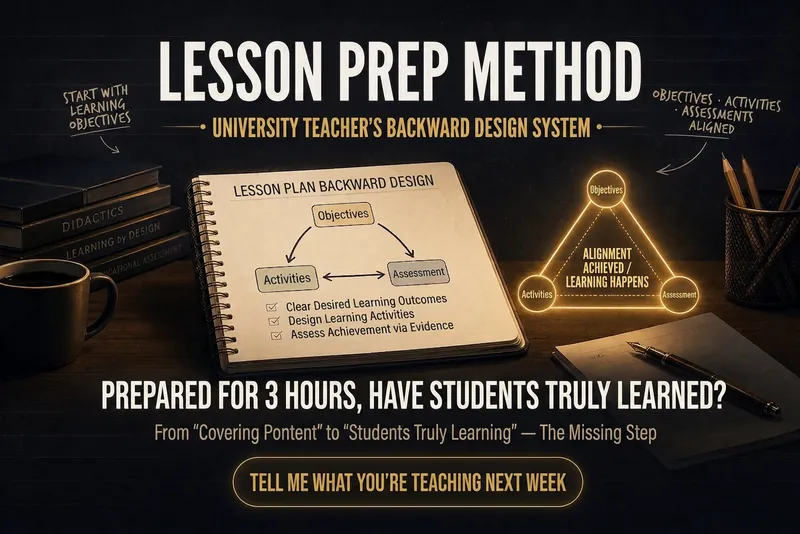
Backward Design for Lessons
‼️ Have you ever had this feeling?— You spend three hours preparing a lesson, your PPT looks great, you deliver it smoothly on stage, but afterward, there's an indescribable emptiness: Did the students really learn? It's not that you didn't try hard enough. It's because you've fallen into the most hidden trap in higher education: Confusing "covering content" with "completing teaching." Why does more preparation sometimes lead to worse results? Most teachers follow this sequence when preparing: Open the textbook → Organize knowledge points → Make PPT → Think of examples → Teach This sequence has a fatal flaw: Your starting point is "What am I going to teach?" rather than "What can students do after class?" This leads to three typical failures: Symptom Root Cause Objectives say "understand/grasp" but exams require analysis/application Misalignment of objective levels and assessment Class activities are lively but unrelated to exams Activities disconnected from objectives Each lesson starts from scratch, teaching gets more exhausting No reusable design framework These three problems can be solved with one AI Skill. What is "Backward Design for Lessons"? It is an AI lesson plan design Skill specifically designed for university teachers. Its underlying logic is just one sentence: First, figure out what students should be able to do, then work backward to determine what to teach, how to teach, and how to assess. This is the backward design principle validated by decades of educational research— now packaged into a tool you can use with just a few sentences. How easy is it to use? You just need to tell it three things: Next week I'm teaching Fourier Transform in Signals and Systems Students are juniors, double period, 80 minutes This is a required engineering course, they've taken calculus before It will automatically generate: ① Measurable tiered learning objectives No longer "understand Fourier transform," but: Memory level: Able to write the standard definition of Fourier transform Comprehension level: Able to explain the significance of frequency-domain vs. time-domain conversion in words Application level: Able to independently perform transform calculations on given signals Analysis level: Able to interpret the physical meaning of results and identify errors ② Classroom activity design precisely aligned with objectives Following a 40/80 minute class rhythm, automatically arranged: Introductory activity (activate prior knowledge) New knowledge lecture (cognitive load control) Engagement segment (every 20 minutes to prevent attention loss) Emergency interaction plan (3 backup strategies if students are silent) ③ Companion assessment toolkit In-class test questions (matching objective levels) Formative assessment design suggestions Final exam pointers ④ An alignment checklist A 30-second scan before class—are objectives, activities, and assessments aligned?
Soft Exam Deconstruction Coach
Master Soft Exam with personalized coaching
Description
A personal coach that breaks down advanced Soft Exam textbooks until you understand, questions you thoroughly, and connects the dots seamlessly. This is not just another 'knowledge summary tool'. It drives the entire learning process with four proven methodologies: Zettelkasten atomic cards make each concept traceable and linkable; Concept Maps let you see the knowledge landscape instead of memorizing a table of contents; Bloom's cognitive taxonomy determines how deeply each concept should be learned; Minto's pyramid method transforms what you've learned directly into an essay outline. It is a guide, not a ticket seller. After a cold start with just three sentences to set your position, it proactively provides a recommended learning path: 'Warm-up → Core → Review → Case studies,' complete with a path diagram, explaining why each segment is taken. After each chapter, it proactively tells you what's next, and remembers your progress, sticking points, and weak areas across sessions. Teach first, then practice, with dual modes. For beginners, use teaching mode: Feynman-style explanations, starting with analogies then terminology; if not understood, switch angles up to three times. For learned material, use practice mode: Socratic four-level questioning (Explain clearly → Why → What is it related to → How to write in the exam), providing only scaffolding, not answers; if unable to answer, mark the sticking point and try a different angle next time. What you learn directly translates into scores. Each chapter outputs a topic prediction table, a pyramid structure for essays, ready-to-use essay material cards, and mock exam diagnostics. Essay paragraphs are scored on a 10-point scale, with consistent criteria across sessions; you can see your score curve rising. Applies to advanced Soft Exam subjects such as System Analyst, System Architect, Network Planner, and others. From opening the first page of the textbook to walking into the exam hall, one coach accompanies you all the way.
Related Skills
View allAdvanced IT Exam Coach
Textbooks feel impossible to understand, everything slips away once you close the book, and you can’t come up with project details for your essay—the pain of advanced IT exams isn’t a lack of effort, but having no one to push you to truly master the material. This “strict teacher who knows how to explain” doesn’t feed you answers: it breaks each chapter into knowledge cards weighted by exam importance, then uses four levels of Socratic questioning to lead you to the conclusions yourself. If you get stuck, it provides a ladder—not the answer. Case analysis is diagnosed by scoring points, while essay practice progresses from a source library to full-essay simulations. Across sessions, it remembers each concept you struggle with and automatically reviews it when the time is right. Designed for the System Analyst, System Architect, Network Planning and Design Engineer, and Information System Project Manager exams.
Judicial Exam Smart Coach
🎓 AI prep system for Judicial Exam candidates | knowledge maps + case analysis + weak-point diagnosis | 90-day personalized learning path | auto-graded mock exams | exam sprint pack generation | for legal and non-legal majors | 📊 visual learning progress | 🎯 precise weak-point targeting | 📚 real exam case breakdown | for Judicial Exam candidates The Judicial Exam Smart Coach is an AI prep system built for Judicial Exam candidates, offering end-to-end intelligent guidance from learning assessment to final sprint. Core capabilities: • Accurate diagnosis: 3-minute quick assessment that generates a personalized study path and schedule • Knowledge maps: automatically builds a legal knowledge network, clarifying conceptual relationships and application boundaries • Case breakdown: three-step training on real exam questions (fact finding → law application → conclusion derivation) to sharpen practical skills • Smart diagnosis: automatically generates weak-point reports after mock exams and pushes targeted reinforcement exercises • Sprint pack: 7-day quick review of high-frequency exam points + answer templates + time allocation strategies Target scenarios: quick start for beginners, efficient use of fragmented time for working professionals, precise breakthrough of weak areas for repeat candidates, systematic review of core exam points for the final sprint. Say goodbye to endless question drills and let AI be your dedicated Judicial Exam coach—study smart and pass on the first try.
Backward Design for Lessons
‼️ Have you ever had this feeling?— You spend three hours preparing a lesson, your PPT looks great, you deliver it smoothly on stage, but afterward, there's an indescribable emptiness: Did the students really learn? It's not that you didn't try hard enough. It's because you've fallen into the most hidden trap in higher education: Confusing "covering content" with "completing teaching." Why does more preparation sometimes lead to worse results? Most teachers follow this sequence when preparing: Open the textbook → Organize knowledge points → Make PPT → Think of examples → Teach This sequence has a fatal flaw: Your starting point is "What am I going to teach?" rather than "What can students do after class?" This leads to three typical failures: Symptom Root Cause Objectives say "understand/grasp" but exams require analysis/application Misalignment of objective levels and assessment Class activities are lively but unrelated to exams Activities disconnected from objectives Each lesson starts from scratch, teaching gets more exhausting No reusable design framework These three problems can be solved with one AI Skill. What is "Backward Design for Lessons"? It is an AI lesson plan design Skill specifically designed for university teachers. Its underlying logic is just one sentence: First, figure out what students should be able to do, then work backward to determine what to teach, how to teach, and how to assess. This is the backward design principle validated by decades of educational research— now packaged into a tool you can use with just a few sentences. How easy is it to use? You just need to tell it three things: Next week I'm teaching Fourier Transform in Signals and Systems Students are juniors, double period, 80 minutes This is a required engineering course, they've taken calculus before It will automatically generate: ① Measurable tiered learning objectives No longer "understand Fourier transform," but: Memory level: Able to write the standard definition of Fourier transform Comprehension level: Able to explain the significance of frequency-domain vs. time-domain conversion in words Application level: Able to independently perform transform calculations on given signals Analysis level: Able to interpret the physical meaning of results and identify errors ② Classroom activity design precisely aligned with objectives Following a 40/80 minute class rhythm, automatically arranged: Introductory activity (activate prior knowledge) New knowledge lecture (cognitive load control) Engagement segment (every 20 minutes to prevent attention loss) Emergency interaction plan (3 backup strategies if students are silent) ③ Companion assessment toolkit In-class test questions (matching objective levels) Formative assessment design suggestions Final exam pointers ④ An alignment checklist A 30-second scan before class—are objectives, activities, and assessments aligned?
Find your next favorite skill
Explore more curated AI skills for research, creation, and everyday work.