youyou
90-Hour Training Reflection
Transform training PPTs and lecture notes into a 90-hour training reflection with theoretical depth, personal reflection, and ready-to-submit quality. This is not "AI writing reflections for you." It is a professional two-step confirmation workflow: first, systematically extract each expert's core theory, key viewpoints, typical cases, and memorable quotes from the training materials, generating a structured summary for your confirmation—only after you confirm does it proceed to writing. The theoretical framework names must remain consistent with the original materials and cannot be fabricated. Core capabilities: • Accurate extraction of expert viewpoints: Read each PPT/PDF/Word/image file individually, extract core theoretical frameworks, 2–3 key statements, typical cases, and memorable quotes by expert, not superficial generalization. • Analysis of inter-theory connections: Identify internal correspondences between different experts' viewpoints (e.g., the correspondence between Bloom's cognitive taxonomy and the three levels of knowledge, ability, and competency), demonstrating systematic understanding—this is the key to distinguishing a deep reflection from a mere record. • Practice transformation section: Select specific teaching units, integrate training theory into assignment design practice, and generate conversion cases from training to classroom—this is the part that reviewers value most. • Complete five-part structure: Training overview and overall feelings → Expert-specific reflections → Internal connections between theories → From training to practice → Reflection and outlook, 3,000–6,000 words. • Reflective writing style: First-person, interweaving theory with personal teaching experience, language with warmth, avoiding empty clichés and slogans. • Word format download: Simultaneously generates a Word download tool, allowing one-click export of a directly submittable document. Applicable scenarios: - Reflection essay writing for middle school math teachers after completing 90-hour training - Reflective article writing for teacher professional development training - Any scenario that requires extracting theory from training materials and transforming it into practical reflection Upload your training materials, confirm the extracted expert viewpoints, and it will generate a complete, well-grounded, and deeply reflective reflection document, along with a Word download tool.
Publishing Skill
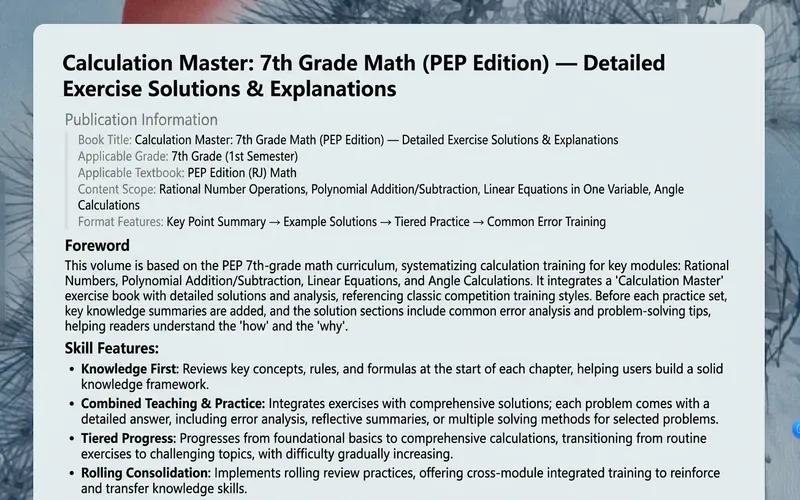
Transform scattered exercises, answers, handouts, and teaching notes into a well-structured, publication-ready supplementary book. This is not 'AI organizing your documents'. It is a five-step publishing-grade workflow: Data inventory and multi-source reading → Target book style analysis → Content integration and structure design → Chapter-by-chapter writing → Full book quality check and delivery. Each step involves professional judgment, not a one-time prompt generation. Core capabilities: • Multi-source data integration: Extract exercises, answers, knowledge points, and teaching sections from PDFs, images, and documents. Identify their relationships (which is the question, which is the answer, which is the style reference) and reorganize them into a complete book. • Internalized supplementary book structure: Built-in typical organization logic—knowledge point review → typical example explanation → leveled practice → answer key with detailed solutions → error analysis/reflection summary/guidance/multiple solution methods → rolling review. • Formula repair: Mathematical formulas extracted from PDFs may become garbled. The skill infers the original expression from context and rewrites it in standard LaTeX. This is one of the most painful parts of publishing supplementary books. • Question-answer matching and merging: Automatically match exercises and answers scattered across different files. Supports two organization modes: integrated instruction and practice, or separate question and answer sections. • Publication-grade structure: Output includes title page, preface, table of contents, chapter-by-chapter text (knowledge points + practice + detailed solutions + teaching sections), and afterword. Use cases: - Middle school math teachers organize years of accumulated exercise handouts into formal supplementary books. - Supplementary book authors/editors quickly integrate scattered materials into a manuscript. - Training institution internal handouts upgraded to standardized publications. Upload your materials, tell it the positioning of the target book, and let it handle the rest. The output is a high-quality Markdown manuscript, including preface, table of contents, chapter-by-chapter content, detailed solutions, and explanations.
Pythagorean Fractal Generator
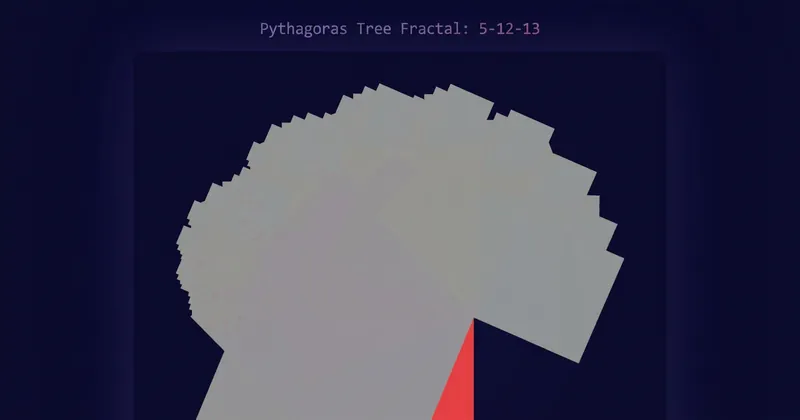
Users input Pythagorean numbers (supporting multiple modes: three numbers, two legs, single angle, ratio, etc.), and the skill automatically selects visual variants, color schemes, and iteration depth, step by step generating a Pythagoras tree fractal pattern, finally outputting a Canvas-rendered visual webpage image.

Pythagorean Triple Finder
Enter a positive integer to exhaustively find all Pythagorean triples containing it. Factor decomposition for legs, traversal for hypotenuse—no omissions or duplicates. Each triple labels the number's role (leg/hypotenuse) with the full verification equation, ready for classroom demonstration. Suitable for middle school math teachers preparing lessons and students exploring the Pythagorean theorem.
Satisfying Novel Writing
Input the genre and your preferred satisfying beats, and generate a complete 15,000-30,000 word satisfying novella in one step. First, search Xiaohongshu for trending posts to extract pacing patterns. Then build a character system + a satisfying beats map + a five-act structure. Finally, generate the main text. It doesn't start writing immediately; it first establishes the structure and then fills in the content. The satisfying beats map progresses by emotional intensity. The five-act structure includes word count distribution. Each satisfying beat has a setup of tension before release and a chain of bystander reactions. Good defeats evil, the protagonist achieves fulfillment, and the villain gets punished. Suitable for self-media creators, Xiaohongshu / WeChat Official Account content operators.

Math Inquiry Report Workshop
Enter a math project topic and get a complete junior high school project-based learning inquiry report. Three-step process: retrieve interdisciplinary knowledge online → build an eight-chapter framework (user confirms) → generate the full report. No blind writing; first confirm the framework, then produce the content. The report includes data tables, formula derivations, real-life application cases, learning reflections, and self-assessment. It automatically determines the grade level, aligns with the 'Comprehensive and Practical' area of curriculum standards, and uses language suited to middle school students' cognitive level. Ideal for middle school math teachers designing comprehensive and practical courses, guiding student projects, or participating in teaching competitions.

Poem into Painting
Input a line of ancient Chinese poetry, and receive an ink-wash painting with artistic conception. First, the system analyzes the imagery, designs the composition, plans the ink shades, and generates a complete poetry-painting analysis report. After your confirmation, it proceeds to generate the ink-wash painting. Two-step confirmation ensures no blind output. It adopts the traditional Chinese ink-wash painting 'Three Distances Method' for composition, five levels of ink shades, with highlights of light color and 30%-50% white space. This is not a simple filter overlay—the painting 'grows' from the poem according to the aesthetic logic of Chinese painting. Suitable for ancient poetry enthusiasts, Chinese language teachers, and cultural content creators.

Social Research Full Workbench
Covers the complete five-stage workflow for social science research in universities, from project application, academic writing, paper polishing, research diagrams to project completion. Users can start at any stage, and each stage automatically inherits research context. Suitable for researchers spanning the full spectrum from undergraduates to professors. Built-in national social science review standards and CSSCI style guide.

2026 Zhejiang Exam Design Comp
Input a life scenario and get a set of original math test questions suitable for competition. Cover the entire exam creation process: direction analysis → question writing → answer key → exam design documentation, supporting multiple iterations. Aligned with the "Compulsory Education Mathematics Curriculum Standards (2022 Edition)", closely following the Zhejiang Province Exam Competition judging criteria: competency-oriented, originality, double-blind review. Question gradient design references real award-winning cases, covering both comprehensive practical problems and plane geometry comprehensive problems. Suitable for middle school math teachers participating in the 2026 Zhejiang Province Exam Competency Competition.