qingyan he

IP Visual Studio Max
One image isn’t the problem. The question is: a year from now, will all 100 of your images still look like the same IP? IP Visual Studio Max helps you build a visual system you can reuse over the long term: a complete IP visual profile, an individual visual master template for each of 3–5 content series, character assets when you have an established character or personal image, and series content planning. Three stages: build the foundation first, then create sample designs Max is not a tool that generates images immediately. It first establishes the fundamentals: **Stage 1: Build your visual profile** Collect your complete IP visual DNA across 10 fields, including tone words, color palette, typeface feel, visual identity or alternatives, and more. Define character assets when you have an established personal image or character. Once the profile is complete, you’ll receive a portable DNA summary that you can save yourself. This is your asset, not a platform memory. **Stage 2: Build your series system** Organize 3–5 content series and create an independent visual master template for each one, covering the primary colors, composition, text style, and information-density rules. Establish adaptation rules for different platforms. **Stage 3: Create sample designs** Create the first representative sample for each series through the complete process: copy lock-in → visual blueprint approval → text-free base image → layout instructions. Once a sample is approved, it becomes the standard for all future content in that series. **Text-layer delivery** The standard delivery is a text-free base image plus layout instructions. You add the text using the tools you’re familiar with. If the host platform is verified to support deterministic text overlays, a precisely typeset final design may also be provided—but this is not a default feature. **About DNA archiving** Each time you confirm your DNA or series system, you’ll receive a portable summary. Bring it with you next time to restore the visual rules you’ve already confirmed. This is not the platform’s automatic, permanent memory—it is a long-term visual asset that you own. **Who it’s for** - Creators who are already publishing but lack a consistent visual style and want to organize it systematically - Knowledge-based creators who want to establish fixed content series and update them over the long term - Creators who need to hand visual guidelines to collaborators, with their personal IP as the starting point - Creators who have used Pro and want to build a more complete asset system on top of it **Not included** - Automatically typeset Chinese designs with perfectly integrated text (standard delivery is a text-free base image + layout instructions) - The platform’s automatic, permanent cross-task DNA archiving (a portable summary is provided for you to keep) - Replacing content operations strategy and decision-making - Rapid batch image generation (each image must go through the confirmation process) - Unlimited usage - Bundled plans, discounts, or package deals
IP Sketch Content Director Pro
You’re not just trying to make one image—you want to turn this content into a set of assets you can actually publish. IP Sketch Content Director Pro handles “content production for the current task”: it consistently turns an idea, a method, or a story into 1–3 narratively connected hand-drawn content visuals, then rearranges them independently for each platform you select instead of simply cropping them. What you’ll get Complete content strategy card: identifies the content type, card-set structure, and multi-platform adaptation strategy for your confirmation before work begins; Copy lock: locks the main title, step or paragraph points, and key terms for each visual one by one. Once confirmed, they won’t be rewritten randomly; 1–3 text-free hand-drawn base images: generated according to the confirmed composition plan, without any text; Precise layout instructions: font size, line spacing, alignment, and margins for each area of every visual, so you can add the text yourself as specified; Local revision protocol: revise the layout without redrawing the base image; revise the composition without changing the copy—solve problems within the smallest possible scope. About the text layer Chinese text should be accurate, editable, and locally revisable. The standard deliverable is a text-free base image plus layout instructions, with text added using the tools you’re familiar with. When the host platform has verified, deterministic text-overlay capabilities, a precisely typeset final image may also be provided—but this is not a default feature and depends on the environment used for the task. Supports adaptation for up to 3 platforms: Xiaohongshu, WeChat Official Account, and WeChat Moments. Each platform is rearranged independently based on aspect ratio, text volume, and narrative pacing—not by cropping the same image. Best for Consultants, instructors, coaches, and operators who need to consistently turn one complete piece of content into publishable visual content, rather than casually producing a single image. Not currently supported Automatic, precise Chinese text-integrated final images (the standard deliverable is a text-free base image plus layout instructions) Automatic saving of IP profiles across tasks (DNA is valid within the current session or project; a summary can be carried forward for future use) Fixed content series systems or long-term character assets (these are better suited to Max) Unlimited usage
IP Hand-Drawn Visual Consultant
It's not that you can't write content; you often get stuck at the last step: what kind of image should this idea, method, or story become to feel like you? The IP Hand-Drawn Visual Consultant breaks down your content expression into a suitable visual form, then gives you a practical visual + text solution. You will receive: - A judgment of whether the content suits an opinion diagram, method diagram, or story diagram; - A hand-drawn visual direction that matches your field and style; - A copy confirmation form to lock in text after review; - A hand-drawn visual base map without text, or a ready-to-use text-free image prompt; - A layout guide: where to place titles, steps, and key text, and how much space to leave. Why provide a text-free base map first? Chinese text needs to be accurate and editable. Instead of letting the image generation model randomly 'draw' text, we first design the image, characters, or scene with white space for text, and then you overlay the confirmed copy using your familiar tools. This is suitable for those who want to first verify if they need a personal visual expression: consultants, lecturers, coaches, knowledge content creators, or those just starting to build their personal brand. This skill currently can do: a single, single-platform content visual solution; one text-free preview base map or text-free prompt; copy confirmation and layout guide; extract hand-drawn IP anchors from photos if available; use professional props, scenes, or abstract symbols to build recognition without photos. Currently does not: generate multiple images or content card sets at once; adapt to multiple platforms simultaneously; save IP archives across tasks; directly generate publishable final images with accurate Chinese text; auto-publish to any platform. If after the experience you naturally need multi-image, multi-platform, long-term fixed character images or serialized columns, those are scenarios better addressed by the subsequent Pro and Max versions. This skill will first complete this single experience and will not proactively upsell.
One Draft, All Platforms
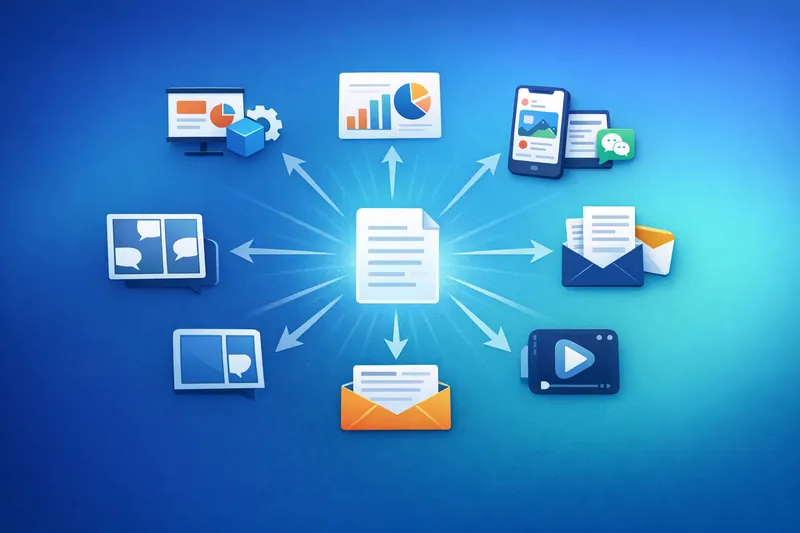
Have you ever counted how much of your week is spent on 'transporting' instead of creating? Write an article, publish it on WeChat. Break it into cards for Xiaohongshu. Rewrite it as a script for a short video. Same idea, five different versions, five times the effort. The real creative work might take an hour, but the rest of the day is lost in translation. This skill puts an end to that. Drop in one piece of content—an article, a recording, or just a few ideas. It first analyzes what format suits it best, then spins it into the formats you need: WeChat long-form, Xiaohongshu visuals, short video storyboards, PPT, infographics, newsletters, comics, or even reusable frameworks. One skeleton, eight forms, with the core message intact. What truly sets it apart are two things no rewrite tool gives you: ① The output sounds like you, not AI. Feed it a few of your past pieces (5 minutes), and it learns your tone, pet phrases, and rhythm. Every platform's copy carries your voice—and it gets better as you use it. ② It's built to remove 'AI flavor.' A built-in set of rules cleans up machine-like phrases like 'leverage,' 'close the loop,' and 'in summary'—so readers can't tell it was written by AI. Write once. Publish everywhere. Give the time back to real creation.
Content Creator Positioning
Designed for content creators, knowledge IPs, and personal brands on platforms like Xiaohongshu, Douyin, WeChat Video Channel, and Bilibili. Using first principles, platform adaptation, anti-homogenization diagnosis, content paths, cognitive symbols, financial structure, and YouMind asset-based output, it helps creators define unique categories, fix existing IP bottlenecks, and build sustainable differentiated positioning.
WeChat Article Formatter
Paste plain text, Markdown, web body text, or existing HTML, and it will automatically recognize the article structure and generate beautiful formatting suitable for WeChat Official Accounts. Supports styles: Minimalist Reading, Knowledge Card, Business Professional, Warm Life, Tech Future, and New Media Magazine. You can either format the entire article in one click, or fine-tune headings, whitespace, key highlights, quotes, lists, and ending CTA while preserving the body. Output uses WeChat-compatible inline HTML, ideal for content operators, brand teams, knowledge bloggers, and corporate accounts.