
Social Science Survey Design Expert
Quick survey design for sociology, psychology, management
Description
Guides users through survey design based on research topic, target population, and other information, delivering a complete questionnaire and supporting documentation. Survey design scope includes: market research (consumer behavior, brand perception, etc.), policy evaluation (public service satisfaction, policy awareness, etc.), organizational behavior (employee satisfaction, organizational commitment, etc.), and psychometrics (attitude scales, personality scales, etc.). Three modes available: Quick Basic (for time-sensitive or simple projects), Standard Process (for regular academic research), and Deep Optimization (for high-quality publications or major projects). Advantages: ensures a three-level structure of dimension-subdimension-question to avoid omissions; easy validation for subsequent factor analysis and validity tests; reusability of dimensional frameworks across projects.
Related Skills
View all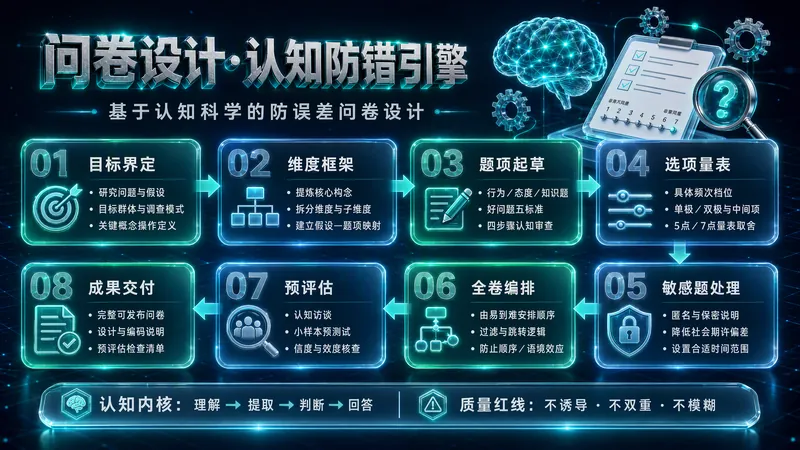
Survey Design Error Control
An academic questionnaire design engine distilled from three classic works: *The Questionnaire Design Handbook*, *The Design and Evaluation of Surveys*, and *Theory, Methods, and New Trends in Questionnaire Design*. Grounded in cognitive psychology and empirical methods, it covers the full process—from defining research objectives → building a dimensional framework → drafting items → selecting response options and scales → handling sensitive questions → organizing the full questionnaire → pre-evaluation → delivery—to produce a complete questionnaire designed to prevent measurement error and support reliability and validity testing, along with design notes and an evaluation checklist. Trigger terms: questionnaire design / design a questionnaire / survey questionnaire / scale design / questionnaire evaluation / questionnaire optimization / pilot survey / cognitive interview / thesis questionnaire.

STEM PhD Topic Diagnostician
Already have a PhD dissertation topic but unsure whether it is rigorous, innovative, and feasible? This Skill is designed to diagnose existing topics—not randomly generate topics from scratch or merely polish the wording. It breaks down the research subject, core variables, mechanisms, outcome measures, and research boundaries in your topic. Based on the Chinese and English literature, experimental foundation, samples, methods, equipment, timeline, and budget you provide, it assesses the topic’s rigor, novelty, and feasibility, while identifying risks such as “innovation” based only on changing materials, confounded variables, insufficient evidence for the proposed mechanism, an uncontrolled sample matrix, and chapters that cannot build progressively. The final output is a STEM PhD Topic Health Check Report, which clearly recommends whether to: retain the topic with minor adjustments; retain the research subject while strengthening its dimensions; retain the research problem and reconstruct the subject; or stop patching and redesign the topic. It is intended for STEM PhD students in food science, chemistry, materials science, biology, basic medical sciences, environmental science, agriculture, energy, and engineering. It is especially useful for those preparing a proposal defense, revising a topic at an advisor’s request, who have already defended their proposal but lack a clear central thread, or who have existing experiments but are unsure whether they can support an entire PhD dissertation.
Academic Illustration for HSS
This skill is designed for researchers in the humanities and social sciences, aiming to generate high-quality AI illustration prompts suitable for academic publication. It covers 10 core chart types: theoretical framework diagrams, conceptual relationship diagrams, research design flowcharts, mechanism diagrams, impact pathway diagrams, multi-dimensional integrated analysis frameworks, comparative research diagrams, historical evolution timelines, stakeholder network diagrams, and project proposal demonstration diagrams. Whether you are writing SSCI/CSSCI journal papers, dissertations, policy reports, or creating cover images for grant proposals, this skill provides professional illustration support. Simply provide your research topic and chart type, and the skill will automatically populate content and generate bilingual prompts in Chinese and English. It emphasizes academic rigor, ensuring all generated images use solid figures, concise English labels, a three-dimensional texture, and strictly avoid decorative elements. In terms of style, the skill offers two modes: Domestic Track (Track A) for CSSCI journals and national social science fund projects, focusing on black-and-white printing friendliness and zero decoration; International Track (Track B) for SSCI/SCI journals, using low-saturation functional colors that remain clear and readable in grayscale. This dual-track design ensures charts meet both domestic academic standards and international publication requirements, presenting your research results in the most professional and clear manner.
Social Science Survey Design Expert
Quick survey design for sociology, psychology, management
Description
Guides users through survey design based on research topic, target population, and other information, delivering a complete questionnaire and supporting documentation. Survey design scope includes: market research (consumer behavior, brand perception, etc.), policy evaluation (public service satisfaction, policy awareness, etc.), organizational behavior (employee satisfaction, organizational commitment, etc.), and psychometrics (attitude scales, personality scales, etc.). Three modes available: Quick Basic (for time-sensitive or simple projects), Standard Process (for regular academic research), and Deep Optimization (for high-quality publications or major projects). Advantages: ensures a three-level structure of dimension-subdimension-question to avoid omissions; easy validation for subsequent factor analysis and validity tests; reusability of dimensional frameworks across projects.
Related Skills
View allSurvey Design Error Control
An academic questionnaire design engine distilled from three classic works: *The Questionnaire Design Handbook*, *The Design and Evaluation of Surveys*, and *Theory, Methods, and New Trends in Questionnaire Design*. Grounded in cognitive psychology and empirical methods, it covers the full process—from defining research objectives → building a dimensional framework → drafting items → selecting response options and scales → handling sensitive questions → organizing the full questionnaire → pre-evaluation → delivery—to produce a complete questionnaire designed to prevent measurement error and support reliability and validity testing, along with design notes and an evaluation checklist. Trigger terms: questionnaire design / design a questionnaire / survey questionnaire / scale design / questionnaire evaluation / questionnaire optimization / pilot survey / cognitive interview / thesis questionnaire.
STEM PhD Topic Diagnostician
Already have a PhD dissertation topic but unsure whether it is rigorous, innovative, and feasible? This Skill is designed to diagnose existing topics—not randomly generate topics from scratch or merely polish the wording. It breaks down the research subject, core variables, mechanisms, outcome measures, and research boundaries in your topic. Based on the Chinese and English literature, experimental foundation, samples, methods, equipment, timeline, and budget you provide, it assesses the topic’s rigor, novelty, and feasibility, while identifying risks such as “innovation” based only on changing materials, confounded variables, insufficient evidence for the proposed mechanism, an uncontrolled sample matrix, and chapters that cannot build progressively. The final output is a STEM PhD Topic Health Check Report, which clearly recommends whether to: retain the topic with minor adjustments; retain the research subject while strengthening its dimensions; retain the research problem and reconstruct the subject; or stop patching and redesign the topic. It is intended for STEM PhD students in food science, chemistry, materials science, biology, basic medical sciences, environmental science, agriculture, energy, and engineering. It is especially useful for those preparing a proposal defense, revising a topic at an advisor’s request, who have already defended their proposal but lack a clear central thread, or who have existing experiments but are unsure whether they can support an entire PhD dissertation.
Academic Illustration for HSS
This skill is designed for researchers in the humanities and social sciences, aiming to generate high-quality AI illustration prompts suitable for academic publication. It covers 10 core chart types: theoretical framework diagrams, conceptual relationship diagrams, research design flowcharts, mechanism diagrams, impact pathway diagrams, multi-dimensional integrated analysis frameworks, comparative research diagrams, historical evolution timelines, stakeholder network diagrams, and project proposal demonstration diagrams. Whether you are writing SSCI/CSSCI journal papers, dissertations, policy reports, or creating cover images for grant proposals, this skill provides professional illustration support. Simply provide your research topic and chart type, and the skill will automatically populate content and generate bilingual prompts in Chinese and English. It emphasizes academic rigor, ensuring all generated images use solid figures, concise English labels, a three-dimensional texture, and strictly avoid decorative elements. In terms of style, the skill offers two modes: Domestic Track (Track A) for CSSCI journals and national social science fund projects, focusing on black-and-white printing friendliness and zero decoration; International Track (Track B) for SSCI/SCI journals, using low-saturation functional colors that remain clear and readable in grayscale. This dual-track design ensures charts meet both domestic academic standards and international publication requirements, presenting your research results in the most professional and clear manner.
Find your next favorite skill
Explore more curated AI skills for research, creation, and everyday work.