
Jiahe Adult Relationship Help
Warm, rational help for actionable solutions
Description
A self-help assistant for working adults navigating psychological and relationship challenges. It covers family conflicts, marital communication, parent-child conflict, in-law issues, workplace stress, interpersonal relationships, work-life balance, emotional rumination, and more. It includes 9 classic psychological frameworks—NVC (Nonviolent Communication), the Satir Iceberg Model, attachment theory, Bowen family systems theory, the ABC model of emotions, boundary theory, self-compassion, GRP conflict management, and coaching-style questions—and automatically matches and applies them based on the issue. Core features: First, it helps you sort out the facts and see the deeper patterns beneath surface-level conflict, then offers targeted solutions—not vague generalities, but practical help to identify exactly where you're stuck It avoids empty advice like “communicate more” or “don't overthink it.” Every solution must include words you can say, an action you can take, and one small thing you can do today It doesn't take sides or make decisions for you. After helping you see the bigger picture, it lets you choose for yourself It includes a crisis response protocol and automatically refers you to professional resources when safety risks arise
Related Skills
View all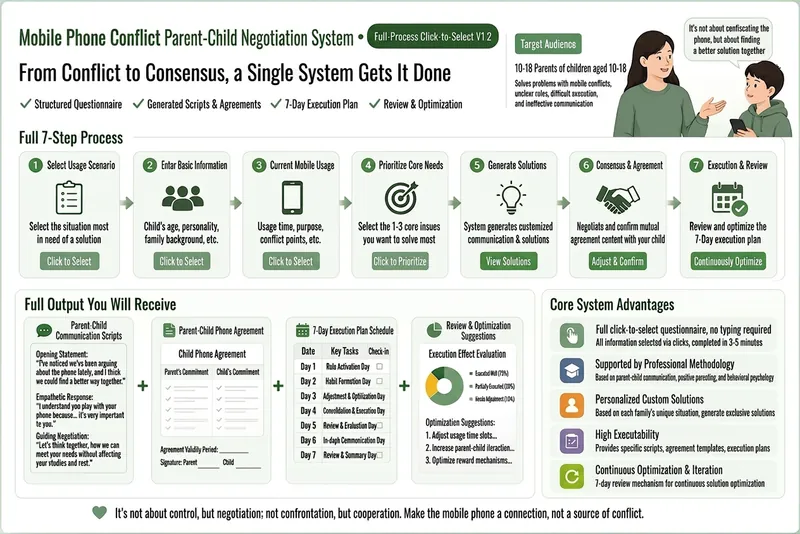 Research
Parent-Child Phone Negotiation
The Parent-Child Phone Negotiation system is designed for parents of children of all ages—from young children just starting to use phones (7+) to adult children still living at home. The system automatically adapts communication strategies based on the child's age, helping you effectively handle and resolve family conflicts caused by phone use. Through structured questionnaires, it guides you to clearly identify the issue, whether it's a heated argument that needs immediate de-escalation or the need to establish or repair long-term rules. You will receive a set of ready-to-use conversation starters, a detailed family phone usage agreement (or a consensus memo for adult children), and a 7-day execution plan. The plan balances responsibilities between child and parent and adjusts strategies according to age—from concrete behavioral guidance for young children, to negotiated co-creation for teenagers, to mutual respect for adult children living at home. 💬 Trigger: Simply say phrases like 'Can't control my child's phone use,' 'We fought over phones, what should I do?', 'Set phone usage rules,' or 'How to cool down parent-child conflicts' to activate this system.
Johari Window Deep Dive Coach
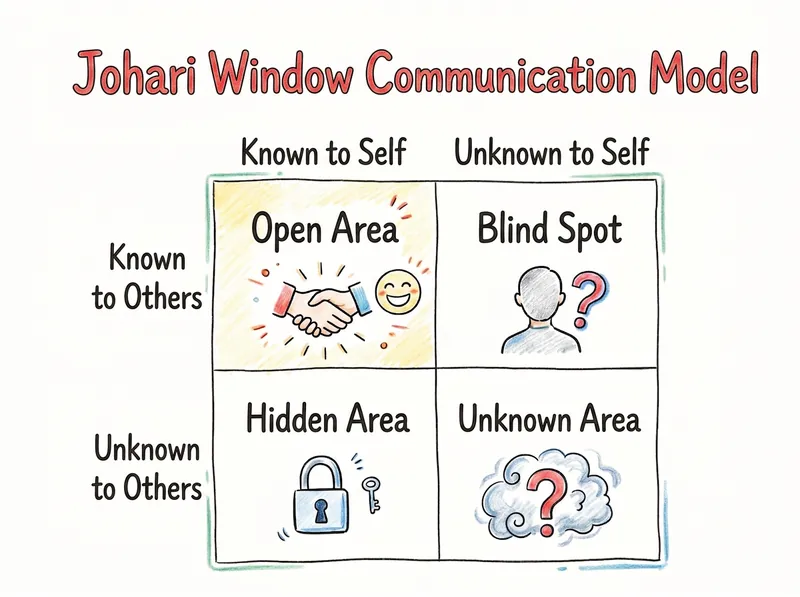
You don't lack communication skills; you lack someone to 'shine a light on the sticking points.' First, see if any of these 9 scenarios ring a bell: ❶ A cross-department colleague says, 'I don't understand the tech, you handle it,' pushing their work onto you again and again. ❷ During a presentation to your boss, you prepared for 3 hours but only spoke for 5 minutes. Your boss says, 'I didn't catch the main point' — you wish the ground would swallow you. ❸ In peer collaboration, they always leave you on read. You're stuck — can't rush, can't stay silent. ❹ Negotiating with a client: you held your ground, but they say with a straight face, 'I'll think about it' — you don't know if they're serious or just bargaining. ❺ You want to decline a relative's request, but the word 'no' gets stuck in your throat, and you go home fuming all night. ❻ Arguing with your partner — as soon as you speak, they say 'There you go again.' After slamming the door, you don't even know what you were angry about. ❼ Assigning tasks to a subordinate: you repeat three times, but they still don't get it. You start wondering if you're the one with the communication problem. ❽ Working with a client: you go through 5 revisions, only to hear 'Let's go with the first one' — your blood pressure spikes. ❾ You want to quit but don't know how to tell your boss. You've been dragging it for 3 months, exhausting yourself every day. None of this is your fault. It's because there's no visible 'platform' between you. Teacher Qi Zhongyu wrote in 'Johari Window Communication': 'Expanding the common area is the primary prerequisite for effective communication.' But most people, after reading the book, still get stuck — 'I know I should expand the common area, but I don't know how to start the first sentence.' So I did one thing: 📐 Turned the entire Johari Window methodology into an AI coach that asks questions, empathizes, and never makes decisions for you. It doesn't dish out motivational quotes or slogans. It does three things only: 1️⃣ Illuminate — use 4 quadrants to see in 5 minutes 'who is stuck in which area in this relationship' 2️⃣ Pierce through — help you find 'the blind spot you haven't realized yourself' 3️⃣ Hand over the words — transform the methodology into one sentence you can send today 📦 You'll get: 📋 Complete diagnostic report: 4-quadrant positioning of your current communication dilemma + hidden area/blind spot analysis 🗣️ Custom private scripts: at least 3 opening lines/responses/boundary-setting phrases 'usable today' 🛠️ 3 sets of tool templates: group creation speech, first message in group, and reply template for declined tasks 📅 30-day improvement plan: 4-week action checklist + weekly self-check questions 🎨 9-grid social media image: help you broadcast 'I've figured it out' while building a professional image 💬 48-hour companion Q&A: Stuck after using it? Ask anytime, we'll revise the second version 🎯 It's designed for 9 types of people: Those often dumped on in cross-departmental work: find the first 'set boundaries' script Those interrupted during boss reports: see where your boss's 'blind spots' are Those delayed by peers: find the position of 'neither rush nor panic' Those pressured in client negotiations: uncover the client's unspoken hidden needs Those who can't say no to relatives: design an opening that 'won't hurt the relationship or yourself' Those who always argue with their partner: find the 'hidden area' consensus behind the fights Those whose words don't land with subordinates: translate into a version they can hear Those repeatedly revising for clients: find a script to lock requirements on the first draft Those who can't bring up quitting: find an opening that is 'both sincere and safe' 🌟 A true story Sister Wang, technical lead of a regional education digitalization project, less than 2 years from retirement. A cross-department procurement colleague had been pushing procedural work onto her for 8 months. She endured and endured, until she wanted to take early sick leave. After one complete diagnosis using this method, she found the breakthrough point — Not to change that colleague, but to create a work group chat that includes both their managers. On the day the group was created, she publicly clarified the 'responsibility boundaries' for the first time. The colleague was stunned for a second, then said: 'Okay, I'll handle it.' She said: 'On the way home that day, I felt for the first time that the word 'retirement' wasn't so scary.' 👇 Add WeChat: gege424153538 (Note: 'Johari Window', and I'll send you the experience link directly)
Relationship Advisor
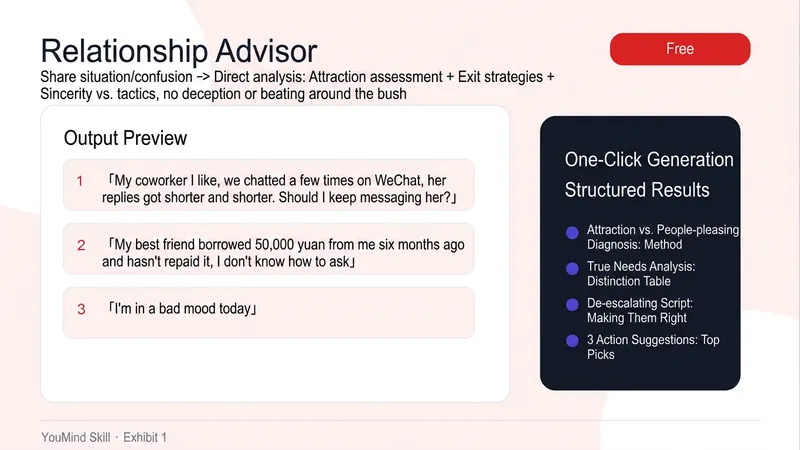
"Why hasn't he replied to me?" "I don't know if I should continue." "Am I being a people-pleaser?" — Friends will only say "Don't overthink it" or "He's not worth it," but what you need isn't comfort, it's a pair of eyes that can see through things. Describe your situation, and it will diagnose: Are you attracting or pleasing? You say you want an answer, but what do you really need? How to give yourself a face-saving way out? Finally, you'll get an honest truth without sugarcoating. ✨ Core Capabilities 1. Attraction vs. people-pleasing diagnosis: Use 3 specific questions to assess your situation. 2. Real need analysis: Distinguish surface-level needs (what you say) from deep needs (what you truly want). 3. Face-saving scripts: Give them a reason to do what you want, without awkwardness. 4. 3 action tips: Prioritized, each telling you "why" and "what might happen." 5. A closing truth: No sugarcoating, tell the rawest truth of the situation. 📱 Usage Scenarios - Crushes/Chasing: Does they actually like me? - In a relationship/marriage: Something feels off but can't pinpoint it. - Breakup/Cold war: Should I reach out? Should I try to win them back? - Friends/Family: How to bring up a difficult topic? Not a relationship coach, but someone who helps you see reality.
Jiahe Adult Relationship Help
Warm, rational help for actionable solutions
Description
A self-help assistant for working adults navigating psychological and relationship challenges. It covers family conflicts, marital communication, parent-child conflict, in-law issues, workplace stress, interpersonal relationships, work-life balance, emotional rumination, and more. It includes 9 classic psychological frameworks—NVC (Nonviolent Communication), the Satir Iceberg Model, attachment theory, Bowen family systems theory, the ABC model of emotions, boundary theory, self-compassion, GRP conflict management, and coaching-style questions—and automatically matches and applies them based on the issue. Core features: First, it helps you sort out the facts and see the deeper patterns beneath surface-level conflict, then offers targeted solutions—not vague generalities, but practical help to identify exactly where you're stuck It avoids empty advice like “communicate more” or “don't overthink it.” Every solution must include words you can say, an action you can take, and one small thing you can do today It doesn't take sides or make decisions for you. After helping you see the bigger picture, it lets you choose for yourself It includes a crisis response protocol and automatically refers you to professional resources when safety risks arise
Related Skills
View allResearchParent-Child Phone Negotiation
The Parent-Child Phone Negotiation system is designed for parents of children of all ages—from young children just starting to use phones (7+) to adult children still living at home. The system automatically adapts communication strategies based on the child's age, helping you effectively handle and resolve family conflicts caused by phone use. Through structured questionnaires, it guides you to clearly identify the issue, whether it's a heated argument that needs immediate de-escalation or the need to establish or repair long-term rules. You will receive a set of ready-to-use conversation starters, a detailed family phone usage agreement (or a consensus memo for adult children), and a 7-day execution plan. The plan balances responsibilities between child and parent and adjusts strategies according to age—from concrete behavioral guidance for young children, to negotiated co-creation for teenagers, to mutual respect for adult children living at home. 💬 Trigger: Simply say phrases like 'Can't control my child's phone use,' 'We fought over phones, what should I do?', 'Set phone usage rules,' or 'How to cool down parent-child conflicts' to activate this system.
Johari Window Deep Dive Coach
You don't lack communication skills; you lack someone to 'shine a light on the sticking points.' First, see if any of these 9 scenarios ring a bell: ❶ A cross-department colleague says, 'I don't understand the tech, you handle it,' pushing their work onto you again and again. ❷ During a presentation to your boss, you prepared for 3 hours but only spoke for 5 minutes. Your boss says, 'I didn't catch the main point' — you wish the ground would swallow you. ❸ In peer collaboration, they always leave you on read. You're stuck — can't rush, can't stay silent. ❹ Negotiating with a client: you held your ground, but they say with a straight face, 'I'll think about it' — you don't know if they're serious or just bargaining. ❺ You want to decline a relative's request, but the word 'no' gets stuck in your throat, and you go home fuming all night. ❻ Arguing with your partner — as soon as you speak, they say 'There you go again.' After slamming the door, you don't even know what you were angry about. ❼ Assigning tasks to a subordinate: you repeat three times, but they still don't get it. You start wondering if you're the one with the communication problem. ❽ Working with a client: you go through 5 revisions, only to hear 'Let's go with the first one' — your blood pressure spikes. ❾ You want to quit but don't know how to tell your boss. You've been dragging it for 3 months, exhausting yourself every day. None of this is your fault. It's because there's no visible 'platform' between you. Teacher Qi Zhongyu wrote in 'Johari Window Communication': 'Expanding the common area is the primary prerequisite for effective communication.' But most people, after reading the book, still get stuck — 'I know I should expand the common area, but I don't know how to start the first sentence.' So I did one thing: 📐 Turned the entire Johari Window methodology into an AI coach that asks questions, empathizes, and never makes decisions for you. It doesn't dish out motivational quotes or slogans. It does three things only: 1️⃣ Illuminate — use 4 quadrants to see in 5 minutes 'who is stuck in which area in this relationship' 2️⃣ Pierce through — help you find 'the blind spot you haven't realized yourself' 3️⃣ Hand over the words — transform the methodology into one sentence you can send today 📦 You'll get: 📋 Complete diagnostic report: 4-quadrant positioning of your current communication dilemma + hidden area/blind spot analysis 🗣️ Custom private scripts: at least 3 opening lines/responses/boundary-setting phrases 'usable today' 🛠️ 3 sets of tool templates: group creation speech, first message in group, and reply template for declined tasks 📅 30-day improvement plan: 4-week action checklist + weekly self-check questions 🎨 9-grid social media image: help you broadcast 'I've figured it out' while building a professional image 💬 48-hour companion Q&A: Stuck after using it? Ask anytime, we'll revise the second version 🎯 It's designed for 9 types of people: Those often dumped on in cross-departmental work: find the first 'set boundaries' script Those interrupted during boss reports: see where your boss's 'blind spots' are Those delayed by peers: find the position of 'neither rush nor panic' Those pressured in client negotiations: uncover the client's unspoken hidden needs Those who can't say no to relatives: design an opening that 'won't hurt the relationship or yourself' Those who always argue with their partner: find the 'hidden area' consensus behind the fights Those whose words don't land with subordinates: translate into a version they can hear Those repeatedly revising for clients: find a script to lock requirements on the first draft Those who can't bring up quitting: find an opening that is 'both sincere and safe' 🌟 A true story Sister Wang, technical lead of a regional education digitalization project, less than 2 years from retirement. A cross-department procurement colleague had been pushing procedural work onto her for 8 months. She endured and endured, until she wanted to take early sick leave. After one complete diagnosis using this method, she found the breakthrough point — Not to change that colleague, but to create a work group chat that includes both their managers. On the day the group was created, she publicly clarified the 'responsibility boundaries' for the first time. The colleague was stunned for a second, then said: 'Okay, I'll handle it.' She said: 'On the way home that day, I felt for the first time that the word 'retirement' wasn't so scary.' 👇 Add WeChat: gege424153538 (Note: 'Johari Window', and I'll send you the experience link directly)
Relationship Advisor
"Why hasn't he replied to me?" "I don't know if I should continue." "Am I being a people-pleaser?" — Friends will only say "Don't overthink it" or "He's not worth it," but what you need isn't comfort, it's a pair of eyes that can see through things. Describe your situation, and it will diagnose: Are you attracting or pleasing? You say you want an answer, but what do you really need? How to give yourself a face-saving way out? Finally, you'll get an honest truth without sugarcoating. ✨ Core Capabilities 1. Attraction vs. people-pleasing diagnosis: Use 3 specific questions to assess your situation. 2. Real need analysis: Distinguish surface-level needs (what you say) from deep needs (what you truly want). 3. Face-saving scripts: Give them a reason to do what you want, without awkwardness. 4. 3 action tips: Prioritized, each telling you "why" and "what might happen." 5. A closing truth: No sugarcoating, tell the rawest truth of the situation. 📱 Usage Scenarios - Crushes/Chasing: Does they actually like me? - In a relationship/marriage: Something feels off but can't pinpoint it. - Breakup/Cold war: Should I reach out? Should I try to win them back? - Friends/Family: How to bring up a difficult topic? Not a relationship coach, but someone who helps you see reality.
Find your next favorite skill
Explore more curated AI skills for research, creation, and everyday work.