
Lossless Markdown Readability
Make Markdown easier to read, keep all info
Description
Turn Markdown documents into something readers with attention difficulties can actually get through: lead with the conclusion, break up paragraphs, shorten sentences, clarify actions, and eliminate noise. Unlike a general “help me improve the formatting” request, this skill is different in three ways. First, the scope of changes is controllable. You can change formatting only, leaving every word of the body untouched while rearranging markers, whitespace, and block order. Or you can change wording only without touching the formatting style. If you do not specify, both are changed. Use Light-Touch mode for documents that are sensitive to edits, such as specifications and API documentation; use Restructure mode for meeting notes and messy notes. Second, it never deletes information. When you ask a model to “simplify” something, the most common result is that it quietly drops two constraint conditions—and you may not notice right away. This skill follows one strict rule: rearrange, never delete. If the document is too long, content is collapsed or moved to an appendix. After editing, it also lists “what was intentionally not changed” so you can verify the result. Third, it removes AI-sounding language along the way. Contrarian framing, teaser-style colons, faux profundity, jargon, vague quantifiers, claims without numbers, and stacked subordinate clauses are not just matters of style. Each one makes readers spend extra attention. Yet these are exactly the patterns models are most likely to produce when rewriting content. The original project is a cross-agent skill with a deterministic script layer for scoring and lossless validation. It can be installed in Claude Code, Codex, Grok Build, Gemini CLI, Cursor, and opencode. The version on YouMind is prompt-only, with the rules included inline but without script-based validation. After editing, compare the result with the original to double-check numbers and exception conditions. Source code and rule library: github.com/tsonglew/adhd-md
Related Skills
View all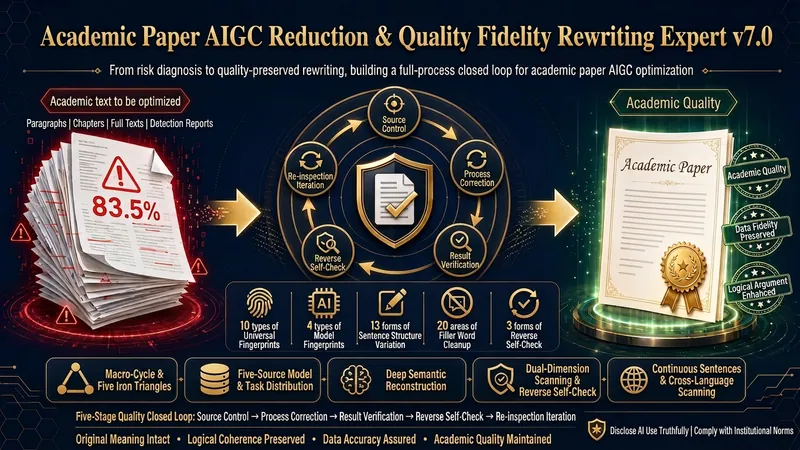 Write
WriteAIGC Reduction & Rewrite v7.0
📚 Academic Paper AIGC Reduction and Quality-Preserving Rewriting Expert v7.0 Designed for graduate students, researchers, and paper authors, this academic text optimization skill operates on a core closed loop of 'source control → process correction → result verification → reverse self-check → iterative re-check'. It systematically diagnoses and optimizes issues such as templated expressions, mechanical logic, vague content, inaccurate terminology, and style inconsistencies while preserving original meaning, technical terms, data, and core conclusions. 🔍📝 🌟 Core Capabilities 🔬 Multi-layer Risk Diagnosis Covers 10 types of universal text fingerprints and assists in identifying common expression patterns of models such as ChatGPT, Claude, DeepSeek, and Wenxin Yiyan. 🧠 Deep Semantic Restructuring Goes beyond synonym replacement to rebuild more natural and in-depth academic reasoning by adjusting proposition expression, information order, argument approach, and evidence organization. ✍️ Quality-Preserving Rewriting Comprehensively applies 13 sentence transformation strategies and 20 methods for cleaning high-frequency templated expressions, improving mechanical sentence structures, repetitive connectors, and overly rigid formatting. 📊 Full-text Structure Diagnosis Through macro-cycle and five key triangles, checks whether research problems, theory, literature review, methods, results, conclusions, and innovation form a complete closed loop. 🧩 Fine-grained Section Adaptation Develops differentiated diagnostic and rewriting strategies for abstract, introduction, literature review, research methods, results, discussion, and conclusion respectively. 🌐 Cross-language Risk Scanning Assists in identifying translationese, passive voice stacking, long sentence nesting, and mixed Chinese-English formatting abnormalities to make Chinese academic expression more natural and accurate. 🔄 Reverse Self-check Loop After rewriting, re-verifies from three aspects: technique distribution, new text fingerprints, and information integrity, to avoid 'becoming more templated' or losing key content. 🛡️ Academic Integrity Protection Does not fabricate literature, data, cases, or policy evidence; separately marks information requiring author verification and reminds users to honestly disclose AI usage. 🎯 Use Cases ✅ Single paragraph or partial section optimization ✅ Targeted modification of marked paragraphs from inspection reports ✅ Polishing of abstract, introduction, literature review, discussion, and conclusion ✅ Full-text AIGC risk feature diagnosis ✅ Language and structure adaptation for target journals ✅ Pre-submission quality review and consistency check 📦 Final Deliverables 📄 Quality-preserving rewritten text 🔎 Risk and issue diagnosis report 🛠️ Rewriting strategy and technique description ✅ Reverse self-check and information integrity report 💡 Items requiring author verification and subsequent revision suggestions 🎓 Original meaning preserved · Logic intact · No fabricated data · Academic quality maintained ⚠️ This skill aims to improve academic expression quality and reduce text risk features. It does not guarantee passage through any specific detection platform or achieving a particular detection score.

Chinese Jargon & SVO Review
Rewrites Chinese materials that “sound professional but leave readers unsure who needs to do what” into language readers can understand, act on, and verify directly. It applies to reports, proposals, notices, articles, product documentation, project updates, policy training, customer service content, official WeChat articles, and AI-generated text, with a focus on Chinese jargon, vague slogans, abstract nouns, and writer-centered framing. Without changing facts, quantities, dates, names, scope, the strength of conclusions, or the boundaries of the evidence, this Skill turns difficult-to-act-on phrases such as “empower,” “strengthen management,” “drive implementation,” “close the loop,” and “align through collaboration” into more specific people, actions, objects, conditions, and outcomes. It also checks whether key sentences clearly state the subject, action, and object, so readers know who is responsible for what, what is affected, and how to determine whether the work is complete. When necessary, it retains specialized terms from regulations, standards, and products while adding explanations in plain language. The output typically includes a ready-to-use rewrite, the key changes that affect understanding, and any people responsible, timelines, data, evidence, or specialized definitions that cannot be confirmed from the original. It does not invent information or rewrite suggestions, records, or system statuses as facts that are completed, resolved, or verified. It is suited to writers, editors, and business teams who want to improve the readability, accuracy, and actionability of Chinese materials.

One Draft, All Platforms
Have you ever counted how much of your week is spent on 'transporting' instead of creating? Write an article, publish it on WeChat. Break it into cards for Xiaohongshu. Rewrite it as a script for a short video. Same idea, five different versions, five times the effort. The real creative work might take an hour, but the rest of the day is lost in translation. This skill puts an end to that. Drop in one piece of content—an article, a recording, or just a few ideas. It first analyzes what format suits it best, then spins it into the formats you need: WeChat long-form, Xiaohongshu visuals, short video storyboards, PPT, infographics, newsletters, comics, or even reusable frameworks. One skeleton, eight forms, with the core message intact. What truly sets it apart are two things no rewrite tool gives you: ① The output sounds like you, not AI. Feed it a few of your past pieces (5 minutes), and it learns your tone, pet phrases, and rhythm. Every platform's copy carries your voice—and it gets better as you use it. ② It's built to remove 'AI flavor.' A built-in set of rules cleans up machine-like phrases like 'leverage,' 'close the loop,' and 'in summary'—so readers can't tell it was written by AI. Write once. Publish everywhere. Give the time back to real creation.
Lossless Markdown Readability
Make Markdown easier to read, keep all info
Description
Turn Markdown documents into something readers with attention difficulties can actually get through: lead with the conclusion, break up paragraphs, shorten sentences, clarify actions, and eliminate noise. Unlike a general “help me improve the formatting” request, this skill is different in three ways. First, the scope of changes is controllable. You can change formatting only, leaving every word of the body untouched while rearranging markers, whitespace, and block order. Or you can change wording only without touching the formatting style. If you do not specify, both are changed. Use Light-Touch mode for documents that are sensitive to edits, such as specifications and API documentation; use Restructure mode for meeting notes and messy notes. Second, it never deletes information. When you ask a model to “simplify” something, the most common result is that it quietly drops two constraint conditions—and you may not notice right away. This skill follows one strict rule: rearrange, never delete. If the document is too long, content is collapsed or moved to an appendix. After editing, it also lists “what was intentionally not changed” so you can verify the result. Third, it removes AI-sounding language along the way. Contrarian framing, teaser-style colons, faux profundity, jargon, vague quantifiers, claims without numbers, and stacked subordinate clauses are not just matters of style. Each one makes readers spend extra attention. Yet these are exactly the patterns models are most likely to produce when rewriting content. The original project is a cross-agent skill with a deterministic script layer for scoring and lossless validation. It can be installed in Claude Code, Codex, Grok Build, Gemini CLI, Cursor, and opencode. The version on YouMind is prompt-only, with the rules included inline but without script-based validation. After editing, compare the result with the original to double-check numbers and exception conditions. Source code and rule library: github.com/tsonglew/adhd-md
Related Skills
View allWriteAIGC Reduction & Rewrite v7.0
📚 Academic Paper AIGC Reduction and Quality-Preserving Rewriting Expert v7.0 Designed for graduate students, researchers, and paper authors, this academic text optimization skill operates on a core closed loop of 'source control → process correction → result verification → reverse self-check → iterative re-check'. It systematically diagnoses and optimizes issues such as templated expressions, mechanical logic, vague content, inaccurate terminology, and style inconsistencies while preserving original meaning, technical terms, data, and core conclusions. 🔍📝 🌟 Core Capabilities 🔬 Multi-layer Risk Diagnosis Covers 10 types of universal text fingerprints and assists in identifying common expression patterns of models such as ChatGPT, Claude, DeepSeek, and Wenxin Yiyan. 🧠 Deep Semantic Restructuring Goes beyond synonym replacement to rebuild more natural and in-depth academic reasoning by adjusting proposition expression, information order, argument approach, and evidence organization. ✍️ Quality-Preserving Rewriting Comprehensively applies 13 sentence transformation strategies and 20 methods for cleaning high-frequency templated expressions, improving mechanical sentence structures, repetitive connectors, and overly rigid formatting. 📊 Full-text Structure Diagnosis Through macro-cycle and five key triangles, checks whether research problems, theory, literature review, methods, results, conclusions, and innovation form a complete closed loop. 🧩 Fine-grained Section Adaptation Develops differentiated diagnostic and rewriting strategies for abstract, introduction, literature review, research methods, results, discussion, and conclusion respectively. 🌐 Cross-language Risk Scanning Assists in identifying translationese, passive voice stacking, long sentence nesting, and mixed Chinese-English formatting abnormalities to make Chinese academic expression more natural and accurate. 🔄 Reverse Self-check Loop After rewriting, re-verifies from three aspects: technique distribution, new text fingerprints, and information integrity, to avoid 'becoming more templated' or losing key content. 🛡️ Academic Integrity Protection Does not fabricate literature, data, cases, or policy evidence; separately marks information requiring author verification and reminds users to honestly disclose AI usage. 🎯 Use Cases ✅ Single paragraph or partial section optimization ✅ Targeted modification of marked paragraphs from inspection reports ✅ Polishing of abstract, introduction, literature review, discussion, and conclusion ✅ Full-text AIGC risk feature diagnosis ✅ Language and structure adaptation for target journals ✅ Pre-submission quality review and consistency check 📦 Final Deliverables 📄 Quality-preserving rewritten text 🔎 Risk and issue diagnosis report 🛠️ Rewriting strategy and technique description ✅ Reverse self-check and information integrity report 💡 Items requiring author verification and subsequent revision suggestions 🎓 Original meaning preserved · Logic intact · No fabricated data · Academic quality maintained ⚠️ This skill aims to improve academic expression quality and reduce text risk features. It does not guarantee passage through any specific detection platform or achieving a particular detection score.
Chinese Jargon & SVO Review
Rewrites Chinese materials that “sound professional but leave readers unsure who needs to do what” into language readers can understand, act on, and verify directly. It applies to reports, proposals, notices, articles, product documentation, project updates, policy training, customer service content, official WeChat articles, and AI-generated text, with a focus on Chinese jargon, vague slogans, abstract nouns, and writer-centered framing. Without changing facts, quantities, dates, names, scope, the strength of conclusions, or the boundaries of the evidence, this Skill turns difficult-to-act-on phrases such as “empower,” “strengthen management,” “drive implementation,” “close the loop,” and “align through collaboration” into more specific people, actions, objects, conditions, and outcomes. It also checks whether key sentences clearly state the subject, action, and object, so readers know who is responsible for what, what is affected, and how to determine whether the work is complete. When necessary, it retains specialized terms from regulations, standards, and products while adding explanations in plain language. The output typically includes a ready-to-use rewrite, the key changes that affect understanding, and any people responsible, timelines, data, evidence, or specialized definitions that cannot be confirmed from the original. It does not invent information or rewrite suggestions, records, or system statuses as facts that are completed, resolved, or verified. It is suited to writers, editors, and business teams who want to improve the readability, accuracy, and actionability of Chinese materials.
One Draft, All Platforms
Have you ever counted how much of your week is spent on 'transporting' instead of creating? Write an article, publish it on WeChat. Break it into cards for Xiaohongshu. Rewrite it as a script for a short video. Same idea, five different versions, five times the effort. The real creative work might take an hour, but the rest of the day is lost in translation. This skill puts an end to that. Drop in one piece of content—an article, a recording, or just a few ideas. It first analyzes what format suits it best, then spins it into the formats you need: WeChat long-form, Xiaohongshu visuals, short video storyboards, PPT, infographics, newsletters, comics, or even reusable frameworks. One skeleton, eight forms, with the core message intact. What truly sets it apart are two things no rewrite tool gives you: ① The output sounds like you, not AI. Feed it a few of your past pieces (5 minutes), and it learns your tone, pet phrases, and rhythm. Every platform's copy carries your voice—and it gets better as you use it. ② It's built to remove 'AI flavor.' A built-in set of rules cleans up machine-like phrases like 'leverage,' 'close the loop,' and 'in summary'—so readers can't tell it was written by AI. Write once. Publish everywhere. Give the time back to real creation.
Find your next favorite skill
Explore more curated AI skills for research, creation, and everyday work.