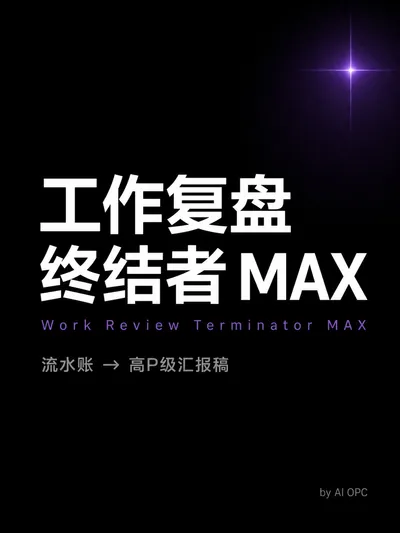
Work Review MAX: Logs→Review
Upgrade weekly, monthly & quarterly reviews
Description
Does your weekly report look like this: “Moved Project A forward this week, participated in discussions for Meeting B, supported the team with Request C, delivered xx documents, and will continue next week.” Your manager glances at it and moves on. It’s not that you didn’t work hard. It’s that you wrote a log, not a review. When evaluators review promotion materials and managers read monthly reports, they care about just five things: ① Why was this work worth doing? (judgment) ② What benchmark shows that the result was good? (data anchoring) ③ Which parts did “you” do, and which were done by the team? (contribution boundaries) ④ What reusable insight did you take away from the work? (growth curve) ⑤ What do you commit to delivering next cycle? (commitment mindset) 99% of review drafts fail to make even one of these clear. They just list features: “Iterated on X,” “launched Y,” “supported Z”—like a robot. This Skill is a structured compiler I refined through frontline business reviews as an AI OPC. Paste in your raw work log exactly as it is—no matter how messy or scattered—and it will produce a complete review that meets senior-level promotion and performance-review standards: 📊 One-line overall assessment (help readers understand your value in 30 seconds) 🎯 Key achievements (STAR + judgment-based narrative, not a feature list) 📈 Data benchmark table (with baselines, definitions, and your share of the contribution) 🧠 Methodology and lessons learned (showing your growth curve) 📅 Next-cycle plan (commitment-letter format, with measurable goals + deadlines + resource needs) ⚠️ Risks and support needed (surfacing risks shows ownership) 📋 Missing-data checklist (everything you need to look up, all at once) Bonus: ✓ Review of 3 key improvement areas (showing which weaknesses in the raw material were addressed) ✓ Defense-risk forecast (which points evaluators may challenge in a promotion review + suggested responses) ✓ Reusable template variables (make a few edits and reuse it next time) How is it different from a typical “AI weekly report” Skill? Others: Rephrase your work log and output it again—it’s still a work log. This one performs structural surgery on it, upgrading it from a “feature-listing format” to a “judgment-based narrative.” What it will never do: ✗ It will not invent data—anything you didn’t provide is marked “needs to be added,” with no made-up numbers ✗ It will not write filler like “As an AI,” “In conclusion,” or “Thank you, leadership” ✗ It will not flatter you or ask, “Can you tell me more?” It gets straight to work Who should use it: People tired of weekly reports and hoping to log off early P6→P7 / M1→M2 / mid-level→senior professionals aiming for promotion Anyone facing a midyear or annual performance review with materials still unwritten Project leads who need to write quarterly reviews for managers, evaluators, or clients Anyone who works hard and wants their work to be truly seen Doing good work doesn’t automatically mean you know how to report it. With the same workload, people who know how to write effective reviews get promoted a year faster. Use it for your next weekly report and make your work visible.
Related Skills
View all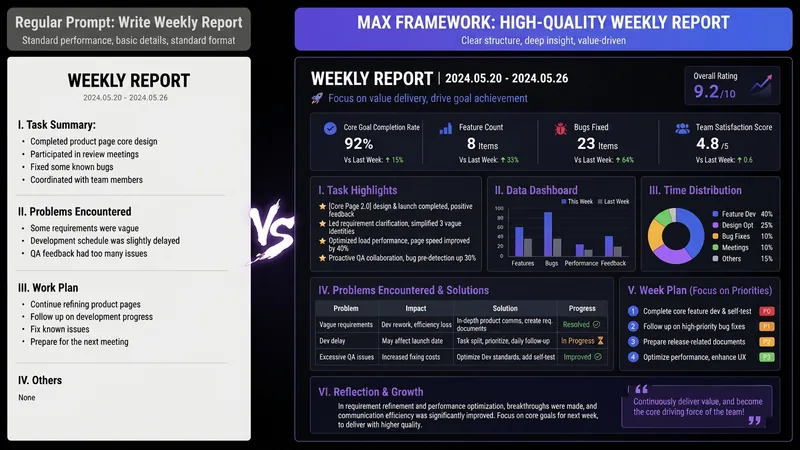
AI Prompt Architect MAX
Have you ever had moments like these— You ask AI to write a weekly report, and it gives you a childish play-by-play; you ask it to revise a résumé, and it serves up “teamwork, diligence, and a strong sense of responsibility”; you ask it to analyze data, and it starts with, “As an AI, I’m happy to help you…” It’s not that AI is incapable—the problem is that your instructions are too amateurish. There are already plenty of Prompt templates teaching you how to write Prompts. But even after using them, you still can’t write your own—because what you’re missing isn’t a template. It’s the ability to compile requirements. This SKILL is my Prompt compiler: a condensed version of the Prompt architecture methodology I use every day as an AI OPC—someone working on the front lines of AI implementation—to write Prompts for teams. You explain what you need in plain language, and it gives you a top-tier architecture. Input: “Help me write a monthly report” Output: a complete eight-module Prompt architecture—role, task, audience, process, constraints, format, self-check, and examples, all locked in. Copy and paste it into ChatGPT / Claude / DeepSeek / Kimi, and the first output will be ready to use. Even better, it will tell you: ✓ Which model is best for this Prompt ✓ Which variables you can change directly next time (learn once, reuse repeatedly) ✓ Which one missing piece of information could take the output to the next level How is it different from an ordinary Prompt template SKILL? Other SKILLs give you a fish—one finished Prompt. This SKILL gives you a compiler—the ability to compile any requirement into a Prompt. Install it once, and every AI use case you have will improve—writing, reporting, analysis, translation, customer service, content creation, and more. Who should install it: People who use AI every day but are never satisfied with the output People who want to learn Prompt engineering without spending thousands on a course Team leaders who want to standardize AI use but don’t know where to start Content creators, researchers, students, job seekers, and side-hustle builders How well you use AI doesn’t depend on which model you choose. It depends on whether you can compile your requirements. Install it today, and the quality of your conversations with AI will take a dramatic leap forward.
 Research
Offer Toolkit
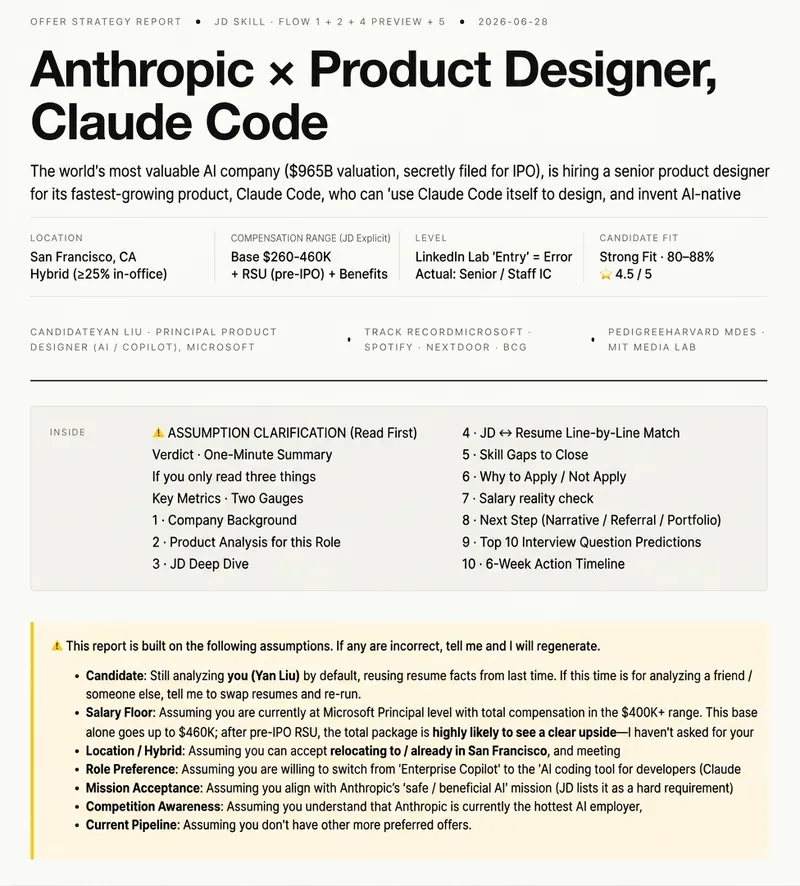
A job search system backed by 10 years of experience at a major Silicon Valley company, packaging genuine hiring insights and job search methodologies into AI. Offer Toolkit | AI Job Search Assistant From "discovering your dream job" to "landing the offer," it breaks down the entire job search process into three smart modules: ① JD Decoder Deeply analyze the job description and generate a personalized Offer Strategy Report: - Whether it's worth applying - Role fit assessment - Core strengths and skill gaps - Interview focus and high-probability question predictions ② Resume Builder Transform your experience from a "job description" into a compelling impact story that recruiters recognize: - Automatically structure your personal experience - Optimize project descriptions and quantify achievements - Generate ATS-friendly, high-quality resumes - Supports 11+ print-ready professional templates ③ Behavioral Story Library Mine your real experiences to build reusable interview story assets: - Extract key projects and growth experiences - Automatically convert to STAR Framework - Build a personal Behavioral Interview Story Bank - Efficiently handle "Tell me about a time..." questions Whether you're debating "should I apply for this job," want to "optimize your resume," need to "analyze a JD," or are preparing for your next behavioral interview, Offer Toolkit will automatically identify your needs and route you to the most suitable AI module. Keywords: Job Search, Offer, Career, Job Hunt, JD, Job Description, Resume, CV, Behavioral Interview, STAR, Tell me about a time, Interview Preparation ------------------------------------- job-description-skill: Paste a JD and your resume, and you'll get an HTML report telling you: whether you should apply for this job, how well you match, what gaps exist, what the interview will likely ask, whether the salary is reasonable, and what to do in the next 6 weeks. resume-skill: Helps you polish your existing resume, import from LinkedIn, or write one from scratch through conversation. Provides 11 print-ready templates (Classic-ATS, Ledger, Tech Compact, Modern Sidebar, Pillar, Elegant Serif, Atelier, Timeline, Swiss, Executive, Color-block). Each time, it provides two files: one directly printable as PDF, and one you can edit by clicking words in the browser. bq-skill: It doesn't give you ready-made answers; instead, it helps you dig out things you've actually done and organize them into a reusable story library. It will ask about your experiences step by step, help you clarify your thinking using STAR/CAR, and tag them with labels like "decision-making" and "overcoming adversity." It saves one copy in Chinese and one in English, so you can use the same story for different behavioral questions next time. It can also look at a JD and predict 20 questions the company might ask, helping you prepare one by one. Three shared rules: 1. No fabrication. All experiences, responsibilities, and numbers come from what the user has actually said. It can help rephrase weak expressions, but it will never invent companies, positions, achievements, or quantified numbers. Numbers must be verified with the user. 2. Ask only one question at a time. Digging stories, building resumes, and preparing BQs are conversations, not questionnaires. 3. Structure first, then output. First convert to a standard data model, confirm it's correct, then render HTML or generate answers.

One Draft, All Platforms
Have you ever counted how much of your week is spent on 'transporting' instead of creating? Write an article, publish it on WeChat. Break it into cards for Xiaohongshu. Rewrite it as a script for a short video. Same idea, five different versions, five times the effort. The real creative work might take an hour, but the rest of the day is lost in translation. This skill puts an end to that. Drop in one piece of content—an article, a recording, or just a few ideas. It first analyzes what format suits it best, then spins it into the formats you need: WeChat long-form, Xiaohongshu visuals, short video storyboards, PPT, infographics, newsletters, comics, or even reusable frameworks. One skeleton, eight forms, with the core message intact. What truly sets it apart are two things no rewrite tool gives you: ① The output sounds like you, not AI. Feed it a few of your past pieces (5 minutes), and it learns your tone, pet phrases, and rhythm. Every platform's copy carries your voice—and it gets better as you use it. ② It's built to remove 'AI flavor.' A built-in set of rules cleans up machine-like phrases like 'leverage,' 'close the loop,' and 'in summary'—so readers can't tell it was written by AI. Write once. Publish everywhere. Give the time back to real creation.
Work Review MAX: Logs→Review
Upgrade weekly, monthly & quarterly reviews
Description
Does your weekly report look like this: “Moved Project A forward this week, participated in discussions for Meeting B, supported the team with Request C, delivered xx documents, and will continue next week.” Your manager glances at it and moves on. It’s not that you didn’t work hard. It’s that you wrote a log, not a review. When evaluators review promotion materials and managers read monthly reports, they care about just five things: ① Why was this work worth doing? (judgment) ② What benchmark shows that the result was good? (data anchoring) ③ Which parts did “you” do, and which were done by the team? (contribution boundaries) ④ What reusable insight did you take away from the work? (growth curve) ⑤ What do you commit to delivering next cycle? (commitment mindset) 99% of review drafts fail to make even one of these clear. They just list features: “Iterated on X,” “launched Y,” “supported Z”—like a robot. This Skill is a structured compiler I refined through frontline business reviews as an AI OPC. Paste in your raw work log exactly as it is—no matter how messy or scattered—and it will produce a complete review that meets senior-level promotion and performance-review standards: 📊 One-line overall assessment (help readers understand your value in 30 seconds) 🎯 Key achievements (STAR + judgment-based narrative, not a feature list) 📈 Data benchmark table (with baselines, definitions, and your share of the contribution) 🧠 Methodology and lessons learned (showing your growth curve) 📅 Next-cycle plan (commitment-letter format, with measurable goals + deadlines + resource needs) ⚠️ Risks and support needed (surfacing risks shows ownership) 📋 Missing-data checklist (everything you need to look up, all at once) Bonus: ✓ Review of 3 key improvement areas (showing which weaknesses in the raw material were addressed) ✓ Defense-risk forecast (which points evaluators may challenge in a promotion review + suggested responses) ✓ Reusable template variables (make a few edits and reuse it next time) How is it different from a typical “AI weekly report” Skill? Others: Rephrase your work log and output it again—it’s still a work log. This one performs structural surgery on it, upgrading it from a “feature-listing format” to a “judgment-based narrative.” What it will never do: ✗ It will not invent data—anything you didn’t provide is marked “needs to be added,” with no made-up numbers ✗ It will not write filler like “As an AI,” “In conclusion,” or “Thank you, leadership” ✗ It will not flatter you or ask, “Can you tell me more?” It gets straight to work Who should use it: People tired of weekly reports and hoping to log off early P6→P7 / M1→M2 / mid-level→senior professionals aiming for promotion Anyone facing a midyear or annual performance review with materials still unwritten Project leads who need to write quarterly reviews for managers, evaluators, or clients Anyone who works hard and wants their work to be truly seen Doing good work doesn’t automatically mean you know how to report it. With the same workload, people who know how to write effective reviews get promoted a year faster. Use it for your next weekly report and make your work visible.
Related Skills
View allAI Prompt Architect MAX
Have you ever had moments like these— You ask AI to write a weekly report, and it gives you a childish play-by-play; you ask it to revise a résumé, and it serves up “teamwork, diligence, and a strong sense of responsibility”; you ask it to analyze data, and it starts with, “As an AI, I’m happy to help you…” It’s not that AI is incapable—the problem is that your instructions are too amateurish. There are already plenty of Prompt templates teaching you how to write Prompts. But even after using them, you still can’t write your own—because what you’re missing isn’t a template. It’s the ability to compile requirements. This SKILL is my Prompt compiler: a condensed version of the Prompt architecture methodology I use every day as an AI OPC—someone working on the front lines of AI implementation—to write Prompts for teams. You explain what you need in plain language, and it gives you a top-tier architecture. Input: “Help me write a monthly report” Output: a complete eight-module Prompt architecture—role, task, audience, process, constraints, format, self-check, and examples, all locked in. Copy and paste it into ChatGPT / Claude / DeepSeek / Kimi, and the first output will be ready to use. Even better, it will tell you: ✓ Which model is best for this Prompt ✓ Which variables you can change directly next time (learn once, reuse repeatedly) ✓ Which one missing piece of information could take the output to the next level How is it different from an ordinary Prompt template SKILL? Other SKILLs give you a fish—one finished Prompt. This SKILL gives you a compiler—the ability to compile any requirement into a Prompt. Install it once, and every AI use case you have will improve—writing, reporting, analysis, translation, customer service, content creation, and more. Who should install it: People who use AI every day but are never satisfied with the output People who want to learn Prompt engineering without spending thousands on a course Team leaders who want to standardize AI use but don’t know where to start Content creators, researchers, students, job seekers, and side-hustle builders How well you use AI doesn’t depend on which model you choose. It depends on whether you can compile your requirements. Install it today, and the quality of your conversations with AI will take a dramatic leap forward.
ResearchOffer Toolkit
A job search system backed by 10 years of experience at a major Silicon Valley company, packaging genuine hiring insights and job search methodologies into AI. Offer Toolkit | AI Job Search Assistant From "discovering your dream job" to "landing the offer," it breaks down the entire job search process into three smart modules: ① JD Decoder Deeply analyze the job description and generate a personalized Offer Strategy Report: - Whether it's worth applying - Role fit assessment - Core strengths and skill gaps - Interview focus and high-probability question predictions ② Resume Builder Transform your experience from a "job description" into a compelling impact story that recruiters recognize: - Automatically structure your personal experience - Optimize project descriptions and quantify achievements - Generate ATS-friendly, high-quality resumes - Supports 11+ print-ready professional templates ③ Behavioral Story Library Mine your real experiences to build reusable interview story assets: - Extract key projects and growth experiences - Automatically convert to STAR Framework - Build a personal Behavioral Interview Story Bank - Efficiently handle "Tell me about a time..." questions Whether you're debating "should I apply for this job," want to "optimize your resume," need to "analyze a JD," or are preparing for your next behavioral interview, Offer Toolkit will automatically identify your needs and route you to the most suitable AI module. Keywords: Job Search, Offer, Career, Job Hunt, JD, Job Description, Resume, CV, Behavioral Interview, STAR, Tell me about a time, Interview Preparation ------------------------------------- job-description-skill: Paste a JD and your resume, and you'll get an HTML report telling you: whether you should apply for this job, how well you match, what gaps exist, what the interview will likely ask, whether the salary is reasonable, and what to do in the next 6 weeks. resume-skill: Helps you polish your existing resume, import from LinkedIn, or write one from scratch through conversation. Provides 11 print-ready templates (Classic-ATS, Ledger, Tech Compact, Modern Sidebar, Pillar, Elegant Serif, Atelier, Timeline, Swiss, Executive, Color-block). Each time, it provides two files: one directly printable as PDF, and one you can edit by clicking words in the browser. bq-skill: It doesn't give you ready-made answers; instead, it helps you dig out things you've actually done and organize them into a reusable story library. It will ask about your experiences step by step, help you clarify your thinking using STAR/CAR, and tag them with labels like "decision-making" and "overcoming adversity." It saves one copy in Chinese and one in English, so you can use the same story for different behavioral questions next time. It can also look at a JD and predict 20 questions the company might ask, helping you prepare one by one. Three shared rules: 1. No fabrication. All experiences, responsibilities, and numbers come from what the user has actually said. It can help rephrase weak expressions, but it will never invent companies, positions, achievements, or quantified numbers. Numbers must be verified with the user. 2. Ask only one question at a time. Digging stories, building resumes, and preparing BQs are conversations, not questionnaires. 3. Structure first, then output. First convert to a standard data model, confirm it's correct, then render HTML or generate answers.
One Draft, All Platforms
Have you ever counted how much of your week is spent on 'transporting' instead of creating? Write an article, publish it on WeChat. Break it into cards for Xiaohongshu. Rewrite it as a script for a short video. Same idea, five different versions, five times the effort. The real creative work might take an hour, but the rest of the day is lost in translation. This skill puts an end to that. Drop in one piece of content—an article, a recording, or just a few ideas. It first analyzes what format suits it best, then spins it into the formats you need: WeChat long-form, Xiaohongshu visuals, short video storyboards, PPT, infographics, newsletters, comics, or even reusable frameworks. One skeleton, eight forms, with the core message intact. What truly sets it apart are two things no rewrite tool gives you: ① The output sounds like you, not AI. Feed it a few of your past pieces (5 minutes), and it learns your tone, pet phrases, and rhythm. Every platform's copy carries your voice—and it gets better as you use it. ② It's built to remove 'AI flavor.' A built-in set of rules cleans up machine-like phrases like 'leverage,' 'close the loop,' and 'in summary'—so readers can't tell it was written by AI. Write once. Publish everywhere. Give the time back to real creation.
Find your next favorite skill
Explore more curated AI skills for research, creation, and everyday work.