
One Source, Five Formats
One piece into doc, slides, cast, webpage and social
Description
Recommended by
nene@YouMind
Why we love this skill
Featured for turning one strong source into a coherent release system, not five recycled summaries. Its approved Message Spine, format-by-format recommendations, visual continuity, credit-aware previews, and final consistency check preserve the argument while adapting it intelligently to each medium.
YouMind can produce a document, a slide deck, a narrated video, an interactive webpage and a set of social posts. Most people use one of them, because doing all five by hand means writing the same argument five times and watching it drift a little further each time. This skill stops the drift by refusing to start until you have a spine. Before anything is generated it writes a Message Spine: one thesis under 25 words, three load-bearing points, the single strongest piece of evidence, the one image a reader should still have tomorrow, the change you want in them, and who this is explicitly not for. You approve it. Every format is then built from the spine, never from the previous format, so nothing compounds an earlier compromise. Then it tells you which formats are actually worth making. A short reflective essay makes bad slides. A dense data teardown makes bad audio. It will recommend two formats and explain why the other three would weaken the work, which is the opposite of what a content-multiplier is supposed to say. Each format gets built to its own rules, one at a time, with your confirmation. Slides get one idea per slide and speaker notes that carry the argument. The cast script is written for the ear, with numbers rounded and given a comparison and a deliberate pause before the strongest evidence. The webpage gets exactly one interactive move the flat text could not do. The social set opens each post on a different point so it does not read as three copies of itself, and every post gives away something real instead of begging for a click. One palette, one type treatment, one recurring motif, decided in writing before the first image is generated. You finish with a ship sheet: what goes where, in what order, how many days apart, with what call to action, and the one signal to watch. Plus a consistency check that quotes the thesis sentence from every format and confirms they still agree. It estimates credits before it spends them and never renders a full cast or image set without an explicit yes.
Related Skills
View all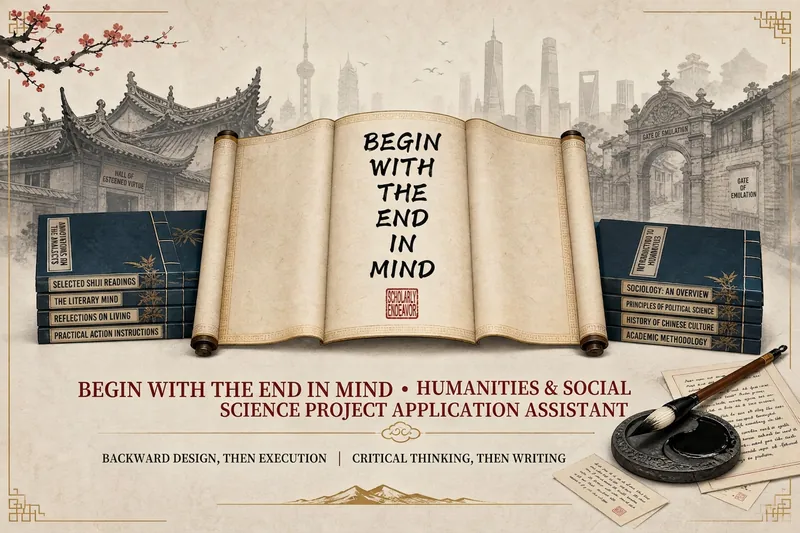 Write
WriteEnd-First Humanities Proposals
The biggest risk in a proposal isn’t writing slowly—it’s heading in the wrong direction. Most methods have you “write from start to finish, following the research process.” This Skill takes the opposite approach—backward first, then forward: it pushes you to clarify “what exactly is the innovation,” then work backward from the reviewers’ perspective to determine “what needs to be shown and why they should believe you.” Only after that does it have you write in a logical reading order. It sets three hard gates: you can’t lock in a topic until you’ve searched the literature thoroughly, you can’t start writing until the innovation is clear, and the final draft can’t be completed without your confirmation. It also uses XYZ multi-axis searches to verify that a “research gap” truly exists—never treating “I didn’t find it” as “no one has studied it.” Other AI helps you write faster. This Skill has you start later, so you get it right the first time.
 Write
WriteHuman-Voice WeChat Writing
Turn a trending event, social phenomenon, workplace or relationship topic, personal experience, industry observation, product material, or existing draft into a WeChat Official Account article with a clear position, genuine emotion, and strong shareability. It doesn’t stop at the safe, even-handed “everyone has a point.” Instead, it helps you find an angle that fits your target readers, identify the real conflicts and pain points, and use specific scenes, everyday details, and memorable judgments to make the article sound like it was written by a real person with experience and preferences—someone who also acknowledges the limits of their understanding. Along with a publish-ready draft, it also organizes the creative decisions, title directions, and article’s core points. It prepares authorial responses for real-world comment scenarios, including challenges to the facts, opposing views, personal experience sharing, and quotes taken out of context, making it easier to handle discussion after publication. For trending topics, controversial events, and high-risk subjects such as law, medicine, and finance, it distinguishes known facts, reasonable inferences, and the author’s judgments, avoids fabricated information, and flags areas that still need sources or verification. It’s suited to WeChat Official Account writers, independent media editors, and content teams creating social commentary, workplace perspectives, relationship and emotional opinions, personal growth topics, and industry commentary. It’s especially useful when you want to move beyond detached “both-sides” writing and AI-sounding prose without relying on personal attacks, exaggerating facts, or creating needless conflict to gain attention.
 Write
WriteVideo copywriting for social media
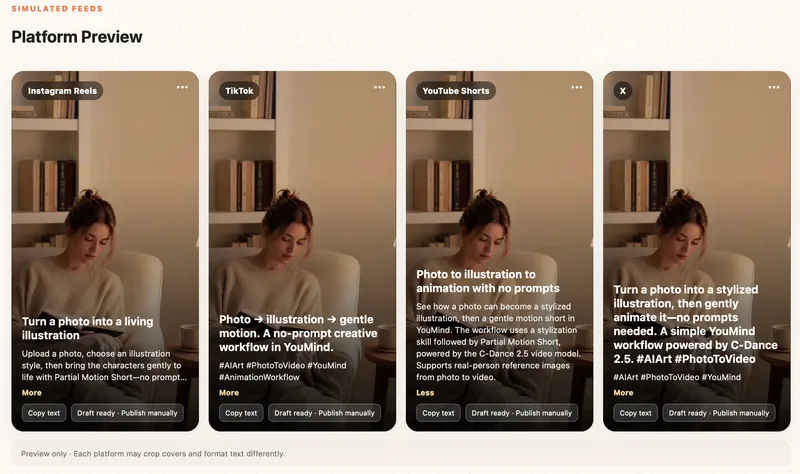
Analyze a video or transcript immediately, prepare evidence-based and platform-native multi-platform including Instagram, X, YouTube, TikTok, titles and copy, and recommend an editable social media editor webpage with 9:16 previews while keeping a concise plain-text copy document available as an alternative.
One Source, Five Formats
One piece into doc, slides, cast, webpage and social
Description
Recommended by
nene@YouMind
Why we love this skill
Featured for turning one strong source into a coherent release system, not five recycled summaries. Its approved Message Spine, format-by-format recommendations, visual continuity, credit-aware previews, and final consistency check preserve the argument while adapting it intelligently to each medium.
YouMind can produce a document, a slide deck, a narrated video, an interactive webpage and a set of social posts. Most people use one of them, because doing all five by hand means writing the same argument five times and watching it drift a little further each time. This skill stops the drift by refusing to start until you have a spine. Before anything is generated it writes a Message Spine: one thesis under 25 words, three load-bearing points, the single strongest piece of evidence, the one image a reader should still have tomorrow, the change you want in them, and who this is explicitly not for. You approve it. Every format is then built from the spine, never from the previous format, so nothing compounds an earlier compromise. Then it tells you which formats are actually worth making. A short reflective essay makes bad slides. A dense data teardown makes bad audio. It will recommend two formats and explain why the other three would weaken the work, which is the opposite of what a content-multiplier is supposed to say. Each format gets built to its own rules, one at a time, with your confirmation. Slides get one idea per slide and speaker notes that carry the argument. The cast script is written for the ear, with numbers rounded and given a comparison and a deliberate pause before the strongest evidence. The webpage gets exactly one interactive move the flat text could not do. The social set opens each post on a different point so it does not read as three copies of itself, and every post gives away something real instead of begging for a click. One palette, one type treatment, one recurring motif, decided in writing before the first image is generated. You finish with a ship sheet: what goes where, in what order, how many days apart, with what call to action, and the one signal to watch. Plus a consistency check that quotes the thesis sentence from every format and confirms they still agree. It estimates credits before it spends them and never renders a full cast or image set without an explicit yes.
Related Skills
View allWriteEnd-First Humanities Proposals
The biggest risk in a proposal isn’t writing slowly—it’s heading in the wrong direction. Most methods have you “write from start to finish, following the research process.” This Skill takes the opposite approach—backward first, then forward: it pushes you to clarify “what exactly is the innovation,” then work backward from the reviewers’ perspective to determine “what needs to be shown and why they should believe you.” Only after that does it have you write in a logical reading order. It sets three hard gates: you can’t lock in a topic until you’ve searched the literature thoroughly, you can’t start writing until the innovation is clear, and the final draft can’t be completed without your confirmation. It also uses XYZ multi-axis searches to verify that a “research gap” truly exists—never treating “I didn’t find it” as “no one has studied it.” Other AI helps you write faster. This Skill has you start later, so you get it right the first time.
WriteHuman-Voice WeChat Writing
Turn a trending event, social phenomenon, workplace or relationship topic, personal experience, industry observation, product material, or existing draft into a WeChat Official Account article with a clear position, genuine emotion, and strong shareability. It doesn’t stop at the safe, even-handed “everyone has a point.” Instead, it helps you find an angle that fits your target readers, identify the real conflicts and pain points, and use specific scenes, everyday details, and memorable judgments to make the article sound like it was written by a real person with experience and preferences—someone who also acknowledges the limits of their understanding. Along with a publish-ready draft, it also organizes the creative decisions, title directions, and article’s core points. It prepares authorial responses for real-world comment scenarios, including challenges to the facts, opposing views, personal experience sharing, and quotes taken out of context, making it easier to handle discussion after publication. For trending topics, controversial events, and high-risk subjects such as law, medicine, and finance, it distinguishes known facts, reasonable inferences, and the author’s judgments, avoids fabricated information, and flags areas that still need sources or verification. It’s suited to WeChat Official Account writers, independent media editors, and content teams creating social commentary, workplace perspectives, relationship and emotional opinions, personal growth topics, and industry commentary. It’s especially useful when you want to move beyond detached “both-sides” writing and AI-sounding prose without relying on personal attacks, exaggerating facts, or creating needless conflict to gain attention.
WriteVideo copywriting for social media
Analyze a video or transcript immediately, prepare evidence-based and platform-native multi-platform including Instagram, X, YouTube, TikTok, titles and copy, and recommend an editable social media editor webpage with 9:16 previews while keeping a concise plain-text copy document available as an alternative.
Find your next favorite skill
Explore more curated AI skills for research, creation, and everyday work.