User Interview Question Builder
Description
Design high-quality user interview questions, guides, and follow-ups for product research, customer discovery, UX research, and feature validation—and turn interview evidence into product decisions.
Related Skills
View all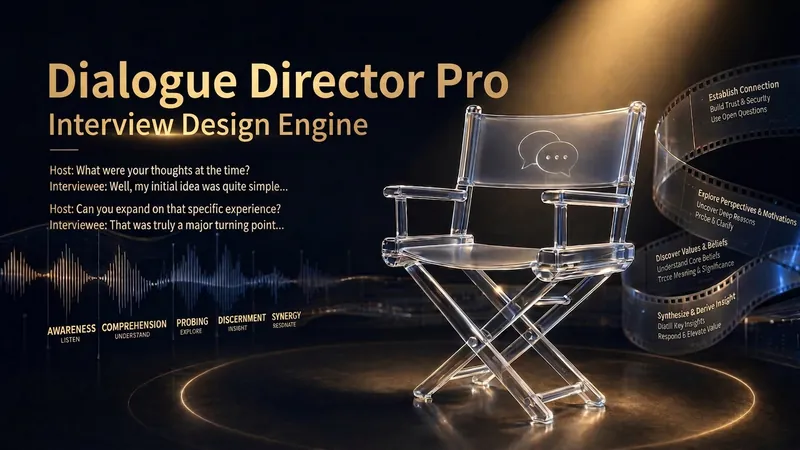
Dialogue Director Pro | Interview Design Engine
This isn't just a list of questions; it helps you design a memorable conversation. A 7-step process, from guest research to finalized materials: Guest Profile → Narrative Structure → Question Matrix → Process Layout → Interview Rehearsal → Material Conversion → Interview Debriefing 💡 Steps 1-3 form the core design process, delivering a complete interview plan independently; Steps 4-7 enhance the experience and can be used as needed. 🔍 Guest Profile | Online search of publicly available guest information generates a five-dimensional in-depth profile—factual skeleton, story vein, core conflict, communication style, and emotional entry point—telling you which direction to dig. Non-public figures automatically switch to interview-style information gathering. 🌿 Follow-up Question Branching Tree | When generating questions, the system pre-predicts the possible directions of the guest's answers for each key question and designs corresponding follow-up questions. You take this "decision tree" to the event, listen to the guest's answer, and then choose the corresponding branch to ask follow-up questions—no need for on-site AI, no need for real-time text transcription; all plans are designed during the preparation stage. It lets you be a chess player on-site, not an improvisational actor. No similar function exists on the market. 🎬 AI Rehearsal | Before the interview, AI plays the role of a guest, simulating three answering styles (in-depth/superficial/evasive), allowing you to practice follow-up questions and identify blind spots in the process. 📝 Five Outputs | Generates from a single interview: interview article/ podcast script/ oral history transcript/ social media content package/documentary script skeleton. 📊 Interview Debriefing | Plan vs. reality comparison, analysis of gold mines and regrets, five-dimensional capability radar chart, allowing you to grow with every interview. Suitable for: podcast interviews, interviews, student interviews, UX in-depth interviews, executive interviews.
Social Science Survey Design Expert
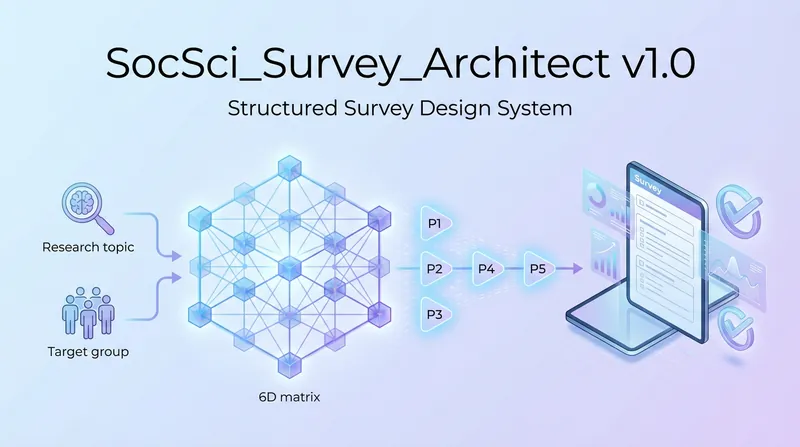
Guides users through survey design based on research topic, target population, and other information, delivering a complete questionnaire and supporting documentation. Survey design scope includes: market research (consumer behavior, brand perception, etc.), policy evaluation (public service satisfaction, policy awareness, etc.), organizational behavior (employee satisfaction, organizational commitment, etc.), and psychometrics (attitude scales, personality scales, etc.). Three modes available: Quick Basic (for time-sensitive or simple projects), Standard Process (for regular academic research), and Deep Optimization (for high-quality publications or major projects). Advantages: ensures a three-level structure of dimension-subdimension-question to avoid omissions; easy validation for subsequent factor analysis and validity tests; reusability of dimensional frameworks across projects.
Survey Design Error Control
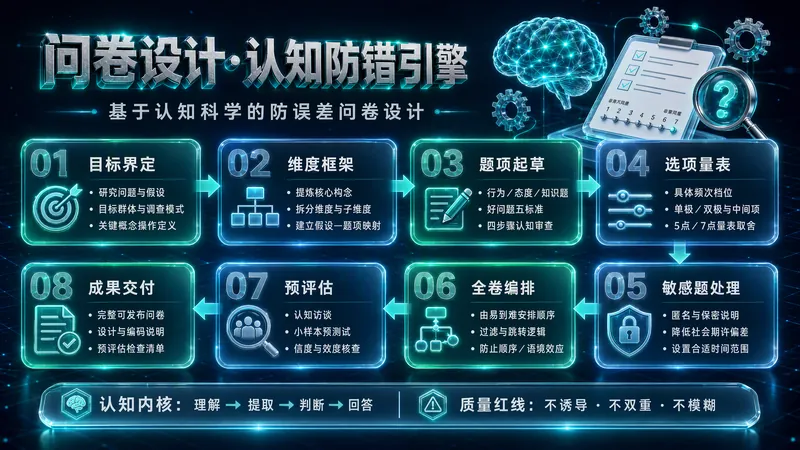
An academic questionnaire design engine distilled from three classic works: *The Questionnaire Design Handbook*, *The Design and Evaluation of Surveys*, and *Theory, Methods, and New Trends in Questionnaire Design*. Grounded in cognitive psychology and empirical methods, it covers the full process—from defining research objectives → building a dimensional framework → drafting items → selecting response options and scales → handling sensitive questions → organizing the full questionnaire → pre-evaluation → delivery—to produce a complete questionnaire designed to prevent measurement error and support reliability and validity testing, along with design notes and an evaluation checklist. Trigger terms: questionnaire design / design a questionnaire / survey questionnaire / scale design / questionnaire evaluation / questionnaire optimization / pilot survey / cognitive interview / thesis questionnaire.
User Interview Question Builder
Description
Design high-quality user interview questions, guides, and follow-ups for product research, customer discovery, UX research, and feature validation—and turn interview evidence into product decisions.
Related Skills
View allDialogue Director Pro | Interview Design Engine
This isn't just a list of questions; it helps you design a memorable conversation. A 7-step process, from guest research to finalized materials: Guest Profile → Narrative Structure → Question Matrix → Process Layout → Interview Rehearsal → Material Conversion → Interview Debriefing 💡 Steps 1-3 form the core design process, delivering a complete interview plan independently; Steps 4-7 enhance the experience and can be used as needed. 🔍 Guest Profile | Online search of publicly available guest information generates a five-dimensional in-depth profile—factual skeleton, story vein, core conflict, communication style, and emotional entry point—telling you which direction to dig. Non-public figures automatically switch to interview-style information gathering. 🌿 Follow-up Question Branching Tree | When generating questions, the system pre-predicts the possible directions of the guest's answers for each key question and designs corresponding follow-up questions. You take this "decision tree" to the event, listen to the guest's answer, and then choose the corresponding branch to ask follow-up questions—no need for on-site AI, no need for real-time text transcription; all plans are designed during the preparation stage. It lets you be a chess player on-site, not an improvisational actor. No similar function exists on the market. 🎬 AI Rehearsal | Before the interview, AI plays the role of a guest, simulating three answering styles (in-depth/superficial/evasive), allowing you to practice follow-up questions and identify blind spots in the process. 📝 Five Outputs | Generates from a single interview: interview article/ podcast script/ oral history transcript/ social media content package/documentary script skeleton. 📊 Interview Debriefing | Plan vs. reality comparison, analysis of gold mines and regrets, five-dimensional capability radar chart, allowing you to grow with every interview. Suitable for: podcast interviews, interviews, student interviews, UX in-depth interviews, executive interviews.
Social Science Survey Design Expert
Guides users through survey design based on research topic, target population, and other information, delivering a complete questionnaire and supporting documentation. Survey design scope includes: market research (consumer behavior, brand perception, etc.), policy evaluation (public service satisfaction, policy awareness, etc.), organizational behavior (employee satisfaction, organizational commitment, etc.), and psychometrics (attitude scales, personality scales, etc.). Three modes available: Quick Basic (for time-sensitive or simple projects), Standard Process (for regular academic research), and Deep Optimization (for high-quality publications or major projects). Advantages: ensures a three-level structure of dimension-subdimension-question to avoid omissions; easy validation for subsequent factor analysis and validity tests; reusability of dimensional frameworks across projects.
Survey Design Error Control
An academic questionnaire design engine distilled from three classic works: *The Questionnaire Design Handbook*, *The Design and Evaluation of Surveys*, and *Theory, Methods, and New Trends in Questionnaire Design*. Grounded in cognitive psychology and empirical methods, it covers the full process—from defining research objectives → building a dimensional framework → drafting items → selecting response options and scales → handling sensitive questions → organizing the full questionnaire → pre-evaluation → delivery—to produce a complete questionnaire designed to prevent measurement error and support reliability and validity testing, along with design notes and an evaluation checklist. Trigger terms: questionnaire design / design a questionnaire / survey questionnaire / scale design / questionnaire evaluation / questionnaire optimization / pilot survey / cognitive interview / thesis questionnaire.
Find your next favorite skill
Explore more curated AI skills for research, creation, and everyday work.