
Product Strategy One-Pager
Info efficiency, talent density, global
Description
Building a product is like driving in the fog—what do users want? Is the team right? Should we go global? Which metric to optimize first? Every decision gambles the team's time and investors' money. Feed it your product info and data, and it uses ByteDance-style product methodology to help you clarify: What information and needs is your product matching? Are your current resources solving 'problems that will matter in three years' or 'urgent matters this month'? Is your team's talent density sufficient? What A/B tests can validate your core assumptions? ✨ Core Capabilities 1. Information match efficiency diagnosis: What is your product essentially matching? Where are the friction points? 2. Delayed gratification assessment: Distinguish 'important in three years' vs 'urgent this month', provide resource reallocation recommendations 3. Talent density and team strategy: Core role talent assessment + Context/Control boundary recommendations 4. A/B test design: Turn your gut assumptions into verifiable experimental plans 5. Global feasibility assessment: Language, culture, compliance, and payment four-dimensional check 📱 Use Cases - Early-stage startup teams making directional decisions - Product managers' quarterly reviews and strategy adjustments - Investors quickly evaluating a project's product logic - Developers building side projects validating ideas It doesn't give you a standard answer—it gives you a framework to ask the right questions.
Related Skills
View all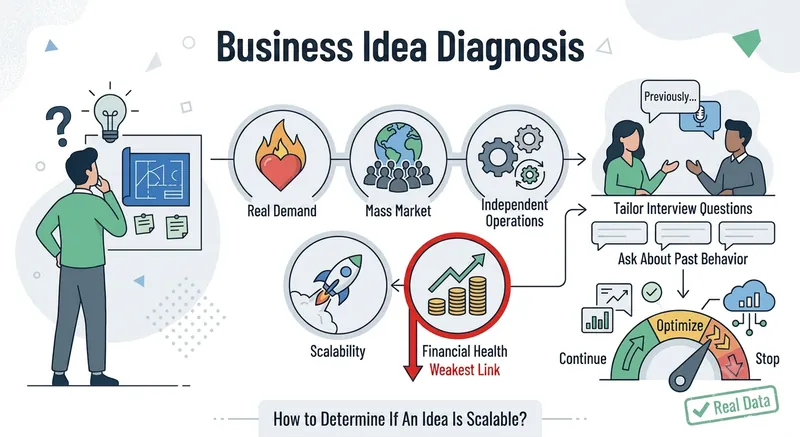
Can Your Business Idea Scale?
One-person company founders and side-hustle explorers: before you invest time and money, do a final calm check with customer data. Supports uploading business plans/BP (PDF/Word/PPT). Unlike the free version—which gives you a quick diagnosis and 3 interview questions to go talk to customers—the full version picks up after you've talked to customers: use customers' real answers (not your own feelings) to rescore the five switches, apply the one-vote veto system, automatically match validation experiments, GO gives a scaling roadmap, PIVOT gives a hypothesis adjustment path, and NO GO helps you extract reusable assets. If you haven't talked to customers yet, the full version can also give you interview questions directly—but it's recommended to first get the quick diagnosis and questions from the free version, talk to customers, and come back with their verbatim responses. The five switches: Is the need real? Can users represent the masses? Can it still run without you? What happens when you scale it 100x? Does selling more make more profit or more loss? If one switch breaks, the whole thing breaks—one-vote veto. Output includes: a customer-data-driven scoring report + 3 types of validation experiment plans (interview / landing page / Wizard of Oz, automatically matched) + GO → scaling roadmap + PIVOT → hypothesis adjustment path + NO GO → reusable asset extraction. Methodology: John List's The Voltage Effect + Rob Fitzpatrick's The Mom Test + Bland & Osterwalder's Testing Business Ideas.
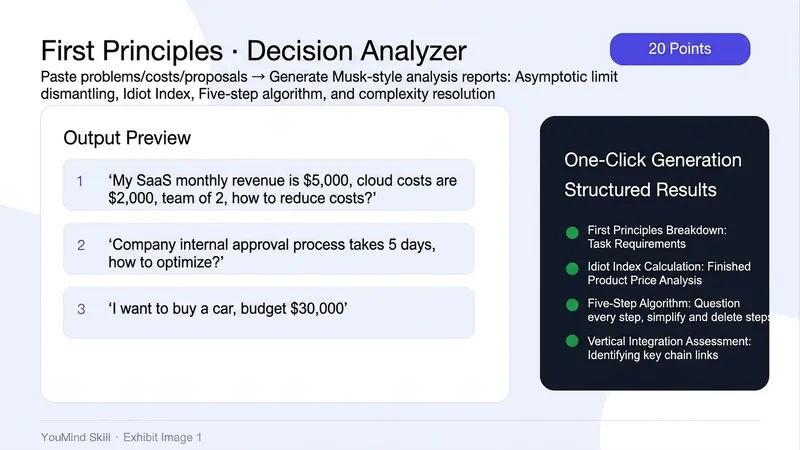
First Principles Analyzer
"This project is too expensive." "This process is too slow." "Should we do it in-house or outsource?" — Every time you're torn over such questions, your gut says something's off, but you can't pinpoint the issue or how much can be improved. Give it your problem and any data you have, and it uses Musk-style engineering thinking — not to sound like Musk, but to apply his decision framework — to break down the problem until it can't be broken further: Where is the asymptotic limit? What's the idiot index? Which steps should be removed or consolidated? One report later, you stop relying on gut feelings. ✨ Core Capabilities 1. First Principles Decomposition: Break any problem down to its fundamental elements, calculate the physical limit vs. the actual gap. 2. Idiot Index Calculation: Finished product cost / raw material cost = ? The higher the index, the more room for improvement. 3. Five-Step Algorithm: Follow the sequence of Question → Delete → Simplify → Accelerate → Automate, providing specific action recommendations. 4. Vertical Integration Assessment: Which steps have an idiot index >5? Which are worth doing in-house? 5. Physical Feasibility Check: Does the plan make sense physically? What is the hardest bottleneck? 📱 Use Cases - Startups / Small Teams: Optimize cost structure, evaluate technical solutions - Product Managers: Question requirements, cut features, accelerate iteration - Personal Decisions: Whether to learn a skill, switch tracks, calculate ROI - Any cost/efficiency issue where you feel something is off but can't articulate it It's not about chatting with Musk — it's about using his mental framework to make decisions.
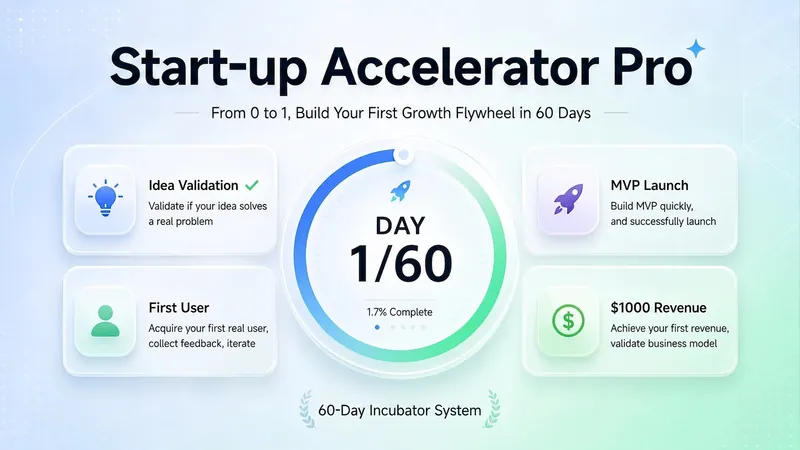
First Move Pro
90% of indie developers get stuck in one of two places: they have an idea but don't know if it can make money, or they built something but can't sell it. This isn't a one-time diagnosis—it's a reusable monetization system that you can use for every new product. ## What You'll Get ### 1️⃣ 4-Step Monetization Framework (Reusable) • Demand validation: Quickly validate if an idea is worth pursuing in 7 days (where to validate, what to ask, how to decide) • MVP launch: Build a minimum chargeable version in 30 days (which tools, how far to go) • Cold-start customer acquisition: Find your first 10-50 paying users (where to find them, how to reach them, how to price) • Growth flywheel: A concrete path from $0 to $1000 (which metrics to track, which levers to optimize) ### 2️⃣ Visual Dashboard Templates (Ready to Use) • Feishu Multidimensional Table / Notion dashboard templates • 4 phases × key actions × completion status • Visual progress, no more confusion ### 3️⃣ Key Metrics Tracking Table (Data-Driven) • Validation phase: How many people validated? How many willing to pay? • MVP phase: Launched? How many users? • Cold-start phase: Customer acquisition cost? Conversion rate? • Growth phase: MRR? Churn rate? ### 4️⃣ Milestones + Kill Switch (Rational Decision Making) • What are the "pass conditions" for each phase? • When should you persist? When should you quit? • Decide with data, not gut feeling ## Why Is This System Worth 1999 Credits? ✅ Reusable indefinitely: Not a one-time diagnosis—you can use this system for every new product ✅ Save time: Save 2-4 weeks of detours per product = 80-160 hours = $4000-8000 in value ✅ Reduce risk: Validate demand with data, avoid building for 3 months only to find no one wants it ✅ Visual clarity: Dashboard + tracking table, clear progress, no more anxiety ## Who Is This For? ✅ People with ideas but unsure if they can make money ✅ People with a product but haven't sold it yet ✅ People who want a side hustle but don't know where to start ✅ People who built a product but failed and want to find the problem ✅ Content creators who want to build products with AI tools (Cursor, Bolt.new) ## Who Is This Not For? ❌ People who only want encouragement (this system will honestly say 'this direction won't work') ❌ People unwilling to put in the time to execute (we give you the system, but you have to do the work) ❌ People expecting overnight riches (this is a systematic 60-90 day path, not quick money) ## Final Deliverables 1. Monetization Diagnostic Report (Long Document) • Your phase assessment + core issue diagnosis • Action checklist for the 4-step monetization framework • Key metrics + Kill Switch 2. Visual Dashboard Template (Feishu/Notion) • Task dashboard for 4 phases • Key metrics tracking table • Milestone checklist 3. One Key Decision Recommendation • Is this direction viable? • If not, which direction should you pivot to? Saving you 2-4 weeks of detours is 100 times more important than sweet talk.
Product Strategy One-Pager
Info efficiency, talent density, global
Description
Building a product is like driving in the fog—what do users want? Is the team right? Should we go global? Which metric to optimize first? Every decision gambles the team's time and investors' money. Feed it your product info and data, and it uses ByteDance-style product methodology to help you clarify: What information and needs is your product matching? Are your current resources solving 'problems that will matter in three years' or 'urgent matters this month'? Is your team's talent density sufficient? What A/B tests can validate your core assumptions? ✨ Core Capabilities 1. Information match efficiency diagnosis: What is your product essentially matching? Where are the friction points? 2. Delayed gratification assessment: Distinguish 'important in three years' vs 'urgent this month', provide resource reallocation recommendations 3. Talent density and team strategy: Core role talent assessment + Context/Control boundary recommendations 4. A/B test design: Turn your gut assumptions into verifiable experimental plans 5. Global feasibility assessment: Language, culture, compliance, and payment four-dimensional check 📱 Use Cases - Early-stage startup teams making directional decisions - Product managers' quarterly reviews and strategy adjustments - Investors quickly evaluating a project's product logic - Developers building side projects validating ideas It doesn't give you a standard answer—it gives you a framework to ask the right questions.
Related Skills
View allCan Your Business Idea Scale?
One-person company founders and side-hustle explorers: before you invest time and money, do a final calm check with customer data. Supports uploading business plans/BP (PDF/Word/PPT). Unlike the free version—which gives you a quick diagnosis and 3 interview questions to go talk to customers—the full version picks up after you've talked to customers: use customers' real answers (not your own feelings) to rescore the five switches, apply the one-vote veto system, automatically match validation experiments, GO gives a scaling roadmap, PIVOT gives a hypothesis adjustment path, and NO GO helps you extract reusable assets. If you haven't talked to customers yet, the full version can also give you interview questions directly—but it's recommended to first get the quick diagnosis and questions from the free version, talk to customers, and come back with their verbatim responses. The five switches: Is the need real? Can users represent the masses? Can it still run without you? What happens when you scale it 100x? Does selling more make more profit or more loss? If one switch breaks, the whole thing breaks—one-vote veto. Output includes: a customer-data-driven scoring report + 3 types of validation experiment plans (interview / landing page / Wizard of Oz, automatically matched) + GO → scaling roadmap + PIVOT → hypothesis adjustment path + NO GO → reusable asset extraction. Methodology: John List's The Voltage Effect + Rob Fitzpatrick's The Mom Test + Bland & Osterwalder's Testing Business Ideas.
First Principles Analyzer
"This project is too expensive." "This process is too slow." "Should we do it in-house or outsource?" — Every time you're torn over such questions, your gut says something's off, but you can't pinpoint the issue or how much can be improved. Give it your problem and any data you have, and it uses Musk-style engineering thinking — not to sound like Musk, but to apply his decision framework — to break down the problem until it can't be broken further: Where is the asymptotic limit? What's the idiot index? Which steps should be removed or consolidated? One report later, you stop relying on gut feelings. ✨ Core Capabilities 1. First Principles Decomposition: Break any problem down to its fundamental elements, calculate the physical limit vs. the actual gap. 2. Idiot Index Calculation: Finished product cost / raw material cost = ? The higher the index, the more room for improvement. 3. Five-Step Algorithm: Follow the sequence of Question → Delete → Simplify → Accelerate → Automate, providing specific action recommendations. 4. Vertical Integration Assessment: Which steps have an idiot index >5? Which are worth doing in-house? 5. Physical Feasibility Check: Does the plan make sense physically? What is the hardest bottleneck? 📱 Use Cases - Startups / Small Teams: Optimize cost structure, evaluate technical solutions - Product Managers: Question requirements, cut features, accelerate iteration - Personal Decisions: Whether to learn a skill, switch tracks, calculate ROI - Any cost/efficiency issue where you feel something is off but can't articulate it It's not about chatting with Musk — it's about using his mental framework to make decisions.
First Move Pro
90% of indie developers get stuck in one of two places: they have an idea but don't know if it can make money, or they built something but can't sell it. This isn't a one-time diagnosis—it's a reusable monetization system that you can use for every new product. ## What You'll Get ### 1️⃣ 4-Step Monetization Framework (Reusable) • Demand validation: Quickly validate if an idea is worth pursuing in 7 days (where to validate, what to ask, how to decide) • MVP launch: Build a minimum chargeable version in 30 days (which tools, how far to go) • Cold-start customer acquisition: Find your first 10-50 paying users (where to find them, how to reach them, how to price) • Growth flywheel: A concrete path from $0 to $1000 (which metrics to track, which levers to optimize) ### 2️⃣ Visual Dashboard Templates (Ready to Use) • Feishu Multidimensional Table / Notion dashboard templates • 4 phases × key actions × completion status • Visual progress, no more confusion ### 3️⃣ Key Metrics Tracking Table (Data-Driven) • Validation phase: How many people validated? How many willing to pay? • MVP phase: Launched? How many users? • Cold-start phase: Customer acquisition cost? Conversion rate? • Growth phase: MRR? Churn rate? ### 4️⃣ Milestones + Kill Switch (Rational Decision Making) • What are the "pass conditions" for each phase? • When should you persist? When should you quit? • Decide with data, not gut feeling ## Why Is This System Worth 1999 Credits? ✅ Reusable indefinitely: Not a one-time diagnosis—you can use this system for every new product ✅ Save time: Save 2-4 weeks of detours per product = 80-160 hours = $4000-8000 in value ✅ Reduce risk: Validate demand with data, avoid building for 3 months only to find no one wants it ✅ Visual clarity: Dashboard + tracking table, clear progress, no more anxiety ## Who Is This For? ✅ People with ideas but unsure if they can make money ✅ People with a product but haven't sold it yet ✅ People who want a side hustle but don't know where to start ✅ People who built a product but failed and want to find the problem ✅ Content creators who want to build products with AI tools (Cursor, Bolt.new) ## Who Is This Not For? ❌ People who only want encouragement (this system will honestly say 'this direction won't work') ❌ People unwilling to put in the time to execute (we give you the system, but you have to do the work) ❌ People expecting overnight riches (this is a systematic 60-90 day path, not quick money) ## Final Deliverables 1. Monetization Diagnostic Report (Long Document) • Your phase assessment + core issue diagnosis • Action checklist for the 4-step monetization framework • Key metrics + Kill Switch 2. Visual Dashboard Template (Feishu/Notion) • Task dashboard for 4 phases • Key metrics tracking table • Milestone checklist 3. One Key Decision Recommendation • Is this direction viable? • If not, which direction should you pivot to? Saving you 2-4 weeks of detours is 100 times more important than sweet talk.
Find your next favorite skill
Explore more curated AI skills for research, creation, and everyday work.