
Objective Industry Research
Any input → structured research, no judgment
Description
An essential tool for investors. In-depth research to support decisions, but no judgments — very important, and those in the know understand. Author: Former engineer/entrepreneur, now a primary market investor, reviewed over 10,000 pitch decks, and has had in-depth discussions with more than 1,000 companies. Usage: Trigger via direct conversation. Example: "Research the triacetate cellulose (TAC film) industry." → The skill will automatically identify and activate. What it does: 1. Automatically identify input type and define research scope. 2. Phase 1: 3-5 search rounds, output a 1,500-word quick panoramic scan (data tables + industry chain + key players + drivers/bottlenecks + information gaps). 3. Phase 2: After you reply "Continue," output a full report covering 7 sections and 21 dimensions (5,000-15,000 words). 4. All output is pure facts, without judgments like "Is it worth investing?" --- # industry-research — In-Depth Industry Research ## Core Principles ## Division of Work ## Step 1: Identify and Define Scope ## Step 2: Phase 1 — Quick Panoramic Scan ### Phase 1 Output Structure ## Step 3: Phase 2 — Complete In-Depth Report ### Phase 1 Output Structure #### Part 1: Macro Overview #### Part 2: Market and Scale #### Part 3: Industry Chain Panorama #### Part 4: Global Perspective #### Part 5: Policy and Regulation #### Part 6: Capital and Market #### Part 7: In-Depth Understanding ## Data Quality Marking ## Phase 2 Parallel Search Strategy (Optional) ## Pre-Output Check
Related Skills
View all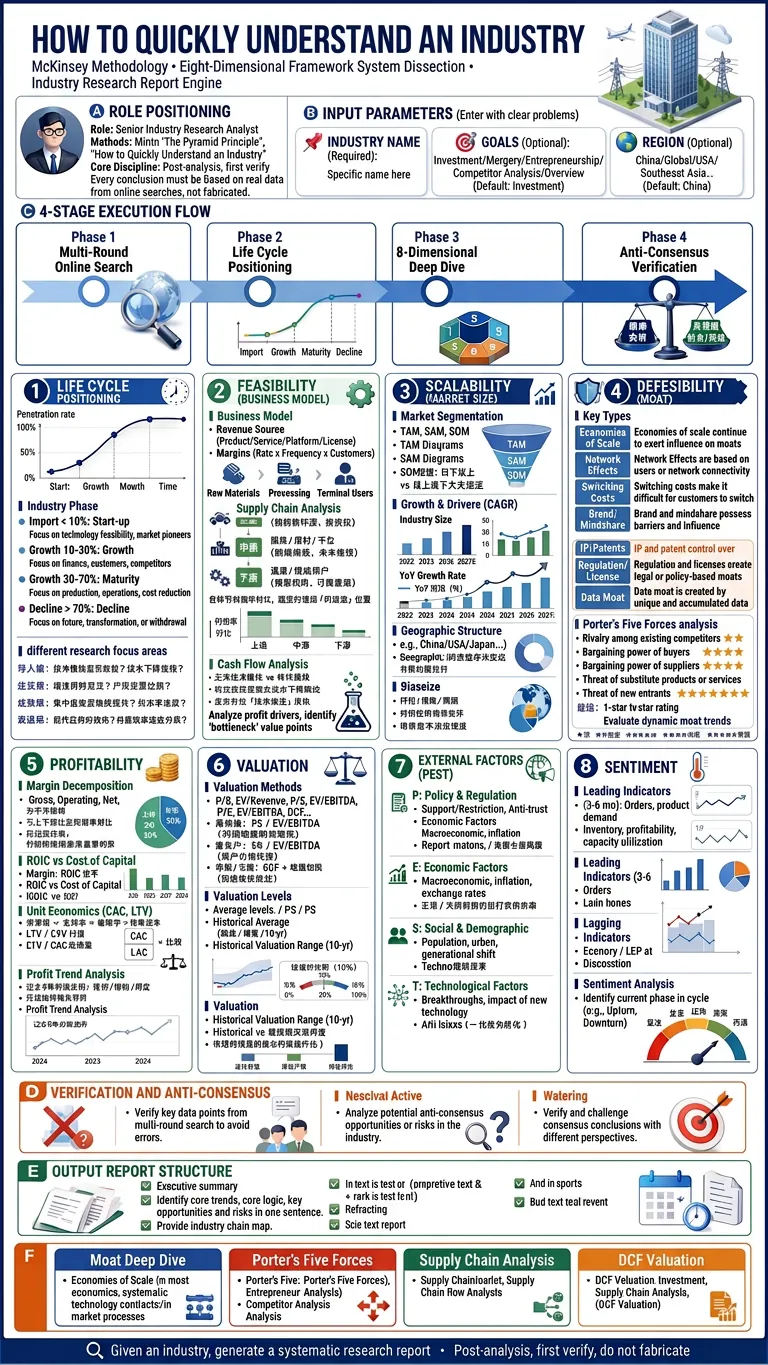 Research
Rapid Industry Understanding
📋 Usage Guide This Skill is an industry research engine based on McKinsey methodology, using the eight-dimension framework from Xiao Jing's "How to Quickly Understand an Industry". Tell it an industry name, and it produces a systematic research report. —————————————————————————————— 🚀 Basic Usage Just tell me the industry you want to research—the more specific, the better: a. "Analyze the solid-state battery industry" b. "Look at the humanoid robot supply chain from an entrepreneurial perspective" c. "Is the solar industry still investable now?" You can optionally provide three details (if missing, I'll use defaults): 1. Industry name: be specific, e.g., "perovskite solar" instead of "new energy"—required; 2. Goal: investment / career / entrepreneurship / competitive analysis / education, default: investment; 3. Region: China market / global / US / Southeast Asia..., default: China market; —————————————————————————————— ⚙️ What it does automatically? The entire process has 4 stages: 1. Multi-round web searches for market size/growth/penetration rate, supply chain, competitive landscape, moat evidence, policy, valuation—every conclusion has a source and timestamp, never fabricated; 2. Lifecycle positioning: use penetration rate to determine if the industry is in introduction/growth/maturity/decline—different stages have completely different research focuses; 3. Eight-dimension deep dive: business model → market size → moat (forced deep dive into dynamic trends) → competitive landscape (forced scoring on each of Porter's Five Forces) → valuation → PEST → business cycle; 4. Contrarian check: distinguish market priced-in consensus from overlooked real issues, and provide decision recommendations; —————————————————————————————— 📊 What it outputs? A professional research report in Markdown format, structured as: 1. ⚡ 30-second verdict — stage / core profit logic / biggest opportunity / biggest risk / one-sentence conclusion; 2. Research object and boundary definition; 3. Lifecycle positioning (with penetration rate data); 4. Eight-dimension analysis (moat includes dynamic trend table, Porter's Five Forces scoring table); 5. Contrarian check; 6. Conclusion and decision recommendations; 7. Key risk list; 8. Data sources and time notes; —————————————————————————————— 🔑 Two Core Highlights 1. Forced deep dive on moat: not just the type of barrier, but must answer "has it widened or narrowed in the past 2-3 years?" using market share/gross margin/pricing power data; 2. Porter's Five Forces scored individually: all five forces scored to avoid shortcuts, determining who has the strongest bargaining power now and whether the landscape is favorable or deteriorating for leaders; —————————————————————————————— ⏱️ Time Approximately 2-4 minutes, due to multiple rounds of search + dimension-by-dimension analysis + report writing —————————————————————————————— 🧩 Subsequent Extensions After the report is generated, you can continue with two specialized analyses (requires manual confirmation, won't run automatically): 1. "Unchain to find bottlenecks": identify physical bottlenecks in the supply chain that can't be bypassed when trends scale, locking in true beneficiary targets; 2. "DCF valuation": run a full discounted cash flow model for a specific company within the industry; —————————————————————————————— ▶️ Want to try? Just tell me an industry name, e.g., "Take a look at the AI agent industry from an entrepreneurial perspective" or "What's the situation with the hydrogen energy supply chain?"
 Research
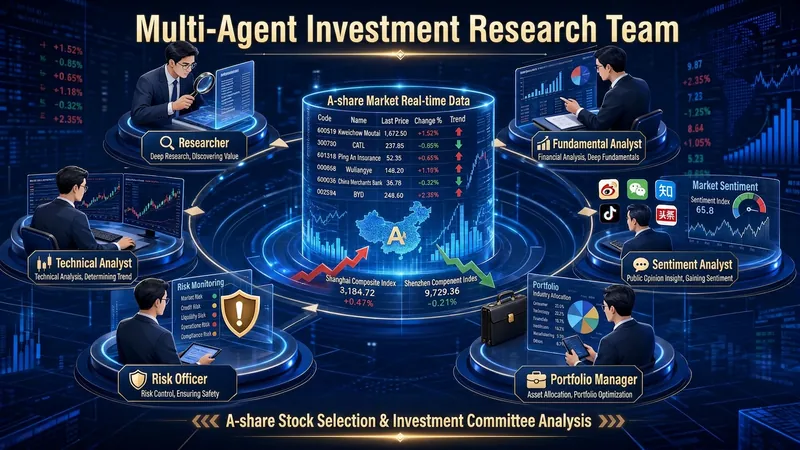
Multi-Agent: A-Share Pick & IC
It's not an AI assistant, but a virtual investment research team. Common AI stock-picking tools suffer from three problems: fabricating financial figures and target prices, giving vague "bullish/bearish" remarks, and offering "buy" recommendations without clear reasoning. The Multi-Agent Investment Research Team tackles these with a three-pronged approach: 6 parallel roles, cross-validation, and mandatory source attribution. It convenes researchers, fundamental analysts, technical analysts, sentiment analysts, risk officers, and investment managers to work in parallel, deliberating like a real investment committee. What you get is not fuzzy opinions, but a professional research document with facts, signals, disagreements, risks, and every number traceable to its source. Two modes covering "researching a single stock" and "screening a batch of stocks" Mode A: Single-Stock Committee Deep Analysis — Just provide a stock (e.g., "Analyze BYD 002594"), and the skill automatically convenes a full investment committee: the researcher aggregates market data, financial reports, research reports, and industry chain positioning, presenting only objective facts; the fundamental analyst issues a financial health scorecard, key changes in the three financial statements, and PEG valuation; the technical analyst evaluates trends, moving averages, MACD, support and resistance levels, and provides a five-point buy signal hit table; the sentiment analyst scans institutional divergence, retail investor sentiment, and potential misinterpretations; the risk officer digs up counter-evidence, systematically refuting optimistic conclusions from other roles; finally, the investment manager, without adding new data, integrates everything to produce committee minutes and a one-page summary. Mode B: Multi-Condition Stock Screening — From a specified universe (e.g., CSI 300, a sector/theme basket, or your own stock pool), apply a three-layer funnel: L1 financial hard screen (three consecutive quarters of growth, ample cash flow, PEG<1 or huge increase in contract liabilities), L2 technical timing (base breakout, moving average golden cross, volume breakout, strong pullback on low volume, MACD crossing above zero line), L3 information validation (research report ratings and industry chain logic, eliminating "pure technical without fundamental basis" picks). After obtaining a candidate list, the top N stocks can automatically proceed to Mode A for deep analysis. What you will get Mode A delivers a fixed "five-piece set": ① Full analysis report integrating all six roles; ② Data source and evidence table, with each key conclusion mapped to "data → source → date"; ③ Meeting-style committee minutes (agenda → each role's view → disagreements → consensus → variables to track); ④ Risk list sorted by high/medium/low severity; ⑤ One-page investment manager summary condensing core logic, key variables, verification points, and confidence level. Mode B delivers: Candidate stock list table (ticker | name | triggered conditions | key data | source | trigger date) plus screening criteria and methodology description, optionally with the full five-piece set for top candidates. All outputs are saved as files with ticker and date in the filename for easy reuse and archiving.

MOE Counselor Review v2.4.0
This Skill does not write your application for you; instead, it pre-screens the questions the review panel would ask: whether your identity is compliant, whether the project limit is violated, whether the research question withstands a one-sentence challenge, whether the research approach collapses by the second paragraph — each item turned into an actionable revision checklist. It incorporates the original text of the 2026 edition of 90 key research directions and 7 clusters of implicit weight tables, and is grounded in the risk map of previous years' special project reviews. Annual hard constraints such as document number, funding amount, research period, submission limit, etc., are verified by default against the current year's official notice — no hardcoding. ## What it does - Formal compliance hard check: identity as full-time counselor, submission limit, funding amount, research period, and other knockout gates (annual parameters based on the current year's official notice) - Sequential referencing diagnosis: for the 「(Reliant Direction N)」 at the end of the title, perform item-level compliance check — sequence validity + three-tier direction-title alignment (strong / moderate / weak) + cluster-level risk warning - Research question stress test: use 「So what?」 and 「What exactly is the difference from existing research?」 as two knives to pre-screen for the review panel - Research approach reverse deconstruction: mark paragraph by paragraph 「how this will be questioned」 rather than 「this is well written」 - Innovation authenticity diagnosis: which of 「first / systematic / breakthrough / fill a gap」 would be debunked by a literature search - Actionable revision checklist: prioritised next steps ## What it does not do - It does not choose your topic for you - It does not generate the application body - It does not 'polish' language - It does not tell you 'this topic is valuable' — no one on the review panel will compliment you like that ## How it differs from similar tools Other project review Skills on the platform assume you are applying for the National Social Science Fund or MOE general projects — the funding amounts, project limits, and identity requirements are all wrong. If you use them, your application will be revised against the wrong standards. This Skill is currently the only reverse review engine on the marketplace specifically for the 'MOE College Counselor Research Special Project', and it incorporates the original 2026 edition of 90 guidelines + 7 clusters of implicit weight tables; the 2025 edition is retained as a historical version, and cross-year applications can use 'sequential referencing diagnosis' for alignment. ## Who it is for - Full-time college counselors preparing to apply for the 2026/2027 MOE Counselor Research Special Project - Heads of student affairs departments (compliance gate before school-level preliminary review) - Applicants who have finished a draft and want the most critical eye to review it again ## Who it is not for - Those who want to generate an application with one click - Those applying for the National Social Science Fund or MOE general humanities and social science projects (please use the corresponding general Skill) - Those who haven't started writing yet — reverse review requires an object to review Version: v2.4.0 | Incorporated 2026 edition of 90 guidelines original text + 7 clusters classification + sequential referencing diagnosis | Annual hard constraint parameters subject to official notice ([Document Number Pending]) | Review engine has undergone multiple rounds of stress testing and retrospective upgrades
Objective Industry Research
Any input → structured research, no judgment
Description
An essential tool for investors. In-depth research to support decisions, but no judgments — very important, and those in the know understand. Author: Former engineer/entrepreneur, now a primary market investor, reviewed over 10,000 pitch decks, and has had in-depth discussions with more than 1,000 companies. Usage: Trigger via direct conversation. Example: "Research the triacetate cellulose (TAC film) industry." → The skill will automatically identify and activate. What it does: 1. Automatically identify input type and define research scope. 2. Phase 1: 3-5 search rounds, output a 1,500-word quick panoramic scan (data tables + industry chain + key players + drivers/bottlenecks + information gaps). 3. Phase 2: After you reply "Continue," output a full report covering 7 sections and 21 dimensions (5,000-15,000 words). 4. All output is pure facts, without judgments like "Is it worth investing?" --- # industry-research — In-Depth Industry Research ## Core Principles ## Division of Work ## Step 1: Identify and Define Scope ## Step 2: Phase 1 — Quick Panoramic Scan ### Phase 1 Output Structure ## Step 3: Phase 2 — Complete In-Depth Report ### Phase 1 Output Structure #### Part 1: Macro Overview #### Part 2: Market and Scale #### Part 3: Industry Chain Panorama #### Part 4: Global Perspective #### Part 5: Policy and Regulation #### Part 6: Capital and Market #### Part 7: In-Depth Understanding ## Data Quality Marking ## Phase 2 Parallel Search Strategy (Optional) ## Pre-Output Check
Related Skills
View allResearchRapid Industry Understanding
📋 Usage Guide This Skill is an industry research engine based on McKinsey methodology, using the eight-dimension framework from Xiao Jing's "How to Quickly Understand an Industry". Tell it an industry name, and it produces a systematic research report. —————————————————————————————— 🚀 Basic Usage Just tell me the industry you want to research—the more specific, the better: a. "Analyze the solid-state battery industry" b. "Look at the humanoid robot supply chain from an entrepreneurial perspective" c. "Is the solar industry still investable now?" You can optionally provide three details (if missing, I'll use defaults): 1. Industry name: be specific, e.g., "perovskite solar" instead of "new energy"—required; 2. Goal: investment / career / entrepreneurship / competitive analysis / education, default: investment; 3. Region: China market / global / US / Southeast Asia..., default: China market; —————————————————————————————— ⚙️ What it does automatically? The entire process has 4 stages: 1. Multi-round web searches for market size/growth/penetration rate, supply chain, competitive landscape, moat evidence, policy, valuation—every conclusion has a source and timestamp, never fabricated; 2. Lifecycle positioning: use penetration rate to determine if the industry is in introduction/growth/maturity/decline—different stages have completely different research focuses; 3. Eight-dimension deep dive: business model → market size → moat (forced deep dive into dynamic trends) → competitive landscape (forced scoring on each of Porter's Five Forces) → valuation → PEST → business cycle; 4. Contrarian check: distinguish market priced-in consensus from overlooked real issues, and provide decision recommendations; —————————————————————————————— 📊 What it outputs? A professional research report in Markdown format, structured as: 1. ⚡ 30-second verdict — stage / core profit logic / biggest opportunity / biggest risk / one-sentence conclusion; 2. Research object and boundary definition; 3. Lifecycle positioning (with penetration rate data); 4. Eight-dimension analysis (moat includes dynamic trend table, Porter's Five Forces scoring table); 5. Contrarian check; 6. Conclusion and decision recommendations; 7. Key risk list; 8. Data sources and time notes; —————————————————————————————— 🔑 Two Core Highlights 1. Forced deep dive on moat: not just the type of barrier, but must answer "has it widened or narrowed in the past 2-3 years?" using market share/gross margin/pricing power data; 2. Porter's Five Forces scored individually: all five forces scored to avoid shortcuts, determining who has the strongest bargaining power now and whether the landscape is favorable or deteriorating for leaders; —————————————————————————————— ⏱️ Time Approximately 2-4 minutes, due to multiple rounds of search + dimension-by-dimension analysis + report writing —————————————————————————————— 🧩 Subsequent Extensions After the report is generated, you can continue with two specialized analyses (requires manual confirmation, won't run automatically): 1. "Unchain to find bottlenecks": identify physical bottlenecks in the supply chain that can't be bypassed when trends scale, locking in true beneficiary targets; 2. "DCF valuation": run a full discounted cash flow model for a specific company within the industry; —————————————————————————————— ▶️ Want to try? Just tell me an industry name, e.g., "Take a look at the AI agent industry from an entrepreneurial perspective" or "What's the situation with the hydrogen energy supply chain?"
ResearchMulti-Agent: A-Share Pick & IC
It's not an AI assistant, but a virtual investment research team. Common AI stock-picking tools suffer from three problems: fabricating financial figures and target prices, giving vague "bullish/bearish" remarks, and offering "buy" recommendations without clear reasoning. The Multi-Agent Investment Research Team tackles these with a three-pronged approach: 6 parallel roles, cross-validation, and mandatory source attribution. It convenes researchers, fundamental analysts, technical analysts, sentiment analysts, risk officers, and investment managers to work in parallel, deliberating like a real investment committee. What you get is not fuzzy opinions, but a professional research document with facts, signals, disagreements, risks, and every number traceable to its source. Two modes covering "researching a single stock" and "screening a batch of stocks" Mode A: Single-Stock Committee Deep Analysis — Just provide a stock (e.g., "Analyze BYD 002594"), and the skill automatically convenes a full investment committee: the researcher aggregates market data, financial reports, research reports, and industry chain positioning, presenting only objective facts; the fundamental analyst issues a financial health scorecard, key changes in the three financial statements, and PEG valuation; the technical analyst evaluates trends, moving averages, MACD, support and resistance levels, and provides a five-point buy signal hit table; the sentiment analyst scans institutional divergence, retail investor sentiment, and potential misinterpretations; the risk officer digs up counter-evidence, systematically refuting optimistic conclusions from other roles; finally, the investment manager, without adding new data, integrates everything to produce committee minutes and a one-page summary. Mode B: Multi-Condition Stock Screening — From a specified universe (e.g., CSI 300, a sector/theme basket, or your own stock pool), apply a three-layer funnel: L1 financial hard screen (three consecutive quarters of growth, ample cash flow, PEG<1 or huge increase in contract liabilities), L2 technical timing (base breakout, moving average golden cross, volume breakout, strong pullback on low volume, MACD crossing above zero line), L3 information validation (research report ratings and industry chain logic, eliminating "pure technical without fundamental basis" picks). After obtaining a candidate list, the top N stocks can automatically proceed to Mode A for deep analysis. What you will get Mode A delivers a fixed "five-piece set": ① Full analysis report integrating all six roles; ② Data source and evidence table, with each key conclusion mapped to "data → source → date"; ③ Meeting-style committee minutes (agenda → each role's view → disagreements → consensus → variables to track); ④ Risk list sorted by high/medium/low severity; ⑤ One-page investment manager summary condensing core logic, key variables, verification points, and confidence level. Mode B delivers: Candidate stock list table (ticker | name | triggered conditions | key data | source | trigger date) plus screening criteria and methodology description, optionally with the full five-piece set for top candidates. All outputs are saved as files with ticker and date in the filename for easy reuse and archiving.
MOE Counselor Review v2.4.0
This Skill does not write your application for you; instead, it pre-screens the questions the review panel would ask: whether your identity is compliant, whether the project limit is violated, whether the research question withstands a one-sentence challenge, whether the research approach collapses by the second paragraph — each item turned into an actionable revision checklist. It incorporates the original text of the 2026 edition of 90 key research directions and 7 clusters of implicit weight tables, and is grounded in the risk map of previous years' special project reviews. Annual hard constraints such as document number, funding amount, research period, submission limit, etc., are verified by default against the current year's official notice — no hardcoding. ## What it does - Formal compliance hard check: identity as full-time counselor, submission limit, funding amount, research period, and other knockout gates (annual parameters based on the current year's official notice) - Sequential referencing diagnosis: for the 「(Reliant Direction N)」 at the end of the title, perform item-level compliance check — sequence validity + three-tier direction-title alignment (strong / moderate / weak) + cluster-level risk warning - Research question stress test: use 「So what?」 and 「What exactly is the difference from existing research?」 as two knives to pre-screen for the review panel - Research approach reverse deconstruction: mark paragraph by paragraph 「how this will be questioned」 rather than 「this is well written」 - Innovation authenticity diagnosis: which of 「first / systematic / breakthrough / fill a gap」 would be debunked by a literature search - Actionable revision checklist: prioritised next steps ## What it does not do - It does not choose your topic for you - It does not generate the application body - It does not 'polish' language - It does not tell you 'this topic is valuable' — no one on the review panel will compliment you like that ## How it differs from similar tools Other project review Skills on the platform assume you are applying for the National Social Science Fund or MOE general projects — the funding amounts, project limits, and identity requirements are all wrong. If you use them, your application will be revised against the wrong standards. This Skill is currently the only reverse review engine on the marketplace specifically for the 'MOE College Counselor Research Special Project', and it incorporates the original 2026 edition of 90 guidelines + 7 clusters of implicit weight tables; the 2025 edition is retained as a historical version, and cross-year applications can use 'sequential referencing diagnosis' for alignment. ## Who it is for - Full-time college counselors preparing to apply for the 2026/2027 MOE Counselor Research Special Project - Heads of student affairs departments (compliance gate before school-level preliminary review) - Applicants who have finished a draft and want the most critical eye to review it again ## Who it is not for - Those who want to generate an application with one click - Those applying for the National Social Science Fund or MOE general humanities and social science projects (please use the corresponding general Skill) - Those who haven't started writing yet — reverse review requires an object to review Version: v2.4.0 | Incorporated 2026 edition of 90 guidelines original text + 7 clusters classification + sequential referencing diagnosis | Annual hard constraint parameters subject to official notice ([Document Number Pending]) | Review engine has undergone multiple rounds of stress testing and retrospective upgrades
Find your next favorite skill
Explore more curated AI skills for research, creation, and everyday work.