Bilibili SRT & Transcription
Fix official Bilibili transcription issue
Description
Under normal conditions where subtitles are successfully fetched and SRT files generated, the AUTO mode consumes a minimum of 77 credits. ---————————————————————————————————————————————————---- Currently, YouMind's transcription of Bilibili videos is not very good and tends to get stuck (see Figure 3). Until an official optimization is available, this Skill can obtain official AI subtitles from Bilibili videos (link/BV number/YouMind video file) via a logged-in browser, generate readable transcript documents, and optionally export standard SRT subtitle files (local .srt + YouMind document). It includes built-in CID calibration and subtitle consistency verification to avoid mismatched/expired subtitles. The operation process has been simplified as much as possible. Following the Skill prompts, when needed (as shown in the demo), manually click on AI subtitle recognition in the already opened Bilibili video page, select Chinese, and the subtitles can be fetched. This is currently the most reliable method; original subtitles attached to the video are generally not recognized. The file will be automatically downloaded to (~.download; macOS system; Windows unknown). In the thread view, click to upload. ---————————————————————————————————————————————————--- Currently, the following issues may occur (and are solvable): 1. When adding a Bilibili link to a YouMind file, fetching may fail. In this case, click the [...] button in the top right corner and select "Re-fetch". After that, the normal view will likely appear, but without the video mini window. Then add a new link again to successfully fetch. Or Close all pages and reopen / click on the Bilibili share link (instead of the web page link) to try. 2. During Skill execution, subtitle fetching errors may occasionally occur, possibly due to paid/free videos. Let the AI auto-fix the task; following the steps should prevent this issue. ---————————————————————————————————————————————————--- Official response records: 1. This Bilibili video itself has no subtitle file. When saving the Bilibili link, the system automatically tries to fetch the subtitle file but fails, so it shows empty. 2. The subtitle fetching task is initiated by the AI, which tries to pull the video stream for transcription, but Bilibili does not support this method. Hence the constant loading loop; it has actually failed. ------ Solution 1. Check if there are corresponding videos on YouTube or TikTok. These sites support pulling video streams for transcription, and using the second method mentioned above should succeed. ------ Future optimizations: 1. We will enhance the AI's grabFileTranscript behavior to avoid fetching Bilibili subtitles, so this situation will not occur. ———————————————————————————————————————————————————————————————— Looking forward to official adaptation in the future. Until then, this skill can serve as a transitional solution. Charging a small number of credits to cover costs. Thank you all. If you have questions, @火腿人肖恩 in the group.
Related Skills
View all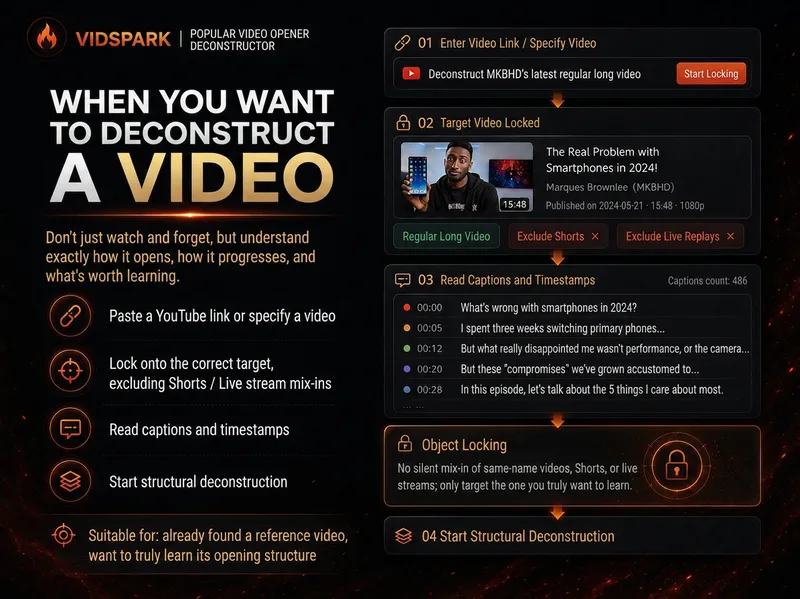 Research
Spark | Video Hook Analyzer
When preparing to make a video, we often run into the same problem: you can clearly see that a reference video “knows how to tell a story,” but when it’s your turn to create, you can only imitate it by feel. 「Spark | Video Hook Analyzer」is designed for this step. Give it a specific YouTube video. It first verifies the video and reads captions that can be checked, then separates three things that are easy to conflate: Literal 30s: What actually happens from 0:00–0:30. Intro: The entire opening before the main content begins. Hook / Re-hook: One or more structural beats that genuinely work to keep viewers watching. So it won’t force the first 30 seconds of every video to be interpreted as the Hook just because “everyone says the first 30 seconds matter most.” If the real Hook comes after the one-minute mark, it will tell you plainly. If the captions or timestamps are insufficient, it will clearly identify the evidence gap instead of filling it with an answer that merely looks professional. After breaking down the opening, it continues by using an outline to reconstruct the structure of the full video: Does it move forward through a timeline, experiment, process, comparison, story, chain of questions, or another organizing device? Finally, it abstracts these structures into [slots] templates. The templates preserve the sequence and function of the structure—not the original creator’s experiences, wording, brand, numbers, opinions, or authority. What you ultimately get is not a video summary, but a Hook Outline + full-video structure template that can be handed off to the next stage of creation. What it does not do It does not: Write the final new Hook for you; Score or rewrite your opening with BRENS; Search the entire niche or channel at scale; Generate a complete script; Generate diagrams, assets, animations, or thumbnails. Finding reference samples at scale belongs to the upstream 「Spark | YouTube Content Researcher」; refining your own Hook belongs to the corresponding follow-up Skill.
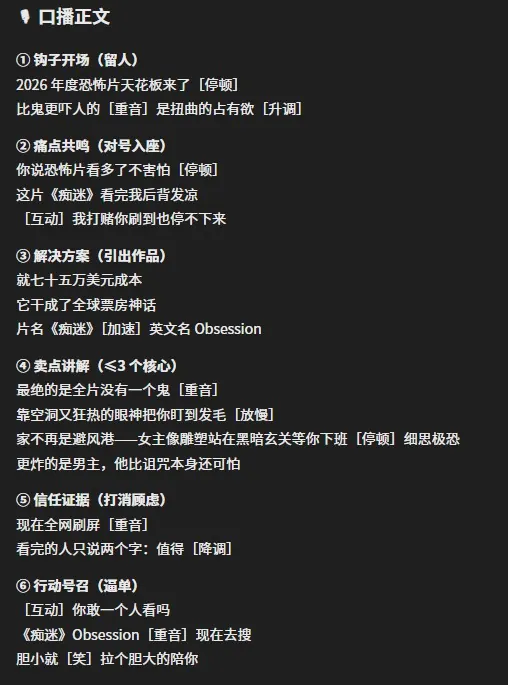
Sales Video Script Generator
This short video sales script assistant transforms stiff written copy into highly compelling video scripts, specifically solving the problems of excessive 'reading aloud' feel and chaotic pacing in sales videos. It not only extracts core selling points from various documents using intelligent parsing technology, but also reworks dull text into an engaging golden six-part structure based on short video platform dissemination logic, ensuring the video grabs attention from the start and drives conversions at the end. Whether you are a sales influencer or content creator, you can easily get logically clear, rhythmically professional scripts. To enhance the performance of the final video, this skill automatically annotates detailed voice guidance suggestions in the generated scripts. Through intuitive markers for pauses, stresses, and intonation fluctuations, you can precisely control the rhythm and emotional intensity when reading aloud, making every line natural, fluent, and persuasive. It supports direct import of multiple file formats and has been deeply optimized for different product categories, helping you ditch formulaic approaches and present the most natural, professional sales state in front of the camera.

Cartoon Self-Intro Video Maker
Upload your photo and self-introduction script to automatically create a cartoon digital twin and generate a cartoon self-introduction video using a fixed three-part script template: medium shot, close-up, and wide shot, with a flexible order, hard cuts, and fixed camera positions. Visual styles come in two tracks: standard (Pixar 3D / Shanghai Animation Film Studio) and distinctive (Keith Haring, Romero Britto, silhouettes, claymation, ukiyo-e, Tim Burton, and other niche art styles). The Skill automatically recommends a tone—serious, humorous, or warm—and can add narration in your own voice, either from an uploaded recording or a voice cloned in YouMind. Ideal for job applications, social media profiles, annual meetings, podcasts, and other self-introduction scenarios. YouMind handles the entire workflow, although video generation can be a little slow. Don’t underestimate how simple this Skill looks: in general, these workflows can’t be completed end to end in YouMind without it. Technical challenges—such as real-person photos not being accepted by the model as references, voice files not being usable as model references, and video-generation tasks timing out—have all been addressed in this Skill, saving you a substantial number of credits.
Bilibili SRT & Transcription
Fix official Bilibili transcription issue
Description
Under normal conditions where subtitles are successfully fetched and SRT files generated, the AUTO mode consumes a minimum of 77 credits. ---————————————————————————————————————————————————---- Currently, YouMind's transcription of Bilibili videos is not very good and tends to get stuck (see Figure 3). Until an official optimization is available, this Skill can obtain official AI subtitles from Bilibili videos (link/BV number/YouMind video file) via a logged-in browser, generate readable transcript documents, and optionally export standard SRT subtitle files (local .srt + YouMind document). It includes built-in CID calibration and subtitle consistency verification to avoid mismatched/expired subtitles. The operation process has been simplified as much as possible. Following the Skill prompts, when needed (as shown in the demo), manually click on AI subtitle recognition in the already opened Bilibili video page, select Chinese, and the subtitles can be fetched. This is currently the most reliable method; original subtitles attached to the video are generally not recognized. The file will be automatically downloaded to (~.download; macOS system; Windows unknown). In the thread view, click to upload. ---————————————————————————————————————————————————--- Currently, the following issues may occur (and are solvable): 1. When adding a Bilibili link to a YouMind file, fetching may fail. In this case, click the [...] button in the top right corner and select "Re-fetch". After that, the normal view will likely appear, but without the video mini window. Then add a new link again to successfully fetch. Or Close all pages and reopen / click on the Bilibili share link (instead of the web page link) to try. 2. During Skill execution, subtitle fetching errors may occasionally occur, possibly due to paid/free videos. Let the AI auto-fix the task; following the steps should prevent this issue. ---————————————————————————————————————————————————--- Official response records: 1. This Bilibili video itself has no subtitle file. When saving the Bilibili link, the system automatically tries to fetch the subtitle file but fails, so it shows empty. 2. The subtitle fetching task is initiated by the AI, which tries to pull the video stream for transcription, but Bilibili does not support this method. Hence the constant loading loop; it has actually failed. ------ Solution 1. Check if there are corresponding videos on YouTube or TikTok. These sites support pulling video streams for transcription, and using the second method mentioned above should succeed. ------ Future optimizations: 1. We will enhance the AI's grabFileTranscript behavior to avoid fetching Bilibili subtitles, so this situation will not occur. ———————————————————————————————————————————————————————————————— Looking forward to official adaptation in the future. Until then, this skill can serve as a transitional solution. Charging a small number of credits to cover costs. Thank you all. If you have questions, @火腿人肖恩 in the group.
Related Skills
View allResearchSpark | Video Hook Analyzer
When preparing to make a video, we often run into the same problem: you can clearly see that a reference video “knows how to tell a story,” but when it’s your turn to create, you can only imitate it by feel. 「Spark | Video Hook Analyzer」is designed for this step. Give it a specific YouTube video. It first verifies the video and reads captions that can be checked, then separates three things that are easy to conflate: Literal 30s: What actually happens from 0:00–0:30. Intro: The entire opening before the main content begins. Hook / Re-hook: One or more structural beats that genuinely work to keep viewers watching. So it won’t force the first 30 seconds of every video to be interpreted as the Hook just because “everyone says the first 30 seconds matter most.” If the real Hook comes after the one-minute mark, it will tell you plainly. If the captions or timestamps are insufficient, it will clearly identify the evidence gap instead of filling it with an answer that merely looks professional. After breaking down the opening, it continues by using an outline to reconstruct the structure of the full video: Does it move forward through a timeline, experiment, process, comparison, story, chain of questions, or another organizing device? Finally, it abstracts these structures into [slots] templates. The templates preserve the sequence and function of the structure—not the original creator’s experiences, wording, brand, numbers, opinions, or authority. What you ultimately get is not a video summary, but a Hook Outline + full-video structure template that can be handed off to the next stage of creation. What it does not do It does not: Write the final new Hook for you; Score or rewrite your opening with BRENS; Search the entire niche or channel at scale; Generate a complete script; Generate diagrams, assets, animations, or thumbnails. Finding reference samples at scale belongs to the upstream 「Spark | YouTube Content Researcher」; refining your own Hook belongs to the corresponding follow-up Skill.
Sales Video Script Generator
This short video sales script assistant transforms stiff written copy into highly compelling video scripts, specifically solving the problems of excessive 'reading aloud' feel and chaotic pacing in sales videos. It not only extracts core selling points from various documents using intelligent parsing technology, but also reworks dull text into an engaging golden six-part structure based on short video platform dissemination logic, ensuring the video grabs attention from the start and drives conversions at the end. Whether you are a sales influencer or content creator, you can easily get logically clear, rhythmically professional scripts. To enhance the performance of the final video, this skill automatically annotates detailed voice guidance suggestions in the generated scripts. Through intuitive markers for pauses, stresses, and intonation fluctuations, you can precisely control the rhythm and emotional intensity when reading aloud, making every line natural, fluent, and persuasive. It supports direct import of multiple file formats and has been deeply optimized for different product categories, helping you ditch formulaic approaches and present the most natural, professional sales state in front of the camera.
Cartoon Self-Intro Video Maker
Upload your photo and self-introduction script to automatically create a cartoon digital twin and generate a cartoon self-introduction video using a fixed three-part script template: medium shot, close-up, and wide shot, with a flexible order, hard cuts, and fixed camera positions. Visual styles come in two tracks: standard (Pixar 3D / Shanghai Animation Film Studio) and distinctive (Keith Haring, Romero Britto, silhouettes, claymation, ukiyo-e, Tim Burton, and other niche art styles). The Skill automatically recommends a tone—serious, humorous, or warm—and can add narration in your own voice, either from an uploaded recording or a voice cloned in YouMind. Ideal for job applications, social media profiles, annual meetings, podcasts, and other self-introduction scenarios. YouMind handles the entire workflow, although video generation can be a little slow. Don’t underestimate how simple this Skill looks: in general, these workflows can’t be completed end to end in YouMind without it. Technical challenges—such as real-person photos not being accepted by the model as references, voice files not being usable as model references, and video-generation tasks timing out—have all been addressed in this Skill, saving you a substantial number of credits.
Find your next favorite skill
Explore more curated AI skills for research, creation, and everyday work.