
One-Click Courseware to Web
Courseware or article links to scrolling site
Description
Why we love this skill
One-click conversion of courseware or articles into beautiful web pages, supporting scroll or PPT mode, easily visualizing content and making professional knowledge accessible.
Turn your courseware into a viewable website. Whether you have a Markdown note, a PDF paper, a PPT slides, or a plain text script, or even a public account link, One-Click Courseware to Web can automatically convert it into a clear, beautifully designed online course display webpage. You don't need to write a single line of code—just provide the content. Two display styles: - Course training content → generates a scrolling long page, like flipping through a book. - Paper/report content → generates a PPT-style page-turning website, like browsing slides one by one. Responsive design adapts to mobile and desktop. What you need to do: Just one step: provide your courseware content. Supported formats: .md Markdown files, .pdf PDF documents, .pptx PPT presentations, .txt plain text. You can also paste course content directly in the conversation. Example commands: "Turn these lecture notes into a webpage" "Make this PDF paper into a PPT-style website" "Here is my courseware content, generate an online display page" What you get: A directly accessible online course display website, with the display mode automatically determined. Your content automatically selects the effect: - Course outlines, training handouts, textbooks → scrolling long pages, modules naturally connected, scroll to browse. - Academic papers, research reports → PPT-style slide flipping, each page focuses on one point. - Speeches, meeting reports → PPT-style page-by-page display, supports keyboard/click navigation. If you explicitly request "scrolling" or "PPT", your request is respected. Content extraction capability: For information-dense papers and long texts, the skill automatically performs: - Structure decomposition: splits continuous discourse into independent chapters/slides. - Information condensation: condenses three paragraphs into three key points, each within 20 characters. - Thesis-first: each page gives the conclusion first, then supporting arguments. - Framework visualization: models and classification systems are presented with charts instead of plain text. - Data highlighting: key numbers and metrics are displayed on separate pages prominently. Subsequent modifications: After the website is generated, you can request adjustments at any time: "Update the content of module three" "Change the color scheme to warm tones" "Add a course roadmap" "Change this module to a timeline layout" Modifications only affect the corresponding part; you don't need to regenerate the entire website. What it does not do: This skill currently focuses on course content display and does not include the following LMS (Learning Management System) features: - User login/registration - Learning progress tracking - File download - Online quizzes/practice If you need these features, they are separate extensions.
Related Skills
View all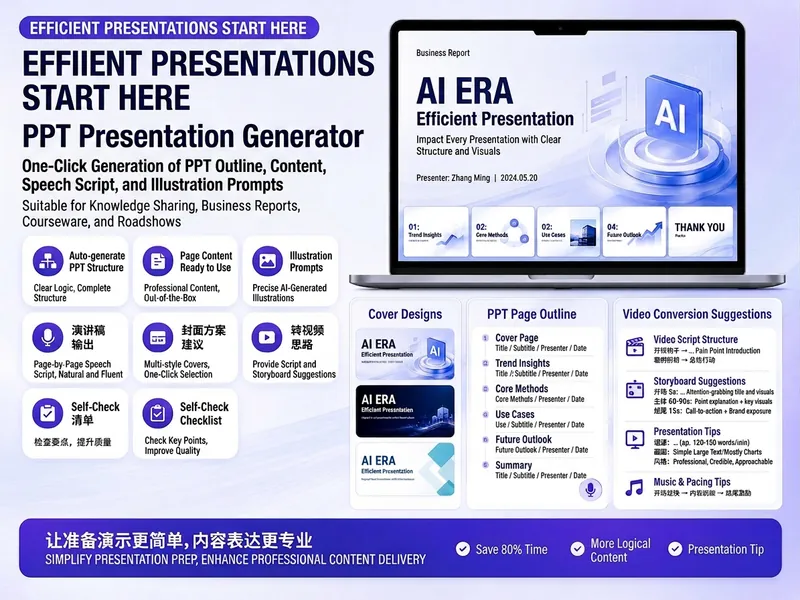
Trending PPT Slides Generator
Easily create engaging PPT Slides for knowledge sharing, business reports, course teaching, product introductions, or roadshows. Simply provide the topic, purpose, audience, duration, number of slides, or style preferences to get a customized PPT content plan. This skill provides a detailed PPT slides plan, including the PPT title, one-sentence theme, audience analysis, slide structure, titles for each slide, body text, and key points for your speech. It also offers specific visual suggestions and image prompts for each slide, even including cover design keywords to help you create a visually cohesive and attractive presentation. If you need to convert your PPT to a short video, this skill can also provide professional video conversion suggestions, covering key elements like rhythm, subtitles, voiceover, camera movements, and cover art to help your content perform well on multiple platforms. Say goodbye to vague outlines; every slide's content is ready to copy and use, ensuring your presentation is both substantive and impressive.
HTML Slides Generator
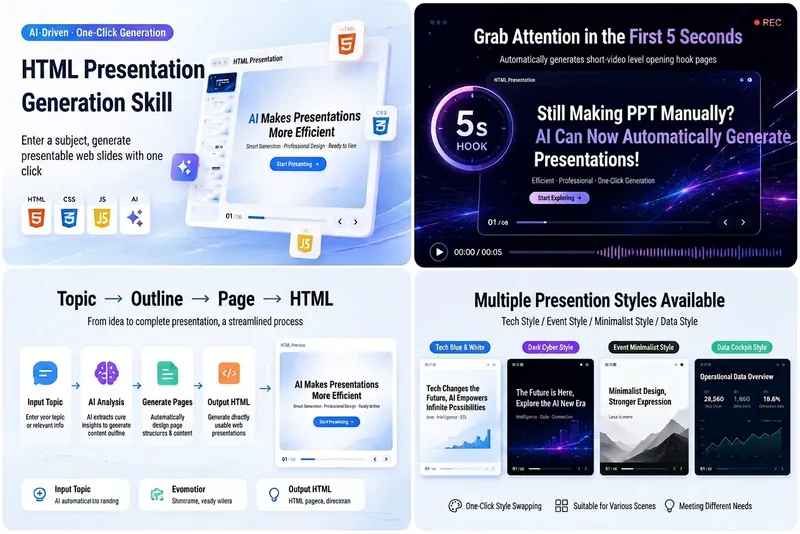
Easily turn your ideas, materials, or scripts into professional-grade HTML slides, designed for screen recording and pitch presentations. Whether you need AI tech sharing for platforms like Douyin, WeChat Video Channel, Xiaohongshu, or Bilibili, or product pitches, course demos, or business reports, this tool helps you quickly generate a visually refined, well-structured web slideshow. It automatically builds a complete slide structure, including an eye-catching opening hook in the first 5 seconds, titles and body text for each page, along with visual design suggestions. You'll get a standalone `index.html` file containing HTML, CSS, and JavaScript, supporting keyboard navigation, button navigation, progress bar, page numbers, and animations—perfectly optimized for 16:9 landscape screen recording. From AI tech blue-white to dark cyberpunk, to Apple keynote or Notion minimal style, you can choose or customize the visual theme to match your topic. Each slide is carefully designed to keep the content focused and easy to understand, with a reserved safe area in the lower right corner for video commentary, making your presentation more expressive and professional.

Automated Course Lesson Plans
One-line summary: Generate all lesson plans for an entire course in one go — not just one lesson, but a whole system of logically connected lesson plans. Detailed description: Still writing lesson plans one by one? This skill directly helps you batch-output all lesson plans for a full course (16 weeks/32 class hours or more) in your school's template format. 🔥 Core Capabilities 1. Cascading design for the entire course, not isolated pieces Each lesson plan is not standalone — the skill has a built-in OBE (Outcome-Based Education) logic engine that works backward from course objectives to each lesson's teaching goals, key/difficult points, activities, and assessment methods. Knowledge progression, ability scaffolding, and method rotation across units are all auto-planned. The result is a systematic set of lesson plans, not 16 unrelated documents. 2. Fully automated pipeline From template parsing → content source confirmation → first unit deep polishing → style locking → subsequent unit auto-generation → course summary matrix → batch file output — the entire pipeline runs automatically. You only need to confirm at key nodes; the repetitive work is all done by AI. 3. Two content sources, flexible adaptation With a textbook: Upload textbook/handouts/PPT, AI automatically extracts knowledge points and chapter structure to generate lesson plans directly. Without a textbook: Just provide the topic and outline, AI searches online for materials, organizes them into structured material packages, and generates after confirmation. Mixed mode: Some units have materials, others need to be gathered — switch flexibly per unit. 4. Template adaptation + style learning No matter what your school's lesson plan template looks like, upload it and AI automatically parses the fields. For the first unit, confirm field by field and edit until satisfied; then AI locks in your writing style (word choice, level of detail, formatting preferences) and automatically generates subsequent units in your style. 5. Professional quality assurance Teaching goals strictly use Bloom's action verbs, avoiding vague expressions like "understand" or "master." Each lesson plan undergoes automatic consistency checks (goals ↔ methods ↔ activities ↔ assessment fully aligned). Every 3 units, an automatic quality inspection (method diversity, knowledge progression, style consistency). Finally outputs a course objective coverage matrix, providing a clear view of the entire course's design logic. 📦 Final Deliverables 📁 A folder containing individual lesson plan documents for all units 📊 A course overview document (unit progression table + objective coverage matrix + method distribution statistics) 🎯 Each lesson plan strictly output in your school's template format, ready to submit 💡 Who Should Use It College/vocational teachers who need to write a full course's lesson plans for a new semester Teaching teams that need to batch-produce lesson plans for multiple courses Teachers preparing for teaching inspections or course evaluations who need to quickly complete a full set of lesson plans Teachers who want to write professional, standardized lesson plans that can pass OBE accreditation review One skill, complete lesson plans for an entire course. It doesn't just help you write one — it helps you design a complete course teaching system, then automatically outputs each one.
One-Click Courseware to Web
Courseware or article links to scrolling site
Description
Why we love this skill
One-click conversion of courseware or articles into beautiful web pages, supporting scroll or PPT mode, easily visualizing content and making professional knowledge accessible.
Turn your courseware into a viewable website. Whether you have a Markdown note, a PDF paper, a PPT slides, or a plain text script, or even a public account link, One-Click Courseware to Web can automatically convert it into a clear, beautifully designed online course display webpage. You don't need to write a single line of code—just provide the content. Two display styles: - Course training content → generates a scrolling long page, like flipping through a book. - Paper/report content → generates a PPT-style page-turning website, like browsing slides one by one. Responsive design adapts to mobile and desktop. What you need to do: Just one step: provide your courseware content. Supported formats: .md Markdown files, .pdf PDF documents, .pptx PPT presentations, .txt plain text. You can also paste course content directly in the conversation. Example commands: "Turn these lecture notes into a webpage" "Make this PDF paper into a PPT-style website" "Here is my courseware content, generate an online display page" What you get: A directly accessible online course display website, with the display mode automatically determined. Your content automatically selects the effect: - Course outlines, training handouts, textbooks → scrolling long pages, modules naturally connected, scroll to browse. - Academic papers, research reports → PPT-style slide flipping, each page focuses on one point. - Speeches, meeting reports → PPT-style page-by-page display, supports keyboard/click navigation. If you explicitly request "scrolling" or "PPT", your request is respected. Content extraction capability: For information-dense papers and long texts, the skill automatically performs: - Structure decomposition: splits continuous discourse into independent chapters/slides. - Information condensation: condenses three paragraphs into three key points, each within 20 characters. - Thesis-first: each page gives the conclusion first, then supporting arguments. - Framework visualization: models and classification systems are presented with charts instead of plain text. - Data highlighting: key numbers and metrics are displayed on separate pages prominently. Subsequent modifications: After the website is generated, you can request adjustments at any time: "Update the content of module three" "Change the color scheme to warm tones" "Add a course roadmap" "Change this module to a timeline layout" Modifications only affect the corresponding part; you don't need to regenerate the entire website. What it does not do: This skill currently focuses on course content display and does not include the following LMS (Learning Management System) features: - User login/registration - Learning progress tracking - File download - Online quizzes/practice If you need these features, they are separate extensions.
Related Skills
View allTrending PPT Slides Generator
Easily create engaging PPT Slides for knowledge sharing, business reports, course teaching, product introductions, or roadshows. Simply provide the topic, purpose, audience, duration, number of slides, or style preferences to get a customized PPT content plan. This skill provides a detailed PPT slides plan, including the PPT title, one-sentence theme, audience analysis, slide structure, titles for each slide, body text, and key points for your speech. It also offers specific visual suggestions and image prompts for each slide, even including cover design keywords to help you create a visually cohesive and attractive presentation. If you need to convert your PPT to a short video, this skill can also provide professional video conversion suggestions, covering key elements like rhythm, subtitles, voiceover, camera movements, and cover art to help your content perform well on multiple platforms. Say goodbye to vague outlines; every slide's content is ready to copy and use, ensuring your presentation is both substantive and impressive.
HTML Slides Generator
Easily turn your ideas, materials, or scripts into professional-grade HTML slides, designed for screen recording and pitch presentations. Whether you need AI tech sharing for platforms like Douyin, WeChat Video Channel, Xiaohongshu, or Bilibili, or product pitches, course demos, or business reports, this tool helps you quickly generate a visually refined, well-structured web slideshow. It automatically builds a complete slide structure, including an eye-catching opening hook in the first 5 seconds, titles and body text for each page, along with visual design suggestions. You'll get a standalone `index.html` file containing HTML, CSS, and JavaScript, supporting keyboard navigation, button navigation, progress bar, page numbers, and animations—perfectly optimized for 16:9 landscape screen recording. From AI tech blue-white to dark cyberpunk, to Apple keynote or Notion minimal style, you can choose or customize the visual theme to match your topic. Each slide is carefully designed to keep the content focused and easy to understand, with a reserved safe area in the lower right corner for video commentary, making your presentation more expressive and professional.
Automated Course Lesson Plans
One-line summary: Generate all lesson plans for an entire course in one go — not just one lesson, but a whole system of logically connected lesson plans. Detailed description: Still writing lesson plans one by one? This skill directly helps you batch-output all lesson plans for a full course (16 weeks/32 class hours or more) in your school's template format. 🔥 Core Capabilities 1. Cascading design for the entire course, not isolated pieces Each lesson plan is not standalone — the skill has a built-in OBE (Outcome-Based Education) logic engine that works backward from course objectives to each lesson's teaching goals, key/difficult points, activities, and assessment methods. Knowledge progression, ability scaffolding, and method rotation across units are all auto-planned. The result is a systematic set of lesson plans, not 16 unrelated documents. 2. Fully automated pipeline From template parsing → content source confirmation → first unit deep polishing → style locking → subsequent unit auto-generation → course summary matrix → batch file output — the entire pipeline runs automatically. You only need to confirm at key nodes; the repetitive work is all done by AI. 3. Two content sources, flexible adaptation With a textbook: Upload textbook/handouts/PPT, AI automatically extracts knowledge points and chapter structure to generate lesson plans directly. Without a textbook: Just provide the topic and outline, AI searches online for materials, organizes them into structured material packages, and generates after confirmation. Mixed mode: Some units have materials, others need to be gathered — switch flexibly per unit. 4. Template adaptation + style learning No matter what your school's lesson plan template looks like, upload it and AI automatically parses the fields. For the first unit, confirm field by field and edit until satisfied; then AI locks in your writing style (word choice, level of detail, formatting preferences) and automatically generates subsequent units in your style. 5. Professional quality assurance Teaching goals strictly use Bloom's action verbs, avoiding vague expressions like "understand" or "master." Each lesson plan undergoes automatic consistency checks (goals ↔ methods ↔ activities ↔ assessment fully aligned). Every 3 units, an automatic quality inspection (method diversity, knowledge progression, style consistency). Finally outputs a course objective coverage matrix, providing a clear view of the entire course's design logic. 📦 Final Deliverables 📁 A folder containing individual lesson plan documents for all units 📊 A course overview document (unit progression table + objective coverage matrix + method distribution statistics) 🎯 Each lesson plan strictly output in your school's template format, ready to submit 💡 Who Should Use It College/vocational teachers who need to write a full course's lesson plans for a new semester Teaching teams that need to batch-produce lesson plans for multiple courses Teachers preparing for teaching inspections or course evaluations who need to quickly complete a full set of lesson plans Teachers who want to write professional, standardized lesson plans that can pass OBE accreditation review One skill, complete lesson plans for an entire course. It doesn't just help you write one — it helps you design a complete course teaching system, then automatically outputs each one.
Find your next favorite skill
Explore more curated AI skills for research, creation, and everyday work.