
SocialScienceCompletionV7.0
Upload proposal, one-click report & doc.
Description
A provincial/department-level social science project completion report generation system based on the AFP 3.1 three-layer architecture. New additions: three-layer nested governance (framework/content separation) + dual-core parameterization (R1-R6 role library) + 9-dimensional quantitative scoring matrix + ratchet version management + cross-conversation persistence + defect P0-P3 classification. Input the project proposal + published papers, complete a 20,000-50,000 word comprehensive report and 13 deliverables in 2-3 days. 6 iterations accumulated experience in handling 13 failure modes.
Related Skills
View all
H&SS Topic Selection AFP
Humanities and Social Sciences Topic Selection Engineering System 🎯 Adaptive Coverage System: | Topic Type | System Fit | Difficulty Level | |------------|------------|------------------| | National Social Science Fund | ✅ Core Application | ★★★★★ | | Ministry of Education Humanities and Social Sciences Project | ✅ Fully Compatible | ★★★★☆ | | National Education Science Planning Key Projects | ✅ Fully Compatible | ★★★★☆ | | Provincial Social Science Planning | ✅ Fully Compatible | ★★★☆☆ | | Vocational Education/Teaching Reform Projects | ✅ Fully Compatible | ★★★☆☆ | 📊 Six-Stage Delivery Process (P0-P5 Mandatory Steps): | Stage | Phase | Core Output | Key Action | |-------|-------|-------------|------------| | P0 | Anchor Your Base | Personal Resources & Position Assessment | Take stock of your academic accumulation, existing achievements, and team resources | | P1 | Policy Decoding & Real Problem Extraction | Policy Analysis Table + Problem List | Scan the latest policy documents to uncover issues that truly matter to the review committee | | P2 | Atomic-Level Object Decomposition | Minimum Granularity Object Table | Break down grand propositions into core research objects | | P3 | Nine-Grid Topic Explosion | 9 Topic Direction Matrix | One object, 9 angles, select the optimal direction | | P4 | Critical Review & Finalization | Revision Suggestions + Risk Checklist | Two-role confrontation: applicant vs. blind reviewer, iterative refinement | | P5 | Asset Packaging | Topic Core Asset Memorandum | Final topic + reasoning logic + ready for proposal writing | 🔧 Built-in Standard Tool Library: ✓ Two-Role Confrontation System — Topic Planner ↔ Blind Review Expert (self vs. self PK) ✓ Naming Red Line Check — No colons/dashes/subtitles allowed, must end with "research" ✓ Trinity Rule — Qualifier + Object + Problem (invisible scoring sheet) ✓ Real-Time Policy Update — Synchronized with latest guidelines from NSSF, MOE, and Education Science Planning ✓ Nine-Grid Topic Matrix — Systematically spread 9 angles, visualize innovation comparison ✓ Blind Review Risk Assessment — Predict topic weaknesses in review 📈 Expected Results: 📌 Grant Approval Rate — From average 20-30% to 60-70%+ (depending on prior accumulation) ⏱️ Topic Selection Cycle — From 3-6 months of polishing to 2-3 weeks of systematic finalization 🎯 Hit Accuracy — From "broadcasting" to precisely targeting the review logic of the target committee 📦 Continuity — The Topic Memorandum can directly interface with "Grant Proposal Writing AFP" for a complete closed loop
Grant Proposal Review PRO V2.0
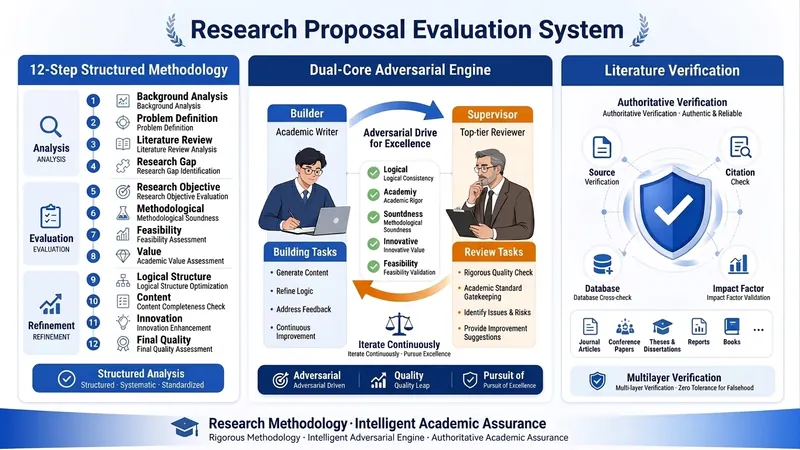
🎯 Core Functionality Overview This is an intelligent review and optimization system specially designed for national social science, education ministry, and provincial grant applications. It simulates the thinking mode of a senior review expert with 15 years of experience, ensuring academic rigor and competitiveness through three core mechanisms. 🔧 Three Core Mechanisms 1️⃣ 12-Step Structured Methodology Covers the full lifecycle of grant proposal review: Phase 1-3: Basic Diagnosis - In-depth analysis of announcement (funding priorities, review criteria, application requirements) - Cross-disciplinary type judgment (precise identification of 8 types) - Research GAP five-dimension identification (theory/methodology/empirical/policy/technology) Phase 4-7: Core Element Review - Research question TMAQ model analysis (theory/methodology/approach/question four dimensions) - Research objective SMART principle test - Research content framework completeness assessment - Research approach type matching (6 types) Phase 8-10: Deep Quality Enhancement - Precise extraction of key difficulties (distinguish criteria + breakthrough paths) - Innovation point seven-dimension mining - Feasibility seven-dimension argumentation Phase 11-12: Overall Optimization - Nine-dimension quality check (academic rigor, innovativeness, feasibility, etc.) - Comprehensive optimization suggestions and final report 2️⃣ Dual-Core Adversarial Mechanism (Builder vs Supervisor) Working Principle: - Builder (academic writer): Generates optimization plans based on user materials - Supervisor (top journal reviewer): Challenges Builder's plans with the strictest standards - Adversarial iteration: 3 rounds of confrontation to ensure plans are robust Application Scenarios: - Innovation point mining: Builder proposes innovation points → Supervisor questions novelty → iterative optimization - Feasibility argumentation: Builder designs plan → Supervisor challenges feasibility → supplementary argumentation - Literature citation: Builder cites literature → Supervisor verifies authenticity → ensure academic standards 3️⃣ Literature Authenticity Verification Mechanism Two working modes: Mode A: Placeholder Mode (Default) - Use markers like [Literature Placeholder-001] in place of specific references - Output a Literature Requirement List specifying search requirements for each placeholder - User searches and fills in real references Mode B: Real-Time Verification Mode - Call Google Scholar to verify literature authenticity in real time - Generate Literature Verification Report (authenticity/relevance/authority scores) - Ensure every citation is traceable Preventing AI Hallucination: - Prohibits fabricating authors, journals, DOIs - All references must be verified or marked as placeholders - Guarantees academic integrity bottom line 💡 Core Value and Applicable Scenarios ✅ Key Pain Points Addressed 1. Academic sloppiness: AI-generated content often includes fake references, logical gaps 2. Insufficient innovation: Difficulty uncovering true academic innovation points 3. Weak feasibility: Research plans lack systematic argumentation 4. Cross-disciplinary difficulty: Interdisciplinary topics often fall between two stools 🎓 Target Users - University faculty (social sciences, education, humanities) - Researchers (applying for national and provincial grants) - Academic teams (needing systematic review processes) 📋 Typical Workflow 1. Input: Upload announcement + proposal draft 2. Review: System executes 12-step structured analysis 3. Adversarial: Dual-core mechanism iteratively optimizes key sections 4. Verification: Literature authenticity check 5. Output: Complete review report + optimization suggestions + literature list 🔍 Differences from Traditional Review | Dimension | Traditional Human Review | Expert Review System | |-----------|------------------------|----------------------| | Review depth | Depends on personal experience | 12-step structured + 9D QC | | Academic rigor | Hard to fully audit | Literature verification + dual-core adversarial | | Innovation mining | Subjective judgment | 7-dimension systematic analysis | | Feasibility argumentation | Experience-driven | 7-dimension item-by-item argumentation | | Consistency | Varies by individual | Standardized process | | Efficiency | Days to weeks | 1-2 hours for initial review | The core advantage of this system is: it makes the tacit knowledge of a 15-year senior review expert explicit, structured, and replicable, enabling every user to receive top-level expert review services.
 Research
Teaching Award App Auto Expert
Teaching Achievement Award Application · Full-Process Automation Advisor System 🎯 Adaptive Recognition of Coverage Levels: Education Type: Basic Education / Vocational Education / Higher Education → Automatically matches the application system Award Level: National / Provincial / School Level → Automatically identifies difficulty and focus of competition 📊 Four Delivery Phases (Staged Closed Loop): | Phase | Output | Core Value | |-------|--------|------------| | 1. Diagnosis & Profiling | 7-8 question smart survey + achievement positioning report | Identify the right application level to avoid over or under applying | | 2. Topic Selection | Topic direction matrix + 3-5 similar successful cases | Know which direction to adjust to be most visible | | 3. Title Incubation | 5-8 alternative titles (SCPAR naming) | If the title is right, half the application is done | | 4. Body Writing | Complete version of the application with strict word count | How many words for innovation, results, and dissemination value — precise to the paragraph | | 5. Diagnostic Scoring | Three-dimensional innovation assessment + expert checklist | Reviewing it yourself after editing is like having a professional review | 🔧 Built-in Standardized Tool Library: ✓ SCPAR Naming Rule — The invisible scoring table for teaching achievement titles ✓ Word Count Hard Constraint Check — Automatically enforces 5000-12000 word range ✓ Three-Dimensional Innovation Assessment Model — Full reproduction of the scoring logic used by award judges ✓ Title Template Library — Reference templates for national/provincial/school level achievements ✓ Expert Checklist — Item-by-item self-check for the finished application 📈 Expected Results: Application success rate from random 30% to precise 70%+ Application preparation time from 2-3 months to 2-3 weeks Higher first-submission hit rate (more accurate topic selection)
SocialScienceCompletionV7.0
Upload proposal, one-click report & doc.
Description
A provincial/department-level social science project completion report generation system based on the AFP 3.1 three-layer architecture. New additions: three-layer nested governance (framework/content separation) + dual-core parameterization (R1-R6 role library) + 9-dimensional quantitative scoring matrix + ratchet version management + cross-conversation persistence + defect P0-P3 classification. Input the project proposal + published papers, complete a 20,000-50,000 word comprehensive report and 13 deliverables in 2-3 days. 6 iterations accumulated experience in handling 13 failure modes.
Related Skills
View allH&SS Topic Selection AFP
Humanities and Social Sciences Topic Selection Engineering System 🎯 Adaptive Coverage System: | Topic Type | System Fit | Difficulty Level | |------------|------------|------------------| | National Social Science Fund | ✅ Core Application | ★★★★★ | | Ministry of Education Humanities and Social Sciences Project | ✅ Fully Compatible | ★★★★☆ | | National Education Science Planning Key Projects | ✅ Fully Compatible | ★★★★☆ | | Provincial Social Science Planning | ✅ Fully Compatible | ★★★☆☆ | | Vocational Education/Teaching Reform Projects | ✅ Fully Compatible | ★★★☆☆ | 📊 Six-Stage Delivery Process (P0-P5 Mandatory Steps): | Stage | Phase | Core Output | Key Action | |-------|-------|-------------|------------| | P0 | Anchor Your Base | Personal Resources & Position Assessment | Take stock of your academic accumulation, existing achievements, and team resources | | P1 | Policy Decoding & Real Problem Extraction | Policy Analysis Table + Problem List | Scan the latest policy documents to uncover issues that truly matter to the review committee | | P2 | Atomic-Level Object Decomposition | Minimum Granularity Object Table | Break down grand propositions into core research objects | | P3 | Nine-Grid Topic Explosion | 9 Topic Direction Matrix | One object, 9 angles, select the optimal direction | | P4 | Critical Review & Finalization | Revision Suggestions + Risk Checklist | Two-role confrontation: applicant vs. blind reviewer, iterative refinement | | P5 | Asset Packaging | Topic Core Asset Memorandum | Final topic + reasoning logic + ready for proposal writing | 🔧 Built-in Standard Tool Library: ✓ Two-Role Confrontation System — Topic Planner ↔ Blind Review Expert (self vs. self PK) ✓ Naming Red Line Check — No colons/dashes/subtitles allowed, must end with "research" ✓ Trinity Rule — Qualifier + Object + Problem (invisible scoring sheet) ✓ Real-Time Policy Update — Synchronized with latest guidelines from NSSF, MOE, and Education Science Planning ✓ Nine-Grid Topic Matrix — Systematically spread 9 angles, visualize innovation comparison ✓ Blind Review Risk Assessment — Predict topic weaknesses in review 📈 Expected Results: 📌 Grant Approval Rate — From average 20-30% to 60-70%+ (depending on prior accumulation) ⏱️ Topic Selection Cycle — From 3-6 months of polishing to 2-3 weeks of systematic finalization 🎯 Hit Accuracy — From "broadcasting" to precisely targeting the review logic of the target committee 📦 Continuity — The Topic Memorandum can directly interface with "Grant Proposal Writing AFP" for a complete closed loop
Grant Proposal Review PRO V2.0
🎯 Core Functionality Overview This is an intelligent review and optimization system specially designed for national social science, education ministry, and provincial grant applications. It simulates the thinking mode of a senior review expert with 15 years of experience, ensuring academic rigor and competitiveness through three core mechanisms. 🔧 Three Core Mechanisms 1️⃣ 12-Step Structured Methodology Covers the full lifecycle of grant proposal review: Phase 1-3: Basic Diagnosis - In-depth analysis of announcement (funding priorities, review criteria, application requirements) - Cross-disciplinary type judgment (precise identification of 8 types) - Research GAP five-dimension identification (theory/methodology/empirical/policy/technology) Phase 4-7: Core Element Review - Research question TMAQ model analysis (theory/methodology/approach/question four dimensions) - Research objective SMART principle test - Research content framework completeness assessment - Research approach type matching (6 types) Phase 8-10: Deep Quality Enhancement - Precise extraction of key difficulties (distinguish criteria + breakthrough paths) - Innovation point seven-dimension mining - Feasibility seven-dimension argumentation Phase 11-12: Overall Optimization - Nine-dimension quality check (academic rigor, innovativeness, feasibility, etc.) - Comprehensive optimization suggestions and final report 2️⃣ Dual-Core Adversarial Mechanism (Builder vs Supervisor) Working Principle: - Builder (academic writer): Generates optimization plans based on user materials - Supervisor (top journal reviewer): Challenges Builder's plans with the strictest standards - Adversarial iteration: 3 rounds of confrontation to ensure plans are robust Application Scenarios: - Innovation point mining: Builder proposes innovation points → Supervisor questions novelty → iterative optimization - Feasibility argumentation: Builder designs plan → Supervisor challenges feasibility → supplementary argumentation - Literature citation: Builder cites literature → Supervisor verifies authenticity → ensure academic standards 3️⃣ Literature Authenticity Verification Mechanism Two working modes: Mode A: Placeholder Mode (Default) - Use markers like [Literature Placeholder-001] in place of specific references - Output a Literature Requirement List specifying search requirements for each placeholder - User searches and fills in real references Mode B: Real-Time Verification Mode - Call Google Scholar to verify literature authenticity in real time - Generate Literature Verification Report (authenticity/relevance/authority scores) - Ensure every citation is traceable Preventing AI Hallucination: - Prohibits fabricating authors, journals, DOIs - All references must be verified or marked as placeholders - Guarantees academic integrity bottom line 💡 Core Value and Applicable Scenarios ✅ Key Pain Points Addressed 1. Academic sloppiness: AI-generated content often includes fake references, logical gaps 2. Insufficient innovation: Difficulty uncovering true academic innovation points 3. Weak feasibility: Research plans lack systematic argumentation 4. Cross-disciplinary difficulty: Interdisciplinary topics often fall between two stools 🎓 Target Users - University faculty (social sciences, education, humanities) - Researchers (applying for national and provincial grants) - Academic teams (needing systematic review processes) 📋 Typical Workflow 1. Input: Upload announcement + proposal draft 2. Review: System executes 12-step structured analysis 3. Adversarial: Dual-core mechanism iteratively optimizes key sections 4. Verification: Literature authenticity check 5. Output: Complete review report + optimization suggestions + literature list 🔍 Differences from Traditional Review | Dimension | Traditional Human Review | Expert Review System | |-----------|------------------------|----------------------| | Review depth | Depends on personal experience | 12-step structured + 9D QC | | Academic rigor | Hard to fully audit | Literature verification + dual-core adversarial | | Innovation mining | Subjective judgment | 7-dimension systematic analysis | | Feasibility argumentation | Experience-driven | 7-dimension item-by-item argumentation | | Consistency | Varies by individual | Standardized process | | Efficiency | Days to weeks | 1-2 hours for initial review | The core advantage of this system is: it makes the tacit knowledge of a 15-year senior review expert explicit, structured, and replicable, enabling every user to receive top-level expert review services.
ResearchTeaching Award App Auto Expert
Teaching Achievement Award Application · Full-Process Automation Advisor System 🎯 Adaptive Recognition of Coverage Levels: Education Type: Basic Education / Vocational Education / Higher Education → Automatically matches the application system Award Level: National / Provincial / School Level → Automatically identifies difficulty and focus of competition 📊 Four Delivery Phases (Staged Closed Loop): | Phase | Output | Core Value | |-------|--------|------------| | 1. Diagnosis & Profiling | 7-8 question smart survey + achievement positioning report | Identify the right application level to avoid over or under applying | | 2. Topic Selection | Topic direction matrix + 3-5 similar successful cases | Know which direction to adjust to be most visible | | 3. Title Incubation | 5-8 alternative titles (SCPAR naming) | If the title is right, half the application is done | | 4. Body Writing | Complete version of the application with strict word count | How many words for innovation, results, and dissemination value — precise to the paragraph | | 5. Diagnostic Scoring | Three-dimensional innovation assessment + expert checklist | Reviewing it yourself after editing is like having a professional review | 🔧 Built-in Standardized Tool Library: ✓ SCPAR Naming Rule — The invisible scoring table for teaching achievement titles ✓ Word Count Hard Constraint Check — Automatically enforces 5000-12000 word range ✓ Three-Dimensional Innovation Assessment Model — Full reproduction of the scoring logic used by award judges ✓ Title Template Library — Reference templates for national/provincial/school level achievements ✓ Expert Checklist — Item-by-item self-check for the finished application 📈 Expected Results: Application success rate from random 30% to precise 70%+ Application preparation time from 2-3 months to 2-3 weeks Higher first-submission hit rate (more accurate topic selection)
Find your next favorite skill
Explore more curated AI skills for research, creation, and everyday work.