Product Research
Competitor, market, user & opportunity research
Description
Used to quickly conduct market research, competitive analysis, feature benchmarking, user segmentation, and product opportunity assessment. It organizes evidence, competitive matrices, risks, and next-step suggestions based on the latest information, suitable for use before project initiation, new feature planning, competitor analysis, or business opportunity evaluation.
Related Skills
View all
Competitive Intel Analyst
Start with a broad view to build a persuasive competitor database, then focus the output on the company’s core business and decision-making needs. This elevates competitor research from “case hunting” to a decision basis that can be verified, compared, and acted on. This is not a prompt that merely lists a few competitors and stitches together webpage screenshots, nor one that crams every database detail into a PPT. “Competitive Intel Analyst” is suitable for consumer goods, technology products, software services, healthcare, education, retail, manufacturing, and other industries. It first defines the research scope and builds a multidimensional search framework covering markets, companies, products/services, user value, technology paths, business models, pricing and channels, intellectual property, partners, and evidence sources. It then creates a continuously updateable, deduplicated, traceable competitor database. Finally, based on the company’s core business, intended use cases, and leadership’s decision questions, it selects a small number of highly relevant benchmarks and produces a conclusion-first leadership briefing PPT, opportunity gaps, and an action roadmap. Suitable for: Panoramic scans of new markets or product categories Product planning, technology planning, and annual strategy research Tracking key competitors, patents, suppliers, or partner ecosystems Adding to, cleaning, and updating evidence in existing competitor databases or PPTs Investment, business development, and management decision briefings Condensing large volumes of material into conclusions that leaders can understand and teams can act on Typical deliverables include a complete competitor database, a shortlist of core competitors, a leadership briefing PPT, technology/patent/ecosystem maps (as needed), an opportunity and risk list, 90/180/365-day action roadmaps, and a source index.

Startup Opportunity Radar
Turn “I think this could make money” into “What evidence is worth testing?” Discover and screen early-stage business opportunities suited to solo businesses, micro-SaaS, AI tools, digital products, data products, physical goods based on supply chains, and transaction services. It starts with real user friction, substitute behaviors, payment actions, and industry changes, helping you avoid mistaking popular trends, search volume, or scattered complaints for genuine demand. You can ask it to scan for new startup directions, or submit a product idea, market, link, screenshot, plan, sales feedback, or historical opportunity list for an individual health check, validation design, or periodic review. The analysis distinguishes facts, inferences, assumptions, and opposing evidence. It examines buyers, use cases, competitive gaps, data and supply chain legality, customer acquisition channels, standardization potential, maintenance costs, and related liability risks. When evidence is insufficient, it states that clearly instead of inventing market size or purchase intent. You will receive a clear opportunity assessment, an evaluation of opportunity quality and user adoption readiness, and a minimum validation plan focused on the riskiest assumptions. This includes validation actions, a stage budget, the maximum acceptable loss, and criteria for proceeding or stopping. It helps you decide which opportunities are worth investigating further while allowing conclusions such as “monitor,” “gather more evidence,” or “do not pursue this cycle,” making startup investment more manageable and gradually building repeatably sellable products and long-term assets.
In-Depth Product Analysis
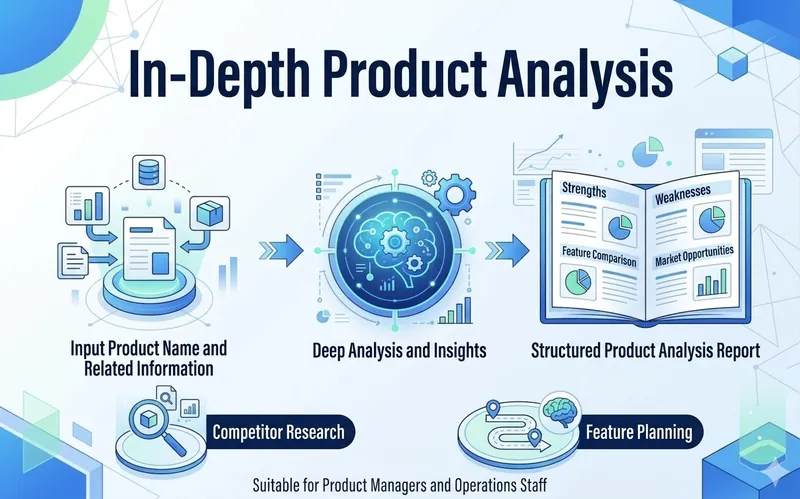
Helps users conduct a comprehensive, in-depth analysis of a product, suitable for competitive research or feature planning scenarios. Enter the product name and relevant information to receive a structured, insightful product analysis report.
Product Research
Competitor, market, user & opportunity research
Description
Used to quickly conduct market research, competitive analysis, feature benchmarking, user segmentation, and product opportunity assessment. It organizes evidence, competitive matrices, risks, and next-step suggestions based on the latest information, suitable for use before project initiation, new feature planning, competitor analysis, or business opportunity evaluation.
Related Skills
View allCompetitive Intel Analyst
Start with a broad view to build a persuasive competitor database, then focus the output on the company’s core business and decision-making needs. This elevates competitor research from “case hunting” to a decision basis that can be verified, compared, and acted on. This is not a prompt that merely lists a few competitors and stitches together webpage screenshots, nor one that crams every database detail into a PPT. “Competitive Intel Analyst” is suitable for consumer goods, technology products, software services, healthcare, education, retail, manufacturing, and other industries. It first defines the research scope and builds a multidimensional search framework covering markets, companies, products/services, user value, technology paths, business models, pricing and channels, intellectual property, partners, and evidence sources. It then creates a continuously updateable, deduplicated, traceable competitor database. Finally, based on the company’s core business, intended use cases, and leadership’s decision questions, it selects a small number of highly relevant benchmarks and produces a conclusion-first leadership briefing PPT, opportunity gaps, and an action roadmap. Suitable for: Panoramic scans of new markets or product categories Product planning, technology planning, and annual strategy research Tracking key competitors, patents, suppliers, or partner ecosystems Adding to, cleaning, and updating evidence in existing competitor databases or PPTs Investment, business development, and management decision briefings Condensing large volumes of material into conclusions that leaders can understand and teams can act on Typical deliverables include a complete competitor database, a shortlist of core competitors, a leadership briefing PPT, technology/patent/ecosystem maps (as needed), an opportunity and risk list, 90/180/365-day action roadmaps, and a source index.
Startup Opportunity Radar
Turn “I think this could make money” into “What evidence is worth testing?” Discover and screen early-stage business opportunities suited to solo businesses, micro-SaaS, AI tools, digital products, data products, physical goods based on supply chains, and transaction services. It starts with real user friction, substitute behaviors, payment actions, and industry changes, helping you avoid mistaking popular trends, search volume, or scattered complaints for genuine demand. You can ask it to scan for new startup directions, or submit a product idea, market, link, screenshot, plan, sales feedback, or historical opportunity list for an individual health check, validation design, or periodic review. The analysis distinguishes facts, inferences, assumptions, and opposing evidence. It examines buyers, use cases, competitive gaps, data and supply chain legality, customer acquisition channels, standardization potential, maintenance costs, and related liability risks. When evidence is insufficient, it states that clearly instead of inventing market size or purchase intent. You will receive a clear opportunity assessment, an evaluation of opportunity quality and user adoption readiness, and a minimum validation plan focused on the riskiest assumptions. This includes validation actions, a stage budget, the maximum acceptable loss, and criteria for proceeding or stopping. It helps you decide which opportunities are worth investigating further while allowing conclusions such as “monitor,” “gather more evidence,” or “do not pursue this cycle,” making startup investment more manageable and gradually building repeatably sellable products and long-term assets.
In-Depth Product Analysis
Helps users conduct a comprehensive, in-depth analysis of a product, suitable for competitive research or feature planning scenarios. Enter the product name and relevant information to receive a structured, insightful product analysis report.
Find your next favorite skill
Explore more curated AI skills for research, creation, and everyday work.