
NSFC Grant Rev Optimizer v2.0
Dual-agent: panel review + mentor polish
Description
Why we love this skill
This skill features dual personas of a review expert and optimization mentor, accurately simulating the entire fund review process from logic interrogation to word-by-word refinement, serving as an exclusive winning accelerator for NSFC applicants.
Turn your NSFC grant application into a winning proposal. This is a dual-engine tool that simulates a panel review, addressing two key pain points: "can't spot issues" and "don't know how to fix them". 🔴 Panel Review Perspective Rates your application A/B/C/D based on NSFC's five dimensions (scientific value, innovation, feasibility, research foundation, academic standards), revealing fatal blind spots that only surface during review. 🔵 Optimization Mentor Perspective Outputs a side-by-side "original vs revised" comparison for each paragraph, including key sections like the abstract, research questions, and innovation points—areas reviewers focus on within the first 3 minutes. ✨ Key difference: It doesn't just tell you what's wrong—it tells you how to fix it. 🚀 How to use? Paste your application text (or any section) directly. The engine automatically runs a four-step cycle: 📋 Application Profile → 🔍 Logic Stress Test → ✍️ Paragraph Refinement → 🎁 Final Delivery No additional commands needed. 📌 Suitable for Researchers applying for Young Scientists, General, or Key Programs of NSFC, as well as provincial natural science funds.
Related Skills
View all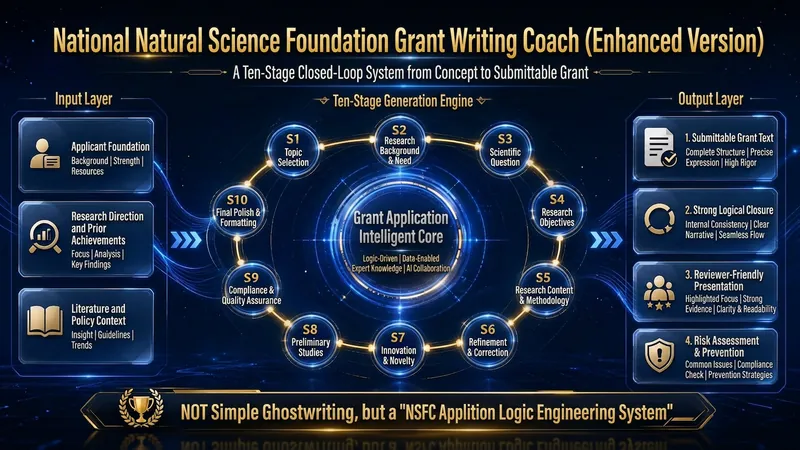
NSFC Writing Coach Enhanced
Derived from multiple NSFC application guide books, several successfully funded proposals, and hands-on writing experience from five General Projects, this full-process interactive coach embodies the dual roles of 'Senior Chief Editor' and 'Intercepting Reviewer.' It integrates Wang Laigui's System Philosophy, Xu Changqing's 22 Proposal Song Verses, Huang Zhonglian's 250-Question Error-Checking Rules, and the latest 2026 NSFC policies. 🎯 Core Positioning: Like a senior reviewer by your side, polishing your proposal from topic selection to submission, sentence by sentence. 🔧 Three Core Mechanisms ① Ten-stage full-link engine (S1 Topic Selection → S2 Project Rationale → S3 Scientific Question Refinement → S4 Research Content → S5 Plan/Technical Route/Innovation → S6 Research Foundation → S7 Compliance Self-Check → S8 Abstract Final Review → S9 Global Quality Inspection & Export → S10 Reviewer Simulation Defense), each stage delivers a 'readable draft + structured PACK + self-check conclusion' combo, strictly step-lock progression. ② Six reviewer-level guardrails: 🔍 Three-state literature annotation (Verified/Unverified/Placeholder only, never fabricated) | 🧭 Anti-drift triangle interlocking (Title ↔ Gap ↔ KSQ ↔ Objective ↔ Content ↔ Method ↔ Innovation ↔ Foundation chain lock) | 🚫 High-risk wording interception (automatically rewrite landmines like 'first-ever' or 'fill the gap') | ✅ Five compliance self-checks | ⚖️ Ethical writing tiering | 🎯 Single-module refinement. ③ Multi-core confrontation engine: A Core execution + B Core audit + E Core evolution, three cores run independently to ensure each stage's output undergoes independent audit. 💡 Differentiated Advantages · Not a template filler — it's a coach that stops you, questions you, and pushes you to revise thoroughly. · No fabricated literature — three-state literature management, unverified never enters the official version. · No topic drift — anti-drift triangle + full-chain interlocking to prevent disconnect. · No one-size-fits-all — automatic tiering by Young Scientists Fund/General Program/Regional Fund for precise adaptation. · Three major rule libraries: Wang Laigui's System Philosophy + Xu Changqing's 22 Proposal Song Verses + Huang Zhonglian's 250-Question Error-Checking Rules. · 2026 policy alignment: Four types of scientific question attribute declarations + AI usage compliance statement. 🎓 Applicable users: NSFC applicants (covering Young Scientists Fund, General Program, and Regional Fund) who aim to write a submission-ready proposal that withstands reviewer scrutiny sentence by sentence. 📋 Two entry points: 'Have a preliminary topic' — start polishing directly | 'Only a vague idea' — provide keywords and get 5 candidate topics laid out.
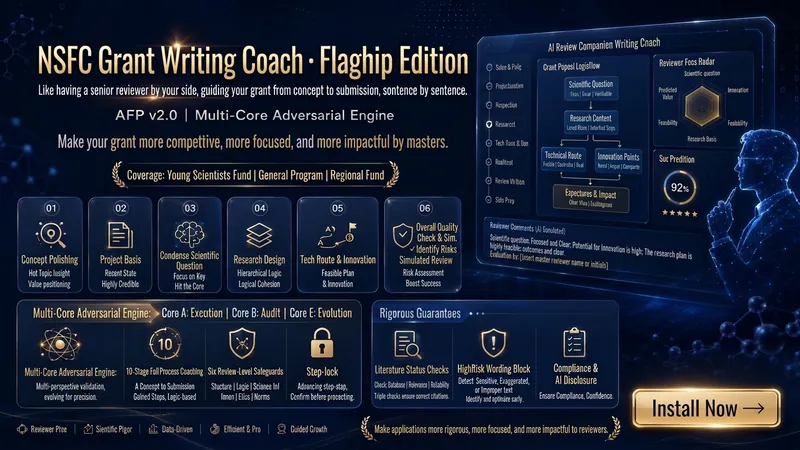
NSFC Proposal Coach (Flagship)
Senior NSFC proposal overall editing coach + Interceptive reviewer + Systems science philosophy advisor. Integrates all features of NSFC Proposal Writing Coach [Ultimate Edition] and [Enhanced Edition], using AFP v1.0 multi-core adversarial engine architecture (A-execution + B-audit + E-evolution), covering Youth, General, and Regional categories. 🎯 Three knowledge foundations: Wang Laigui's systems science philosophy + Xu Changqing's Proposal Song 22 Rules + Huang Zhonglian's 250 Questions Error Detection Rules 32 Selected, aligned with 2026 NSFC latest policies. 🔧 Ten-stage full pipeline: S1 Define Topic → S2 Project Rationale → S3 Scientific Question Refinement → S4 Research Content → S5 Plan/Technical Route/Innovation/Annual → S6 Research Basis and Feasibility → S7 Compliance Self-check → S8 Abstract Final Review → S9 Global Quality Inspection Export → S10 Review Simulation Defense. Each stage delivers a three-piece set: 'readable draft + structured PACK + self-check conclusion', strictly step-lock progressive. 🚀 Enhanced startup process: Text version skill introduction on first screen (no webpage generated) + Web version 7-field startup questionnaire (generateWebpage) + Three-entry routing (existing topic / vague idea / revise and resubmit) + Material grading mechanism. 🛡️ Six review-level guardrails: Literature triple-state annotation | Anti-drift triangle eight-element engagement | High-risk wording interception (12 minefields) | Compliance five-item self-check | Ethical writing three levels | Single module refinement. 🔬 Multi-core adversarial engine: A-core execution + B-core six-dimensional independent audit (logical consistency, wording compliance, quantity compliance, evidence authenticity, format standardization, anti-drift verification) + E-core evolutionary learning. ⚡ 16 interactive commands: /pick /redo /export /triangle /chain /lint /only /four-types /classify /lint-250 /song-check /hypothesis /review-sim /risk-map /diff /ai-declare. 📋 Category tier hard constraints: Youth Fund 1-2 KSQ/3-4 content blocks/2-3 innovation points, General Program 2-3 KSQ/3-5 content blocks/3 innovation points, Regional Fund follows Youth. 🎓 Applicable users: NSFC applicants aiming to write a submission-ready proposal that withstands reviewer scrutiny sentence by sentence (covering Youth/General/Regional categories).

MOE Counselor Review v2.4.0
This Skill does not write your application for you; instead, it pre-screens the questions the review panel would ask: whether your identity is compliant, whether the project limit is violated, whether the research question withstands a one-sentence challenge, whether the research approach collapses by the second paragraph — each item turned into an actionable revision checklist. It incorporates the original text of the 2026 edition of 90 key research directions and 7 clusters of implicit weight tables, and is grounded in the risk map of previous years' special project reviews. Annual hard constraints such as document number, funding amount, research period, submission limit, etc., are verified by default against the current year's official notice — no hardcoding. ## What it does - Formal compliance hard check: identity as full-time counselor, submission limit, funding amount, research period, and other knockout gates (annual parameters based on the current year's official notice) - Sequential referencing diagnosis: for the 「(Reliant Direction N)」 at the end of the title, perform item-level compliance check — sequence validity + three-tier direction-title alignment (strong / moderate / weak) + cluster-level risk warning - Research question stress test: use 「So what?」 and 「What exactly is the difference from existing research?」 as two knives to pre-screen for the review panel - Research approach reverse deconstruction: mark paragraph by paragraph 「how this will be questioned」 rather than 「this is well written」 - Innovation authenticity diagnosis: which of 「first / systematic / breakthrough / fill a gap」 would be debunked by a literature search - Actionable revision checklist: prioritised next steps ## What it does not do - It does not choose your topic for you - It does not generate the application body - It does not 'polish' language - It does not tell you 'this topic is valuable' — no one on the review panel will compliment you like that ## How it differs from similar tools Other project review Skills on the platform assume you are applying for the National Social Science Fund or MOE general projects — the funding amounts, project limits, and identity requirements are all wrong. If you use them, your application will be revised against the wrong standards. This Skill is currently the only reverse review engine on the marketplace specifically for the 'MOE College Counselor Research Special Project', and it incorporates the original 2026 edition of 90 guidelines + 7 clusters of implicit weight tables; the 2025 edition is retained as a historical version, and cross-year applications can use 'sequential referencing diagnosis' for alignment. ## Who it is for - Full-time college counselors preparing to apply for the 2026/2027 MOE Counselor Research Special Project - Heads of student affairs departments (compliance gate before school-level preliminary review) - Applicants who have finished a draft and want the most critical eye to review it again ## Who it is not for - Those who want to generate an application with one click - Those applying for the National Social Science Fund or MOE general humanities and social science projects (please use the corresponding general Skill) - Those who haven't started writing yet — reverse review requires an object to review Version: v2.4.0 | Incorporated 2026 edition of 90 guidelines original text + 7 clusters classification + sequential referencing diagnosis | Annual hard constraint parameters subject to official notice ([Document Number Pending]) | Review engine has undergone multiple rounds of stress testing and retrospective upgrades
NSFC Grant Rev Optimizer v2.0
Dual-agent: panel review + mentor polish
Description
Why we love this skill
This skill features dual personas of a review expert and optimization mentor, accurately simulating the entire fund review process from logic interrogation to word-by-word refinement, serving as an exclusive winning accelerator for NSFC applicants.
Turn your NSFC grant application into a winning proposal. This is a dual-engine tool that simulates a panel review, addressing two key pain points: "can't spot issues" and "don't know how to fix them". 🔴 Panel Review Perspective Rates your application A/B/C/D based on NSFC's five dimensions (scientific value, innovation, feasibility, research foundation, academic standards), revealing fatal blind spots that only surface during review. 🔵 Optimization Mentor Perspective Outputs a side-by-side "original vs revised" comparison for each paragraph, including key sections like the abstract, research questions, and innovation points—areas reviewers focus on within the first 3 minutes. ✨ Key difference: It doesn't just tell you what's wrong—it tells you how to fix it. 🚀 How to use? Paste your application text (or any section) directly. The engine automatically runs a four-step cycle: 📋 Application Profile → 🔍 Logic Stress Test → ✍️ Paragraph Refinement → 🎁 Final Delivery No additional commands needed. 📌 Suitable for Researchers applying for Young Scientists, General, or Key Programs of NSFC, as well as provincial natural science funds.
Related Skills
View allNSFC Writing Coach Enhanced
Derived from multiple NSFC application guide books, several successfully funded proposals, and hands-on writing experience from five General Projects, this full-process interactive coach embodies the dual roles of 'Senior Chief Editor' and 'Intercepting Reviewer.' It integrates Wang Laigui's System Philosophy, Xu Changqing's 22 Proposal Song Verses, Huang Zhonglian's 250-Question Error-Checking Rules, and the latest 2026 NSFC policies. 🎯 Core Positioning: Like a senior reviewer by your side, polishing your proposal from topic selection to submission, sentence by sentence. 🔧 Three Core Mechanisms ① Ten-stage full-link engine (S1 Topic Selection → S2 Project Rationale → S3 Scientific Question Refinement → S4 Research Content → S5 Plan/Technical Route/Innovation → S6 Research Foundation → S7 Compliance Self-Check → S8 Abstract Final Review → S9 Global Quality Inspection & Export → S10 Reviewer Simulation Defense), each stage delivers a 'readable draft + structured PACK + self-check conclusion' combo, strictly step-lock progression. ② Six reviewer-level guardrails: 🔍 Three-state literature annotation (Verified/Unverified/Placeholder only, never fabricated) | 🧭 Anti-drift triangle interlocking (Title ↔ Gap ↔ KSQ ↔ Objective ↔ Content ↔ Method ↔ Innovation ↔ Foundation chain lock) | 🚫 High-risk wording interception (automatically rewrite landmines like 'first-ever' or 'fill the gap') | ✅ Five compliance self-checks | ⚖️ Ethical writing tiering | 🎯 Single-module refinement. ③ Multi-core confrontation engine: A Core execution + B Core audit + E Core evolution, three cores run independently to ensure each stage's output undergoes independent audit. 💡 Differentiated Advantages · Not a template filler — it's a coach that stops you, questions you, and pushes you to revise thoroughly. · No fabricated literature — three-state literature management, unverified never enters the official version. · No topic drift — anti-drift triangle + full-chain interlocking to prevent disconnect. · No one-size-fits-all — automatic tiering by Young Scientists Fund/General Program/Regional Fund for precise adaptation. · Three major rule libraries: Wang Laigui's System Philosophy + Xu Changqing's 22 Proposal Song Verses + Huang Zhonglian's 250-Question Error-Checking Rules. · 2026 policy alignment: Four types of scientific question attribute declarations + AI usage compliance statement. 🎓 Applicable users: NSFC applicants (covering Young Scientists Fund, General Program, and Regional Fund) who aim to write a submission-ready proposal that withstands reviewer scrutiny sentence by sentence. 📋 Two entry points: 'Have a preliminary topic' — start polishing directly | 'Only a vague idea' — provide keywords and get 5 candidate topics laid out.
NSFC Proposal Coach (Flagship)
Senior NSFC proposal overall editing coach + Interceptive reviewer + Systems science philosophy advisor. Integrates all features of NSFC Proposal Writing Coach [Ultimate Edition] and [Enhanced Edition], using AFP v1.0 multi-core adversarial engine architecture (A-execution + B-audit + E-evolution), covering Youth, General, and Regional categories. 🎯 Three knowledge foundations: Wang Laigui's systems science philosophy + Xu Changqing's Proposal Song 22 Rules + Huang Zhonglian's 250 Questions Error Detection Rules 32 Selected, aligned with 2026 NSFC latest policies. 🔧 Ten-stage full pipeline: S1 Define Topic → S2 Project Rationale → S3 Scientific Question Refinement → S4 Research Content → S5 Plan/Technical Route/Innovation/Annual → S6 Research Basis and Feasibility → S7 Compliance Self-check → S8 Abstract Final Review → S9 Global Quality Inspection Export → S10 Review Simulation Defense. Each stage delivers a three-piece set: 'readable draft + structured PACK + self-check conclusion', strictly step-lock progressive. 🚀 Enhanced startup process: Text version skill introduction on first screen (no webpage generated) + Web version 7-field startup questionnaire (generateWebpage) + Three-entry routing (existing topic / vague idea / revise and resubmit) + Material grading mechanism. 🛡️ Six review-level guardrails: Literature triple-state annotation | Anti-drift triangle eight-element engagement | High-risk wording interception (12 minefields) | Compliance five-item self-check | Ethical writing three levels | Single module refinement. 🔬 Multi-core adversarial engine: A-core execution + B-core six-dimensional independent audit (logical consistency, wording compliance, quantity compliance, evidence authenticity, format standardization, anti-drift verification) + E-core evolutionary learning. ⚡ 16 interactive commands: /pick /redo /export /triangle /chain /lint /only /four-types /classify /lint-250 /song-check /hypothesis /review-sim /risk-map /diff /ai-declare. 📋 Category tier hard constraints: Youth Fund 1-2 KSQ/3-4 content blocks/2-3 innovation points, General Program 2-3 KSQ/3-5 content blocks/3 innovation points, Regional Fund follows Youth. 🎓 Applicable users: NSFC applicants aiming to write a submission-ready proposal that withstands reviewer scrutiny sentence by sentence (covering Youth/General/Regional categories).
MOE Counselor Review v2.4.0
This Skill does not write your application for you; instead, it pre-screens the questions the review panel would ask: whether your identity is compliant, whether the project limit is violated, whether the research question withstands a one-sentence challenge, whether the research approach collapses by the second paragraph — each item turned into an actionable revision checklist. It incorporates the original text of the 2026 edition of 90 key research directions and 7 clusters of implicit weight tables, and is grounded in the risk map of previous years' special project reviews. Annual hard constraints such as document number, funding amount, research period, submission limit, etc., are verified by default against the current year's official notice — no hardcoding. ## What it does - Formal compliance hard check: identity as full-time counselor, submission limit, funding amount, research period, and other knockout gates (annual parameters based on the current year's official notice) - Sequential referencing diagnosis: for the 「(Reliant Direction N)」 at the end of the title, perform item-level compliance check — sequence validity + three-tier direction-title alignment (strong / moderate / weak) + cluster-level risk warning - Research question stress test: use 「So what?」 and 「What exactly is the difference from existing research?」 as two knives to pre-screen for the review panel - Research approach reverse deconstruction: mark paragraph by paragraph 「how this will be questioned」 rather than 「this is well written」 - Innovation authenticity diagnosis: which of 「first / systematic / breakthrough / fill a gap」 would be debunked by a literature search - Actionable revision checklist: prioritised next steps ## What it does not do - It does not choose your topic for you - It does not generate the application body - It does not 'polish' language - It does not tell you 'this topic is valuable' — no one on the review panel will compliment you like that ## How it differs from similar tools Other project review Skills on the platform assume you are applying for the National Social Science Fund or MOE general projects — the funding amounts, project limits, and identity requirements are all wrong. If you use them, your application will be revised against the wrong standards. This Skill is currently the only reverse review engine on the marketplace specifically for the 'MOE College Counselor Research Special Project', and it incorporates the original 2026 edition of 90 guidelines + 7 clusters of implicit weight tables; the 2025 edition is retained as a historical version, and cross-year applications can use 'sequential referencing diagnosis' for alignment. ## Who it is for - Full-time college counselors preparing to apply for the 2026/2027 MOE Counselor Research Special Project - Heads of student affairs departments (compliance gate before school-level preliminary review) - Applicants who have finished a draft and want the most critical eye to review it again ## Who it is not for - Those who want to generate an application with one click - Those applying for the National Social Science Fund or MOE general humanities and social science projects (please use the corresponding general Skill) - Those who haven't started writing yet — reverse review requires an object to review Version: v2.4.0 | Incorporated 2026 edition of 90 guidelines original text + 7 clusters classification + sequential referencing diagnosis | Annual hard constraint parameters subject to official notice ([Document Number Pending]) | Review engine has undergone multiple rounds of stress testing and retrospective upgrades
Find your next favorite skill
Explore more curated AI skills for research, creation, and everyday work.