MM-Article
Description
Why we love this skill
Ideal for deep content creators, this Skill accurately captures the latest hot topics and forward-looking signals from vast information, providing well-structured, traceable topic and article outlines to ensure content is both in-depth and timely.
A lightweight topic research and writing Skill based on sources from the last 3 days. It extracts anchor points (Anchor Bank) from your sources, then recommends 5 candidate topics (3 consensus hot topics + 2 forward-looking signals). After you select a topic, it deep-dives into materials and generates an editable outline. Only proceeds to full writing after you explicitly confirm the outline.
Related Skills
View all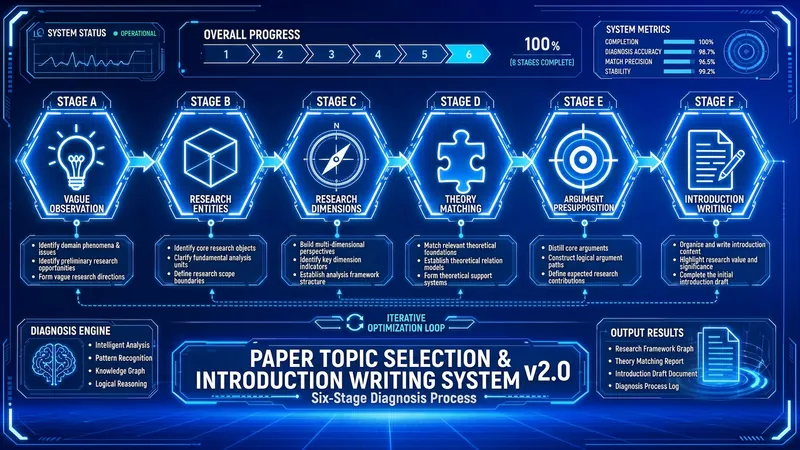 Research
Thesis Topic & Intro v3.2
Read in 10 seconds: turn a vague observation into a defensible topic, then into an introduction that can pass review. Throughout, it uses only the real materials you provide — no fabricated references. Trigger words: thesis topic, topic selection, introduction, research gap, academic writing, thesis proposal, topic selection before literature review. Applies to: journal papers / dissertations / conference papers / course papers, across all disciplines — humanities and social sciences, STEM, agriculture, medicine, and life sciences. Up and running in 3 minutes: lock in your discipline and starting point → shape the topic layer by layer → strict evidence-chain gate → module-by-module introduction → ratchet finalization. [Division of labor with other skills] The health check comes first, writing comes after, and polishing comes last. This skill handles the middle stretch: topic shaping + introduction draft. It does not write the full paper (that's the Academic Paper Full-Process Writing System v4.x), and it does not polish language sentence by sentence (that's the Academic Paper Three-Track Polishing System v8.x). [Six gates] 1. Discipline placement: classify into one of four categories — 1A humanities/arts, 1B social sciences, 2A STEM, 2B agriculture/medicine/life sciences — and load the corresponding red-line norms; for category 2B, ethics review status is always checked. 2. Stage positioning: are you at a vague observation, have a unit but no angle, have an object but no theory, lack a method, lack a viewpoint, or only lack an introduction? Start from the corresponding gate instead of starting over from scratch. 3. Topic shaping: research unit → dimension compass → theoretical perspective → research method → research viewpoint, locked layer by layer; before locking each layer, first judge whether the previous layer holds. 4. Strict evidence-chain gate: before the introduction, your references are registered into an M1/M2… material library, each entry verified on four elements — author/year/title/locator; if fewer than 3 references are registered in the conversation, the system refuses to generate the research-gap statement — not a downgrade, a refusal. 5. Module-by-module generation: the introduction is produced in five inverted-pyramid modules, and each module must be annotated with citation numbers [Mn]; no source, no sentence. 6. Ratchet finalization: only versions that have passed receive credit; qualifying modules are locked and no longer changed; scores only go up, never down. [Deliverables] A '[Topic Keyword] · Topic & Introduction' document + a sentence-level traceable citation mapping table + a ⚠️ to-verify checklist + an AFP archive code. The archive code works across four systems — the proposal health-checker, the v4.x full-process system, and the three-track polishing system — so switching skills doesn't require re-stating your discipline, topic, journal, or material library. [Explicitly not done] It does not fabricate authors, years, volumes, issues, page numbers, or DOIs; any bibliographic records retrieved online are marked ⚠️ to-verify and can only be written into the reference list after you verify them; it makes no promises of acceptance or passing review. Authorship and responsibility are yours — please verify every citation and data point.
 Write
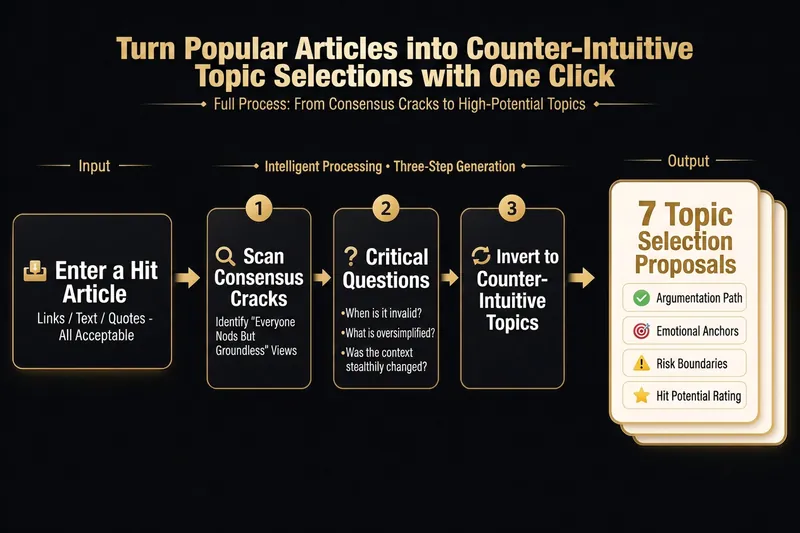
Write1 Post->3-7 Unexpected Topics
😤 Do you feel this too— You scroll through viral articles for an hour, save seven or eight, and feel like you've "learned." But when you sit down to come up with topics—your mind goes blank. Hundreds of articles in your bookmarks, and not one of them turns into your own content. You're not lacking material; you're lacking a method to "extract your own topics from others' viral posts." 🔍 Where's the problem— Inside every 100,000+ viral article, there are a few viewpoints that "most people nod along with, but actually don't hold up." Most people scroll past them. A few people pick these views out, think in reverse—and a new topic is born. The gap is in this one "deconstruction" action. 🛠️ How it helps you— 📥 Drop in a viral article link 🔬 Automatically scans the full text, picks out common consensus that "sounds right, but the conditions for truth are quietly stripped away" ❓ Dives into three key questions for each: ① Under what circumstances is it false? ② What does it oversimplify? ③ Which context did it sneak in from? 🔄 Reverses into 3–7 counterintuitive topic ideas 📊 Each comes with a complete output: ✅ Logical path — why this topic holds up ✅ Emotional hook audience — who it's for, what hits them ✅ Risk boundary — where you might go wrong ✅ 5‑dimensional viral score — how hard this topic can hit It doesn't give you a bunch of directions to think about; it gives you topics you can start writing on right away. ✍️ 🚀 Give it a try— Search for "1 Post->3-7 Unexpected Topics" in YouMind. Open it and drop a link to a viral article you've seen recently, and it will walk you through deconstructing it into topics. 🗂️ Supports deep dives on single articles + batch filtering 📎 Opinion pieces, experience sharing, tutorials, lists—works with any article type
 Write
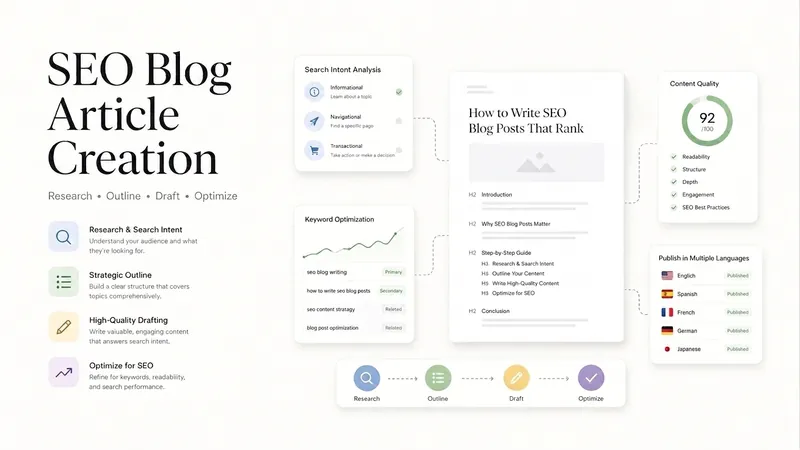
WriteBest SEO Blog Post Writer
Create high-quality, SEO-oriented blog posts for your products. Suitable for users who need to create English source drafts based on keywords or topics, emphasize information value, require online research for the latest facts, and need automatic generation of cover images and in-text illustrations.
MM-Article
Description
Why we love this skill
Ideal for deep content creators, this Skill accurately captures the latest hot topics and forward-looking signals from vast information, providing well-structured, traceable topic and article outlines to ensure content is both in-depth and timely.
A lightweight topic research and writing Skill based on sources from the last 3 days. It extracts anchor points (Anchor Bank) from your sources, then recommends 5 candidate topics (3 consensus hot topics + 2 forward-looking signals). After you select a topic, it deep-dives into materials and generates an editable outline. Only proceeds to full writing after you explicitly confirm the outline.
Related Skills
View allResearchThesis Topic & Intro v3.2
Read in 10 seconds: turn a vague observation into a defensible topic, then into an introduction that can pass review. Throughout, it uses only the real materials you provide — no fabricated references. Trigger words: thesis topic, topic selection, introduction, research gap, academic writing, thesis proposal, topic selection before literature review. Applies to: journal papers / dissertations / conference papers / course papers, across all disciplines — humanities and social sciences, STEM, agriculture, medicine, and life sciences. Up and running in 3 minutes: lock in your discipline and starting point → shape the topic layer by layer → strict evidence-chain gate → module-by-module introduction → ratchet finalization. [Division of labor with other skills] The health check comes first, writing comes after, and polishing comes last. This skill handles the middle stretch: topic shaping + introduction draft. It does not write the full paper (that's the Academic Paper Full-Process Writing System v4.x), and it does not polish language sentence by sentence (that's the Academic Paper Three-Track Polishing System v8.x). [Six gates] 1. Discipline placement: classify into one of four categories — 1A humanities/arts, 1B social sciences, 2A STEM, 2B agriculture/medicine/life sciences — and load the corresponding red-line norms; for category 2B, ethics review status is always checked. 2. Stage positioning: are you at a vague observation, have a unit but no angle, have an object but no theory, lack a method, lack a viewpoint, or only lack an introduction? Start from the corresponding gate instead of starting over from scratch. 3. Topic shaping: research unit → dimension compass → theoretical perspective → research method → research viewpoint, locked layer by layer; before locking each layer, first judge whether the previous layer holds. 4. Strict evidence-chain gate: before the introduction, your references are registered into an M1/M2… material library, each entry verified on four elements — author/year/title/locator; if fewer than 3 references are registered in the conversation, the system refuses to generate the research-gap statement — not a downgrade, a refusal. 5. Module-by-module generation: the introduction is produced in five inverted-pyramid modules, and each module must be annotated with citation numbers [Mn]; no source, no sentence. 6. Ratchet finalization: only versions that have passed receive credit; qualifying modules are locked and no longer changed; scores only go up, never down. [Deliverables] A '[Topic Keyword] · Topic & Introduction' document + a sentence-level traceable citation mapping table + a ⚠️ to-verify checklist + an AFP archive code. The archive code works across four systems — the proposal health-checker, the v4.x full-process system, and the three-track polishing system — so switching skills doesn't require re-stating your discipline, topic, journal, or material library. [Explicitly not done] It does not fabricate authors, years, volumes, issues, page numbers, or DOIs; any bibliographic records retrieved online are marked ⚠️ to-verify and can only be written into the reference list after you verify them; it makes no promises of acceptance or passing review. Authorship and responsibility are yours — please verify every citation and data point.
Write1 Post->3-7 Unexpected Topics
😤 Do you feel this too— You scroll through viral articles for an hour, save seven or eight, and feel like you've "learned." But when you sit down to come up with topics—your mind goes blank. Hundreds of articles in your bookmarks, and not one of them turns into your own content. You're not lacking material; you're lacking a method to "extract your own topics from others' viral posts." 🔍 Where's the problem— Inside every 100,000+ viral article, there are a few viewpoints that "most people nod along with, but actually don't hold up." Most people scroll past them. A few people pick these views out, think in reverse—and a new topic is born. The gap is in this one "deconstruction" action. 🛠️ How it helps you— 📥 Drop in a viral article link 🔬 Automatically scans the full text, picks out common consensus that "sounds right, but the conditions for truth are quietly stripped away" ❓ Dives into three key questions for each: ① Under what circumstances is it false? ② What does it oversimplify? ③ Which context did it sneak in from? 🔄 Reverses into 3–7 counterintuitive topic ideas 📊 Each comes with a complete output: ✅ Logical path — why this topic holds up ✅ Emotional hook audience — who it's for, what hits them ✅ Risk boundary — where you might go wrong ✅ 5‑dimensional viral score — how hard this topic can hit It doesn't give you a bunch of directions to think about; it gives you topics you can start writing on right away. ✍️ 🚀 Give it a try— Search for "1 Post->3-7 Unexpected Topics" in YouMind. Open it and drop a link to a viral article you've seen recently, and it will walk you through deconstructing it into topics. 🗂️ Supports deep dives on single articles + batch filtering 📎 Opinion pieces, experience sharing, tutorials, lists—works with any article type
WriteBest SEO Blog Post Writer
Create high-quality, SEO-oriented blog posts for your products. Suitable for users who need to create English source drafts based on keywords or topics, emphasize information value, require online research for the latest facts, and need automatic generation of cover images and in-text illustrations.
Find your next favorite skill
Explore more curated AI skills for research, creation, and everyday work.