Workplace Writing Assistant
Description
Covers high-frequency scenarios such as weekly reports, emails, presentations, meeting minutes, summaries, communication replies, and brainstorming for plans. Users only need to naturally describe their needs, and the skill will automatically identify the scenario, fill in key information, and generate a ready-to-send draft. It also supports further polishing and rewriting. Example usage: help me write a weekly report, help me organize meeting minutes, help me reply with a tactful message, rewrite this review into a leadership report version, give me 5 event plan ideas.
Related Skills
View all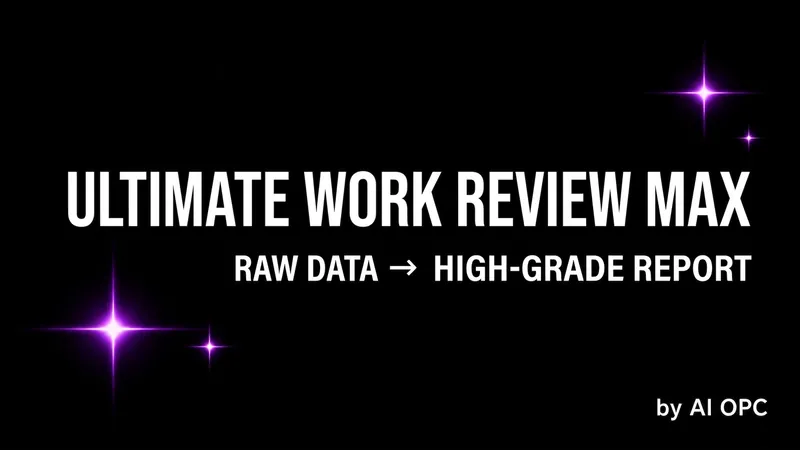
Work Review MAX: Logs→Review
Does your weekly report look like this: “Moved Project A forward this week, participated in discussions for Meeting B, supported the team with Request C, delivered xx documents, and will continue next week.” Your manager glances at it and moves on. It’s not that you didn’t work hard. It’s that you wrote a log, not a review. When evaluators review promotion materials and managers read monthly reports, they care about just five things: ① Why was this work worth doing? (judgment) ② What benchmark shows that the result was good? (data anchoring) ③ Which parts did “you” do, and which were done by the team? (contribution boundaries) ④ What reusable insight did you take away from the work? (growth curve) ⑤ What do you commit to delivering next cycle? (commitment mindset) 99% of review drafts fail to make even one of these clear. They just list features: “Iterated on X,” “launched Y,” “supported Z”—like a robot. This Skill is a structured compiler I refined through frontline business reviews as an AI OPC. Paste in your raw work log exactly as it is—no matter how messy or scattered—and it will produce a complete review that meets senior-level promotion and performance-review standards: 📊 One-line overall assessment (help readers understand your value in 30 seconds) 🎯 Key achievements (STAR + judgment-based narrative, not a feature list) 📈 Data benchmark table (with baselines, definitions, and your share of the contribution) 🧠 Methodology and lessons learned (showing your growth curve) 📅 Next-cycle plan (commitment-letter format, with measurable goals + deadlines + resource needs) ⚠️ Risks and support needed (surfacing risks shows ownership) 📋 Missing-data checklist (everything you need to look up, all at once) Bonus: ✓ Review of 3 key improvement areas (showing which weaknesses in the raw material were addressed) ✓ Defense-risk forecast (which points evaluators may challenge in a promotion review + suggested responses) ✓ Reusable template variables (make a few edits and reuse it next time) How is it different from a typical “AI weekly report” Skill? Others: Rephrase your work log and output it again—it’s still a work log. This one performs structural surgery on it, upgrading it from a “feature-listing format” to a “judgment-based narrative.” What it will never do: ✗ It will not invent data—anything you didn’t provide is marked “needs to be added,” with no made-up numbers ✗ It will not write filler like “As an AI,” “In conclusion,” or “Thank you, leadership” ✗ It will not flatter you or ask, “Can you tell me more?” It gets straight to work Who should use it: People tired of weekly reports and hoping to log off early P6→P7 / M1→M2 / mid-level→senior professionals aiming for promotion Anyone facing a midyear or annual performance review with materials still unwritten Project leads who need to write quarterly reviews for managers, evaluators, or clients Anyone who works hard and wants their work to be truly seen Doing good work doesn’t automatically mean you know how to report it. With the same workload, people who know how to write effective reviews get promoted a year faster. Use it for your next weekly report and make your work visible.

Email Writing V2.0
Email Writing Description: Professional business email writing skills covering 6 major scenarios: daily work emails, meeting invitations, project reports, client communication, job applications, apologies and complaints. Includes 5-part structure (subject, salutation, body, closing, signature), etiquette guidelines (China-US differences), 10 common email type templates, 20 subject line templates, salutation and closing etiquette library, attachment and CC rules, and tips to avoid pitfalls. Applicable for: (1) business workplace emails, (2) cross-cultural communication emails, (3) job application emails, (4) client communication emails. Trigger keywords: email, email, business email, cover letter, meeting invitation, client email, project report, apology, complaint, cc, CC, subject line, email etiquette.

Weekly Report Writing
High-quality weekly, daily, and monthly report writing skills, covering 4 main scenarios: regular reports, project reports, R&D reports, and management reports. Includes a 5-section golden structure (this week's accomplishments, progress data, issues and risks, next week's plan, support needed), OKR progress tracking, quantified language library, issue prioritization, risk warnings, 6 common mistakes to avoid, and cross-department communication scripts. Applicable to: (1) Weekly reports for internet/tech company employees, (2) R&D team weekly reports, (3) Middle management weekly reports, (4) Startup team weekly reports. Trigger keywords: weekly report, weekly plan, weekly, daily report, monthly report, OKR progress, project weekly report, team weekly report, management report.
Workplace Writing Assistant
Description
Covers high-frequency scenarios such as weekly reports, emails, presentations, meeting minutes, summaries, communication replies, and brainstorming for plans. Users only need to naturally describe their needs, and the skill will automatically identify the scenario, fill in key information, and generate a ready-to-send draft. It also supports further polishing and rewriting. Example usage: help me write a weekly report, help me organize meeting minutes, help me reply with a tactful message, rewrite this review into a leadership report version, give me 5 event plan ideas.
Related Skills
View allWork Review MAX: Logs→Review
Does your weekly report look like this: “Moved Project A forward this week, participated in discussions for Meeting B, supported the team with Request C, delivered xx documents, and will continue next week.” Your manager glances at it and moves on. It’s not that you didn’t work hard. It’s that you wrote a log, not a review. When evaluators review promotion materials and managers read monthly reports, they care about just five things: ① Why was this work worth doing? (judgment) ② What benchmark shows that the result was good? (data anchoring) ③ Which parts did “you” do, and which were done by the team? (contribution boundaries) ④ What reusable insight did you take away from the work? (growth curve) ⑤ What do you commit to delivering next cycle? (commitment mindset) 99% of review drafts fail to make even one of these clear. They just list features: “Iterated on X,” “launched Y,” “supported Z”—like a robot. This Skill is a structured compiler I refined through frontline business reviews as an AI OPC. Paste in your raw work log exactly as it is—no matter how messy or scattered—and it will produce a complete review that meets senior-level promotion and performance-review standards: 📊 One-line overall assessment (help readers understand your value in 30 seconds) 🎯 Key achievements (STAR + judgment-based narrative, not a feature list) 📈 Data benchmark table (with baselines, definitions, and your share of the contribution) 🧠 Methodology and lessons learned (showing your growth curve) 📅 Next-cycle plan (commitment-letter format, with measurable goals + deadlines + resource needs) ⚠️ Risks and support needed (surfacing risks shows ownership) 📋 Missing-data checklist (everything you need to look up, all at once) Bonus: ✓ Review of 3 key improvement areas (showing which weaknesses in the raw material were addressed) ✓ Defense-risk forecast (which points evaluators may challenge in a promotion review + suggested responses) ✓ Reusable template variables (make a few edits and reuse it next time) How is it different from a typical “AI weekly report” Skill? Others: Rephrase your work log and output it again—it’s still a work log. This one performs structural surgery on it, upgrading it from a “feature-listing format” to a “judgment-based narrative.” What it will never do: ✗ It will not invent data—anything you didn’t provide is marked “needs to be added,” with no made-up numbers ✗ It will not write filler like “As an AI,” “In conclusion,” or “Thank you, leadership” ✗ It will not flatter you or ask, “Can you tell me more?” It gets straight to work Who should use it: People tired of weekly reports and hoping to log off early P6→P7 / M1→M2 / mid-level→senior professionals aiming for promotion Anyone facing a midyear or annual performance review with materials still unwritten Project leads who need to write quarterly reviews for managers, evaluators, or clients Anyone who works hard and wants their work to be truly seen Doing good work doesn’t automatically mean you know how to report it. With the same workload, people who know how to write effective reviews get promoted a year faster. Use it for your next weekly report and make your work visible.
Email Writing V2.0
Email Writing Description: Professional business email writing skills covering 6 major scenarios: daily work emails, meeting invitations, project reports, client communication, job applications, apologies and complaints. Includes 5-part structure (subject, salutation, body, closing, signature), etiquette guidelines (China-US differences), 10 common email type templates, 20 subject line templates, salutation and closing etiquette library, attachment and CC rules, and tips to avoid pitfalls. Applicable for: (1) business workplace emails, (2) cross-cultural communication emails, (3) job application emails, (4) client communication emails. Trigger keywords: email, email, business email, cover letter, meeting invitation, client email, project report, apology, complaint, cc, CC, subject line, email etiquette.
Weekly Report Writing
High-quality weekly, daily, and monthly report writing skills, covering 4 main scenarios: regular reports, project reports, R&D reports, and management reports. Includes a 5-section golden structure (this week's accomplishments, progress data, issues and risks, next week's plan, support needed), OKR progress tracking, quantified language library, issue prioritization, risk warnings, 6 common mistakes to avoid, and cross-department communication scripts. Applicable to: (1) Weekly reports for internet/tech company employees, (2) R&D team weekly reports, (3) Middle management weekly reports, (4) Startup team weekly reports. Trigger keywords: weekly report, weekly plan, weekly, daily report, monthly report, OKR progress, project weekly report, team weekly report, management report.
Find your next favorite skill
Explore more curated AI skills for research, creation, and everyday work.