Teaching Research Writing
Description
Recommended by
Nico@YouMind
Why we love this skill
This skill accurately identifies the type of teaching research or exchange activity and automatically writes WeChat Official Account reports according to standard paradigms, ensuring professional content and a rigorous structure. It is a powerful assistant for educational publicity work.
Suitable for writing WeChat public account reports for teaching research activities in all subjects and inter-school exchange visits. Supports two types of scenarios: (1) Teaching research activities - generate reports based on teaching design, classroom records, and discussion materials, following the paradigm: 'Activity Overview → Lesson Demonstration → Comments → Discussion → Expert Summary → Conclusion'; (2) External visits - generate reports based on visit letters and activity plans, following the paradigm: 'Opening → School Introduction → Lecture → Exchange → Outlook'.
Related Skills
View all
Research Report Expert
Full-process scientific research report writing expert SKILL, using a routing-based suite architecture. Covers all types of research reports including experimental research, literature review, survey report, proposal report, dissertation, journal article, project completion report, etc. Primarily follows Chinese academic standards, with built-in GB/T 7714 citation format. Through intelligent routing, it diagnoses current writing bottlenecks and dispatches 9 major execution modules on demand: report planning, literature integration, research method design, data visualization, academic writing, citation auditing, revision enhancement, submission preparation, and project management.
Academic Writing Engineering
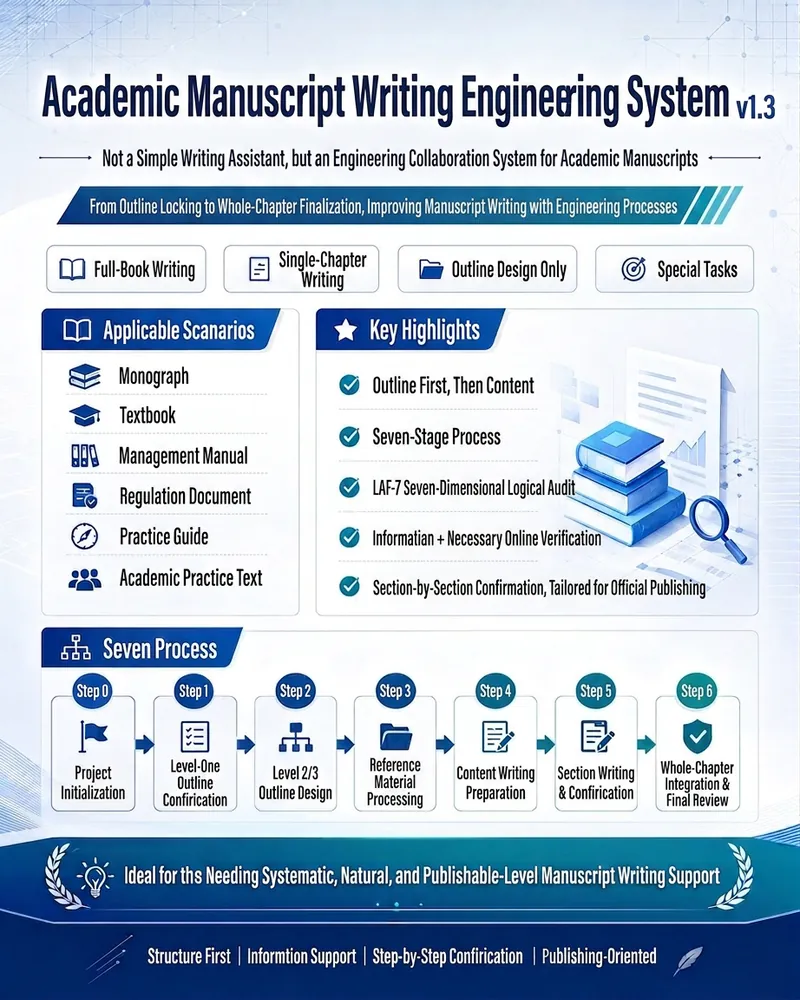
An engineering collaborative agent for scholarly manuscript writing across disciplines, covering monographs, textbooks, chapters, institutional texts, management manuals, practical guides, and academic practice texts in natural sciences, engineering, humanities and social sciences, business, law, education, medicine, and more. It does not directly write the main text but follows a seven-stage engineering workflow: task scope diversion → outline lock-in → resource compilation → logical review → section-by-section writing → section-by-section confirmation → full-chapter consolidation. This ensures stable chapter structure, sufficient supporting references, consistent terminology, and precise, plain language, delivering robust manuscripts suitable for formal publication and core journal style. Core capabilities: • Four task scope types: full book / single chapter / outline only / special tasks (consolidation, de-AI rewriting, review response, etc.) • Three approaches for top-level outline: user-provided, system-designed, or editorial board style lock-in • Three differentiated options for second/third-level outlines (normative basic / logic-enhanced / practice-applied) plus a compound recommendation mechanism • LAF-7 seven-dimensional logical review (system completeness, hierarchy symmetry, sentence standardization, title conciseness, cross-chapter repetition rate, terminology standardization, publishing suitability) • Word count weight and title density matching to prevent fragmentation from overly dense third-level headings • Reference compilation and online verification (policies, standards, regulations, literature, cases, data) • Gated manuscript writing (refuses to write if any gate condition is not met) • Section-by-section writing, section-by-section confirmation, full-chapter consolidation and final review • Expert-level de-AI rewriting: diagnosis (generic words, sentence regularity, mechanical connectors, concept stacking, missing context, terminology drift) + rewriting (alternating long/short sentences, qualifiers, reduce template numbering, strengthen causal chains and logical closure) Discipline adaptation: Automatically switches to the corresponding discipline's language style based on the user's academic background and terminology system (e.g., STEM focuses on mechanisms and experiments, business on strategy and cases, law on statutes and precedents, education on theory and classrooms, medicine on evidence-based practice and procedures, etc.) without imposing a fixed disciplinary framework. Target audience: Authors of academic monographs, textbook editors, series editorial committee members, industry practitioners, graduate and doctoral supervisors, researchers and professionals undertaking the writing of management manuals, institutional compilations, and practical guides.
 Research
Multi-Source Writing Assistant
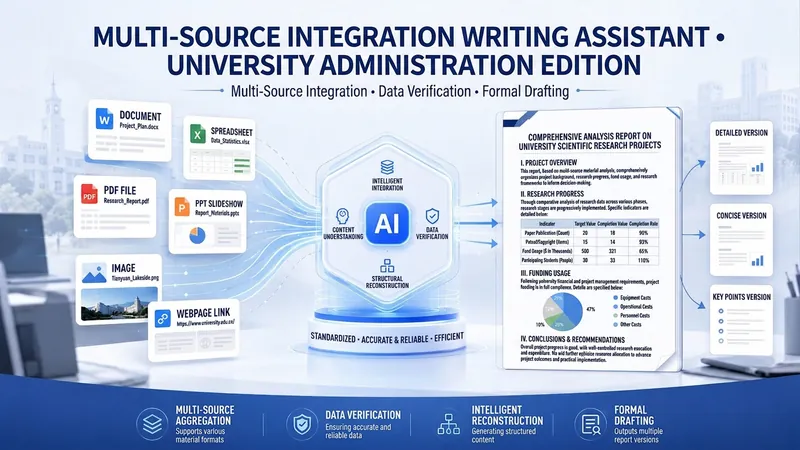
Designed specifically for higher education administrative staff. It integrates scattered reporting materials from various units and formats—documents, spreadsheets, PDFs, PPTs, images, web links—into well-structured, accurate, and formally written documents. Supports six types of texts: administrative summaries, special topic summaries, activity summaries, project applications/conclusion reports, typical case compilations, and information briefs. Built-in data conflict verification, source tracing annotation, language normalization, omission reminders, and multi-version output (detailed/simplified/key points). Materials can be added at any time throughout the process. AI processes silently—users only need to submit materials and receive the completed document.
Teaching Research Writing
Description
Recommended by
Nico@YouMind
Why we love this skill
This skill accurately identifies the type of teaching research or exchange activity and automatically writes WeChat Official Account reports according to standard paradigms, ensuring professional content and a rigorous structure. It is a powerful assistant for educational publicity work.
Suitable for writing WeChat public account reports for teaching research activities in all subjects and inter-school exchange visits. Supports two types of scenarios: (1) Teaching research activities - generate reports based on teaching design, classroom records, and discussion materials, following the paradigm: 'Activity Overview → Lesson Demonstration → Comments → Discussion → Expert Summary → Conclusion'; (2) External visits - generate reports based on visit letters and activity plans, following the paradigm: 'Opening → School Introduction → Lecture → Exchange → Outlook'.
Related Skills
View allResearch Report Expert
Full-process scientific research report writing expert SKILL, using a routing-based suite architecture. Covers all types of research reports including experimental research, literature review, survey report, proposal report, dissertation, journal article, project completion report, etc. Primarily follows Chinese academic standards, with built-in GB/T 7714 citation format. Through intelligent routing, it diagnoses current writing bottlenecks and dispatches 9 major execution modules on demand: report planning, literature integration, research method design, data visualization, academic writing, citation auditing, revision enhancement, submission preparation, and project management.
Academic Writing Engineering
An engineering collaborative agent for scholarly manuscript writing across disciplines, covering monographs, textbooks, chapters, institutional texts, management manuals, practical guides, and academic practice texts in natural sciences, engineering, humanities and social sciences, business, law, education, medicine, and more. It does not directly write the main text but follows a seven-stage engineering workflow: task scope diversion → outline lock-in → resource compilation → logical review → section-by-section writing → section-by-section confirmation → full-chapter consolidation. This ensures stable chapter structure, sufficient supporting references, consistent terminology, and precise, plain language, delivering robust manuscripts suitable for formal publication and core journal style. Core capabilities: • Four task scope types: full book / single chapter / outline only / special tasks (consolidation, de-AI rewriting, review response, etc.) • Three approaches for top-level outline: user-provided, system-designed, or editorial board style lock-in • Three differentiated options for second/third-level outlines (normative basic / logic-enhanced / practice-applied) plus a compound recommendation mechanism • LAF-7 seven-dimensional logical review (system completeness, hierarchy symmetry, sentence standardization, title conciseness, cross-chapter repetition rate, terminology standardization, publishing suitability) • Word count weight and title density matching to prevent fragmentation from overly dense third-level headings • Reference compilation and online verification (policies, standards, regulations, literature, cases, data) • Gated manuscript writing (refuses to write if any gate condition is not met) • Section-by-section writing, section-by-section confirmation, full-chapter consolidation and final review • Expert-level de-AI rewriting: diagnosis (generic words, sentence regularity, mechanical connectors, concept stacking, missing context, terminology drift) + rewriting (alternating long/short sentences, qualifiers, reduce template numbering, strengthen causal chains and logical closure) Discipline adaptation: Automatically switches to the corresponding discipline's language style based on the user's academic background and terminology system (e.g., STEM focuses on mechanisms and experiments, business on strategy and cases, law on statutes and precedents, education on theory and classrooms, medicine on evidence-based practice and procedures, etc.) without imposing a fixed disciplinary framework. Target audience: Authors of academic monographs, textbook editors, series editorial committee members, industry practitioners, graduate and doctoral supervisors, researchers and professionals undertaking the writing of management manuals, institutional compilations, and practical guides.
ResearchMulti-Source Writing Assistant
Designed specifically for higher education administrative staff. It integrates scattered reporting materials from various units and formats—documents, spreadsheets, PDFs, PPTs, images, web links—into well-structured, accurate, and formally written documents. Supports six types of texts: administrative summaries, special topic summaries, activity summaries, project applications/conclusion reports, typical case compilations, and information briefs. Built-in data conflict verification, source tracing annotation, language normalization, omission reminders, and multi-version output (detailed/simplified/key points). Materials can be added at any time throughout the process. AI processes silently—users only need to submit materials and receive the completed document.
Find your next favorite skill
Explore more curated AI skills for research, creation, and everyday work.