Management Deep Dissector
Description
This is a deep reading and deconstruction Skill for management academic research. It is suitable for Chinese core, CSSCI, SSCI/SCI management papers, especially empirical research in areas such as organizational behavior, human resources, strategic management, marketing, innovation and entrepreneurship, digital platform governance, and education management. The goal of this Skill is not simply to summarize the paper, but to break it down into reusable research components: research question, theoretical foundation, logic chain, hypothesis structure, variable design, measurement method, sample and methodology, result interpretation, theoretical contribution, practical implications, limitations, and future research. It further refines these into transferable "writing templates" and "topic selection templates" for users.
Related Skills
View all
Mgmt Read & Mech Dissect v2
This is an advanced analysis Skill for management empirical research, applicable to Chinese core journals, CSSCI, SSCI/SCI management papers, focusing on quantitative research in fields such as organizational behavior, human resource management, strategic management, marketing management, innovation and entrepreneurship, digital governance, and education management.
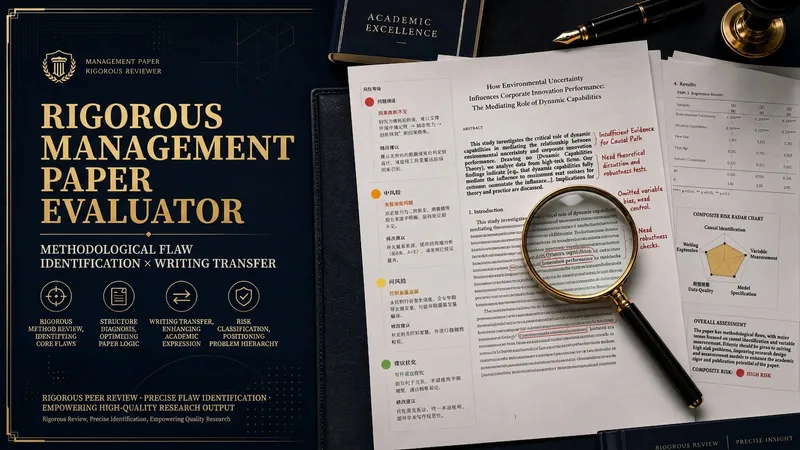
Management Paper Strict Review
Have you encountered these problems? ❌ You cited a seemingly authoritative paper, only to have reviewers question, 'This study has severe endogeneity issues.' ❌ When writing a literature review, you're unsure whether a paper's conclusions are trustworthy. ❌ After reading dozens of papers, you still don't know how to apply others' writing techniques to your own paper. ❌ Before submission, you want to check for methodological risks but don't know which hard flaws top journal reviewers focus on. This Skill helps you: ✅ Quick mode (15–25 min): Determine whether a paper is worth reading in depth and can be cited confidently. ✅ Deep mode (45–60 min): Check methodological flaws item by item like an AMJ/ASQ/SMJ reviewer. ✅ Quantitative credibility rating: 🔴 Not citable / 🟠 Use with caution / 🟡 Reference only / 🟢 Safe to cite – at a glance. ✅ Writing transfer task card: Turn techniques from others' papers into executable tasks for your own Introduction/Methods/Results/Discussion sections. Covers seven methodology types: Quantitative regression, experimental studies, quasi-experimental causal identification, fsQCA, case studies, grounded theory, mixed methods. Output includes: - Six-area deep reading (theoretical dialogue, mechanism pathways, construct operationalization, method-data fit, contribution critique, writing techniques) - P1/P2/P3 risk levels (fatal/important/arguable) - Counterfactual testing (can the model explain reverse scenarios?) - Boundary condition check (5 dimensions: market/regulation/capital/technology/competition) - Writing transfer task card (specific techniques directly applicable to your own paper) In a nutshell: It is not a gentle paper summarizer. It's a strict academic writing assistant that helps you discover, 'Where can't this paper be trusted? What is worth learning from it? How can I apply it to my paper?' Suitable for you if you are: 📚 PhD/master's students writing literature reviews 📝 Management researchers preparing submissions to top journals 🔍 Reviewers needing quick paper quality assessments 📖 Paper writers wanting to learn top journal writing techniques

Research Paper Deconstruction
Submit an empirical research paper and receive a deep deconstruction report to help you master the essence of academic writing. This tool is based on the methodology of 'Deconstructing Papers: Understanding Academic Writing through Close Reading,' systematically analyzing the paper from diagnosing the research question, constructing the GAP, connecting theory and materials, to sentence-by-sentence close reading of key paragraphs, layer by layer, revealing the internal logic and writing techniques of the paper. You will receive a structured analysis report that includes an assessment of the specificity and essential nature of the research question, tracking of the GAP logical chain and identification of its strategy type, as well as a detailed examination of the quality of the 'two-way' connection between theory and real-world materials. The report will also specially select the strongest and weakest paragraphs, providing sentence-by-sentence logical function annotations and technique comments, and offering specific revision suggestions for areas that can be improved. This report not only helps you understand the writing secrets of high-level papers but also points out common writing mistakes, allowing you to learn while reading and improve while analyzing. Whether evaluating the depth of the research question, optimizing the narrative of the literature review, or enhancing the rigor of the discussion section, this tool provides powerful guidance to help you write more insightful and persuasive academic works.
Management Deep Dissector
Description
This is a deep reading and deconstruction Skill for management academic research. It is suitable for Chinese core, CSSCI, SSCI/SCI management papers, especially empirical research in areas such as organizational behavior, human resources, strategic management, marketing, innovation and entrepreneurship, digital platform governance, and education management. The goal of this Skill is not simply to summarize the paper, but to break it down into reusable research components: research question, theoretical foundation, logic chain, hypothesis structure, variable design, measurement method, sample and methodology, result interpretation, theoretical contribution, practical implications, limitations, and future research. It further refines these into transferable "writing templates" and "topic selection templates" for users.
Related Skills
View allMgmt Read & Mech Dissect v2
This is an advanced analysis Skill for management empirical research, applicable to Chinese core journals, CSSCI, SSCI/SCI management papers, focusing on quantitative research in fields such as organizational behavior, human resource management, strategic management, marketing management, innovation and entrepreneurship, digital governance, and education management.
Management Paper Strict Review
Have you encountered these problems? ❌ You cited a seemingly authoritative paper, only to have reviewers question, 'This study has severe endogeneity issues.' ❌ When writing a literature review, you're unsure whether a paper's conclusions are trustworthy. ❌ After reading dozens of papers, you still don't know how to apply others' writing techniques to your own paper. ❌ Before submission, you want to check for methodological risks but don't know which hard flaws top journal reviewers focus on. This Skill helps you: ✅ Quick mode (15–25 min): Determine whether a paper is worth reading in depth and can be cited confidently. ✅ Deep mode (45–60 min): Check methodological flaws item by item like an AMJ/ASQ/SMJ reviewer. ✅ Quantitative credibility rating: 🔴 Not citable / 🟠 Use with caution / 🟡 Reference only / 🟢 Safe to cite – at a glance. ✅ Writing transfer task card: Turn techniques from others' papers into executable tasks for your own Introduction/Methods/Results/Discussion sections. Covers seven methodology types: Quantitative regression, experimental studies, quasi-experimental causal identification, fsQCA, case studies, grounded theory, mixed methods. Output includes: - Six-area deep reading (theoretical dialogue, mechanism pathways, construct operationalization, method-data fit, contribution critique, writing techniques) - P1/P2/P3 risk levels (fatal/important/arguable) - Counterfactual testing (can the model explain reverse scenarios?) - Boundary condition check (5 dimensions: market/regulation/capital/technology/competition) - Writing transfer task card (specific techniques directly applicable to your own paper) In a nutshell: It is not a gentle paper summarizer. It's a strict academic writing assistant that helps you discover, 'Where can't this paper be trusted? What is worth learning from it? How can I apply it to my paper?' Suitable for you if you are: 📚 PhD/master's students writing literature reviews 📝 Management researchers preparing submissions to top journals 🔍 Reviewers needing quick paper quality assessments 📖 Paper writers wanting to learn top journal writing techniques
Research Paper Deconstruction
Submit an empirical research paper and receive a deep deconstruction report to help you master the essence of academic writing. This tool is based on the methodology of 'Deconstructing Papers: Understanding Academic Writing through Close Reading,' systematically analyzing the paper from diagnosing the research question, constructing the GAP, connecting theory and materials, to sentence-by-sentence close reading of key paragraphs, layer by layer, revealing the internal logic and writing techniques of the paper. You will receive a structured analysis report that includes an assessment of the specificity and essential nature of the research question, tracking of the GAP logical chain and identification of its strategy type, as well as a detailed examination of the quality of the 'two-way' connection between theory and real-world materials. The report will also specially select the strongest and weakest paragraphs, providing sentence-by-sentence logical function annotations and technique comments, and offering specific revision suggestions for areas that can be improved. This report not only helps you understand the writing secrets of high-level papers but also points out common writing mistakes, allowing you to learn while reading and improve while analyzing. Whether evaluating the depth of the research question, optimizing the narrative of the literature review, or enhancing the rigor of the discussion section, this tool provides powerful guidance to help you write more insightful and persuasive academic works.
Find your next favorite skill
Explore more curated AI skills for research, creation, and everyday work.