
Top 10 Cognitive Bias Shield
1
Description
Enable this skill when tasks involve objective judgment, decision analysis, content creation, knowledge organization, design review, pricing strategy, or logical reasoning. It enforces comprehensive resistance against cognitive biases—with confirmation bias as the central challenge—while systematically defeating anchoring, survivorship bias, the Dunning–Kruger effect, loss aversion, the planning fallacy, and the halo effect. Use this skill when output quality depends on rationality, truth, and freedom from mental shortcuts rather than intuition or preference.
Related Skills
View all
Plan Vulnerability Scanner
🛡️ **One-sentence value**: Enter your plan, proposal, or decision, and an AI red-team expert systematically surfaces every potential vulnerability, so you can see the risk before you fail. 🔍 **Core features**: - **Five-dimensional red-team scan**: logical assumptions, market and users, competition and substitutes, execution and resources, finance and profitability—attack from every angle - **Severity rating**: Critical🔴 / High🟠 / Medium🟡 / Low🟢—so you know what to tackle first - **Transparent attack logic**: every risk point includes the red team's reasoning, not guesswork - **Scoring system**: independent score for each of the five dimensions + an overall confidence score - **Actionable mitigation recommendations**: not just criticism—it tells you what to do 🎯 **Use cases**: - 📄 Business plan/BP: plug all logic gaps before meeting investors - 🚀 New product/feature planning: run a red-team test before launch to avoid pitfalls - 📊 Strategic decisions: assess risks in major decisions such as market entry, M&A, and transformation - 💰 Fundraising/budget proposals: find the most fragile assumptions in financial forecasts - 🏗️ Project execution plans: spot traps on the execution path before work begins 👩💼 **Who it's for**: founders, product managers, strategy leads, investors, project managers—anyone who needs to make decisions based on a plan.
CogMirror|YouMind ThinkPrint
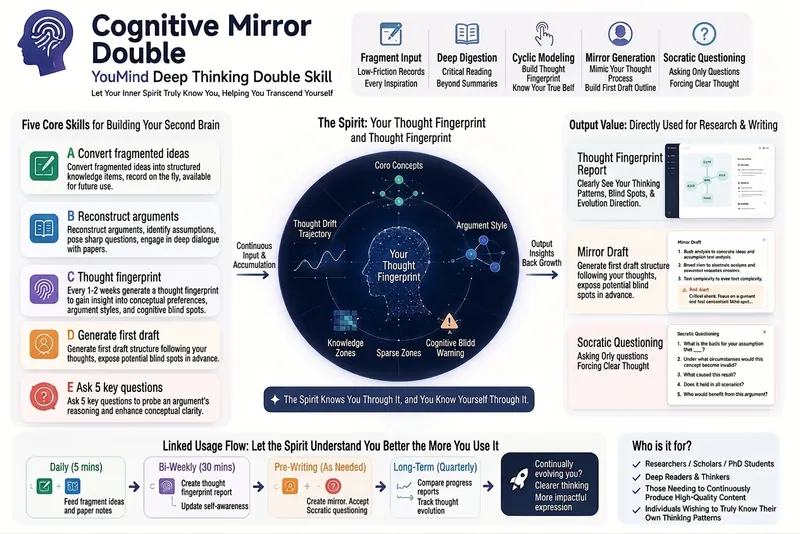
Cognitive Mirror is not just an ordinary note-taking tool; it is a personal cognitive modeling Skill for deep thinkers. It uses 'low-friction input, periodic modeling, mirror generation, and Socratic questioning' as its core mechanisms to help you continuously turn daily fragmented thoughts, paper reading notes, research judgments, and writing inspiration into personal knowledge assets that can be accumulated, reflected upon, and recalled. The system has five built-in lightweight Skills: Fragmented Note Digester: structures scattered ideas; Paper Critical Reader: helps you reconstruct arguments, identify assumptions, and ask sharp questions; Thinking Fingerprint Generator: periodically analyzes your conceptual preferences, argumentation style, and cognitive blind spots; Mirror Draft Generator: generates initial frameworks that 'read like you wrote them' based on your thinking patterns; Socratic Questioner: specifically attacks the weakest points of an argument. It does not think for you, but continuously trains your second brain, allowing your knowledge base to gradually develop its own judgment, problem awareness, and writing style.

Skill Judge
Evaluate any AI skill you want to assess—an installed skill, a marketplace page or SKILL.md text, or a spoken description of your needs. Following the principle of “test it, don’t judge by description,” Skill Judge creates a customized minimum test set with four positive, one negative, and one ambiguous use case for live verification. If the skill can be run, it is tested on the spot; otherwise, the entire process is marked 【Static evaluation】 and the findings are weighted accordingly. The output begins with a conclusion and includes a five-dimension weighted scorecard: trigger reliability (30%), execution effectiveness (25%), cost efficiency (15%), robustness and boundaries (15%), and safety and trustworthiness (15%). Overall scores are classified as ≥80: retain; 60–80: targeted refinement; <60: redo. It also identifies the causes of weaknesses—description, steps, final self-check, or length—and provides prioritized improvement suggestions. By default, you get a one-page rapid-test conclusion. Say “deep review” to upgrade to a full diagnostic report with three consecutive runs of the same task for a stability comparison, plus online verification of the source and author’s reputation. Results are automatically filed in the “Skill Evaluation Reports” group. Use it to screen skills before installing them from the marketplace, quality-check skills you create, or re-evaluate installed skills.
Top 10 Cognitive Bias Shield
1
Description
Enable this skill when tasks involve objective judgment, decision analysis, content creation, knowledge organization, design review, pricing strategy, or logical reasoning. It enforces comprehensive resistance against cognitive biases—with confirmation bias as the central challenge—while systematically defeating anchoring, survivorship bias, the Dunning–Kruger effect, loss aversion, the planning fallacy, and the halo effect. Use this skill when output quality depends on rationality, truth, and freedom from mental shortcuts rather than intuition or preference.
Related Skills
View allPlan Vulnerability Scanner
🛡️ **One-sentence value**: Enter your plan, proposal, or decision, and an AI red-team expert systematically surfaces every potential vulnerability, so you can see the risk before you fail. 🔍 **Core features**: - **Five-dimensional red-team scan**: logical assumptions, market and users, competition and substitutes, execution and resources, finance and profitability—attack from every angle - **Severity rating**: Critical🔴 / High🟠 / Medium🟡 / Low🟢—so you know what to tackle first - **Transparent attack logic**: every risk point includes the red team's reasoning, not guesswork - **Scoring system**: independent score for each of the five dimensions + an overall confidence score - **Actionable mitigation recommendations**: not just criticism—it tells you what to do 🎯 **Use cases**: - 📄 Business plan/BP: plug all logic gaps before meeting investors - 🚀 New product/feature planning: run a red-team test before launch to avoid pitfalls - 📊 Strategic decisions: assess risks in major decisions such as market entry, M&A, and transformation - 💰 Fundraising/budget proposals: find the most fragile assumptions in financial forecasts - 🏗️ Project execution plans: spot traps on the execution path before work begins 👩💼 **Who it's for**: founders, product managers, strategy leads, investors, project managers—anyone who needs to make decisions based on a plan.
CogMirror|YouMind ThinkPrint
Cognitive Mirror is not just an ordinary note-taking tool; it is a personal cognitive modeling Skill for deep thinkers. It uses 'low-friction input, periodic modeling, mirror generation, and Socratic questioning' as its core mechanisms to help you continuously turn daily fragmented thoughts, paper reading notes, research judgments, and writing inspiration into personal knowledge assets that can be accumulated, reflected upon, and recalled. The system has five built-in lightweight Skills: Fragmented Note Digester: structures scattered ideas; Paper Critical Reader: helps you reconstruct arguments, identify assumptions, and ask sharp questions; Thinking Fingerprint Generator: periodically analyzes your conceptual preferences, argumentation style, and cognitive blind spots; Mirror Draft Generator: generates initial frameworks that 'read like you wrote them' based on your thinking patterns; Socratic Questioner: specifically attacks the weakest points of an argument. It does not think for you, but continuously trains your second brain, allowing your knowledge base to gradually develop its own judgment, problem awareness, and writing style.
Skill Judge
Evaluate any AI skill you want to assess—an installed skill, a marketplace page or SKILL.md text, or a spoken description of your needs. Following the principle of “test it, don’t judge by description,” Skill Judge creates a customized minimum test set with four positive, one negative, and one ambiguous use case for live verification. If the skill can be run, it is tested on the spot; otherwise, the entire process is marked 【Static evaluation】 and the findings are weighted accordingly. The output begins with a conclusion and includes a five-dimension weighted scorecard: trigger reliability (30%), execution effectiveness (25%), cost efficiency (15%), robustness and boundaries (15%), and safety and trustworthiness (15%). Overall scores are classified as ≥80: retain; 60–80: targeted refinement; <60: redo. It also identifies the causes of weaknesses—description, steps, final self-check, or length—and provides prioritized improvement suggestions. By default, you get a one-page rapid-test conclusion. Say “deep review” to upgrade to a full diagnostic report with three consecutive runs of the same task for a stability comparison, plus online verification of the source and author’s reputation. Results are automatically filed in the “Skill Evaluation Reports” group. Use it to screen skills before installing them from the marketplace, quality-check skills you create, or re-evaluate installed skills.
Find your next favorite skill
Explore more curated AI skills for research, creation, and everyday work.