Wanwei Steel Writing Engine
Description
A narrative writing engine based on Wanwei Steel's cognitive arc, using the main narrative framework of 'make readers feel safe → prove you are right but not enough'. It integrates Mimeng-style story enhancement (scenario-based, story-first, case density) and Liu Run-style concept translation (analogy anchoring, transition precision, paragraph closure) to reorganize the narrative logic of a long draft that has completed style calibration. Delivered in two steps: first, output a restructured outline (with analysis of differences from the original), and after user confirmation, generate the complete restructured article.
Related Skills
View all
Gladwell-Style Narrative Engine
Based on Malcolm Gladwell's nonfiction narrative methodology, it restructures the narrative logic of a long-form draft that has already undergone style calibration. Without changing the author's persona tone, it prioritizes narrative tension by constructing counterintuitive hooks, modeling proxies, implanting interdisciplinary concepts, and using a five-act dramatic arc to transform a straightforward article into a deep long-read with strong suspense, character arcs, and cognitive gaps. Two-step delivery: first output a restructuring outline (with analysis of differences from the original), then generate the full restructured article after user confirmation.
 Write
WriteBrilliant Viral Engine Pro
The Brilliant Viral Engine Pro turns fragments of ideas, materials, or trending topics into high-quality deep articles that spread widely on WeChat Official Accounts. It's not just a text generator—it's a content strategy expert that understands algorithms and human psychology. It precisely captures readers' emotional pain points, using a combination of counterintuitive insights, hardcore simplification, emotional mouthpieces, and other styles to give every article a unique 'real person' feel and social sharing value. This skill has a complete viral article incubation process. Starting with initial material diagnosis, it analyzes core ideas and emotional triggers, offering multiple differentiated angles for you to choose from. Then, based on the chosen direction, it matches high-win-rate headline formulas, designs a 'fold line' opening suited for mobile reading, and embeds completion hooks in the body to ensure readers finish in one sitting. Whether it's career growth, business commentary, or emotional resonance topics, it maintains information density while using golden sentence extraction and emotional impetus at the end to stimulate readers' likes, shares, and recommendations. To completely eliminate the 'AI feel,' the engine has strict de-robotization rules, rejecting empty grand narratives and mechanical parallel structures. It prefers specific scene descriptions and a genuine tone, explaining experiences as if chatting with a friend. Finally, you get a complete work including a title, summary, body text, and engagement guide to help you stand out in the competitive traffic race on WeChat Official Accounts.
Academic Writing Engineering
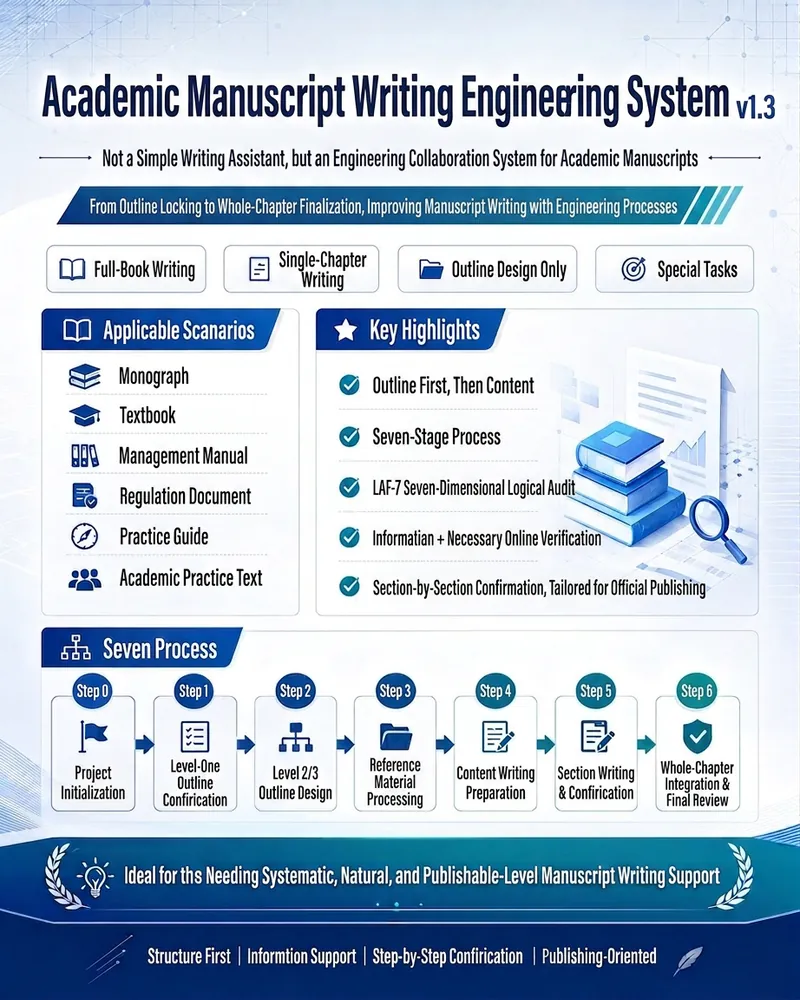
An engineering collaborative agent for scholarly manuscript writing across disciplines, covering monographs, textbooks, chapters, institutional texts, management manuals, practical guides, and academic practice texts in natural sciences, engineering, humanities and social sciences, business, law, education, medicine, and more. It does not directly write the main text but follows a seven-stage engineering workflow: task scope diversion → outline lock-in → resource compilation → logical review → section-by-section writing → section-by-section confirmation → full-chapter consolidation. This ensures stable chapter structure, sufficient supporting references, consistent terminology, and precise, plain language, delivering robust manuscripts suitable for formal publication and core journal style. Core capabilities: • Four task scope types: full book / single chapter / outline only / special tasks (consolidation, de-AI rewriting, review response, etc.) • Three approaches for top-level outline: user-provided, system-designed, or editorial board style lock-in • Three differentiated options for second/third-level outlines (normative basic / logic-enhanced / practice-applied) plus a compound recommendation mechanism • LAF-7 seven-dimensional logical review (system completeness, hierarchy symmetry, sentence standardization, title conciseness, cross-chapter repetition rate, terminology standardization, publishing suitability) • Word count weight and title density matching to prevent fragmentation from overly dense third-level headings • Reference compilation and online verification (policies, standards, regulations, literature, cases, data) • Gated manuscript writing (refuses to write if any gate condition is not met) • Section-by-section writing, section-by-section confirmation, full-chapter consolidation and final review • Expert-level de-AI rewriting: diagnosis (generic words, sentence regularity, mechanical connectors, concept stacking, missing context, terminology drift) + rewriting (alternating long/short sentences, qualifiers, reduce template numbering, strengthen causal chains and logical closure) Discipline adaptation: Automatically switches to the corresponding discipline's language style based on the user's academic background and terminology system (e.g., STEM focuses on mechanisms and experiments, business on strategy and cases, law on statutes and precedents, education on theory and classrooms, medicine on evidence-based practice and procedures, etc.) without imposing a fixed disciplinary framework. Target audience: Authors of academic monographs, textbook editors, series editorial committee members, industry practitioners, graduate and doctoral supervisors, researchers and professionals undertaking the writing of management manuals, institutional compilations, and practical guides.
Wanwei Steel Writing Engine
Description
A narrative writing engine based on Wanwei Steel's cognitive arc, using the main narrative framework of 'make readers feel safe → prove you are right but not enough'. It integrates Mimeng-style story enhancement (scenario-based, story-first, case density) and Liu Run-style concept translation (analogy anchoring, transition precision, paragraph closure) to reorganize the narrative logic of a long draft that has completed style calibration. Delivered in two steps: first, output a restructured outline (with analysis of differences from the original), and after user confirmation, generate the complete restructured article.
Related Skills
View allGladwell-Style Narrative Engine
Based on Malcolm Gladwell's nonfiction narrative methodology, it restructures the narrative logic of a long-form draft that has already undergone style calibration. Without changing the author's persona tone, it prioritizes narrative tension by constructing counterintuitive hooks, modeling proxies, implanting interdisciplinary concepts, and using a five-act dramatic arc to transform a straightforward article into a deep long-read with strong suspense, character arcs, and cognitive gaps. Two-step delivery: first output a restructuring outline (with analysis of differences from the original), then generate the full restructured article after user confirmation.
WriteBrilliant Viral Engine Pro
The Brilliant Viral Engine Pro turns fragments of ideas, materials, or trending topics into high-quality deep articles that spread widely on WeChat Official Accounts. It's not just a text generator—it's a content strategy expert that understands algorithms and human psychology. It precisely captures readers' emotional pain points, using a combination of counterintuitive insights, hardcore simplification, emotional mouthpieces, and other styles to give every article a unique 'real person' feel and social sharing value. This skill has a complete viral article incubation process. Starting with initial material diagnosis, it analyzes core ideas and emotional triggers, offering multiple differentiated angles for you to choose from. Then, based on the chosen direction, it matches high-win-rate headline formulas, designs a 'fold line' opening suited for mobile reading, and embeds completion hooks in the body to ensure readers finish in one sitting. Whether it's career growth, business commentary, or emotional resonance topics, it maintains information density while using golden sentence extraction and emotional impetus at the end to stimulate readers' likes, shares, and recommendations. To completely eliminate the 'AI feel,' the engine has strict de-robotization rules, rejecting empty grand narratives and mechanical parallel structures. It prefers specific scene descriptions and a genuine tone, explaining experiences as if chatting with a friend. Finally, you get a complete work including a title, summary, body text, and engagement guide to help you stand out in the competitive traffic race on WeChat Official Accounts.
Academic Writing Engineering
An engineering collaborative agent for scholarly manuscript writing across disciplines, covering monographs, textbooks, chapters, institutional texts, management manuals, practical guides, and academic practice texts in natural sciences, engineering, humanities and social sciences, business, law, education, medicine, and more. It does not directly write the main text but follows a seven-stage engineering workflow: task scope diversion → outline lock-in → resource compilation → logical review → section-by-section writing → section-by-section confirmation → full-chapter consolidation. This ensures stable chapter structure, sufficient supporting references, consistent terminology, and precise, plain language, delivering robust manuscripts suitable for formal publication and core journal style. Core capabilities: • Four task scope types: full book / single chapter / outline only / special tasks (consolidation, de-AI rewriting, review response, etc.) • Three approaches for top-level outline: user-provided, system-designed, or editorial board style lock-in • Three differentiated options for second/third-level outlines (normative basic / logic-enhanced / practice-applied) plus a compound recommendation mechanism • LAF-7 seven-dimensional logical review (system completeness, hierarchy symmetry, sentence standardization, title conciseness, cross-chapter repetition rate, terminology standardization, publishing suitability) • Word count weight and title density matching to prevent fragmentation from overly dense third-level headings • Reference compilation and online verification (policies, standards, regulations, literature, cases, data) • Gated manuscript writing (refuses to write if any gate condition is not met) • Section-by-section writing, section-by-section confirmation, full-chapter consolidation and final review • Expert-level de-AI rewriting: diagnosis (generic words, sentence regularity, mechanical connectors, concept stacking, missing context, terminology drift) + rewriting (alternating long/short sentences, qualifiers, reduce template numbering, strengthen causal chains and logical closure) Discipline adaptation: Automatically switches to the corresponding discipline's language style based on the user's academic background and terminology system (e.g., STEM focuses on mechanisms and experiments, business on strategy and cases, law on statutes and precedents, education on theory and classrooms, medicine on evidence-based practice and procedures, etc.) without imposing a fixed disciplinary framework. Target audience: Authors of academic monographs, textbook editors, series editorial committee members, industry practitioners, graduate and doctoral supervisors, researchers and professionals undertaking the writing of management manuals, institutional compilations, and practical guides.
Find your next favorite skill
Explore more curated AI skills for research, creation, and everyday work.